Feeds:
Posts
Comments

Posts Tagged ‘rats’

Photo: Colleen Reichmuth, NMFS 23554, via the New York Times.
Ronan, a California sea lion of the Long Marine Laboratory at the University of California, Santa Cruz.

Do you recall reading about the dancing cockatoo Snowball with the head-banger technique? Snowball was a big hit for a while there. I think critter behavior is interesting even when it does not look like human behavior, but it seems that scientists can’t get enough of animals dancing like humans.

Here are two relevant Guardian reports — one on on sea lions and one on rats.

“Ronan the sea lion can still keep a beat after all these years. She can groove to rock and electronica. But the 15-year-old California sea lion’s talent shines most in bobbing to disco hits such as ‘Boogie Wonderland.

“ ‘She just nails that one,’ swaying her head in time to the tempo changes, said Peter Cook, a behavioral neuroscientist at New College of Florida who has spent a decade studying Ronan’s rhythmic abilities.

“Not many animals show a clear ability to identify and move to a beat aside from humans, parrots and some primates. But then there’s Ronan, a bright-eyed sea lion that has scientists rethinking the meaning of music.

“A former rescue sea lion, she burst to fame about a decade ago after scientists reported her musical skills. From age three, she has been a resident at the University of California, Santa Cruz’s Long Marine Laboratory, where researchers including Cook have tested and honed her ability to recognize rhythms. …

“What is particularly notable about Ronan is that she can learn to dance to a beat without learning to sing or talk musically.

“ ‘Scientists once believed that only animals who were vocal learners – like humans and parrots – could learn to find a beat,’ said Hugo Merchant, a researcher at Mexico’s Institute of Neurobiology, who was not involved in the Ronan research.

“But in the years since since Ronan came into the spotlight, questions emerged about whether she still had it. Was her past dancing a fluke? Was Ronan better than people at keeping a beat?

“To answer the challenge, Cook and colleagues devised a new study. … The result: Ronan still has it. She is back and better than ever. This time the researchers focused not on studio music but on percussion beats in a laboratory. They filmed Ronan bobbing her head as the drummer played three different tempos – 112, 120 and 128 beats per minute. Two of those beats Ronan had never been exposed to, allowing scientists to test her flexibility in recognizing new rhythms.

“And the researchers asked 10 college students to do the same, waving their forearm to changing beats. Ronan was the top diva.

“ ‘No human was better than Ronan at all the different ways we test quality of beat-keeping,’ said Cook, adding, ‘she’s much better than when she was a kid.’ “

Meanwhile, at the Guardian, Hannah Devlin writes that rats, too, “instinctively move in time to music. This ability was previously thought to be uniquely human and scientists say the discovery provides insights into the animal mind and the origins of music and dance.

“ ‘Rats displayed innate – that is, without any training or prior exposure to music – beat synchronization,’ said Dr Hirokazu Takahashi of the University of Tokyo.

“ ‘Music exerts a strong appeal to the brain and has profound effects on emotion and cognition,’ he added.

“While there have been previous demonstrations of animals dancing along to music – TikTok has a wealth of examples – the study is one of the first scientific investigations of the phenomenon.

“In the study, published in the journal Science Advances, 10 rats were fitted with wireless, miniature accelerometers to measure the slightest head movements. They were then played one-minute excerpts from Mozart’s Sonata for Two Pianos in D Major, at four different tempos: 75%, 100%, 200% and 400% of the original speed. Twenty human volunteers also participated.

“The scientists thought it possible that rats would prefer faster music as their bodies, including heartbeat, work at a faster pace. By contrast, the time constant of the brain is surprisingly similar across species.

“However, the results showed that both the rat and human participants had optimal beat synchronicity when the music was in the 120-140 beats per minute (bpm) range – close to the Mozart composition’s original 132bpm – suggesting we share a ‘sweet spot’ for hitting the beat. The team also found that rats and humans jerked their heads to the beat in a similar rhythm, and that the level of head jerking decreased the more that the music was sped up. …

“The team now plans to investigate how other musical properties such as melody and harmony relate to the dynamics of the brain.

“ ‘Also, as an engineer, I am interested in the use of music for a happy life,’ said Takahashi.”

Gotta love scientists! More on rats. More on Ronan.

Read Full Post »

Photo: Pixabay.
Not that you were worried about how rats got along when Covid closed restaurants, but the Post has a story on the reasons rats never run out of options — and what you can do about it.

Few of us are fans of cockroaches, rats, or other durable scourges of the human community, and yet perhaps we owe them grudging respect for an uncanny ability to survive no matter what.

Dana HedgpethTara McCarty and Joe Fox reported at the Washington Post on how the rats of the nation’s capital essentially laughed off Covid and its effect on easy food.

“Rats are a fixture of urban life,” they write, “but early in the pandemic, their populations in urban cores shrank as restaurants, parks and offices shut down — and their access to trash did too. But many adapted, desperate to survive. They ate off the bottom of restaurant doors in search of food … and a large number, to residents’ frustration, migrated.

“ ‘They’ve gotten into places where there were no rats, and now people are calling and saying, “I’ve lived here for 20 years and never seen a rat until now,” ‘ said Gerard Brown, who oversees rodent control at D.C. Health. …

“ ‘There’s a rat resurgence,’ said Bobby Corrigan, among the world’s best-known rodentologists. ‘They may be bouncing back with larger families in both the urban core and in the more residential neighborhoods of D.C.’

“Known formally as Rattus norvegicus, the brown rat is the species found in D.C.’s streets and many major cities. Most people agree that rats are gross and that they can cause health problems and property damage. …

“Orkin, one of the biggest pest control management companies in the country, ranked D.C. fourth in its annual ranking of the top 50 ‘rattiest cities,’ placing it behind Chicago, New York and Los Angeles.

“In D.C., reports of rat sightings are up: The city service hotline has fielded more than 13,300 complaints in the 2022 fiscal year — compared with roughly 6,200 in the 2018 fiscal year, according to the city’s health department. Despite this increase, health officials said they haven’t seen a surge in rat-related illnesses.

“More complaints mean more work for rat catchers: Before the pandemic, Scott Mullaney and his wife, Angie Mullaney — who run a business that uses Patterdale terriers to catch and kill rats — used to average about 25 rats at a job site. Now as people return to life and business as usual, their dogs catch closer to 60 per site some nights. …

“To survive as a rat, you must be clever. Think you have what it takes to scavenge for something to eat or find a safe place to sleep? We built a video game to show you how rats live — and thrive — in the city. You’ll play as Cheddar, a D.C. rat whose name was picked by readers. Try your hand (or paw) at survival by finding food, water and a spot to nest in different environments throughout this story. …

“Rats are smart. They know that they can reliably get food and water from fountains, birdbaths, pet bowls, dripping sprinklers and trash cans and that some decked-out yards offer bigger bounties — including pet poop. …

“Redevelopment creates prime real estate for rats: Home and apartment renovations leave stray pipes that can provide a path from the sewer into buildings and into the walls.

“Jake Rosen was living in Petworth when he repeatedly heard rats inside the walls of his home. He believes they worked their way in through gaps in the concrete under a porch when construction started on a nearby house, where he thinks the rats were probably nesting. It takes only one house on a block to draw rats in, and then suddenly they’re everyone’s problem. …

“Tucked away in an alley off Ward Court NW, in Dupont Circle, rats were scrounging for their meals among a cluster of trash cans and dumpsters by several apartment buildings. They fled pedestrians and their dogs, sprinting under bushes and other plants.

“Michael Beidler has lived on the block for more than three decades and sees rats scavenge in trash bags left outside, often on the ground spilling over from dumpsters. For rats, it’s the perfect setup. They get their food from the dumpsters and then burrow in his yard. Beidler spent about $3,000 on rat traps and had a contractor pour as much concrete as he could to cover up his garden to try to keep out the rats. …

“Apartment buildings offer rats a trash feast. From a dumpster, they can jump onto and scurry up the outside of a trash chute, squeezing into holes behind the brackets to get inside. They also get inside trash rooms through open doors or gnaw through the mortar between bricks in a foundation.

“A rat can fit its head through a hole about the size of a marble. Its rib cage has a ‘collapsibility function,’ and once it gets its head in, a rat uses its vibrissae — long whiskers on its nose and face — to feel to make sure it’s safe. Then it does what Corrigan calls ‘squeeze-wiggle gymnastics’ to get the rest of its body through. …

“Rats will never be eliminated — and play an important role in the ecosystem as food for foxes, coyotes, snakes, hawks and owls. Yet for the D.C. rat-control crew, the end game is to reduce their population in areas where humans live, work and play.” That’s the bottom line.

The Post, here. has a list of what to do if you have rats. And in the interest of helping you outsmart them, the newspaper also offers a game that helps you think like a rat. Check it out.

Read Full Post »

Here’s a new one. Certain rats, with their renowned sense of smell, are being used in the fight against traffickers of endangered species.

The unusual rats had previously been tapped for tasks such as identifying who has tuberculosis and needs treatment. And as I noted a year ago, they have also been successful at sniffing out land mines.

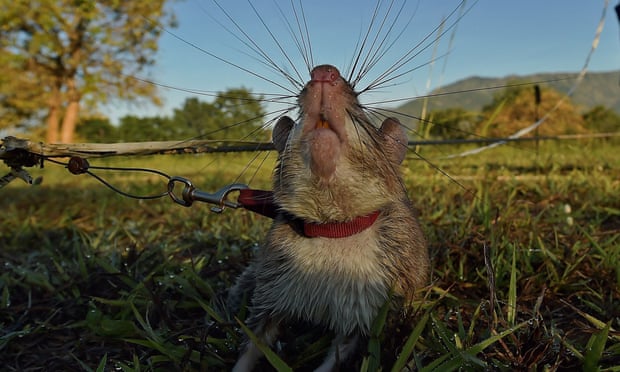
Now, according to Oliver Milman the Guardian, “An elite group of African giant pouched rats will be used at ports, initially in Tanzania, to detect illegal shipments of pangolins – the world’s most trafficked animal, which has been pushed towards extinction due to the trade in its scales and skins …

“The US Fish & Wildlife Service is spending $100,000 on a pilot project that will train rats to detect the illegal items and learn to communicate this to their human handlers. The rats, which can grow up to 3ft long, have poor eyesight but an excellent sense of smell. …

“The Fish & Wildlife Service said it hoped that the foray into the investigation of wildlife smuggling would be the first stage of a ‘much larger project to mainstream rats as an innovative tool in combating illegal wildlife trade.’ …

“The money for rat training is part of a larger $1.2m package that will provide funding for law enforcement in Cambodia, forest patrols to reduce tiger poaching in Indonesia and sniffer dogs to unearth illegal shipments of saiga antelope horn.”

More here.

Photo: Carl de Souza/AFP/Getty Images
African giant pouched rats like the one seen here are being trained to investigate illegal wildlife trafficking.

Read Full Post »

I was not surprised to note in the Beatrix Potter biography I’m reading that although Potter worked hard to get rid of rat infestations in her Hill Top Farm house, she had a soft spot for rats. An artist who could draw all sorts of bugs and wildlife with meticulous care, she kept a pet rat as part of her menagerie and even wrote an indulgent story about Samuel Whiskers.

Rats turn out to be good for other things, too: for example, saving people from land mines.

Michael Sullivan writes at National Public Radio (NPR), “It’s 5:45 in the morning, and in a training field outside Siem Reap, home of Angkor Wat, Cambodia’s demining rats are already hard at work. Their noses are close to the wet grass, darting from side to side, as they try to detect explosives buried just beneath the ground.

“Each rat is responsible for clearing a 200-square-meter (239-square-yard) patch of land. Their Cambodian supervisor, Hulsok Heng, says they’re good at it.

“T ‘hey are very good,’ he says. ‘You see this 200 square meters? They clear in only 30 minutes or 35 minutes. If you compare that to a deminer, maybe two days or three days. The deminer will pick up all the fragmentation, the metal in the ground, but the rat picks up only the smell of TNT.’ …

“These are not kitchen rats, but African giant pouched rats, also known as Gambian pouched rats, about 2 feet long from head to tail. Their eyesight is terrible. But their sense of smell is extraordinary. The rats can detect the presence of TNT in amounts starting at 29 grams (about 1 ounce).

“A Belgian nonprofit called Apopo began harnessing the rodents’ olfactory prowess 15 years ago. (The group also trains rats to detect tuberculosis). The organization set up a breeding program and training center in Tanzania and began deploying rats to post-conflict countries, first to Mozambique and Angola. Apopo’s Cambodia program began in April, in partnership with the Cambodian Mine Action Center.

” ‘The idea was very strange,’ says operations coordinator Theap Bunthourn. ‘Cambodian people kill rats, don’t like rats. But they’re cost-efficient, they’re easy to transport, they’re easy to train, and they don’t set off the mines because they’re too light.’ ”

Gosh, they detect TB, too? Who knew?

Read more at NPR, here.

Photo: Michael Sullivan for NPR
Victoria, a 2-year-old rat, sniffs for TNT, sticking her nose high in the air to indicate she’s found some. She is able to detect the presence of TNT at a distance of approximately half a yard.

Read Full Post »

Douglas Quenqua recently wrote in the NY Times about a study with rats that could someday lead to aids for the blind.

“Blind rats with a sensor and compass attached to their brains were able to navigate a maze as successfully as sighted rats, researchers found.

“Researchers at the University of Tokyo wanted to test whether a mammal could use allocentric sense — the awareness of one’s body relative to its environment — to replace vision. The scientists attached a geomagnetic sensor and digital compass to the visual cortices of rats with their eyes sewn shut.

“When the rats moved their heads, the sensors generated electrical impulses to tell them which direction they were facing. The rats were then trained to find pellets in various mazes.

“Within a few days, the blind rats were able to navigate the mazes as well as rats that could see. The two groups of rodents relied on similar navigation strategies. The findings, published in the journal Current Biology, could help lead to devices that help blind people independently navigate their surroundings.

“ ‘The most plausible application is to attach a geomagnetic sensor to a cane so that the blind can know the direction via tactile signals such as vibration,’ Yuji Ikegaya, a pharmacologist and co-author of the study, wrote in an email.” More here.

I couldn’t find a picture of three rats together although there were lots of drawings of three blind mice. I started thinking, Do children even know nursery rhymes anymore? I wonder what they would make of Jack, for example, who fell down “and broke his crown” and “went to bed to mend his head with vinegar and brown paper.” I know a couple kids who would have a lot of questions about that medical treatment.

Perhaps we should make a concerted effort to teach these rhymes before they are lost completely. After all, they are part of our culture, one of our many cultures.

Photo: redorbit

Read Full Post »