Feeds:
Posts
Comments

Posts Tagged ‘record’

Photo: Lisa Guerriero.
A restored 1946 Wurlitzer jukebox model 1015, known as “the Bubbler” for the bubble tubes on its front.

In the 1950s, when the jukebox was at the height of its popularity, one of my brothers received for Christmas a magnificent toy version. I remember it lighting up in bright colors when you turned it on. It could not exchange records like tan authentic jukebox, but it was real enough to become the wonder of the neighborhood, at least for a while.

At the Smithsonian, Steven Melendez reminds us that the basic concept was launched long before the 1950s.

“In 1889, a San Francisco tavern called the Palais Royale debuted a hot new attraction: a modified Edison phonograph that, when a customer inserted a nickel, played music from a single wax cylinder. Electrical sound amplification was still years away, so customers had to insert stethoscope-like tubes into their ears to hear anything. …

“Despite this unwieldy setup, the machine reportedly brought in more than $1,000 (some $34,000 today) in less than six months, and coin-operated music machines soon proliferated in bars, at drugstores and even in new listening parlors across the country. Alas, poor sound quality meant selections couldn’t be soft or subtle, so popular offerings included such earsplitting numbers as John Philip Sousa marches and the novelty whistler John Yorke AtLee performing popular ditties of the day. By the early 1900s, the machines struggled to compete against player pianos and other automated instruments that could entertain whole venues with higher-quality audio. …

“Record players continued to improve in quality and volume, and pay-to-play phonographs made a huge comeback in the 1920s, paving the way for the jukebox era. In 1927, the Automatic
Musical Instrument Company unveiled the first amplified, multi-record coin phonograph.

“Jukeboxes — they took on this nickname in the 1930s in reference to African American ‘juke joints’ of the South — introduced the world to music on demand, for far less than buying a record (and on better equipment than people had at home). … Danceable big-band numbers and tunes like the ‘Beer Barrel Polka’ were early hits, and the irrepressible popularity of jukeboxes soon rocketed artists like swing impresario Glenn Miller to national fame, creating an audience for loud, catchy, rollicking tunes. …

“Jukebox operators came to account for a majority of record sales, as they frequently changed out selections to keep customers dropping nickels. Using meters within the machines, operators could track which tunes were most popular at which locations, and they programmed boxes accordingly, offering a mix of national hits and more regionally specific selections. The latter included many tunes by Black and working-class musicians, in folk genres such as country and blues that tended to get scant airplay on the radio of the day but soon found appreciative listeners on jukeboxes. 

“By the early 1940s, about 500,000 jukeboxes dotted the country, sometimes inspiring too much of a ruckus: Newspapers frequently reported on bar fights over music selections. …

“Jukeboxes had a chance to prove their patriotic bona fides during World War II, when they provided vital entertainment on military bases and at troops’ canteens, sometimes on machines donated by public-spirited American operators — not a single nickel required. …

“After the war, stylish and streamlined jukebox cabinets in diners let teenagers listen to rock ’n’ roll at volumes generally impossible (or at least inadvisable) to achieve at home. Jukeboxes became indelibly associated with 1950s youth culture. … The format of hit-after-hit music queues also helped inspire teen-friendly Top 40 radio, replacing older formats that defaulted to playing several songs in a row by a single artist.

“Over the next couple of decades, jukeboxes would see their numbers dwindle as fans turned to other sources of entertainment, including increasingly high-fidelity home stereos, television and the transistor radio.”

Teddy Brokaw continues the jukebox story at Smithsonian with a description of how mobsters saw easy money in the phenomenon.

“The jukebox,” Brokaw reports, “with its all-cash business model and fungible record-keeping, showed clear potential for tax evasion and money-​laundering operations and quickly caught the attention of organized crime.

“By the 1940s, Mafiosi, foremost among them Meyer Lansky, had pioneered the typical racket: Buy up all the jukeboxes in an area and lease them to businesses in exchange for 50 percent or more of the take. But the scheme’s true brilliance was its scope: The mob owned not only the jukeboxes, but also, often, the record companies supplying the discs and the contracts of the artists cutting the records. It was a masterpiece of vertical integration, and it worked gangbusters.

“By the mid-1950s, one enterprising gangster — Chicago Outfit member Jake ‘Greasy Thumb’ Guzik … controlled 100,000 of America’s half-million jukeboxes and was raking in several million dollars a year. 

“With made men at the helm, the jukebox industry relied on hits — of both kinds. Mobsters could make or break an artist’s career through their control over what made it into the machines and thus climbed the charts. And beatings, bombings and even murders were just ‘one of the liabilities of the business,’ as a Wurlitzer sales executive testified to a Senate investigative committee in 1959. Jukebox owners who didn’t play nice risked seeing their machines destroyed, while rival jukebox distributors who refused to cut the mob in on their operations were whacked on more than one occasion.

“The jukebox may be a relic of a bygone era, but the mob’s influence in jukeboxes remains. As recently as 2018, a reputed mobster was gunned down. … The victim’s funeral procession was led by a car carrying — what else? — a jukebox made of flowers.”

More at Smithsonian, here.
Read Full Post »

Photo: picture alliance.
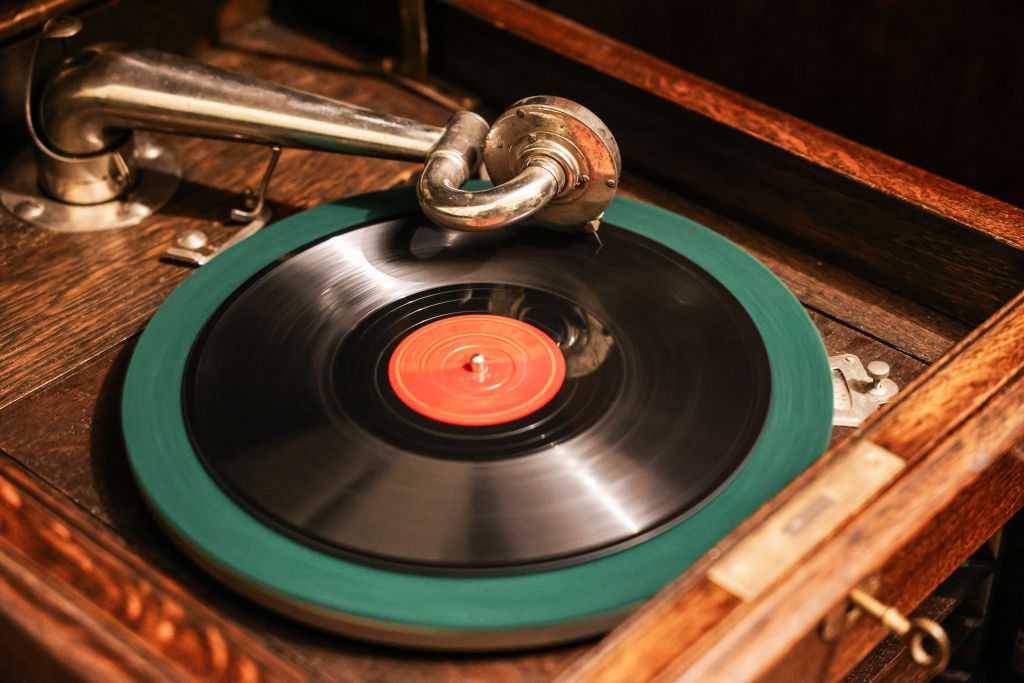
An old-time record player playing a 78 rpm record. This is shellac — ie, before vinyl.

Maybe it’s because I still feel guilty about how my brother and I made a game of smashing our grandfather’s shellac records when we were children, but I can’t help taking sides in the court battle described below. Now that I’m a grownup, I believe that we should protect these oldies, and let the public get at them.

Ashley Belanger reports at Ars Technica that the Internet Archive’s battle with music publishers has ended in a settlement that will, in my view, be to the public’s benefit.

“A settlement has been reached in a lawsuit where music publishers sued the Internet Archive over the Great 78 Project, an effort to preserve early music recordings that only exist on brittle shellac records.

“No details of the settlement have so far been released, but a court filing on Monday confirmed that the Internet Archive and UMG Recordings, Capitol Records, Sony Music Entertainment, and other record labels ‘have settled this matter.’ …

“Days before the settlement was announced, record labels had indicated that everyone but the Internet Archive and its founder, Brewster Kahle, had agreed to sign a joint settlement, seemingly including the Great 78 Project’s recording engineer George Blood, who was also a target of the litigation. But in the days since, IA has gotten on board, posting a blog confirming that ‘the parties have reached a confidential resolution of all claims.’ …

“For IA — which strove to digitize 3 million recordings to help historians document recording history — the lawsuit from music publishers could have meant financial ruin. Initially, record labels alleged that damages amounted to $400 million, claiming they lost streams when IA visitors played Great 78 recordings.

“But despite IA arguing that there were comparably low downloads and streams on the Great 78 recordings — as well as a music publishing industry vet suggesting that damages were likely no more than $41,000 — the labels intensified their attacks in March. In a court filing, the labels added so many more infringing works that the estimated damages increased to $700 million. It seemed like labels were intent on doubling down on a fight that, at least one sound historian suggested, the labels might one day regret.

“Notably, the settlement comes after IA previously lost a court fight with book publishers last year, where IA could have faced substantial damages. In that fight, IA accused book publishers of being unable to prove that IA’s emergency library had hurt their sales. But book publishers, represented by the same legal team as music labels, ultimately won that fight and negotiated a judgment that similarly included an undisclosed payment.

“With both legal battles likely ending in undisclosed payments, it seems likely we’ll never know the true cost to the digital library of defending its digitization projects.

“In a court filing ahead of the settlement in the music label fight, IA had argued that labels had added an avalanche of infringing works so late into the lawsuit to create leverage to force a settlement.

“David Seubert, who relied on the Great 78 Project and manages sound collections at the University of California, Santa Barbara library, previously told Ars that he suspected that the labels’ lawsuit was ‘somehow vindictive,’ because the labels’ revenue didn’t seem to be impacted by the Great 78 Project. He suggested that perhaps labels just ‘don’t like the Internet Archive’s way of pushing the envelope on copyright and fair use.

” ‘There are people who, like the founder of the Internet Archive, want to push that envelope, and the media conglomerates want to push back in the other direction.’ “

More at ArsTechnica, here. Of related interest, at My Dad’s Records, here, my nephew once preserved the old R&B vinyl 78s of the same naughty brother who was guilty with me, but my nephew let the tumblr site go years ago. Check it out anyway.

Read Full Post »

Photo: Suwa City.
Kiyoshi Miyasaka, a Shinto priest, leads parishioners from the Yatsurugi Shrine onto the frozen Lake Suwa in 2018, the last time the Miwatari, or Sacred Crossing, formed.

Climate change shows up in many ways around the world, especially where humans have kept records for centuries. One such place is in Japan.

Martin Fackler and Hisako Ueno report at the New York Times, “For at least six centuries, residents along a lake in the mountains of central Japan have marked the depth of winter by celebrating the return of a natural phenomenon once revered as the trail of a wandering god.

“It would only appear after days of frigid temperatures had frozen Lake Suwa into a sheet of solid white. First, people were awakened at night by a loud rumbling. Dawn broke to reveal its source: a long, narrow ridge of jagged ice that had mysteriously arisen across the lake’s surface, meandering like the spiked back of a twisting dragon.

“This was the Miwatari, meaning the sacred crossing, which local belief held was left by a passing god of Japan’s native Shinto belief. Its appearance evoked feelings of awe but also reassurance among the residents, who ventured onto the ice to perform a ceremony honoring what they saw as a visitation from the supernatural.

In the rare winters when the ice ridge did not appear, the god’s absence was viewed as a warning that the natural world was out of balance.

“So  important was the Miwatari that residents recorded whether it appeared, the condition of the lake and what historical events accompanied it. They have loyally written these descriptions every winter since 1443, creating a remarkable archive that attests to centuries of monotonously cold winters.

“But recently, the chronicles of Suwa have told a different, more alarming story. For the past seven winters, the Miwatari has failed to appear because the lake didn’t freeze. While there have been occasional years without ice, an absence of this length has happened only once before in the archive, and that was a half millennium ago.

“In fact, Lake Suwa has not fully frozen over — what locals call ‘an open sea’ — for 18 of the past 25 years. Kiyoshi Miyasaka, the chief priest of Yatsurugi Shrine, which for the past three and a half centuries has borne the duty of maintaining the records, says ice has failed to appear with regularity since the 1980s. He and other locals blame the disappearance of the ancient rhythms on global climate change.

“ ‘In old times, an open sea was regarded as a bad omen,’ said Mr. Miyasaka, 74, whose shrine’s traditional stone gate and tile-roofed wooden buildings stand about a mile from the lakeshore. ‘We hear about melting of ice caps and Himalayan glaciers, but our own lake is also trying to alert us.’ …

“Only parishioners in their 60s or older remember when the Miwatari was still big enough to make a sound that could wake them at night. The last time an ice ridge formed, in 2018, it was barely six inches tall.

“ ‘When I was child, the ice spikes rose higher than my height,’ said Isao Nakazawa, 81, a retired auto company worker. ‘We knew when it appeared because it made a sound like a taiko drum, “Gon-gon-gon!” ‘

“These days, the Miwatari has lost much of its religious significance. Residents in Suwa, a small, sleepy city wrapped along the lake’s edge, see it as a local rite of winter. …

” ‘Carrying on a tradition for 580 years binds our community together,’ said the mayor, Yukari Kaneko, 66. ‘I fear what’s happening now is a warning to rethink how we’re living.’

“Science has also robbed the ice ridges of their mystery by explaining how they arise. When Lake Suwa freezes, its surface hardens into a slab some two and a half miles across. On particularly cold nights, the ice contracts, opening cracks that fill with lake water, which also freezes. As temperatures rise again, the slab expands back into its original shape, pushing the newly formed ice upward into buckled ramparts. …

“While Mr. Miyasaka says he feels discouraged by the failure of the ice ridge to return, he intends to keep updating the archive.

“ ‘You cannot just quit something that has been around for more than 580 years,’ said Mr. Miyasaka, whose family has held the position of chief priest for five generations. ‘I will not be the one who ends it.’ ”

More at the Times, here.

Read Full Post »

Photo: Phuong Tâm.
‘I was lucky – I sang every night’: Phuong Tâm on the front cover of Đẹpmagazine, Saigon, 1965.

I first heard this story at Public Radio International’s the World, but decided to use the Guardian version here because it has more details. It tells what a Vietnamese American woman did after discovering that her mother was once a rock star.

Here’s Sheila Ngoc Pham with an interview at the Guardian.

“In early 1960s Saigon, Nguyễn Thi Tâm would appear on stage in the city’s vibrant phòng trà (tearooms) and nightclubs. She embodied quintessential young womanhood, with long, straight black hair and wearing a white áo dài, an elegant Vietnamese dress. But instead of traditional songs, she would belt out music that recalled American hot rods, hip-swinging dance crazes and even teenage abandon: using the stage name Phuong Tâm, she was one of Vietnam’s first rock’n’roll singers. ‘Back then, everyone was singing Vietnamese, some French, but no one else was singing American music,’ says Tâm, now 76. ‘Just me.’

“Lost for decades, 25 of the brilliantly crafted songs she recorded – all rich in verve and atmosphere – can now be found on Magical Nights, a landmark compilation that required an international collective effort to recover a lost era of early Vietnamese rock.

“Tâm and I speak in Vietnamese, logging on from our homes in two of the world’s largest Vietnamese-diaspora communities: she is in San José, California; I am in Sydney, Australia. Given that we are talking about events from more than half a century ago, I’m astonished by her vivid recall. ‘Of course, these are precious memories. I was lucky. I sang every night.’ …

“When she was 12, she started learning music from a mandolin-playing neighbor who suggested she use the more feminine-sounding Phuong Tâm as her stage name. In 1961, at the age of 16, she auditioned for the Biet Doan Van Nghe, the art and culture brigade of South Vietnam: the government scheme enlisted performing artists to be part of the war effort. Her father wanted her to keep studying, but she had made up her mind – ‘I was in love with singing’ – and quit high school.

“During the 1960s, the live music and dance scene in Saigon was flourishing, flush with the injection of capital from American GIs and Vietnamese businessmen. Tâm’s voice was in high demand. During the day she would rehearse and at night she would perform to successive foreign and Vietnamese audiences. ‘I would sing from five in the afternoon until one in the morning. I would start at the airport base, then at 7pm I would sing at the officers’ club. I’d go to another dancing club after that.’ …

“When a position came up for her new husband hundreds of miles north of Saigon in Da Nang, as a flight surgeon in the South Vietnamese air force, she didn’t hesitate to follow him. Although she earned far more as a singer than he did as a physician, she left it all behind. ‘I forgot about all of it,’ Tâm says. ‘I didn’t have time to feel regret because I was soon busy taking care of three kids.’ In April 1975, in the final days of the war, the family fled to the US, where they were accepted as refugees.

“Tâm never divulged her musical past to her children. Only once while browsing in a Vietnamese music store in Orange County did she find a CD with some of her recordings, but she didn’t think to show it to them. …

“Tâm’s eldest daughter, Hannah Hà, joins the two of us on the call from St Louis, Missouri, where she lives and works as a doctor. Growing up in the US, Hà didn’t particularly like Vietnamese music compared with jazz, rock and pop, ‘but now I can’t get enough of it.’

“Hà always knew her mother wasn’t an amateur, thanks to the way she would steal the show at karaoke parties. As she writes in her moving essay in the liner notes: ‘Swaying and singing with her eyes closed, she transported the entire room back to a pre-1975 Saigon nightclub.’ She didn’t give her mother’s singing much thought, however, until the end of 2019, when a producer of the film Mat Biec (Dreamy Eyes) wrote to Tâm to discuss using her music. The approach piqued Hà’s curiosity: did her mother really sing rock’n’roll? Soon she found a 7-in vinyl single for sale on eBay with three tracks. …

“Hà put in a maximum bid of $2,000. ‘I just had this intense desire to have it,’ she says (in the end, she scored it for $167). Hà then sought the help of Mark Gergis, producer of the cult compilation Saigon Rock and Soul (2010), but finding the rest of Tâm’s music seemed impossible, given all they had to go on were three tracks and some incorrectly labelled YouTube videos.

“Gergis drew on his own collection and reached out to his extensive network; Hà messaged strangers on YouTube and Discogs before finding Adam Fargason, an American collector living in Vietnam.

‘Adam took me on these Saigon shopping trips which were virtual, because this was during the pandemic,’ Hà says.

” ‘He would visit these mom-and-pop antique shops and they would have these records on the floor in the back. They often had layers and layers of dirt, just naked albums without sleeves. He would put his phone to them so I could see, and we would go through them one by one.’ It was eventually discovered that Tâm recorded 27 tracks in total.

“ ‘When Hannah sent the music to me, I cried listening to every song,’ says Tâm. … ‘The project seemed tiring, but Hannah insisted,’ she says. ‘It’s taken 18 months because of all the scratched records; it’s been like climbing a mountain backwards. She’s very stubborn.’ “

More at the Guardian, here. Listen to the mother and daughter at the World, here.

Read Full Post »