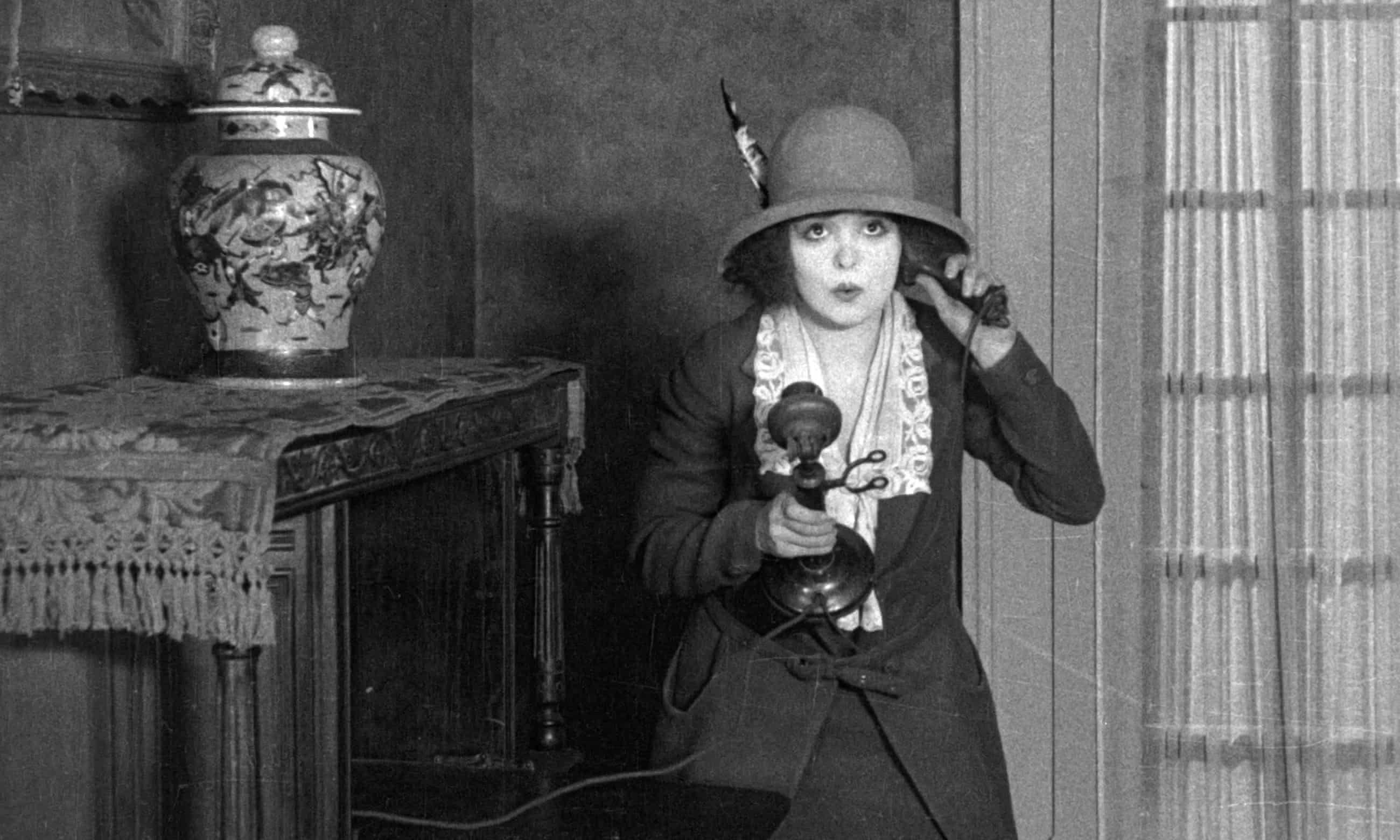
Photo: San Francisco Silent film festival.
Clara Bow in newly rediscovered The Pill Pounder, a 14-minute film.
We had one of the first televisions (1948? 1949?) because my father was writing a story for Fortune. It was a Dumont, a big wooden box with a tiny black and white screen. There wasn’t much content available at the time, so we watched lots of silent movies. I can’t remember if I ever saw any of starlet Clara Bow’s films, but I wouldn’t be surprised. I was too young to register names of actors.
Pamela Hutchinson writes at the Guardian, “A century after she first began to turn heads, Clara Bow is ‘It’ once more. The iconic flapper of the silent film era inspired Margot Robbie’s character Nellie in Damien Chazelle’s Hollywood epic Babylon, is name checked on Taylor Swift’s forthcoming album ‘The Tortured Poets Department,’ and yesterday at the San Francisco Silent Film Festival, one of her earliest films was shown for the first time since the days of bathtub gin.
“The story of the film’s discovery has already caused excitement online. Film-maker Gary Huggins inadvertently snapped up a slice of lost silent film history at an auction in a car park in Omaha, Nebraska, that was selling old stock from a distribution company called Modern Sound Pictures. Hoping to bid on a copy of the 1926 comedy Eve’s Leaves that he had spotted on top of a pile, Huggins was informed that he could only buy the whole pallet of movies, not individual cans. The upside? The lot was his for only $20.
“Huggins soon discovered that his new pile of reels included 1923’s The Pill Pounder, a silent comedy that had been thought to be lost for decades. It is a short, two-reel film, shot on Long Island, New York. … The film stars rubber-faced vaudeville veteran Charlie Murray, the so-called ‘Irish comedian’ who was actually from Laurel, Indiana. He plays a hapless pharmacist, the ‘pill pounder’ of the title, who is trying to host a clandestine poker game in the back room of his drugstore.
“What few realized until Huggins watched the film, was that it also features 17-year-old Bow in a supporting role. She plays the girlfriend of Murray’s son, played by James Turfler, who had already appeared with Bow in her second film Down to the Sea in Ships, directed by Elmer Clifton and screened in 1922. …
“In this, one of her earliest surviving performances on film, Bow looks even younger than her years. Although she lacks the sleek Hollywood glamour she later acquired, she has the charisma to turn a thankless bit-part into something of a scene-stealer. The critics took note: based on the evidence of this film, the Exhibitors’ Trade Review described her as ‘perhaps the most promising of the younger actresses.’ …
“The film, which has been restored by the festival’s organizers and was screened with accompanying music from composer Wayne Barker, now looks remarkably good for its age. The festival’s senior film restorer, Kathy Rose O’Regan, said it was in great shape when they received it. She added: ‘We imagined it was screened maybe a few times, but there’s hardly any damage.’ …
“It is still incomplete, being in what Stenn called a ‘beta version.’ That’s because the copy Huggins found was not from the 1920s, but a 35mm print from the 1950s or 1960s of an edit of the film that was destined to become part of a 16mm compilation of old silent films with a comic voiceover poking fun at its archaic aspects. The intertitles have been removed and there are a few scenes and shots missing, too. This process is deeply unflattering to old movies, but it has been responsible for preserving versions of silent films that would otherwise have been lost. …
“ ‘For me, it is a pretty perfect 14-minutes of fun,’ says O’Regan. ‘It would be nice to know what the titles were, but you can certainly get the gist without them.’
“Stenn called the tale of the film’s discovery ‘miraculous’ and … explained that there was reason to believe that some of the discarded material was among the other cans that were sold at the Omaha auction. The hunt is on to round out The Pill Pounder, and several people have joined in the search, combing through thousands of reels.”
More at the Guardian, here. No paywall.


 Suzanne's Mom's Blog