Feeds:
Posts
Comments

Posts Tagged ‘reforestation’

Photo: Zach Mordan.
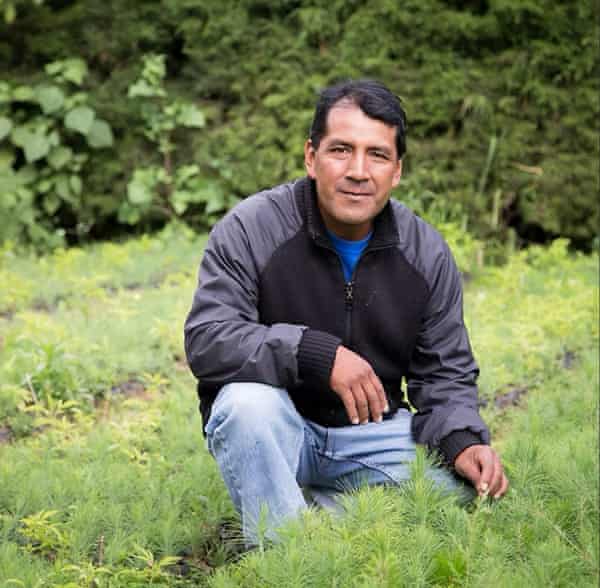
Armando López Pocol, who set up Guatemala’s Chico Mendes Reforestation Project in 1999.

Sometimes I am just overwhelmed at the power of one person to make the world better. It may be the man who starts a regreening project on ruined land. It may be the woman who draws cheery pictures on patients’ insurance bills. It may be you when, after getting a long run-around on a robotic telephone chain, you are kind to the poor schlemiel who is the first human you talk to.

Let’s start with the artist in the billing department. Steve Hartman at CBS, recounts what happened to a patient called Melody Morrow.

“A few years ago, Melody Morrow of New York City hurt her foot and needed physical therapy. However, she said what really made her feel better was paying the bill.

” ‘On the envelope, on the front of the envelope, it had these little music notes,’ Morrow told CBS News of the billing statement she received in the mail, a play on her name, ‘Melody.’ …

” ‘This was a stranger,’ Morrow said. ‘And she was doing that just for me.  And that’s the beauty of it.’ ”  More at CBS, here.

Now let’s turn to Armando López Pocol in Guatemala. Suzanne Bearne has an in-depth report at the Guardian on what he started.

It begins, “Armando López Pocol is showing off some of the thousands of trees he has planted in Pachaj, his village in the highlands of western Guatemala, when he suddenly halts his white pickup truck. Alongside an American volunteer, Lyndon Hauge, he gazes out over a charred field. Clouds of smoke are still billowing from the ground.

“As he walks through the ash-covered field, his optimistic speech turns to sadness and he pauses in silence to take in the barren landscape.

“Before the fire, this 2-hectare (5-acre) plot of land in the mountains of Cantel was home to 2,000 trees, all planted through Pocol’s reforestation project.

“Over a quarter of a century, he and his small team of volunteers and community members have planted thousands of trees, regenerating the landscape of Guatemala’s highlands and mitigating the impacts of the climate crisis, while also generating revenue for local communities.

“Pocol initiated the Chico Mendes Reforestation Project in Pachaj – located 2,400 metres (7,900ft) above sea level and about 6 miles (10km) from the town of Quetzaltenango, known as Xela – in 1999. At that time, the region had suffered extensive deforestation over several decades.

“The organization was named after the Brazilian environmentalist Chico Mendes, who fought to preserve the rainforest and for Indigenous rights until he was murdered by a cattle rancher in 1988.

“ ‘The struggles he went through in Brazil are similar to the ones we go through in Guatemala,’ Pocol says.

“ ‘From the 1960s to the 1990s, there was a lot of deforestation in Cantel, as the wood was used extensively for building houses and as firewood for families,’ he says. ‘I started Chico Mendes to stop the deforestation, as I was worried about climate change and environmental problems in Guatemala, with mining companies destroying the community forests of Indigenous people.’

“He says deforestation is now largely caused by fires during the dry season, and attributes the latest one – the third in his fields so far this year – to an arson attack.

“ ‘We’re losing many tree plantations,’ he says, adding that the region lost more than 100,000 trees to fires in 2023 alone.

‘What keeps my spirit alive are the workers and volunteers showing their support and not giving up.’

“Since he embarked on his tree-planting mission, Pocol has become resigned to the fact that he cannot stop fires. ‘We just don’t have enough staff,’ he admits. ‘It’s expensive to have people out here watching all this land.’

“While he believes some of the fires are due to foul play, he says they have tried to reduce the number by creating fire corridors in the forests. …

“Pocol says his organization has not received any money. ‘We don’t receive funds from the government as we are against mining projects and environmental injustices in Guatemala, and we know that all the funds the government manages come from transnational companies.’ …

“Without a regular income, the Chico Mendes project depends on donations and a ‘volunteering fee’ (equivalent to about [$20] a day), which covers a homestay and three meals. Volunteers gather seeds, source decomposed leaves, fill bags with soil, and plant trees.

“Donations and the volunteering fee are crucial for Chico Mendes, as Pocol sees his initiative as much more than a reforestation project. The organization also supports the community through ecotourism, with funds circulating through the local economy via homestays and treks, as well as volunteers spending money in the village. …

“[Dr René Zamora-Cristales, outgoing director of the Latin American restoration initiative 20×20 at the World Resources Institute] praises Pocol’s work and says Guatemala needs more people like him. ‘Deforestation has always been an issue, but different efforts, such as the one from Armando, have reduced the overall deforestation in the country. We certainly need more local leaders committed to improving the livelihoods of local communities by restoring nature,’ he says.

“Pocol, who works on his project every day without a break, including weekends, and tops up his income in the evenings as an Uber driver, admits he is exhausted.

“ ‘I wake up in the night and wonder what the future is going to be for the project as there’s been a lot of difficult times. But I’ve never given up, and it always lifts my spirits when volunteers come.’ ”

More at the Guardian, here.
Read Full Post »

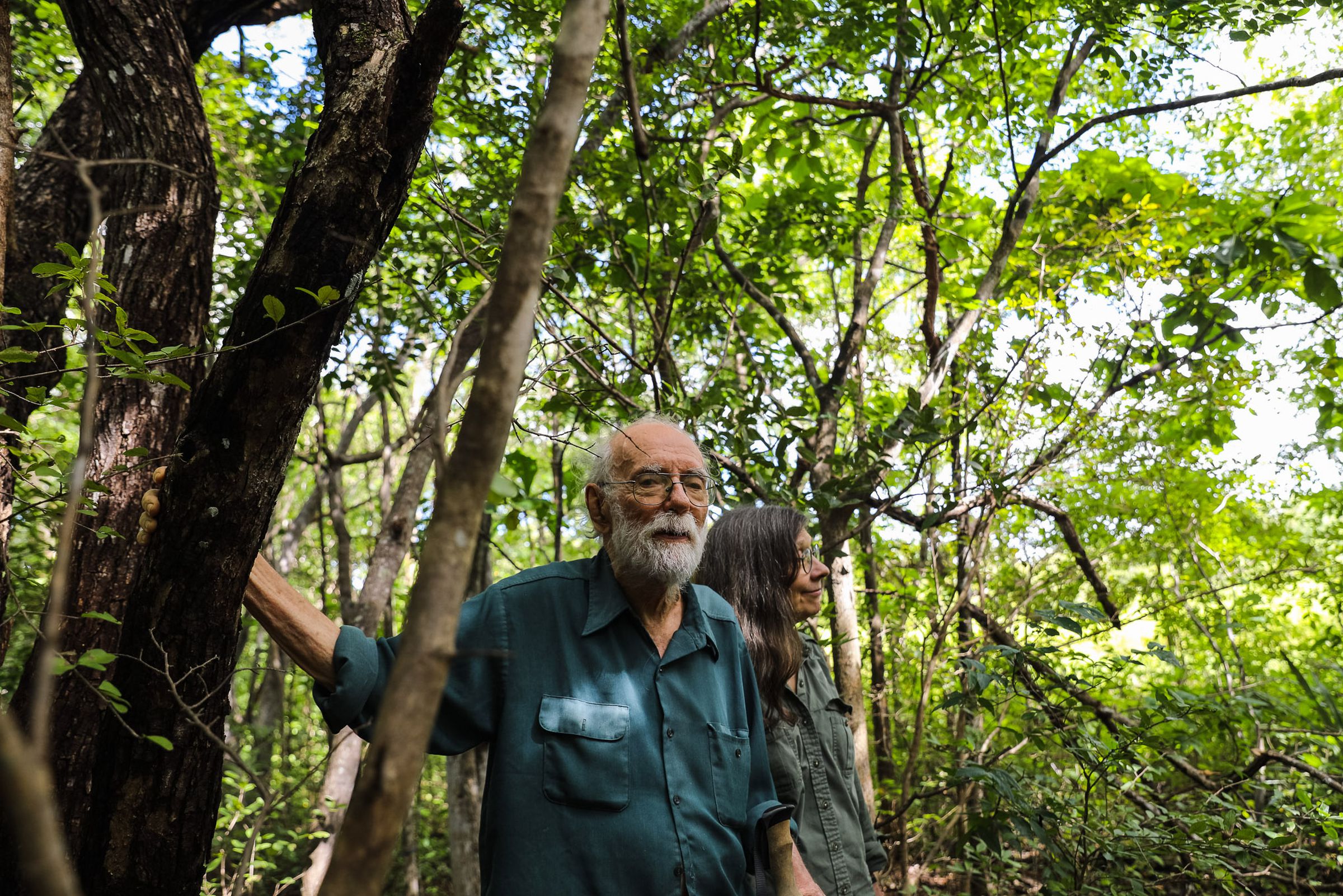
Photo: The Verge.
Daniel Janzen and Winnie Hallwachs, together with other conservationists, has brought forests back to the Area de Conservación Guanacaste (ACG) in Costa Rica — an area larger than the Hawaiian island of Oahu.   

Costa Rica, a beautiful country, has the right priorities. It has restored its forests and moved to renewable energy. Justine Calma at the Verge writes about the people behind the reforestation efforts and how climate change is starting to make their work more difficult.

“Ecologist Daniel Janzen wades into the field, clutching a walking stick in one hand and a fist full of towering green blades of grass in the other to steady himself. Winnie Hallwachs, also an ecologist and Janzen’s wife, watches him closely, carrying a hat that she hands to him once he stops to explain our whereabouts. 

“Together with other conservationists who have dedicated decades of their lives to this place, the couple has brought forests back to the Area de Conservación Guanacaste (ACG). It’s ​​an astonishing 163,000 hectares [~403,000 acres] of protected landscapes — an area larger than the Hawaiian island of Oahu — where forests have reclaimed farmland in Costa Rica. …

“ACG is a success story, a powerful example of what can happen when humans help forests heal. It’s part of what’s made Costa Rica a destination for ecotourism and the first tropical country in the world to reverse deforestation. But now, the couple’s beloved forest faces a more insidious threat.

“Across the road, the leaves are too perfect. It’s like they’re growing in a greenhouse, Janzen says. There’s an eerie absence among the foliage — although you’d probably also have to be a regular in the forest to notice. …

“There should have been bees, wasps, and moths along our walk, she explains. And plenty of caterpillar ‘houses’ — curled up leaves the critters sew together that eventually become shelter for other insects. …

“The bugs play crucial roles in the forest — from pollinating plants to forming the base of the food chain. Their disappearance is a warning. Climate change has come to the ACG, marking a new, troubling chapter in the park’s comeback story. … What’s happening here in the ACG says a lot about what it takes to revive a forest — especially in a warming world. …

“The dry season is about two months longer than it was when Janzen arrived in the 1960s. Climate change is making seasons more unpredictable and weather more erratic across the planet. …

“María Marta Chavarría, ACG’s field investigation program coordinator … explains it like this, ‘A big rain is the trigger. It’s time! The rainy season is going to start!’ Trees unfurl new leaves. Moths and other insects that eat those leaves emerge. But now, the rains don’t always last. The leaves die and fall. That has ripple effects across the food chain, from the insects that eat the leaves to birds that eat the insects. They perish or move on. And next season, there are fewer pollinators for the plants. ‘The big trigger in the beginning was false,’ Chavarría explains. …

“In 1978, Janzen … recalls in a 2021 paper he and Hallwachs published in the journal PNAS [his front wall was plastered with moths at night]. The title was ‘To us insectometers, it is clear that insect decline in our Costa Rican tropics is real, so let’s be kind to the survivors.’

“That observation in 1978 led the couple to focus their research on caterpillars and their parasites. In 1980, they used light traps to inventory moth species across the country, documenting at least 10,000 species. Since then, however, they’ve seen a steady decline in caterpillars. … 

“Hanging a white sheet and lights at the edge of a cliff overlooking a vast stretch of both old and new-growth forests, they photographed moths that came to rest on the sheet in 1984, 1995, 2007, and 2019. The first photograph is an impressive tapestry of many different winged critters. By 2019, that’s been reduced to a mostly white sheet speckled here and there with far fewer moths. Instead of an intricate tapestry of wings and antennae, the sheet looks more like a blank canvas an artist has only started to splatter with a brush. 

“Hallwachs and Janzen can see the same phenomenon now standing in broad daylight in the forest across from the field. Just because forests have come roaring back across the ACG doesn’t mean the struggle to survive is over. …

” ‘A lot of the reforestation projects are kind of assuming that trees are mechanical objects,’ Hallwachs says. But they don’t stand alone, not in a healthy forest. 

“Merely plant rows of trees, and the result is a tree plantation — not a forest. Bringing back a forest is a much different endeavor. It’s more about restoring relationships — reconnecting remaining forests with land that’s been cleared and nurturing new kinds of connections between people and the land.  

“In ACG’s dry forest, they didn’t have to plant trees by hand. By getting rid of the grass and stopping the fires, they cleared the way for the forest’s return. The first seeds blew in with the wind.

“Hallwachs and Janzen recognize them like old friends — stopping next to a Dalbergia tree that was one of the first to grow where they stomped out the fires. Its seeds are light and flat, allowing them to float on a breeze. When those trees start to grow, they attract animals in search of food or shelter. 

“Janzen measures each animal up by how many seeds they can hold and then spit or defecate onto the forest floor. ‘When you see a bird fly by, what you’re seeing is a tablespoon full of seeds,’ he says. ‘Every deer you see is a liter of seeds.’ ”

More at the Verge, here.

Read Full Post »

researcher20deborah20goffner20discussing20the20koyli20aplpha20gardens20with20samba20fall20garden20manager20and20change20agent2

Photo: Stockholm Resilience Centre
Discussing the Great Wall of Africa among drought-resistant plants in the village of Koyli Alpha in Senegal. Reforestation efforts include providing fodder for livestock.

Sometimes the places with the biggest needs are the places with the biggest innovations. Consider the greening initiative that Africa is taking on to fight drought.

Aryn Bakerwrites for Time magazine, “The seedlings are ready. One hundred and fifty thousand shoots of drought-resistant acacia, hardy baobab and Moringa spill out of their black plastic casings. The ground has been prepared with scores of kilometer-long furrows leading to a horizon studded with skeletal thorn trees. It’s early August, and in less than a week, 399 volunteers from 27 countries will arrive in this remote corner of northern Senegal to participate in one of the world’s most audacious efforts to combat the effects of climate change: an $8 billion plan to reforest 247 million acres of degraded land across the width of Africa, stretching from Dakar to Djibouti.

“The Great Green Wall project, spearheaded by the African Union and funded by the World Bank, the European Union and the United Nations, was launched in 2007 to halt the expansion of the Sahara by planting a barrier of trees running 4,815 miles along its southern edge. Now, as concerns mount about the impact of climate change on the Sahel, the semiarid band of grassland south of the Sahara that is already one of the most impoverished regions on earth, the Great Green Wall is filling a new role. The goal now, say its designers, is to transform the lives of millions living on the front line of climate change by restoring agricultural land ruined by decades of overuse; when done, it should provide food, stem conflict and discourage migration. When the project is completed in 2030, the restored land is expected to absorb some 250 million metric tons of carbon dioxide from the atmosphere, the equivalent of keeping all of California’s cars parked for 3½ years. …

“When people think of potential fixes for global warming, they tend to focus on big projects. But if human activity is at the root of climate change, whether it be the carbon emissions of the industrialized world or the overgrazing of the Sahel, then that is where the solution lies as well. Environmentalists celebrate the Great Green Wall for its epic territorial ambition, but its biggest impact will come from allowing people to meet their needs without destroying nature in the process.

“The Sahara isn’t expanding so much as the Sahel is shrinking, destroyed by decades of overgrazing, climate-change-induced drought and poor farming practices that have stripped the once lush grasslands of the fertile topsoil needed to regenerate. … Planting trees not only reduces carbon on a global scale—research in the journal Science estimates planting more than 2 billion acres of trees could remove two-thirds of all the emissions that human activity has pumped into the atmosphere since the Industrial Revolution­—it also recharges the water table and creates micro­climates that increase local rainfall. … Though it may not sound like much, the solution to climate change in the Sahel starts with getting grass to grow.

“ ‘If we can solve people’s problems by improving their living conditions now,’ says Goudiaby, ‘they will be able to help themselves by protecting the trees that protect their future.’

After all, stopping global warming isn’t about saving the planet. … It’s about saving humanity. One way to do that is by helping those who are most vulnerable to what chaos we have already created.

“Just 25 miles south of Mbar Toubab, near the village of Koyli Alpha, 50-year-old Dienaba Aka pulls her heavily laden donkey cart to the side of the road. She and her extended family have spent the day cutting grass in a ‘forage bank’ managed by the national Great Green Wall agency. … Now herders pay $1.70 a day to harvest the waist-high grass for their cattle until the rains bring new grazing opportunities. For Aka, the idea of a grass ‘bank’ is a radical departure from an itinerant childhood spent following the family herd in search of forage. Now she can feed her cattle in the lean season without stripping trees.

“Aka, like women from many villages in the region, has been planting trees for the GGW project since 2012. She earns $96 during the six-week planting season. It’s good money, she says, but most women do it because they have been told it will bring back the rain, which in turn brings the grass that feeds their livestock.

“There is another advantage to forage banking, Aka says, gazing proudly at her two 10-year-old nieces perched atop several bags of recently cut grass. ‘Before­ the Great Green Wall, the kids had to go with us when we took the cattle to graze. Now they can stay in school.’ ” More here.

Hat tip: UN Environment Programme on Twitter

Read Full Post »


Photo: Storify
Mudslides in Haiti in 2011. Reforestation of the once lush island is badly needed, but how can people in poverty wait decades for results when a sapling could provide charcoal for a hungry family?

Recently, I read a book that I recommend highly. It’s Apricot Irving’s memoir The Gospel of Trees. I wrote the following about it on GoodReads.

Author Apricot Irving’s parents were missionaries in Haiti for several years starting in the 1970s, and Apricot’s memoir evokes what the experience meant for her as a child, a teenager, and an adult. The vividness of her writing benefits from the fact that both parents kept diaries. Her own journal, which she started at a very young age, also gives both happy and bitter memories remarkable immediacy.

Apricot’s counterculture parents were people used to hiking long distances and sleeping under the stars. They shunned middle-class materialism and thought nothing of raising children in a shack with an outhouse. (The family eventually included three daughters.) They got religion at a point in their marriage when Apricot’s mother was fed up with Apricot’s father and his remoteness. She was ready to split. A pamphlet left by her mother-in-law led to her epiphany.

When the church the couple joined needed help at a medical mission in Haiti, Apricot’s father (a hard-working farmer and forest ranger) found the mission’s reforestation sideline appealing. Off they all went to save the poor people and tell them what was needed.

Over the years, the family began to see that that’s not how development is successful. They learned what Paul Farmer of Partners in Health had been preaching for decades in Haiti — namely that the local people must lead. (Oddly, the famous doctor is never mentioned, suggesting to me there’s some enmity.)

The Irving family lived through years of getting trees started in the ravaged, depleted soil, where mudslides, destruction, and death were the norm, only to see the new growth eaten by goats or cut down for charcoal — over and over and over and over.

They lived through revolutions, political upheaval (sometimes aggravated by US military action), danger, and crushing disappointment, coming back to help any way they could after the devastating 2010 earthquake. Once back there, they relived all the ironies– paying locals to plant trees, which enabled them to buy goats, which ate the trees. By this time they knew that buying imported furniture as NGOs demanded was wrong when desperate locals were struggling to keep their own furniture businesses afloat. They knew that forcing a flourishing local cooperative to meet an NGO timeline might be dooming it to failure. They agonized for the country they still loved.

The author recounts the history of the island, going back to Columbus, who discovered what was then a lush paradise, eventually ruined by clearing the land for crops grown by slaves. And she gradually peals back the stages of her personal awakening, her conflicted feelings about the country, her wish to help, her understanding that although the job is never finished, you still need to do what you can and know that others will continue the work.

I found that I liked Apricot a lot and admired her ongoing effort to find common ground with her demanding, sometimes cruel, father. I also admired her stalwart mother’s efforts to bring cheer — especially as the mission was falling apart and all the doctors and nurses and staff were feeling demoralized.

You get to see the beauty of the country in this book and the different strengths of the people. And you especially get to see why decades of do-gooder initiatives were bound to fail. Not that the medical mission did no good at all — many lives were saved, many people got jobs and other kinds of help — but the model was unsustainable.

I can think of so many people I know who would love this book — people who work with immigrants from Haiti and elsewhere, tree people trying to protect the environment, people who love beautiful, honest writing.

Read Full Post »

Having given myself a serious scare reviewing the film Revolution (on the planet’s race to extinction through practices such as destroying critical forests), I was happy to read about a positive forestry initiative started in India and expanded to Haiti and Kenya. The pressures are the same in those countries as in Madagascar, which was featured in Revolution, but there is also a recognition that trees are life-giving.

Gregory M. Lamb writes at the Christian Science Monitor, “Aviram Rozin was excited. He had just returned from Haiti where the 80,000 Maya nut trees that volunteers with Sadhana Forest had planted there during the past five years had started to flower. Before long each tree would be producing huge quantities of nuts high in protein and other nutrients. One tree could supply enough yearly protein for a family of five.

“The nonprofit Sadhana Forest, cofounded by Mr. Rozin and his wife, Yorit, follows three simple strategies:

“• Plant indigenous trees in arid regions that once had been forested but have become barren, useless land.

“• With few exceptions, do the work using volunteers, both local and from around the world.

“• Since trees don’t grow overnight, plan on staying around for a long, long time to see the project through.

“The Rozins started Sadhana Forest in 2003, the year after they moved to India from Aviram’s native Israel to live in Auroville, an experimental township in southeast India that emphasizes sustainable living and has attracted immigrants from all over. The couple bought 70 acres of degraded land and set about creating a community dedicated to reforestation. …

“The aim of Sadhana Forest isn’t to buy and reforest massive tracts of public land. Rather, it is to teach local people how to grow trees on their own land. Faced with the dry climate, Rozin has come up with a simple, yet innovative, way to water the trees: wick irrigation. A two-liter plastic bottle filled with water is planted up to its neck next to each sapling or tree. A piece of cotton rope fed through a tiny hole in the bottom of the bottle acts as a wick, slowly moistening the soil. Loosening or tightening the bottle’s cap can control the rate of flow. …

“Each wick bottle becomes ‘a personal watering system for each tree,’ Rozin says, yet the materials are readily available locally and cost almost nothing. …

“Rozin, who studied psychology and later worked in management for an Israeli medical device company, does not have a degree in forestry but says that may have been a blessing in disguise.

“ ‘We found out that, in a way, ignorance is bliss because we’re very open to learning,’ he says. ‘We don’t think we know everything. A lot of innovation comes from listening to people, to being open.’ ”

More here.

Photo: Sadhana Forest
Volunteer Nixon Casseus (l.) and Sadhana Forest cofounder Aviram Rozin show off the first flowering Maya nut tree in Haiti.

Read Full Post »

After Haiti’s devastating earthquake three years ago, money flowed in. Today many funders have retreated, but a 5,000-farmer coffee-growing coop is showing it can manage with guidance and small loans.

Daniel Jensen at Global Envision (a Mercy Corps blog) writes, “Root Capital is providing loans and consulting expertise to COOPCAB, a Haitian coffee co-op that markets its products internationally while investing money in local reforestation efforts that improve its own production. The cooperative, which has expanded six-fold under Root Capital’s guidance, now includes 5,000 members …

“Managing COOPCAB comes with its own set of challenges. Meeting them requires a model that creates local business leaders rather than simply employing foreign relief workers. Root Capital’s Willy Foote explains:

” ‘COOPCAB … is managed by local Haitian farmers with little formal training in financial management and accounting. … As a consequence, we’ve had to innovate and hone our business model in Haiti, slowing our lending in the short term while accelerating and deepening our financial advisory services program.’ …

“Soon, Haitian entrepreneurs may find new opportunities to replicate COOPCAB’s model, as [U.S.] Ambassador [Paul] Altidor has asked Foote to help advise formal policy decisions. Haitian minister of agriculture Thomas Jacques also plans to create a rice commission focused on increasing domestic production.” More.

Consider buying your coffee beans at COOPCAB and giving Haiti a helping hand.

Photograph: coffeeresearch.org

Read Full Post »