Feeds:
Posts
Comments

Posts Tagged ‘repurpose’

Photo: Lou Foglia for WBEZ.
Seth Boustead of the nonprofit Access Contemporary Music in Chicago describes the location they chose for their concerts: “The door dings when you walk in, like a 7-Eleven — we left that.”

I love stories about the successful repurposing of eyesore buildings. In today’s article, WBEZ’s Graham Meyer gives an inspiring example from Chicago.

“Not everyone looks at the long-vacant husk of a former convenience store and gets visions of string quartets and piano recitals. But that’s exactly how it happened for Seth Boustead, the head of Access Contemporary Music.

“In February 2023, in a cab traveling on North Clark Street, Boustead saw the familiar sight of the empty store at 4116, once a 7-Eleven, before that a White Hen Pantry. This time, the window had a ‘for rent’ sign. After the cab ride, Boustead zipped back on his bicycle and peered in the dark windows.

“ ‘This would be an amazing chamber music venue,’ he remembers thinking. …

“ ‘It’s pretty unrecognizable [now],’ Boustead said. ‘The door dings when you walk in, like a 7-Eleven — we left that. Behind the bar, there’s still, where the grease trap used to be, a door that goes down into the floor where they used to dump grease. I found a training poster for their employees, and we’re planning to frame it and put it in the bathroom.’

“ACM, now 21 years old, has always done many different things simultaneously. It gives music lessons, has a composer collective and presents concerts, such as the annual Sound of Silent Film Festival, where it commissions and live-performs scores for modern silent films. And once a year, it throws a classical music street festival called Thirsty Ears.

“The CheckOut [aims] to put on two or three chamber concerts a week, mostly self-produced. There are incipient plans for a jazz night on Thursday and for cabaret shows to fill the void left when Davenport’s abruptly canceled all its cabarets in April. …

“Unsurprisingly, a project of this magnitude had obstacles, money chief among them. Boustead said the rent for the CheckOut is close to the three music schools’ combined. And it quickly became clear that in addition to the renovations necessary to convert the space to a music venue, they would have to make up for upkeep that 7-Eleven had inconveniently deferred. …

“Then there were the administrative hurdles. The property was zoned for single-family houses, and the area had a liquor license moratorium. Both the odd zoning and the moratorium had the effect of funneling ACM through 46th Ward Ald. Angela Clay’s office, so that she and the community could weigh in before the project began. Boustead made a presentation to the Graceland West Area Community Association about lessons, rehearsals and concerts for 60 to 100 audience members filling the empty shell.

“ ‘Folks were excited about having this kind of small cultural institution in the neighborhood, but there’s a lot of red tape the city puts up,’ said Jesse Orr, director of infrastructure and development in Clay’s office.

“Boustead started checking boxes. With some hand-holding from Clay’s office, they hacked through the permits, inspections, zoning and other city tasks. And he worked on money. ACM landed a Community Development Grant through the city’s Department of Planning and Development for $250,000. They started a capital campaign, offering naming rights for the stage and chairs. …

“[In August] Boustead assembled a preview crowd and noted the irony that 7-Elevens play classical music to prevent people from loitering. This time, the 7-Eleven left, and the classical music stayed around.

“The Palomar Trio, part of ACM’s long-standing house ensemble, played piano-violin-cello music ranging chronologically from modern Dmitri Shostakovich to the of-the-minute 42-year-old Reena Esmail. With acoustical work still to be done, the room echoed more than would be ideal, and how to manage the sound of the air conditioning against the temperature of the room hasn’t been settled. But the music filled the space nicely, the louds excitingly loud and soft effects detectable. You’d never guess it had once been slinging slushies.” More at WBEZ, here.

If you are interested, Dylan Weinert at New City Music has a review of the opening, here.
Read Full Post »

Photo: Melanie Stetson Freeman/CSM.
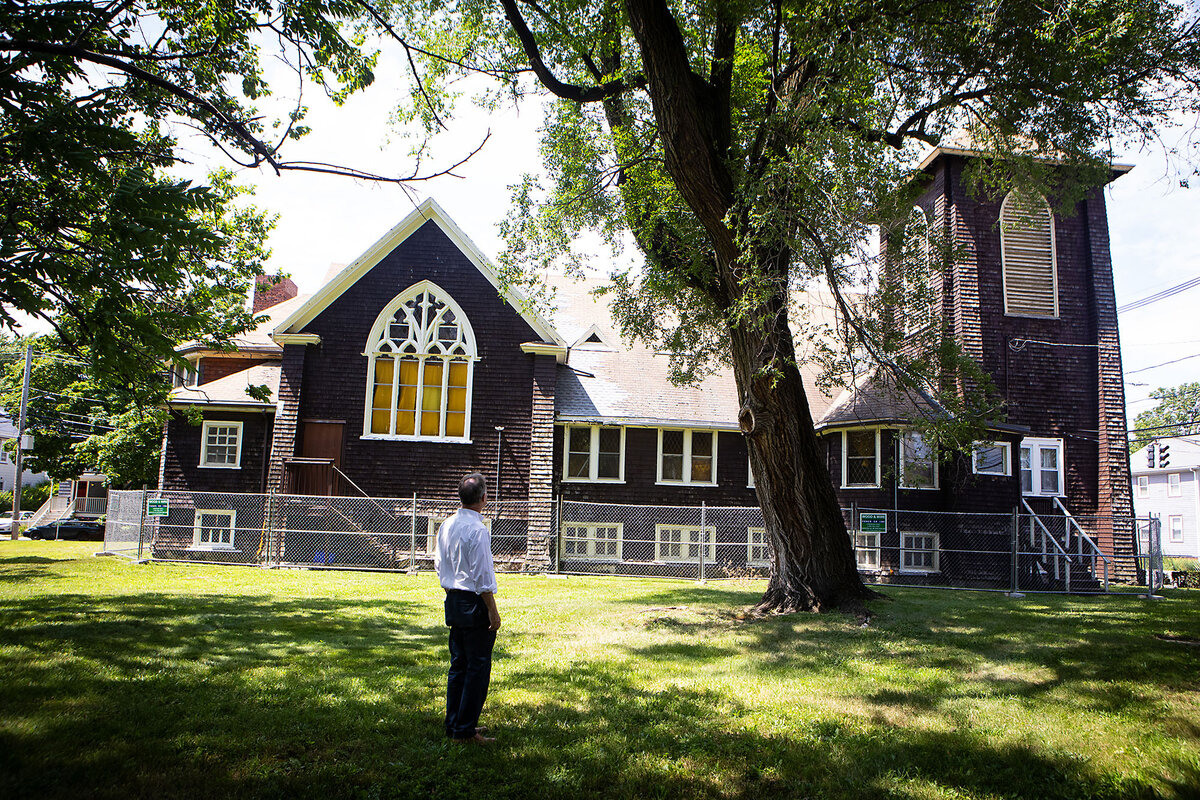
John Woods, director of Allston Brighton Community Development Corp. in Massachusetts, stands in front of Hill Memorial Baptist Church in July. The church and grounds are being turned into a housing complex for older adults.

My 9-year-old granddaughter assures me that the best place to stay overnight in Nova Scotia is a converted church. The light from the stained glass was beautiful, she says, and so was the rest of the building.

Her family’s rental was privately owned, but in today’s story we learn about a Boston-area initiative to turn other unused churches into subsidized housing. And Boston is not alone.

Troy Aidan Sambajon reports for the Monitor, “With its 58-foot bell tower standing sentinel, Hill Memorial Baptist Church has witnessed Allston-Brighton’s dramatic transformation. Upscale apartments and condos now stand on the site of once-bustling stockyards. Gourmet food shops have replaced affordable grocery stores. Now, the 120-year-old church is set for its own transformation. … The church is finding a new role in the community: much-needed affordable housing for older people.

“Churches and faith communities across the United States are increasingly closing their doors. Five years ago, The American Baptist Churches of Massachusetts, noting a dwindling congregation in Allston-Brighton, considered downsizing or repurposing the land. The choice was ultimately left to Hill Memorial’s congregation.

“In a final act of generosity, members chose to sell the land to fulfill the church’s ‘mission of giving back to the Allston community in the form of senior housing,’ says the Rev. Catherine Miller, former pastor, over email. With the blessing of its former congregation, the site will become 50 apartments for older adults on a fixed income. Today, the average price to rent a one-bedroom apartment in Allston is $2,786 per month, according to Apartments.com. The average wait time for senior housing in Boston currently stretches more than five years.

“ ‘Something good needed to happen here,’ says John Woods, executive director of Allston Brighton Community Development Corp., a housing developer. …

“Across the country, more faith communities are opening their doors to creative affordable housing solutions: Some are building homes on underutilized land or converting unused residences.

“In California, the grassroots ‘Yes in God’s Backyard’ movement led to the Affordable Housing on Faith Lands Act. This makes it legal for faith-based institutions to build affordable, multifamily homes on lands they own by streamlining the permitting process and overriding local zoning restrictions.

A federal version, the Yes in God’s Backyard Act, was introduced this spring by Ohio Sen. Sherrod Brown. …

” ‘It’s sad when a church closes,’ says Donna Brown, executive director of the South Boston Neighborhood Development Corp., which is leading the conversion of a former convent. ‘When they sit empty, it leaves a real void in the neighborhood. But when a building can be converted to housing so that people can stay in that community – it can be a wonderful thing to knit a community back together.’

“The U.S. is not building housing fast enough to support America’s aging population, according to Housing America’s Older Adults 2023 report, recently released by Harvard University’s Joint Center for Housing Studies. … By 2030, Americans age 65 and older will make up more than 20% of the population, according to Census Bureau projections. The need for affordable housing for this demographic will only grow. Meanwhile, homelessness is rising among older adults. …

“Sometimes, those being priced out of a neighborhood have lived there for decades. Moving means leaving not only friends but also support structures. Take Allston-Brighton, which was once a very affordable neighborhood, says Karen Smith, president of Brighton Allston Elderly Homes Inc. With rising rent costs and the cost of care, it’s tough for older adults on a fixed income to stretch their budgets thousands of dollars more a year. …

“In densely populated cities, the space to build affordable housing is often far from where it is needed most, says the Rev. Patrick Reidy, associate professor of law at the University of Notre Dame. However, faith communities and former churches are typically located in high-density areas that are accessible to the most people.

“ ‘These kinds of adaptive reuse projects for affordable housing are a win-win-win,’ says Professor Reidy. ‘The local governments that are desperately in need of land for affordable housing are given access by faith communities seeking to live out their religious mission, and those who need affordable housing don’t always have to uproot their lives from their neighborhood.’

“Boston is a prime example of this trend. The transformation of former churches … illustrates how adaptive reuse can unite communities in finding solutions to the housing crisis. The locations of older church properties in New England are unique for other reasons. Many are quite literally older than zoning laws, which were first passed around the 1920s.

“Blessed Sacrament Church sits at the heart of the historic Latin Quarter. It is set to become a sanctuary of affordable living, with 55 income-restricted units, along with a performance and community space.

“The building sat empty for years. High restoration costs prompted its owners to contemplate selling it to developers on the open market to become high-end apartments. Former parishioners and residents opposed the sale and advocated for community input. In the end, after meetings attended by hundreds in the area, the selected proposal from developer Pennrose aimed to preserve the historic exterior of the church while renovating the interior to create affordable housing.”

More at the Monitor, here. No firewall. Subscriptions are reasonable. For more on repurposing old church buildings, see the other part of the Monitor series, here.

Read Full Post »

Photo: Murdo MacLeod/The Guardian
A music and performance space in Springburn Park, Glasgow, Scotland, was created inside a steel hut by repurposing old pianos.

We had a parlor grand for many years, and I took lessons on it. It had belonged to my mother-in-law, who was much more musical than I. After I stopped playing, the piano sat forlorn a long time, drawing the attention only of toddler grandchildren. My husband decided maybe we could use the space. The piano did need work, and no one was buying a fixer-upper at the time, so he gave it away to a guy who would remove it.

What do you think that guy wanted a piano for? He planned to rent it to companies staging high-end houses before they went on the market. Ugh. What a sorry end for that piano! I like the idea in today’s article much better for an instrument that had once been loved.

Libby Brooks writes at the Guardian, “Inside a cavernous steel hut in the middle of Glasgow’s Springburn Park, the sweeping arc of keyboards, lids and carved panels has been taking shape, creating the UK’s first permanent auditorium made entirely of recycled pianos.

“Using mainly upright instruments, with a baby grand artfully sliced in half to make a corner balcony, about 40 pianos have been expertly disarticulated to create the tiered seating.

“ ‘When you dismantle a piano you end up with a kit of different parts, from the ornate front pieces to the strong planks normally hidden beneath the key,’ explains Tom Binns, who founded the Glasgow Piano City project in 2013, finding new uses for unwanted instruments in public places from hospitals to bookshops.

“It was Binns who brought together a Glasgow community activist with big plans and the Edinburgh-based instrumental innovators Pianodrome in what he says is a testament to the collaborative potential of social enterprise.

“Two years ago, Alex Docherty, a hip-hop artist and chair of Friends of Springburn Park, countered plans to demolish the site where the massive hut stands with a proposal for a community village with an event space, cafe and outdoor classroom.

“ ‘When I talk to my gran who grew up in Springburn, it used to have cinemas and places to go,’ Docherty says. ‘But since the decline in industry and the motorway demolitions [creating the unpopular dual carriageways and flyovers that bisect Springburn] they disappeared. We really need a community space in the area.’

“The area has its problems, including widespread unemployment and a high rate of drug deaths, but ‘there’s been an energy of change in Springburn over the last few years,’ Docherty says. …

“The plan to use old pianos for the seating came through Binns. He visited the team at Pianodrome, whose mobile amphitheatre has impressed audiences at previous Edinburgh festivals as a creative response to consumer culture, to see their initial constructions. ‘I thought: “This could work,” ‘ he says.

‘We were hired to design a permanent theatre space,’ says Matt Wright, a co-founder of Pianodrome. ‘It breaks down the division between audience and performer. You’re sitting on an instrument while you watch and listen to someone play.’ …

“Wright says the arrangement of benches rather than having separate seats is more appropriate to social distancing: ‘You can space people out but it doesn’t look so stark as having empty seats.’

“For Binns, the project has grown out of a respect for people’s deep connection to their individual instruments and the hopes they have when they pass them on. ‘People have an extraordinary emotional attachment to their instruments and would be heartbroken to see them go in a [dumpster]. We’re giving pianos a new life.’ ”

More here.

Read Full Post »