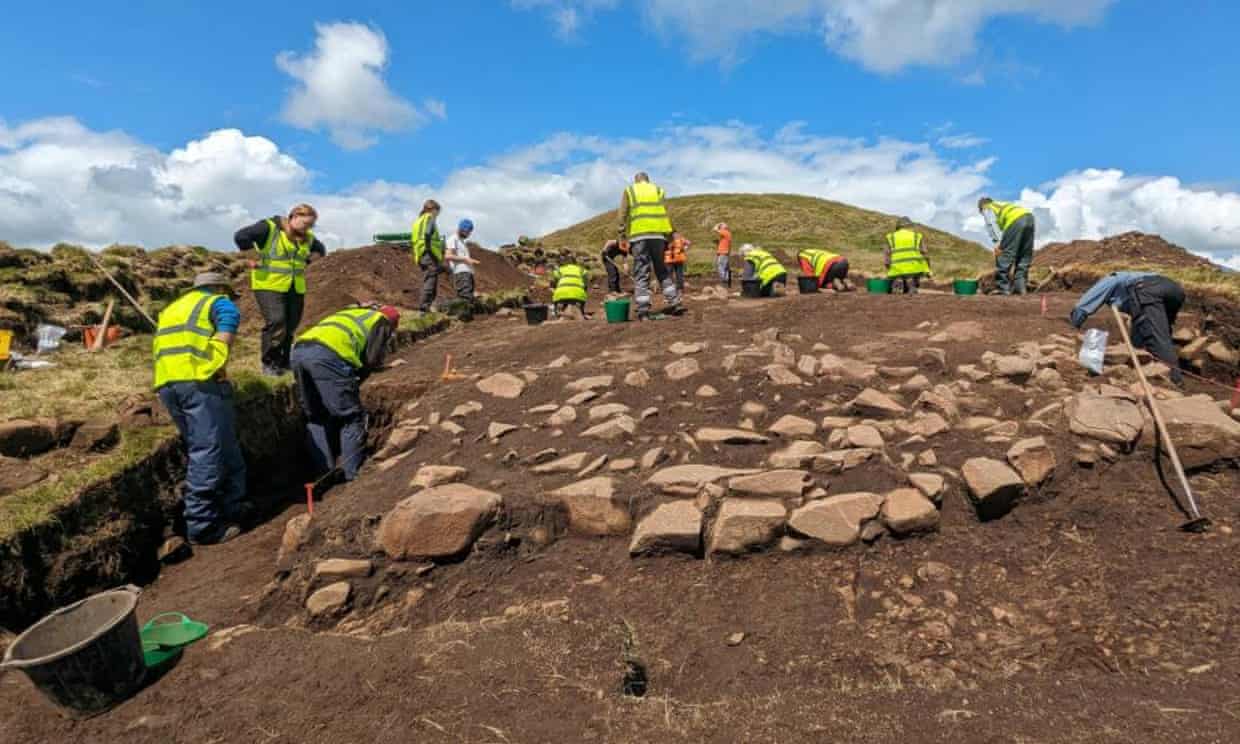
Photo: Gordon Noble, University of Aberdeen.
The community archaeological dig at the East Lomond hillfort site.
Did you ever want to be an archaeologist? I think there was a period in childhood that it interested me, encouraged by gifts of picture books about the discovery of Knossos in Crete. But then I moved off in other directions.
Perhaps you had that experience, too, always wondering what it would have been like. Today there are opportunities to get a taste of that world as a volunteer.
Libby Brooks writes at the Guardian about the thrill of being a citizen archaeologist in Scotland.
“They were moving forward in a line across the 10 sq metre [~108 square foot] trench, volunteer excavators elbow to elbow with academics, and Joe Fitzpatrick was at the far edge.
“He was digging around the hearth of a building, about 60cm (2ft) below surface level, when he hit the earth twice with his mattock and out it popped – a rare bronze spear butt, a metal fitting placed over the end of a wooden shaft to counterbalance the spear head. Covered in Pictish inscriptions, it had remained buried for more than one and a half millennia, and was one of the most groundbreaking archaeological discoveries of 2024 in Scotland.
‘The hair stands up on the back of your neck and you tingle,’ says Fitzpatrick, of the moment he realized the significance of the find. ‘It is special.’
“Fitzpatrick, who has always had a passion for history, got involved with the regular community dig at the site of the East Lomond hillfort, beside the village of Falkland in Fife, as a retirement activity.
“He was working next to Prof Gordon Noble, the head of archaeology at the University of Aberdeen, who was leading the dig: ‘We just looked at each other,’ Fitzpatrick recalls. ‘Two men with their jaws hanging open, dumbfounded.’
“He helped unearth the artifact in July, during excavations organized by the Falkland Stewardship Trust and the University of Aberdeen, which bring together members of the public and students to help uncover settlement remains dating from around the second or third century AD to around AD700.
“He is one of a growing legion of citizen archaeologists, eager volunteers who are sustaining projects across the country even as volunteering more generally is in decline.
“Fitzpatrick says: ‘A lot of people who retire are more aware of keeping active and outdoors, but we also have young people working out what to do after their studies, and the media has broadened archaeology’s appeal with programs like ‘Time Team’ and ‘Digging for Britain’ – it’s not just Oxford dons doing it.’
“An ‘exceptionally rare’ find like the spear butt boosts team morale … says Noble. ‘Community involvement has really ramped up in the past 10 years,’ he says. ‘There’s the excitement of uncovering the past on your doorstep. These volunteers come from all walks of life.’ …
“Although Volunteer Scotland has warned that last year’s Scottish Household Survey results ‘point to a crisis in volunteering,’ for those participating in culture and heritage the numbers remain constant, compared with a drop of four percentage points elsewhere.
“Jeff Sanders, the head of outreach for the Society of Antiquaries of Scotland, says the cost of living crisis has affected individuals and their ability to participate, but also organizations and their capacity to put things on for volunteers. …
“As well as funding challenges, Sanders says there is a push to diversify volunteering – volunteers are often retirees with more disposable income. Sanders also works on the Make Your Mark campaign, which worked with the Scottish Refugee Council over the summer to co-design archaeology taster sessions to attract people who wouldn’t ordinarily get involved in volunteering.
“This ‘continuing upward trend’ in community involvement has prompted Emily Johnston to chart the citizen archaeologist phenomenon as part of her doctoral research at the University of Edinburgh. She has launched a database of community archaeology activities across Scotland, Outreach in Scottish Archaeology (OScA). …
“Says Johnston, ‘A lot of volunteers have been really interested in archaeology from a young age. It’s about creating a tie to your past and gives people a sense of identity.’ “
I love the idea of “taster sessions” for volunteers — in any field. I imagine more people would take on gigs if they knew there was no embarrassment about dropping out. They would keep trying things until they found the right opportunity for them. I tried volunteering with many ESL [English as a
Second Language] organizations until I found the right fit.
More at the Guardian, here.

 Suzanne's Mom's Blog