Feeds:
Posts
Comments

Posts Tagged ‘rome’

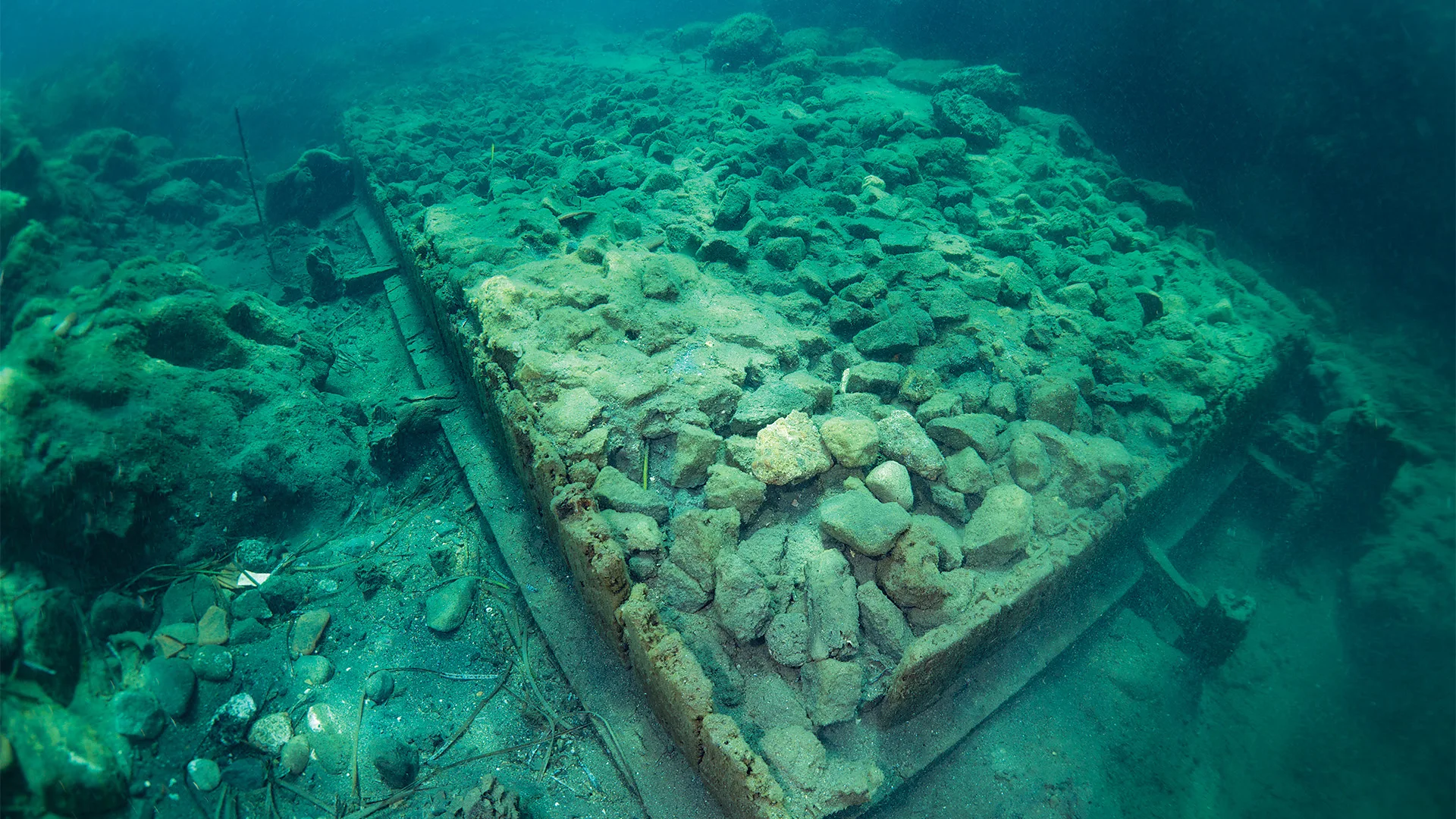
Photo: Alessandra Benini.
The ruins of Aenaria were buried in the sea for nearly 2,000 years, preserved underneath volcanic sediments.

Today’s story is about finding Aenaria, a Roman port that disappeared under the sea after a volcano erupted. Eva Sandoval at the BBC begins by describing a tour you can take there if you are interested in archaeology.

“As our tour sets sail, the vast Bay of Cartaromana opens up before us. Jagged cliffs shoot up from the waves; sunbathers sprawl on the inlet bridge leading to the 2,500-year-old Aragonese Castle. … After just 10 minutes at sea, we reach a network of buoys marking the ruins below. I press my hands against the vessel’s transparent bottom. Through the turquoise-blue water, between waving fields of seagrass and small striped fish, I glimpse a pile of rocks. Then the seagrass parts and I see that the rocks are arranged into a long rectangular form, its sides encased in wooden planks. This is an ancient city’s quay; buried in the cool dark for centuries and perfectly preserved. …

“I am on the Italian island of Ischia, where sometime around AD180, the Cretaio volcano erupted, and the ensuing shockwaves sank the Roman port city of Aenaria beneath the sea.

“At least, that’s what archaeologists think happened. … There are no records of the explosion, and very little written about the settlement itself. For nearly 2,000 years, there was no physical trace of it either. …

“The first hints of its existence were in 1972, when two scuba divers found Roman-era pottery shards and two lead ingots off Ischia’s eastern shore. The find intrigued archaeologists, but the ensuing investigation, helmed by local priest Don Pietro Monti and archaeologist Giorgio Buchner, yielded nothing. … The case went cold for nearly 40 years.

“Then, in 2011, passionate local sailors reopened the excavation, this time digging into the sea floor. Soon, they were able to confirm that 2meters beneath the bay’s volcanic seabed lay the ruins of a massive Roman-era quay. …

“As far as anyone had ever known, Ischia’s DNA was Greek. The island was renowned as the site of the first Greek colony in the Italian peninsula, established around 750BC in the north of the island. …

“When the Romans seized Pithecusae sometime around 322BC, they renamed the island Aenaria – a name that appears in ancient texts from Pliny the Elder to Strabo, often in relation to military events. But unlike the Greeks, who left behind a necropolis, kilns and troves of pottery, the Romans left only a few modest tombs, engravings and scattered opus reticulatum. …

” ‘The name was documented,’ echoes local resident Giulio Lauro. ‘But no one could find the place.’ Archaeologists had been looking for Roman Ischia on dry land, but it was buried below the sea.

“Lauro is the founder of the Marina di Sant’Anna; the cultural branch of the Ischia Barche sea-tourism cooperative. Along with various affiliated cultural groups – comprised of Ischian seafarers, history enthusiasts and archaeologists – they have self-funded the excavations for the past 15 years.

“Lauro is quick to tell me that he’s no scientist. ‘But I love the sea,’ he said. ‘In 2010, I got the idea to look again.’ …

“There were challenges, recalls Lauro: ‘Getting authorizations, training people, sourcing funds. We started from zero. We were lucky to believe in it. And then to actually find it.’ …

” ‘It was believed that the Romans never built a city on Ischia,’ says [Dr Alessandra Benini, the project’s lead archaeologist]. ‘It was the opposite.’ …

“Each summer, Benini and her team excavate the sea floor. Progress is painstaking due to a perennial shortage of funds. … During the site’s active months, curious visitors can take glass-bottomed boat tours, as well as snorkelling and scuba excursions to get even closer to the ruins. ‘You can see the underwater archaeologists at work, the equipment they use and everything involved,’ says Benini. …

“I ask Benini what she hopes to find this summer.

” ‘My dream is to find the foundations of the residential city,’ she says. ‘If we’ve found the port, then we know there was a city.’  

“The team hopes to introduce Lidar, Georadar and sub-bottom profiler instruments into the digs, but Benini points out, ‘That’s expensive. We need more investors.’ “

Lots more at the BBC, here. No paywall.
Read Full Post »

Photo: AP.
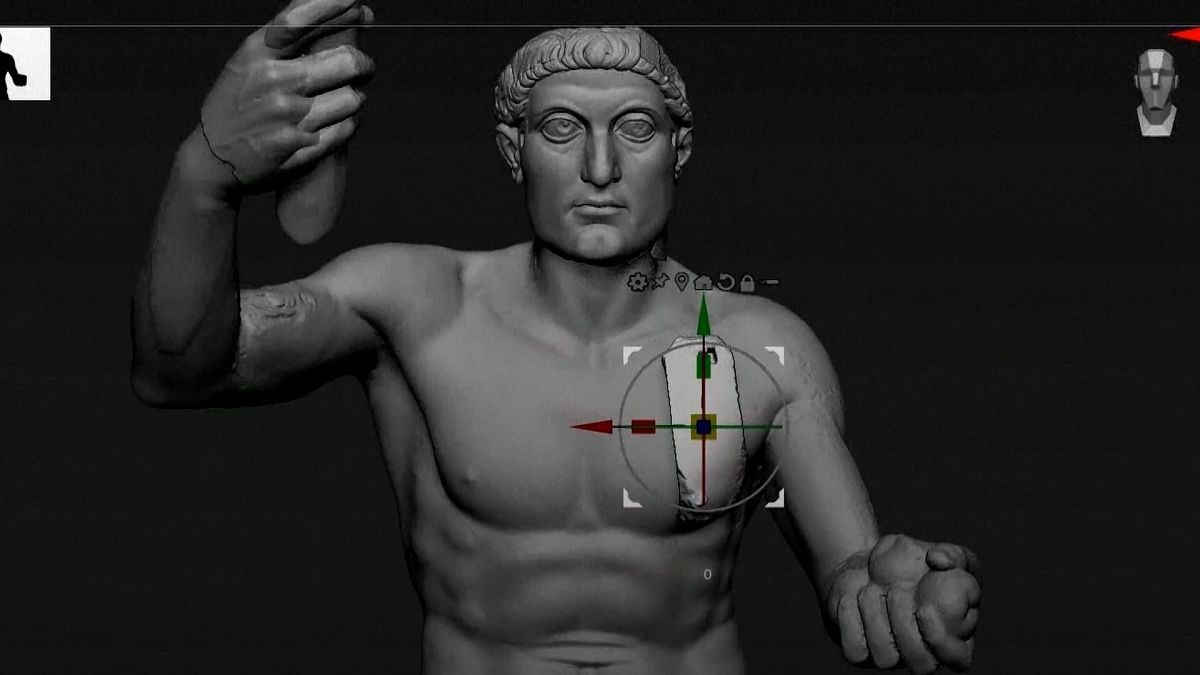
“Factum Foundation, a Madrid-based digital art group, analyzed 10 fragments from a sculpture of Constantine the Great, a fourth-century Roman emperor, to create a 1:1 replica,” says AP. See the digital scan above.

Planning to be in Rome anytime soon? Here’s a sight that’s a bit out of the ordinary — both ancient and completely modern.

Elisabetta Povoledo writes at the New York Times, “It may not be authentic, exactly, or very old at all. But the colossal statue of a fourth-century emperor, Constantine the Great, is a newly erected monument to Rome if nothing else: a homage to the ancient city’s grandeur, and of its endless capacity to remake itself. In this case, the remaking was literal.

“Towering over visitors, the 43-foot seated statue was painstakingly reconstructed by a Madrid-based digital art group, Factum Foundation, from the 10 known fragments of the original sculpture. …

“ ‘Seeing Constantine, on top of the Capitoline Hill, looking out at the whole of Rome, he feels extraordinary,’ said Adam Lowe, the founder of the Factum Foundation, which originally created the statue for a 2022 exhibit at the Prada Foundation in Milan.

“The head and most of the other fragments of the colossal statue were discovered in 1486, in the ruins of a building not far from the Colosseum. They were transferred to what eventually became the Capitoline collection, and nine of those ancient fragments — including a monumental head, feet and hand — are permanently on show at the museums.

“The fragments found fame from the moment they were excavated, said Salvatore Settis, an archaeologist and one of the curators of the Prada exhibit. ‘They have been etched by leading artists from the 15th century on,’ he said. …

“Five hundred years and many more technological advancements later, a team from the Factum Foundation spent three days using photogrammetry, a 3D scan with a camera, to record the fragments in the Capitoline courtyard. Over the course of several months, the high-resolution data became 3D prints, which were used to cast replicas, made of acrylic resin and marble powder.

“Those were then integrated with other body parts — the ones Constantine was missing — that were constructed after historical research and discussions with curators and experts.

A statue of the emperor Claudius as the god Jupiter, now at the ancient Roman altar known as the Ara Pacis, was used as a model for the pose and draping, which was originally in bronze.

“ ‘It’s through the evidence of those fragments, working rather like forensic scientists, with all the experts from different disciplines, we were able to build back something … awe inspiring,’ Mr. Lowe said, adding that new technologies were offering museums new avenues of research and dissemination. …

“Recent scholarship on the statue has suggested the statue of Constantine was itself reworked from an existing colossus, possibly depicting Jupiter. Irrefutable signs of reworking are especially present on the colossal statue’s face, according to Claudio Parisi Presicce, Rome’s top municipal art official, the director of the Capitoline Museums and an expert on the colossus.

“Indeed, some experts hypothesize that the sculpture was originally the cult statue of a temple devoted to Jupiter — the Temple of Jupiter Optimus Maximus — which would mean that the Constantine facsimile has finally returned home.

“ ‘We can’t be certain that it’s the same statue, but there is some possibility that it was,’ Mr. Settis said. Constantine, the first emperor to convert to Christianity, may have specifically selected a statue of Jupiter to transform into an icon of himself. ‘That’s one hypothesis,’ he said. ‘It would mark a passage in Western Europe, from the pagan empire to a Christian one.’

“The statue will be on show in the Capitoline garden until at least the end of 2025, officials said. Where it will go afterward, and whether it will withstand the ravages of time better than its fractured original, remain open questions.

“ ‘It’ll be as fine as anything is outside,’ Mr. Lowe said. ‘We hope. Of course, even during the opening there were pigeons sitting on its head. I’m afraid there’s not much you can do about that.’

More at the Times, here.

Read Full Post »

Photos: Viaggio nei Fori
Special multimedia light shows will be enriching Roman history at the forums of Caesar and Augustus until November 11 this year.

Recently, I was talking to the amazing Margaret, who was diagnosed with my sister’s horrible cancer more than eight years ago and has never had a recurrence. She had just returned from volunteering with a Jesuit refugee organization in Rome and showing her nephew the sights of the city. She described how they were given access to a special Mass in the crypt below St. Peter’s Basilica, where recent archaeological testing suggests that Peter’s bones really were buried.

I thought of Margaret and her nephew as I read this article about a initiative to bring history alive for Rome’s many visitors.

Livia Hengel has a report at Forbes. “Rome is a city filled with cultural heritage. Every building, statue and column has a story to tell, but it takes a vast amount of knowledge to piece together the city’s nearly 2,800-year-old history. … Where do you even begin? …

“From video projections cast upon ancient walls and multimedia light shows to virtual reconstructions revealed through 3D visors, technology is being used to help tell the story of Rome in a more concrete and compelling way.

“A large part of this trend can be attributed to the pioneering work of Paco Lanciano, a Rome-born physicist with a passion for cultural communication and a keen understanding of the learning process. Namely: if you make education fun, it sticks. ‘You need to strike a balance between creating something spectacular to hold an audience’s attention while also helping them learn in the process,’ Mr. Lanciano tells me. …

“Together with Piero Angela, a leading Italian television host and science journalist, Mr. Lanciano designed an immersive multimedia visit of ‘Le Domus Romane’ within Palazzo Valentini over a decade ago – the first time technology was used to enhance an archeological site in the capital. During the virtual tour, visitors can see baths, furnishings and decorations brought to life through digital projections that enhance the archeological site without compromising it. …

“After the success of Palazzo Valentini, Mr. Lanciano and Mr. Angela worked together again to create Viaggio nei Fori, two popular shows that cast the stories of Emperor Augustus and Julius Caesar onto the ancient forums each evening during the summer months. These screenings have become a mainstay of Rome’s summer entertainment and are on view this year from April 21 to November 11 2019.

“Now Mr. Lanciano has turned his attention to an even more ambitious project with Welcome to Rome, a 30-minute introduction to the city, through a stirring film and 3-dimensional models of some of the city’s major landmarks. The show begins thousands of years ago when Rome is home to a handful of tribes scattered across its seven hills and takes the viewer on a journey through the Roman Republic, the Roman Empire, the Middle Ages, the Renaissance and then finally the present day. ‘It was quite a challenge to synthesize the story of Rome, but the feedback has been very positive,’ ” says Lanciano.

More at Forbes, here.

This summer’s light shows in Rome are available in eight languages: Italian, English, French, Spanish, German, Russian, Chinese, and Japanese. (Gives you an idea of where the city expects most visitors to come from.)

Read Full Post »

Photo: beniculturali.gov.it
The newly discovered “commander’s house” was found while digging Rome’s Metro C subway line. It dates back to the 2nd century.

Nowadays, archaeologists get involved at construction sites early, especially if there’s a suspicion of buried culture deep down. It must be frustrating for builders to delay a project when something of historical significance is unearthed, but I like to think that some builders (or perhaps some low-level workers) find it exciting to be part of history. I like to imagine that once in a while an inspired worker goes back to school and becomes an archaeologist.

In Rome, a subway project first revealed unexpected treasure in 2016. Elena Goukassian has a report at Hyperallergic.

“In the summer of 2016, while digging the new Metro C subway line in Rome, workers came across a rare archeological find, a 2nd-century CE Roman barracks. [More recently] archeologists uncovered the remains of a ‘commander’s house’ (domus) connected to the barracks, ‘the first discovery of its kind in the Italian capital,’ according to the Agenzia Nazionale Stampa Associata (ANSA).

“Complete with marble floors, mosaics, and frescoes, the Hadrian-era house was found [roughly 39 feet] under the Amba Aradam station, close to the Basilica of San Giovanni Laterano. …

“Measuring 300 square meters (~3,200 square feet), the house contains 14 separate rooms, including a ‘bathhouse with underfloor heating.’

“The house will be dismantled piece by piece and temporarily moved, before returning to its original location and incorporated into the new metro station, which ‘will surely become the most beautiful metro station in the world,” [the head of Rome’s monuments authority, Francesco Prosperetti] told reporters.”

Great pictures at Hyperallergic, here.

Who wouldn’t love the mosaic owl discovered under a subway line in Italy?

Read Full Post »

Have you ever run into one of those pay-it-forward situations — when a stranger does you a small favor and then you choose if you want to do the same for another person? I was in line to buy coffee at a Jamaica Plain shop a couple years ago when the person in front paid for me. Then I paid for the person behind me. Fun. I blogged about the phenomenon here and here. It can be about helping someone who has few resources, but not necessarily.

Here’s a recent example of the practice. It involves theater tickets.

“A theatre in Rome has taken the tradition of ‘suspended coffees’ — where a person buys an extra drink for someone less well-off — and applied it to tickets.

“The initiative [ran] for just over two weeks at the Teatro delle Muse, where people buying tickets for a variety show [purchased] an extra seat at a reduced price to leave at the box office for someone else … The aim is to use a small charitable gesture to make the theatre accessible to everyone. The comedy show, called ‘You Are Not Neapolitans,’ [started] on 16 February. …

“The ‘caffe sospeso’ tradition originates in Naples, the idea being that when ordering your coffee you also anonymously gift another to a stranger in need. The idea has now spread internationally, and in some places has been adapted to include pizza or other food items. In a nod to the original Neapolitan custom, the theatre’s donated tickets [came] with a steaming cup of coffee … courtesy of a local bar.”

More here. Il Messaggero reported the story, and the BBC passed it on.

I’d love to know if you have encountered this kind of thing. Panera Cares, for example, was a noble experiment begun during the economic downturn in 2010 to help the hungry, but I read that the some of the locations ran into trouble.

Photo: Google Maps
The initiative at Teatro delle Muse is called “Theatre and Coffee… on hold for you”

Read Full Post »

Roma families (also called gypsies, tinkers or travelers) have a hard life in Europe. Recently, Elisabetta Povoledo wrote at the New York Times about some Roma women who are hoping to build a better life for their families by starting food businesses.

“On a muggy July evening, a handful of Italian hipsters milled around a food stand at an alternative music festival in Rome, trying to decipher some of the exotic offerings: mici, sarmale and dolma.

“These Balkan delicacies — barbecued meatballs, cabbage wraps and stuffed peppers — are the basic ingredients of an entrepreneurial scheme cooked up by a group of Roma women looking to better their lives and leave the overcrowded and insalubrious camp in Rome where they currently live.

“They call themselves the Gipsy Queens.

“ ‘Cooking? I’ve been cooking practically since I was born,’ said one of the chefs, Florentina Darmas, 33, a mother of three, who is originally from Romania. …

“Nowadays she is trying to break down some of the barriers faced by her traditionally marginalized group using the universal language of food. …

“ ‘We realized there was unexpressed potential in the community, especially on the part of women,’ said Mariangela De Blasi, a social worker with Arci Solidarietà Onlus, a Rome-based nonprofit organization that works with marginalized people and manages the burgeoning catering business. …

“If their entrepreneurial plans pan out, the Gipsy Queens hope to buy a food truck or rent a kitchen on a more permanent basis — foundations for steady work that will bring in rent money.

“ ‘Getting out [of the camp] is my first priority,’ said Hanifa Hokic, 31, a divorced mother of five children between 8 and 12 years old, who is originally from Bosnia. …

“Maria Miclescu, a 20-year-old mother of two, agreed that to give her children ‘a better future,’ she had to leave. Her husband is trying to establish a small-appliance repair business …

“The oldest member of the group, Mihaela Miclescu, 49, who is a grandmother, was happy to join the Gipsy Queens.

‘I wanted to show Italians that we are not bad people, that we want to work, not to beg.’

More here.

Photo: Gianni Cipriano for the New York Times
Maria Miclescu, left, and Codruca Balteanu at a food stand run by the Gipsy Queens during a music festival in Rome. 

Read Full Post »

Maybe this is the way cities are meant to operate — with residents taking charge to make sure the work gets done.

In April, Frances D’Emilio wrote at the Associated Press that the people of Rome, fed up with their dysfunctional government, had started filling potholes and tackling other maintenance chores themselves.

“Armed with shovels and sacks of cold asphalt, Rome’s residents fill potholes. Defying rats, they yank weeds and bag trash along the Tiber’s banks and in urban parks. Tired of waiting years for the city to replace distressed trees, neighbors dig into their own pockets to pay for new ones for their block.

“Romans are starting to take back their city, which for years was neglected and even plundered by City Hall officials and cronies so conniving that some of them are on trial as alleged mobsters.

“In doing the work, Romans are experimenting with what for many Italians is a novel and alien concept: a sense of civic duty.

“One recent windy Sunday morning, Manuela Di Santo slathered paint over graffiti defacing a wall on Via Ludovico di Monreale, a residential block in Rome’s middle-class Monteverde neighborhood. …

” ‘Either I help the city, or we’re all brought to our knees,” said Di Santo.

“Splotches of paint stained a blue bib identifying her as a volunteer for Retake Roma, a pioneer in an expanding array of citizen-created organizations in the past few years aimed at encouraging Romans to take the initiative in cleaning and repairing their city. …

“Calls and text messages pour into Cristiano Davoli’s cellphone from citizens alerting him to ominously widening potholes on their block or routes to work. On weekends, Davoli and four helpers – an off-duty doorman, a graphic artist, a government worker and a retiree – who call themselves ‘Tappami’ (Fill Me Up) load their car trunks with donated bags of cold asphalt and fan out.

” ‘Sometimes it’s the municipal traffic police who call me,’ said Davoli, a shopkeeper.” Imagine that!

Read more here.

Photo: Alessandra Tarantino
Retake Roma volunteers do the jobs that a dysfunctional government has failed to do.

Read Full Post »