Feeds:
Posts
Comments

Posts Tagged ‘root system’

Photo: J Zapell/Wikimedia.
The world’s oldest organism, a grove of Populus tremuloides (Quaking Aspen) sharing one root system. From Fish Lake National Forest website.

Here’s something that’s a little hard to believe. Unless you live in Utah, I suppose. It’s a forest with one root system, so it’s technically one tree, and its “genetic integrity has been sustained over a long period time (between 9,000 and 12,000 years),” according to Wikipedia.

I first got interested thanks to Kayleen Devlin’s story “Can Trees Really Live Forever?” at BBC Earth, which focused on ancient gingko trees, mostly in China. But Pando in Utah is said to be the world’s largest tree. And it’s really old.

Wikipedia says, “Pando (Latin for ‘I spread’), the world’s largest tree, is a quaking aspen tree (Populus tremuloides) located in Sevier CountyUtah in the Fishlake National Forest. A male clonal organism, Pando has an estimated 47,000 stems (ramets) that appear as individual trees, but are connected by a root system that spans 106 acres.

“Pando is the largest tree by weight and landmass and, is the largest known aspen clone. Pando was identified as a single living organism because each of its stems possesses identical genetic markers. The massive interconnected root system coordinates energy production, defense and regeneration across its expanse. Pando spans 0.63 miles by 0.43 miles of the southwestern edge of the Fishlake Basin in the Fremont River Ranger District of the Fishlake National Forest and lies 0.43 miles to the west of Fish Lake, the largest natural mountain freshwater lake in Utah. Pando is located at an elevation of 2,700 m (8,900 ft) above sea level.

“Pando occupies approximately 106 acres (43 ha) and is estimated to weigh collectively 6,000 tonnes (6,000,000 kg), or 13.2 million pounds, making it the heaviest known organism. Systems of classification used to define large trees vary considerably, leading to some confusion about Pando’s status. In contrast to the General Sherman Tree, the largest single stem tree, Pando is often characterized as an ‘organism’ or ‘plant.’ Pando, however, is a tree and commonly known as the ‘Pando Tree.’

“Within the United States, the Official Register of Champion Trees defines the largest trees in a species specific way, in this case, Pando is the largest aspen tree (Populus tremuloides). In forestry, the largest trees are measured by the greatest volume of a single stem, regardless of species. While many emphasize that Pando is the largest clonal organism, other large trees, including Redwoods can also reproduce via cloning. This leaves Pando in a class of its own being the largest aspen tree, largest tree by weight and, the largest by land mass, combined.

More at Friends of Pando, here, BBC Earth, here, and Wikipedia, here.
Read Full Post »

Photo: Plant Image Library, Flickr, CC BY-SA 2.0.
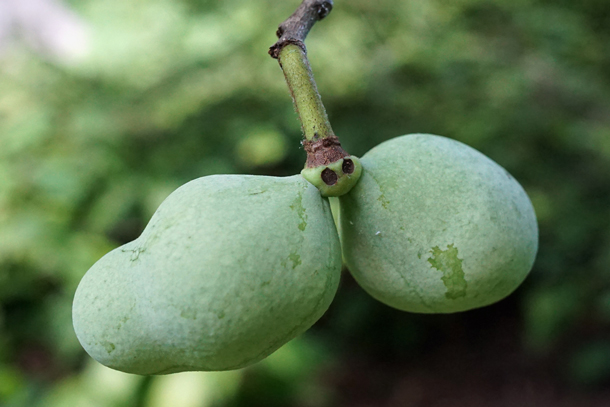
Pawpaw trees provide a rich tropical fruit, whose flavor has been compared to that of mangoes and bananas. Loved by Native Americans, pawpaws once fed people escaping slavery.

Recently the environmental radio show Living on Earth took a look at a fruit long beloved of indigenous people, the pawpaw, and asked whether it might be a good plant to introduce beyond its traditional range.

“STEVE CURWOOD: In many parts of North America, it’s well past harvest time, but not for the pawpaw. The pawpaw is a native fruit in the Eastern US that ripens in the late fall. Pawpaws were a delicious food source for Native Americans, as well for people escaping from slavery on the journey North to freedom. And there are still some pawpaw patches feeding folks today, though you can’t find them in grocery stores. Last spring When Living on Earth’s Bobby Bascomb spoke with Michael Weishan, former host of The Victory Garden on PBS, about gardening amid the coronavirus, Michael offered to dig up a few of his pawpaws for Bobby to try growing at home. …

“MICHAEL WEISHAN: Welcome to my pawpaw grove. So in front of us is the tree, It’s probably now about 30 feet tall and 15 feet wide. These are big, long lanceolate leaves [about] seven, eight inches long, three inches wide. And then as you go up, you see that they’re starting to change color. And that they’re a brilliant, brilliant yellow, which is one of the great fall features of this tree. …

“BOBBY BASCOMB: I’ve never seen one in the flesh, so to speak. [I] thought that they would be maybe bigger or greener or something.

“WEISHAN: It looks something like a green potato, wouldn’t you say?

“BASCOMB: Yeah, it’s a green potato. They’re sort of stuck together like a snow man or something. …

“WEISHAN: They’re not in commercial production because they’re very variable. So it would be very hard to ship them. They’re also, here you can feel one, they’re also quite soft.

“BASCOMB: Yeah, it’s like a ripe avocado. …

“WEISHAN: These trees are very unusual in that they form thickets … and they’re all tied via underground runners. And so when you try to go dig one up, you sever the runner. …

“BASCOMB: Now do they only reproduce by sending out runners? Or can you also take a seed and grow it and get a pawpaw? …

“WEISHAN: You can definitely plant the seeds. And presumably, that’s how this was grown. And that would actually be an easier way to propagate than these cuttings because then of course, it would form the roots within the pot. …

“The flowers are really interesting, too. They’re beautiful, long [inch] and a half flowers of a dark sort of vermilion purple color. And, interestingly, they have very little smell or a very unpleasant smell depending on your nose.

[They’re] propagated by flies, and not by bees. They bloom very early, before the bees are active. …

“BASCOMB: I was under under the impression that they grow really well in the south, like the Mid-Atlantic region and New England was sort of pushing the envelope for pawpaws. But yours looks pretty good here. …

“WEISHAN: We are at the northern edge of the range. So how much further north they will go? I don’t know. You’re right. They’re very well known down in the Mid-Atlantic and southeastern United States. However, with [climate change] things are moving north. …

“Plant it. If it dies, try the seeds. … I’m just gonna cut this open and then split it apart. [You] can see it’s like a banana. So at this point, I’m gonna give you a spoon. And these are the big black seeds. And you just take the seeds out, and then scoop it out like you would custard.

“BASCOMB: Hmm! It’s so good. Not what I expected. Everybody says banana and mango. And it’s got like, the texture of banana maybe, but …

“WEISHAN: It’s a delicious eating experience prized by the Native Americans. Of course, this was a principal food source all up and down the East Coast. A beautiful tree, great flower, great fruit … and great fall color. So if you can grow one of these in your yard, I highly recommend it.

“BASCOMB: [They] taste like a tropical fruit, almost, here in New England, which is so unusual. But … we’re into November and you’re just now harvesting these. That’s pretty unusual. [Even] apples are sort of on their way out at this point.”

More at Living on Earth, here. I’m thinking Deb will know something about pawpaws. Her blog has taught me a lot about life in the South.

Read Full Post »