Feeds:
Posts
Comments

Posts Tagged ‘rose art museum’

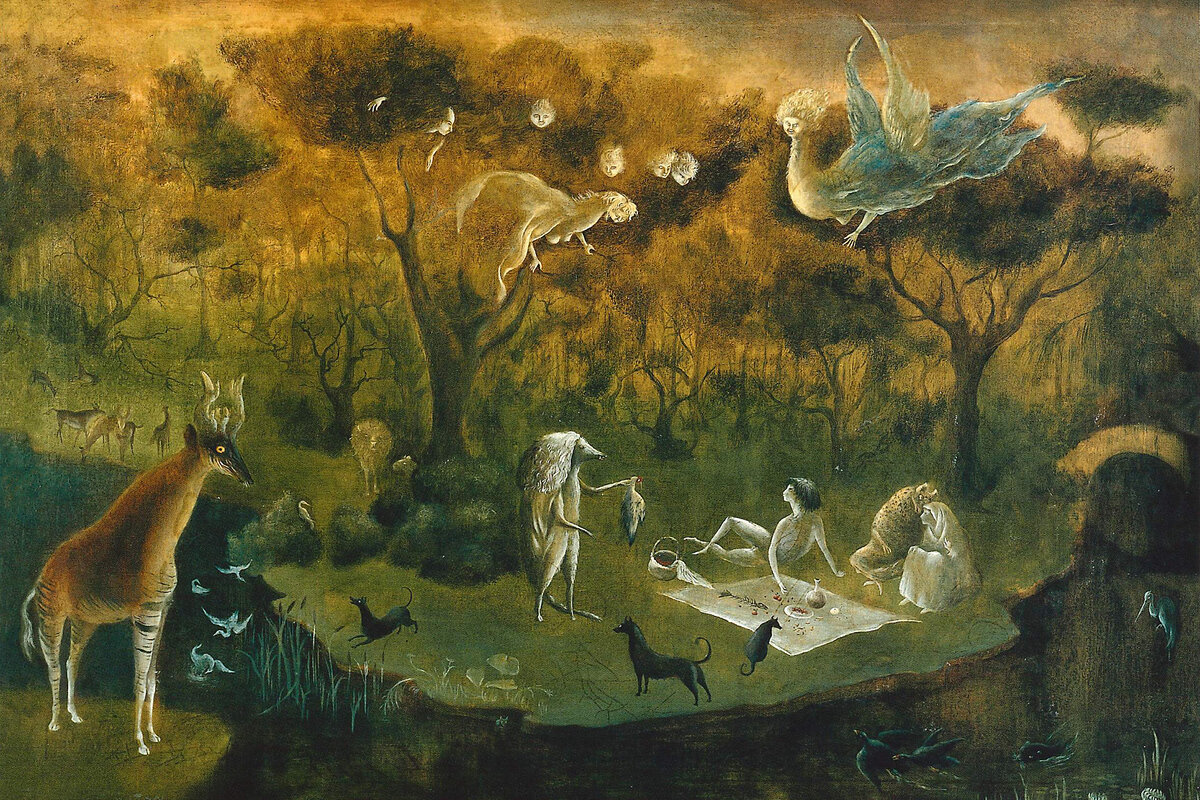
Art: Leonora Carrington/Arts Rights Society, New York.
“Pastoral” (1950) is among the works included in “Leonora Carrington: Dream Weaver” at Brandeis University’s Rose Art Museum in Waltham, Massachusetts.

All praise to the Rose Art Museum at Brandeis University for thinking differently. Compared with other museums in New England, it has always been a little bit “out there.” In today’s story that involves taking a new look at the surrealists, especially a previously underappreciated one.

Mackenzie Farkus writes at the Christian Science Monitor, “Shape-shifting creatures. Dreamscapes of greenery. Prancing hyenas and noble white horses. These are just a few of the hallmarks of surrealist Leonora Carrington.

“The artist – who was born in 1917 in England and died in 2011 – was once on the periphery of the surrealist movement. But in the decade following her death, Ms. Carrington’s work has experienced a revival.

“While her adopted homeland of Mexico has long embraced her art, the celebration of Ms. Carrington’s legacy has reached a crescendo in other parts of the world in recent years. Her reemergence follows a trend of increased attention to fellow women creators. …

“In the case of Ms. Carrington, her ‘Les Distractions de Dagobert’ (1945) sold for $28.5 million at Sotheby’s in 2024, cementing her status as the highest-selling female artist in British history. … Her first solo exhibition in New England – at Brandeis University’s Rose Art Museum – is on display until June 1, and then moves to the Katonah Museum of Art in New York. …

” ‘What Leonora offers – and what surrealism offers – are alternative ways of understanding the world: not through the capitalist economic system of transactional politics, but tapping into empowerment through the imagination, invisible truths, things that have to do with our subconscious,’ says Gannit Ankori, director and chief curator of the Rose Art Museum in Waltham, Massachusetts.

“Dr. Ankori curated the museum’s exhibit ‘Leonora Carrington: Dream Weaver.’ A number of the pieces on display – including works in tempera, gouache, acrylic, oil, pencil, pen, and fiber – have rarely been seen outside private collections. …

“In the 1950 painting ‘Pastoral,’ water fowl, a hyena, and other animals congregate around an androgynous couple as ethereal animal-human hybrids float above. Ms. Carrington often emphasized the coexistence of humans and animals in her work.

“Of particular resonance to Dr. Ankori was Ms. Carrington’s love for Mexico … ‘a welcoming country that embraced and offered safe haven to refugees from war-torn Europe in the 1940s,’ says Dr. Ankori. … ‘And these immigrants, many of them intellectuals and artists, resettled in this new, embracing homeland and felt welcome. They built community and developed cultural excellence in the arts and philosophy and literature and more.’

“Alongside her many paintings, textile works, and sculptures, Ms. Carrington was also a prolific writer. Her 1944 memoir, Down Below, details her experiences of institutionalization in Spain. Her fictional work includes a wide range of surrealist short stories, plays, and novels. …

“Born into an upper-class Catholic family in England, Ms. Carrington often rebelled against the societal restrictions imposed on her. She was twice expelled from convent schools, and favored reading Irish fairy tales, Lewis Carroll, and Beatrix Potter over learning how to become the perfect debutante.

“A viewing of Max Ernst’s 1924 painting ‘Two Children Are Threatened by a Nightingale’ and a copy of Herbert Read’s 1936 book Surrealism influenced her artistic development, as did her tutelage under the French modernist Amédée Ozenfant.

“Women in the surrealist movement were often relegated to the role of the femme enfant – often young, beautiful women who were expected to be subservient to male artists.

“Ms. Carrington, however, had other plans. ‘I didn’t have time to be anyone’s muse,’ she once said. ‘I was too busy rebelling against my family and learning to be an artist.’ …

“Ms. Carrington eventually found her way to Mexico and married Hungarian photographer Emérico ‘Chiki’ Weisz.

“There, she encountered a community of European artists who had fled the horrors of World War II, often exhibiting her art in local galleries. She became close friends with fellow émigré and artist Ms. Varo. Together, they studied kabbalah, alchemy, Tibetan Buddhism, and Mayan mystical writings – the ideas of which feature prominently in Ms. Carrington’s art. She went on to become one of the founding members of Mexico’s 1970s feminist movement. …

“Ms. Carrington’s first solo museum show in Italy will open at Milan’s Palazzo Reale in September, on view until January 2026. An exhibition at the Musée du Luxembourg in Paris will be on view from Feb. 18 to July 19, 2026.”

More at the Monitor, here. No paywall.

Read Full Post »

I was reading about the community outreach of the artist chosen to represent the United States at the Venice Biennale in 2017. How inspiring to see a once-disadvantaged kid reach back to help others after he meets with success!

Sebastian Smee writes at the Boston Globe, “The next artist to represent America at the Venice Biennale, the world’s most prestigious contemporary art event, will be the Los Angeles-based artist Mark Bradford. And his exhibit for the US Pavilion will be presented by the Rose Art Museum at Brandeis University. …

“The recipient of a 2009 ‘genius’ grant from the MacArthur Foundation, Bradford grew up in South Los Angeles. He worked for many years in his mother’s hair salon, which later became his studio. …

“Bradford, 54, is known for his tough, large-scale abstract works made from layers of paper, much of it salvaged and repurposed, and bound together with clear shellac. Using power sanders and other devices, he then works back into the surface, exposing the layers underneath. The results are some of the most beautiful, raw, and inventive works in recent art. …

“Bradford and his partner, Allan DiCastro, along with the collector Eileen Harris Norton, established a private foundation called Art + Practice, which combines an exhibition space with the provision, among other things, of job training and other forms of support for children transitioning out of foster care.”

More at the Globe. Check out Bradford, Norton and DiCastro’s nonprofit, Art + Practice, here.

Photo: Caitlin Julia Rubin
Christopher Bedford (left), director of the Rose Art Museum at Brandeis University, with artist Mark Bradford at the Rose in 2014.

Read Full Post »

Maser-Flanagan-quilt-Concord-Library

This was a weekend for looking at art. The quilts on the left are by Valerie Maser-Flanagan and are on display at the Concord Library. My favorite was the one with the vertical stripes.

My husband and I also visited Brandeis University’s Rose Art Museum, back in action after being threatened with extinction by a president who lost his job over the ensuing uproar. I must say, the Rose presents some pretty inaccessible stuff, but the weird films by Mika Rottenberg were the highlight of the visit for me today. Mesmerizing.

The films carried me back to Kenneth Anger’s and Andy Warhol’s experimental movies in the ’60s. I didn’t understand those films either, but I was fascinated. Rottenberg’s kooky stories also was reminded me (my husband, too) of an offbeat video Asakiyume lent us recently called Cold Fever, which we loved. (Saying it was about a young Japanese businessman getting lost in Iceland in winter — on a quest to honor his dead parents with ceremonies he doesn’t believe in — hardly does it justice.)

Sebastian Smee at the Boston Sunday Globe has more on Rottenberg’s videos, and he covers the other exhibits, too.

Also this weekend, I stopped in at a gallery I like in Lincoln. They were featuring several interesting artists, including the photographer Leonard Freed, below. And they have other great work coming up March 4 — take a taste here.

Photo: Leonard Freed
From “Black and White in America” exhibit at the Clark Gallery in Lincoln. See review by Mark Feeney in the Boston Globe, here.

Read Full Post »

You knew that the poet Wallace Stevens was a lawyer for the Hartford Insurance Company in Connecticut, right?

It’s fascinating, the double lives many creative people live. In this post, for example, I mentioned Kyan Bishop, a colleague with a pretty businesslike job, who turns out to be an accomplished conceptual artist.

Today I have two gentlemen from the financial-services industry, which whatever else one might say about it, pays enough for a guy to indulge an artistic bent.

Consider first Geoff Hargadon, now showing at the Kayafas Gallery in Boston.

Art critic Cate McQuaid writes in the Boston Globe, “Bring up conceptual art, and some people’s eyes glaze over. So before we dive into the conceptual underpinnings of the work of … Geoff Hargadon now up at Gallery Kayafas, let’s say this: It’s funny, wry, and self-mocking — accessible on many levels.

“Hargadon’s ‘Dealers Protected!’ features signs that he has put up, first around Boston and then during the Frieze Art Fair in London in October, and during Art Basel Miami Beach earlier this month. Perhaps you have seen them. They read ‘Cash for Your Warhol.’ This show features the signs themselves, and photos of them in situ.

“The artist, who is an unlikely hybrid of street artist and senior vice president at the financial services company UBS, was inspired by the ‘cash for your house’ signs he saw on telephone poles during the worst of the economic collapse. He hilariously posted his first ‘Cash for Your Warhol’ sign outside the Rose Art Museum at Brandeis in 2009, after the museum announced controversial — and later canceled — plans to close and sell off its collection.” Read more here.

Second is the late Warren Hellman, Wall Street financier and devoted banjo player. “After nearly 20 years at Lehman in New York, he started several money management businesses, including Hellman & Friedman in San Francisco, one of the country’s most successful private equity funds. More recently Mr. Hellman focused on philanthropy, bestowing millions of dollars on cultural, educational and medical charities in the Bay Area. The three-day concert he founded, Hardly Strictly Bluegrass, held each year in Golden Gate Park, has been financed entirely by him.” Read about Hellman in the NY Times obit.

Read Full Post »