Photo: Dominique Soguel.
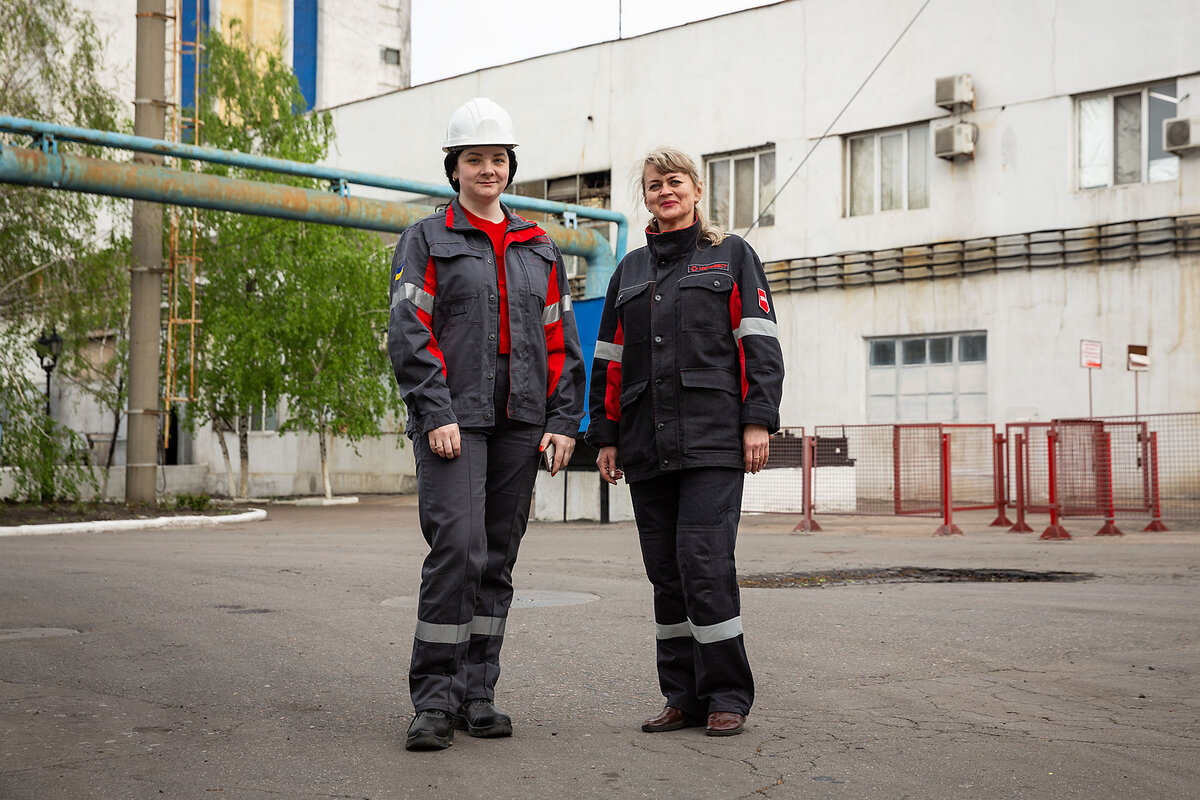
Kateryna Tolmachova (at left) and Olena Boiko stand in front of Metinvest Pokrovsk Coal, April 17, 2024. Both women have had to step up their work since Russia’s invasion has called away many of their male colleagues to military duty.
Yesterday I sent another donation to a Ukrainian I know from my four-month gig with Ukrainian journalists at the beginning of the Russian invasion. (Read about that here.) The war has kept going since then, affecting every aspect of life in Ukraine.
Consider how some women have had to step up to jobs men used to do. The women in today’s story work in coal mining. Whether coal mining is a bad thing in general is a topic for another day.
Dominique Soguel writes for the Christian Science Monitor, “Kateryna Tolmachova started working in the Donbas coal industry in 2017. But when Russia invaded Ukraine in February 2022 and men were called to military service, her career accelerated. For women like her, stepping into the critical roles the men left empty wasn’t just an opportunity, but a duty.
“ ‘Who, if not us?’ says Ms. Tolmachova, who recently became deputy head of the pumping division at Metinvest Pokrovsk Coal. ‘If our men are taken to the army and protect us from there, we need to protect the economy.’
“Nowhere is this shift more evident than in the coal mining industry of Donbas, where women have increasingly taken on critical roles to sustain both the war machine and their families. Ms. Tolmachova’s journey from machine operator to a leadership role highlights the expanding opportunities for women in the industry as more men get called to the front. …
“Metinvest Pokrovsk Coal, one of Ukraine’s newest coal mines, has been quick to harness the potential of female employees. … The war has brought significant challenges to the company. Approximately 1,000 employees have been mobilized to the Ukrainian military, and about 1,500 have moved to safer regions with their families. In all, 87 employees have been killed and 232 injured due to the ongoing conflict. Before the war, Metinvest employed around 8,000 people; now, this number has decreased to about 6,000.
“In response, the company’s female employees are taking on a greater share of the workload, and in more critical capacities. As Andry Akulih, general director of Metinvest notes, they make up almost a third of the current workforce (31%) compared with just under a quarter (24%) before the war. Those who stay often do so to care for older relatives who are either unable or unwilling to leave. Women are turning to the mine for employment opportunities as there is a dearth of other jobs, with most supermarkets and schools closed in the region.
“Traditionally, he explains, women at the coal mine were confined to roles such as operating the elevator or managing the facilities where miners receive their lamps and oxygen equipment. These jobs were considered suitable for women, as they did not involve the strenuous physical labor required underground.
“ ‘Women have come to substitute men in some underground jobs like pumping and electrical machines,’ he says. Before, ‘there were enough men to do these jobs. Women were not interested.’ …
“Metinvest’s training center, led by Larysa Batrukh, has adapted to this new reality. Previously, the center trained approximately 100 students per month, but now it trains around 50, including a small but growing number of women. …
“Inside a large classroom with boarded-up windows, most chairs are stacked on empty desks. One woman was killed after a Russian missile hit the grounds of the training center.
“But that did not deter Oksana Mariash, who returned to the mine after evacuating her daughter to Poland. She is training to become a pumping system operator, and focuses attentively on her lessons, aware that exams are approaching. ‘Of course, it is scary and hard when you hear explosions, but it is interesting to learn, and I really like my teachers.’
“One of those instructors, Yevhen Mezhenny, oversees the education for technical positions, including welders and machine operators. He is impressed by the seamless transition of women into traditionally male-dominated roles.
“ ‘I’m surprised, but it is going very smoothly, with no big hiccups,’ he says. ‘Ukrainian women are very smart and hardworking, and they put a lot of effort into studying. Many of them were previously teachers or accountants.’
“Most of the women working or training at the mine also have significant responsibilities on the home front, too.
“Tetiana Hrekova manages the demands of her job while caring for her 11-year-old son and her elderly parents. She begins her day at 4 a.m. to catch the bus, a crucial link in keeping operations running smoothly despite the war. She returns home at 5 p.m. and starts a fresh shift feeding the family and supporting her son’s online schooling.
“ ‘I can only hope that the war will be over soon and children will go to school,’ she says during her eight-hour shift deep in the coal mine. ‘We will not be afraid of leaving them above ground and be able to … enjoy our work.’ ”
Rosie the Riveter rises again!
More at the Monitor, here. No paywall.


 Suzanne's Mom's Blog