Feeds:
Posts
Comments

Posts Tagged ‘sahara’

Photo: .Ross D. Franklin/AP.
A giant dust storm called a haboob is seen approaching Phoenix, Arizona. In a haboob, a monsoon-like storm pushes large quantities of dust into the air.

I’ve lived all my life in snow country, and one thing I concluded soon after learning to drive is never to drive in a whiteout. It’s like temporary blindness. If you can’t see anything, you shouldn’t drive.

I imagine the same is true for driving in a haboob.

Juliana Kim wrote at NPR in late August, “Parts of central Arizona were engulfed by a towering wall of dust on Monday evening — producing dramatic scenes that sent shockwaves far beyond the Grand Canyon state.

” ‘ It was larger and it went through a metropolitan area so it gained a lot of attention,’ said Mark O’Malley, a meteorologist with the National Weather Service in Phoenix.

“According to O’Malley, the dust storm — known as a haboob — originated in southern Arizona around 3:30 p.m. local time and reached the city of Phoenix about two hours later.

“The storm gradually weakened as it moved through north-central Arizona and in total, lasted about an hour, O’Malley added.

‘The haboob was accompanied by intense thunderstorms. On Monday evening, more than 39,000 households in Arizona were without power and the bulk of outages were in Maricopa County, which includes Phoenix, according to NPR member station KJZZ.

“The dust storm also reduced visibility to a quarter-mile across the city. The state’s Department of Transportation urged drivers to stay off the road and flights at the Phoenix Sky Harbor International Airport were temporarily grounded, KJZZ reported.

“Although images from the haboob may look apocalyptic, dozens of dust storms occur each year in southwestern U.S., according to the National Oceanic and Atmospheric Administration (NOAA). …

“These dust storms are the result of powerful winds from a thunderstorm. As the storm cell moves, it forces air down and forward, picking up dust and debris along the way, according to NOAA.

“The recent haboob that swept through Phoenix also came after a series of severe thunderstorms in the area.

“  ‘That’s how these outflows form is behind thunderstorms and it pushes across the desert and in this case, picked up a lot of dirt and transported it into the Phoenix metro area,’ O’Malley said.

“The word ‘haboob’ comes from the Arabic word ‘haab’ meaning ‘wind’ or ‘blow,’ according to NOAA. Haboobs are common in hot and dry regions like the Sahara desert and the Arabian Peninsula. Wind speeds reaching 60 miles per hour can cause a wall of dust as high as 10,000 feet, NOAA said. But these storms are typically brief, lasting between 10 to 30 minutes.

“Still, dust storms have been the cause of dozens of traffic fatalities in the U.S. over the years. In 2023, researchers from NOAA’s Air Resources Laboratory estimated that between 2007 and 2017, there were at least 232 deaths from dust storm-related traffic events.

” ‘We found that dust events caused life losses comparable to events like hurricanes and wildfires in some years,’ Daniel Tong, one of the authors of the research paper, said in 2023. ‘Greater awareness could reduce crashes and possibly save liv”

More at NPR, here.
Read Full Post »

gettyimages-620774214-60_custom-03a0d7a6fd67b082ca5d73210e8e6b4ebb7f0418-s600-c85

Photo: Fadel Senna /AFP/Getty Images
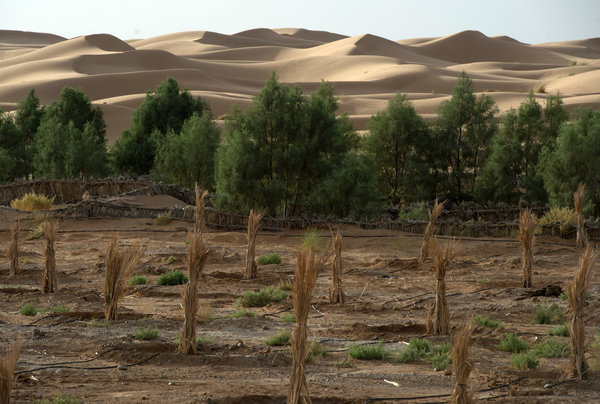
The Sahara desert is seen creeping up on a palm field. Desertification can be reversed, but it starts with thinking big.

I’m always so impressed with people who think big about big problems. Here is a credible idea for keeping the Sahara desert from taking over more of Africa. Is it possible? Don’t know. But thank goodness for scientists who get fired up when they hear that something’s not possible!

Dan Charles has a report at National Public Radio (NPR) on how we could reverse desertification.

“The Sahara desert is expanding, and has been for at least a century. It’s a phenomenon that seems impossible to stop.

“But it hasn’t stopped at least one group of scientists from dreaming of a way to do it. And their proposed solution, a grand scheme that involves covering vast areas of desert with solar panels and windmills, just got published in the prestigious journal Science.

“Eugenia Kalnay, a prominent atmospheric scientist at the University of Maryland, has been thinking about this idea for a decade. …

“Her academic adviser at MIT, Jule Charney, was among the first to describe the vicious cycle that can lead to desertification. With drought, green vegetation disappears, and the light-colored dirt that remains reflects more of the sun. This cools the land surface, which in turn means that there’s less heat driving air upward into higher and cooler levels of the atmosphere – the process that normally produces precipitation. So there’s less rain, killing even more vegetation.

“Kalnay wondered if there might be a way to revive those atmospheric currents. ‘It occurred to me that the same [cycle] would go in the opposite way, so it would increase precipitation, and vegetation, and then more precipitation,’ she says.

“And then she thought of solar panels. They’re dark, so they don’t reflect the sun’s light. Could they heat up the surface and revive those rain-bringing air currents?

“Kalnay convinced one of her post-doc researchers to create a computer simulation of an otherworldly Sahara where 20 percent of the land is covered with solar panels. The computer model also turned the desert into a giant wind farm, covered with turbines. Kalnay thought they might also help boost those beneficial air currents.

“And the simulation turned out just the way she’d hoped. It showed rainfall increasing by enough to bring back vegetation. The model showed the biggest increases in rainfall along the southern edge of the Sahara, the area called the Sahel. …

“The super solar farm she imagines is huge, as big as the entire United States. And it would generate four times as much electricity as the entire planet consumes right now. Kalmay talks of novel high-capacity transmission lines delivering power to Europe and the rest of Africa. …

“She’s used to imagining the workings of the entire planet’s atmosphere. A few billion solar panels and windmills in the desert? No big deal.” More at NPR, here.

If you imagine it, it can happen. “The desert shall rejoice, and blossom as the rose.” (Some translations say “crocus.” Check out variations on the quotation here. They all amount to the same thing: imagining “the impossible.”)

Read Full Post »

Photo: The Economist

Reversing desertification in Africa has to be one of the biggest challenges ever attempted. But if we believe that the longest journey starts with a single step, then the continent’s long journey is off to a good start.

According to the Economist, “Building a wall of trees across the width of Africa is a tall order. Solving the twin problems of land degradation and desertification poses a greater challenge still. But more than 60 years after it was first proposed, just such a project is underway at the edge of the Sahara. …

“In 1952 Richard St Barbe Baker, a British environmental scientist, proposed planting a swathe of trees across the southern reaches of the Sahara. The trees would block the wind and sand that move southward from the desert and improve the quality of the soil by binding sediment together and adding nutrients to the mix.

“Although Mr Baker was unable to convince others of his plan during his lifetime, the idea has since taken root. In 2005, Olusegun Obasanjo, then president of Nigeria, revisited Mr Baker’s proposition, seeing in it an answer to some of the social, economic and environmental problems afflicting the Sahel-Sahara region.

“An estimated 83% of rural sub-Saharan Africans are dependent on the region’s land for their livelihoods, but 40% of it is degraded—worn away by soil erosion, human activity and scorching temperatures—leaving much of it unfit for use.

“In 2007, Mr Obasanjo gained the support of the African Union. The Great Green Wall Initiative was launched the same year. Today some 21 African countries are involved in the project, which has grown in scope. Trees have been planted, but building a wall of them is no longer the priority.

“Instead, the wall of trees has become a vehicle for a wider goal: countries in the region working together to tackle climate change, food security and economic growth. Recent projects include abating soil erosion and improving water management in Nigeria, agri-business development in Senegal and forestry management in Mali.”

More at the Economist.

Read Full Post »