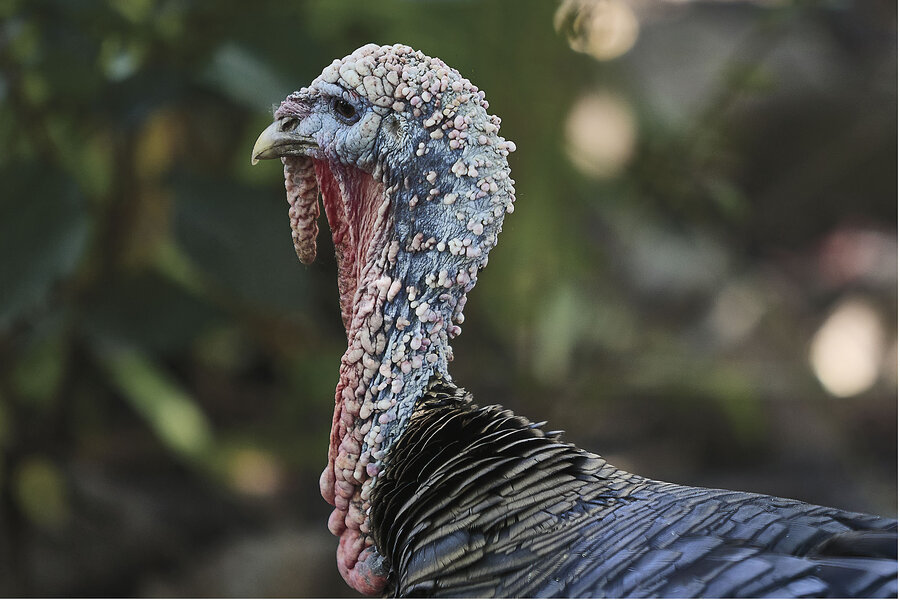
Photo: Ginnette Riguelme Quezada/Special to the Christian Science Monitor.
A turkey, or guajolote, walks in the Quino González family’s backyard in Puente Caporal, Mexico.
Who knew there was so much Mexican culture involving turkeys? Want to do the turkey dance, Anyone? In San Marcos, it’s traditional at weddings.
Whitney Eulich writes at the Christian Science Monitor, “Alejandra Quino González carries a small purple bowl filled with freshly crushed corn kernels into her rocky front yard,. … She doesn’t have to say a word; the turkeys, with their fire-engine-red wattles, beeline for their lunch.
“Although turkeys are central to holiday meals in the United States and across Europe, they were first domesticated in Mexico, long before Spanish colonizers arrived. Known locally as guajolotes, they’re featured in pre-Hispanic codices as divine creatures and markers of celebration and wealth. And yet today in Mexico, with the exception of the Yucatán Peninsula, turkey consumption is low, as the price can be nearly five times more than that of chicken.
“For Ms. Quino González, who has memories of feeding her mother’s turkeys with corn out of the palm of her hand as a child, raising these birds feels important. …
“ ‘It’s not valued anymore,’ ” she says of what locals refer to as criollo chickens and turkeys, whose meat tends to be tougher and less robust than that of industrial birds. ‘But the difference in flavor is remarkable.’
“The flavor makes Ms. Quino González, the third of six children, think of school breaks as a kid, when she and her siblings would go out into the fields with their dad to help with the milpa cultivation – corn, beans, and squash growing together. ‘I remember coming home to a delicious, rich turkey soup,’ she says. …
“Her home, which is a few steps away from the house she grew up in, is surrounded by livestock, including baby calves and day-old chicks. But Ms. Quino González only reconnected with the tradition of raising turkeys about a decade ago. Her goddaughter was getting married in nearby San Marcos, which is one of the few communities in the area that celebrates weddings with a traditional turkey dance.
“In San Marcos, that involves the families of the bride and groom dancing with ornately decorated baskets filled with a turkey and the multitude of fresh ingredients required to make a traditional mole sauce. The turkeys represent abundance and gratitude for the couple’s future together. Ms. Quino González and her husband added some turkeys to their menagerie so that they could provide two as their wedding gift to the goddaughter. The turkeys they didn’t give away remained with them, laying eggs. Today, the couple has six of the birds, and Ms. Quino González’s mother, Soledad González Morales, started raising turkeys again as well. …
“Raising guajolotes ‘is a connection with the past,’ says Ms. González Morales, as yellow-and-black butterflies flutter above her. She’s referring to the birds’ pre-Hispanic roots, but there are other memories that endear her to the finicky creatures. She remembers her son, who died in an accident 17 years ago when he was in his early 20s, walking outside as a toddler and beckoning her. ‘Ma! Ma!’ he’d call, she remembers, and then he’d perfectly imitate the guttural gobble of the turkeys milling around the house. Now, when the family prepares to celebrate his life each year on Oct. 28, ahead of Day of the Dead, they will often prepare red mole with turkey or chicken, one of his favorite dishes.
“One November, about five years ago, Ms. Quino González got a glimpse of the U.S. tradition of Thanksgiving. A Texan family visiting the nearby ‘pueblo mágico’ of Malinalco hired her sister to prepare Thanksgiving dinner. Carmen Quino González cooked up an entirely Mexican meal for the celebration with recipes that echoed popular U.S. Thanksgiving ingredients, including turkey in mole and a creamy pumpkin soup.
“ ‘It was really special to see our traditions valued,’ she says. ‘And it felt like a family effort, buying the turkey from my sister, me cooking the meal, and then watching another family express such gratitude for our culture and our efforts.’ ”
More at the Monitor, here. No paywall. Nice photos.


