Feeds:
Posts
Comments

Posts Tagged ‘scientist’

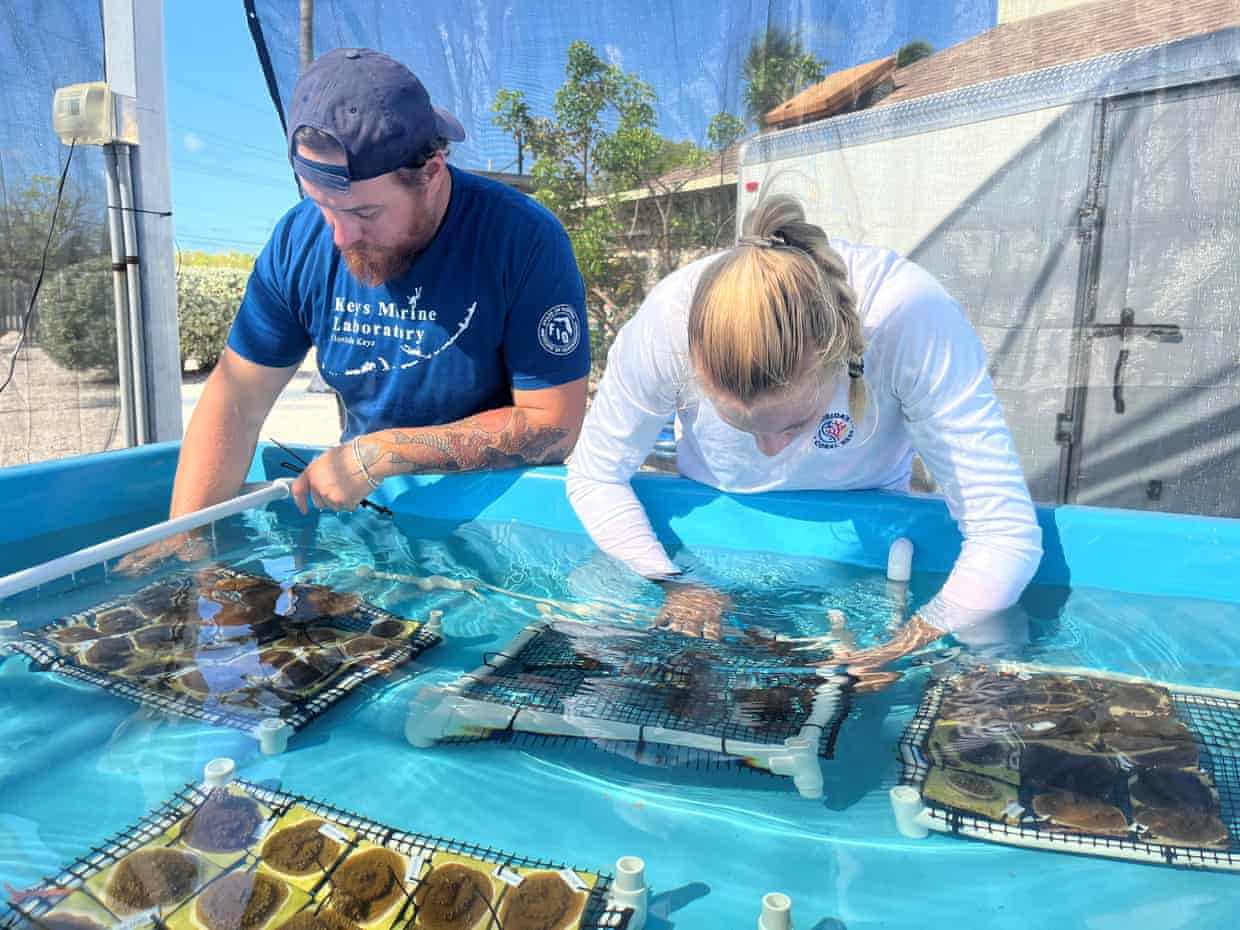
Photo: Keys Marine Lab.
Experts inspect nursery-grown juveniles from the reef-building elkhorn coral species.  They’re testing them to withstand warmer temperatures.

Scientists don’t give up, do they? They will surely have a harder time without federal grants, but I hope they will find ways to keep improving life on Planet Earth.

Take this effort to address the damage that global warming poses to coral. Richard Luscombe reports at the Guardian that a group pf experts are seeking “to save Florida’s dying reefs with hardy nursery-grown coral.”

“A taskforce of experts looking into the mass bleaching and decline of Florida’s delicate coral reefs is planting more than 1,000 nursery-grown juveniles from the reef-building elkhorn species in a new effort to reverse the tide of destruction.

Record ocean heat in 2023 hastened the death spiral for reefs in the Florida Keys, which have lost 90% of their healthy coral cover over the last 40 years, largely because of the climate emergency, according to the National Oceanic and Atmospheric Administration (NOAA).

“Marine biologists from the Keys Marine Laboratory of the University of South Florida (USF) partnered with scientists from Tampa’s Florida Aquarium to develop a large-scale restoration project involving elkhorn coral, which is critically endangered but also one of the fastest-growing and most resilient species.

“[In May], the USF facility in Long Key, halfway along the ecologically fragile Florida Keys island chain, took delivery of 1,050 young elkhorn corals spawned between 2022 and 2023 at the aquarium’s conservation and research center in Apollo Beach.

The corals are acclimatizing in temperature-regulated seawater beds in Long Key.

“They will be distributed to research partners including the Coral Restoration Foundation, the Mote Marine Laboratory, Reef Renewal USA, and Sustainable Oceans and Reefs for planting at seven designated offshore sites around the Keys during the next two months.

“Teams will monitor their progress over the following months and years. While project managers say not all will survive, they hope some of the juveniles will thrive and grow, and the knowledge gleaned will help better inform future recovery efforts.

“ ‘Maybe there will only be 100 out there a year from now, but even if it’s only one out of a hundred that survives that’s particularly tough, we can propagate that one,’ said Cindy Lewis, director of the Keys Marine Laboratory. …

“ ‘The coral juveniles we just transferred are made up of many new mother and father combinations that we hope will be more resilient to future stressors,’ Keri O’Neil, director of the [Florida Aquarium] coral conservation program, said.

” ‘Without human intervention, these parent corals would not be able to breed due to the extent of the loss. They’re a sign that, even during a crisis, we can make a difference. By working together we’re protecting a reef that’s essential to our environment, our economy and the thousands of species that call it home.’

“Lewis said the elkhorn project was a small component of a vast wider effort by numerous universities, environmental groups, and state and federal partners to try to restore as much lost coral as possible. …

“ ‘All these different organizations produced over 25,000 pieces of coral this winter to put out on the reef that are going to make a difference, along with our elkhorn.

“ ‘Even though it seems dismal and depressing, the ray of hope is that we can produce these corals, we can get these corals out there, and that everybody has banded together to work together. No one organization is going to do it all. We need everybody, and we need everybody’s ideas.’ “

More at the Guardian, here. No firewall.

Read Full Post »

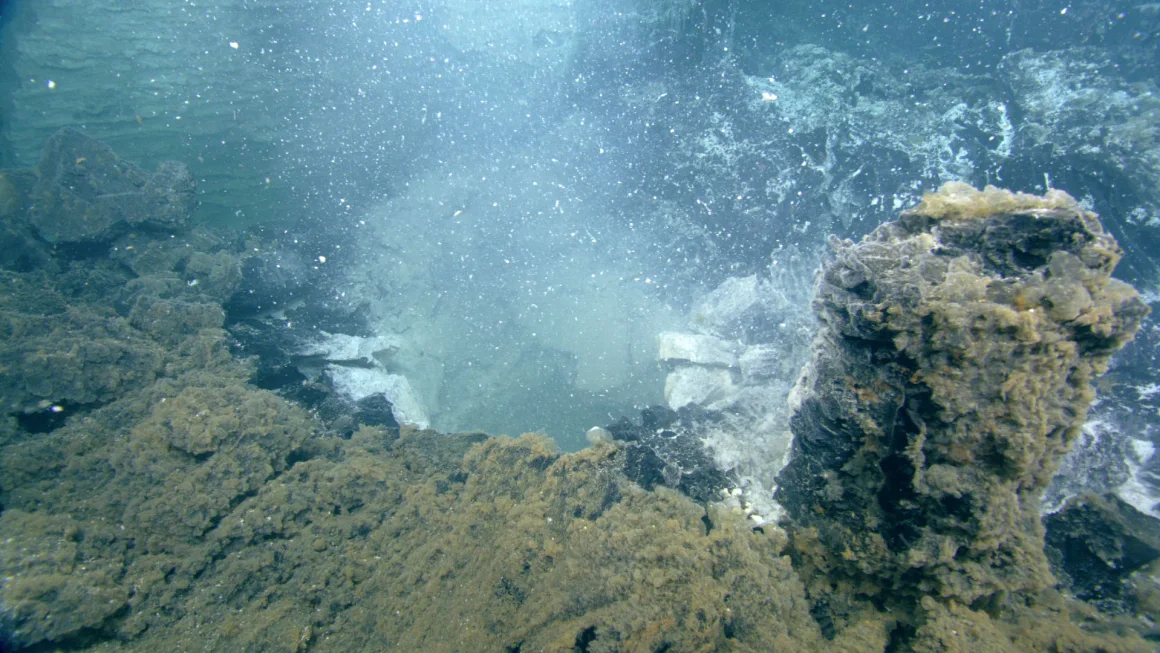
Photo: UW/NSF-OOI/CSSF-ROPOS via CNN Science.
White clouds of microbial waste billow from the seafloor — the result of a volcanic eruption. 

Rachel Carson thought it would be hard for humans to pollute the oceans because they were so vast. I guess she was wrong about that, but the oceans’ vastness does make them likely to remain a source of wonder and discovery — mysterious no matter how much we study them.

Today’s example of deep-sea wonder comes from the New York Times, where Maya Wei-Haas reports that scientists have witnessed a volcanic eruption that had never been experienced in person.

“Andrew Wozniak, a chemical oceanographer at the University of Delaware,” she writes, “struggled to process what his eyes were taking in. Dr. Wozniak was parked on the bottom of the Pacific Ocean beneath nearly 1.6 miles of water in Alvin, a research submersible. As far as he could see lay a mostly barren expanse of jet-black rock.

“Just a day before, at this same spot, a vibrant ecosystem had thrived in the sweltering waters of the Tica hydrothermal vent, about 1,300 miles west of Costa Rica. Creatures inhabited every inch of the rocky seafloor, writhing in a patchwork of life. The crimson tips of giant tube worms waggled in the current, tangling around clusters of mussels. Buglike crustaceans scuttled through the scene while ghostly white fish languidly prowled for their next kill.

“Now, only a single cluster of tube worms remained in the blackened terrain, all dead. A haze of particulates filled the water as glints of bright orange lava flickered among the rocks.

“ ‘My brain was trying to understand what was going on,’ Dr. Wozniak said. ‘Where did things go?’

“Eventually it clicked: He and the sub’s other passengers were witnessing the tail end of a submarine volcanic eruption that had entombed the flourishing ecosystem under fresh lava rock.

“This was the first time scientists had witnessed a clearly active eruption along the mid-ocean ridge, a volcanic mountain chain that stretches about 40,000 miles around the globe, like the seams of a baseball. The ridge marks the edges of tectonic plates as they pull apart, driving volcanic eruptions and creating fresh crust, or the layer of the Earth we live on, beneath the sea. About 80 percent of Earth’s volcanism happens on the seafloor, with the vast majority occurring along the mid-ocean ridge. …

“Observing such an event live offers a unique opportunity for scientists to study one of our planet’s most fundamental processes: the birth of new seafloor, and its dynamic effects on ocean chemistry, ecosystems, microbial life and more.

“ ‘Being there in real time is just this absolutely phenomenal gift — I’m really jealous,’ said Deborah Kelley, a marine geologist at the University of Washington who was not part of the research team.

“Dr. Wozniak and colleagues sailed on a ship, the R/V Atlantis, before setting out in the Alvin sub. Their original goal was to study carbon flowing from the Tica vent, funded by the National Science Foundation. Hydrothermal vents are like a planetary plumbing system, expelling seawater that’s heated as it seeps through the ocean floor. The process transports both heat and chemicals from Earth’s interior, helping regulate ocean chemistry and feeding a unique community of deep marine life.

“The dive on [on that May] Tuesday morning started like any other. Alyssa Wentzel, an undergraduate at the University of Delaware who joined Dr. Wozniak aboard Alvin, described the enchantment of sinking into the darkness of the ocean depths on the 70-minute journey to the seafloor. As the light vanished, bioluminescent jellies and tiny zooplankton drifted by.

“ ‘It was magical,’ she said. ‘It really takes your words away.’

“But as they approached the site, a darker magic set in as temperatures slowly ticked upward and particles filled the water. The usual dull gray-brown of the seafloor was capped by tendrils of inky rock that glimmered with an abundance of glass — the result of rapid quenching when lava hits chilly water.

“As particulates clouded the view from Alvin, Kaitlyn Beardshear of the Woods Hole Oceanographic Institution, the pilot in command of the day’s journey, slowed the sub, keeping close watch on the temperatures. As they ticked up, so too did concerns for safety of the submersible and the crew. Eventually, the pilot made the call to retreat. …

“The team learned after returning to the ship that sensitive microphones, called hydrophones, aboard the Atlantis had detected the volcanic eruption earlier in the day. It registered as a series of low frequency booms and campfire-like crackle.

“This was the third known eruption at the Tica vent since its discovery in the 1980s. Over the decades, Dan Fornari, a marine geologist at Woods Hole, and his colleagues have closely monitored the site, tracking changes in temperature, water chemistry and more. …

“In 1991, he and his colleagues had arrived at Tica within days of an eruption’s start. It might even have still been active, he said, but they saw no flashes of lava to confirm. This time, he said, there’s no doubt of what the Alvin crew saw. ‘This has been the closest that we ever come to witnessing the initiation of an eruption’ along the mid-ocean ridge, he said.

“The team is continuing to study the volcanic activity. Given safety concerns, they’re collecting data and taking photographs remotely from the Atlantis.

“The data will help researchers unravel the mysteries of deep-sea volcanism and the role it plays in marine ecosystems. ‘All of this has to do with understanding this holistic system that is Earth and ocean,’ Dr. Fornari said. ‘It’s so intertwined, and it’s both complex and beautiful.’ ”

More at the Times, here.

Read Full Post »

Photo: Colleen Reichmuth, NMFS 23554, via the New York Times.
Ronan, a California sea lion of the Long Marine Laboratory at the University of California, Santa Cruz.

Do you recall reading about the dancing cockatoo Snowball with the head-banger technique? Snowball was a big hit for a while there. I think critter behavior is interesting even when it does not look like human behavior, but it seems that scientists can’t get enough of animals dancing like humans.

Here are two relevant Guardian reports — one on on sea lions and one on rats.

“Ronan the sea lion can still keep a beat after all these years. She can groove to rock and electronica. But the 15-year-old California sea lion’s talent shines most in bobbing to disco hits such as ‘Boogie Wonderland.

“ ‘She just nails that one,’ swaying her head in time to the tempo changes, said Peter Cook, a behavioral neuroscientist at New College of Florida who has spent a decade studying Ronan’s rhythmic abilities.

“Not many animals show a clear ability to identify and move to a beat aside from humans, parrots and some primates. But then there’s Ronan, a bright-eyed sea lion that has scientists rethinking the meaning of music.

“A former rescue sea lion, she burst to fame about a decade ago after scientists reported her musical skills. From age three, she has been a resident at the University of California, Santa Cruz’s Long Marine Laboratory, where researchers including Cook have tested and honed her ability to recognize rhythms. …

“What is particularly notable about Ronan is that she can learn to dance to a beat without learning to sing or talk musically.

“ ‘Scientists once believed that only animals who were vocal learners – like humans and parrots – could learn to find a beat,’ said Hugo Merchant, a researcher at Mexico’s Institute of Neurobiology, who was not involved in the Ronan research.

“But in the years since since Ronan came into the spotlight, questions emerged about whether she still had it. Was her past dancing a fluke? Was Ronan better than people at keeping a beat?

“To answer the challenge, Cook and colleagues devised a new study. … The result: Ronan still has it. She is back and better than ever. This time the researchers focused not on studio music but on percussion beats in a laboratory. They filmed Ronan bobbing her head as the drummer played three different tempos – 112, 120 and 128 beats per minute. Two of those beats Ronan had never been exposed to, allowing scientists to test her flexibility in recognizing new rhythms.

“And the researchers asked 10 college students to do the same, waving their forearm to changing beats. Ronan was the top diva.

“ ‘No human was better than Ronan at all the different ways we test quality of beat-keeping,’ said Cook, adding, ‘she’s much better than when she was a kid.’ “

Meanwhile, at the Guardian, Hannah Devlin writes that rats, too, “instinctively move in time to music. This ability was previously thought to be uniquely human and scientists say the discovery provides insights into the animal mind and the origins of music and dance.

“ ‘Rats displayed innate – that is, without any training or prior exposure to music – beat synchronization,’ said Dr Hirokazu Takahashi of the University of Tokyo.

“ ‘Music exerts a strong appeal to the brain and has profound effects on emotion and cognition,’ he added.

“While there have been previous demonstrations of animals dancing along to music – TikTok has a wealth of examples – the study is one of the first scientific investigations of the phenomenon.

“In the study, published in the journal Science Advances, 10 rats were fitted with wireless, miniature accelerometers to measure the slightest head movements. They were then played one-minute excerpts from Mozart’s Sonata for Two Pianos in D Major, at four different tempos: 75%, 100%, 200% and 400% of the original speed. Twenty human volunteers also participated.

“The scientists thought it possible that rats would prefer faster music as their bodies, including heartbeat, work at a faster pace. By contrast, the time constant of the brain is surprisingly similar across species.

“However, the results showed that both the rat and human participants had optimal beat synchronicity when the music was in the 120-140 beats per minute (bpm) range – close to the Mozart composition’s original 132bpm – suggesting we share a ‘sweet spot’ for hitting the beat. The team also found that rats and humans jerked their heads to the beat in a similar rhythm, and that the level of head jerking decreased the more that the music was sped up. …

“The team now plans to investigate how other musical properties such as melody and harmony relate to the dynamics of the brain.

“ ‘Also, as an engineer, I am interested in the use of music for a happy life,’ said Takahashi.”

Gotta love scientists! More on rats. More on Ronan.

Read Full Post »

Photo: Carolyn Cole/Los Angeles Times via Getty Images.
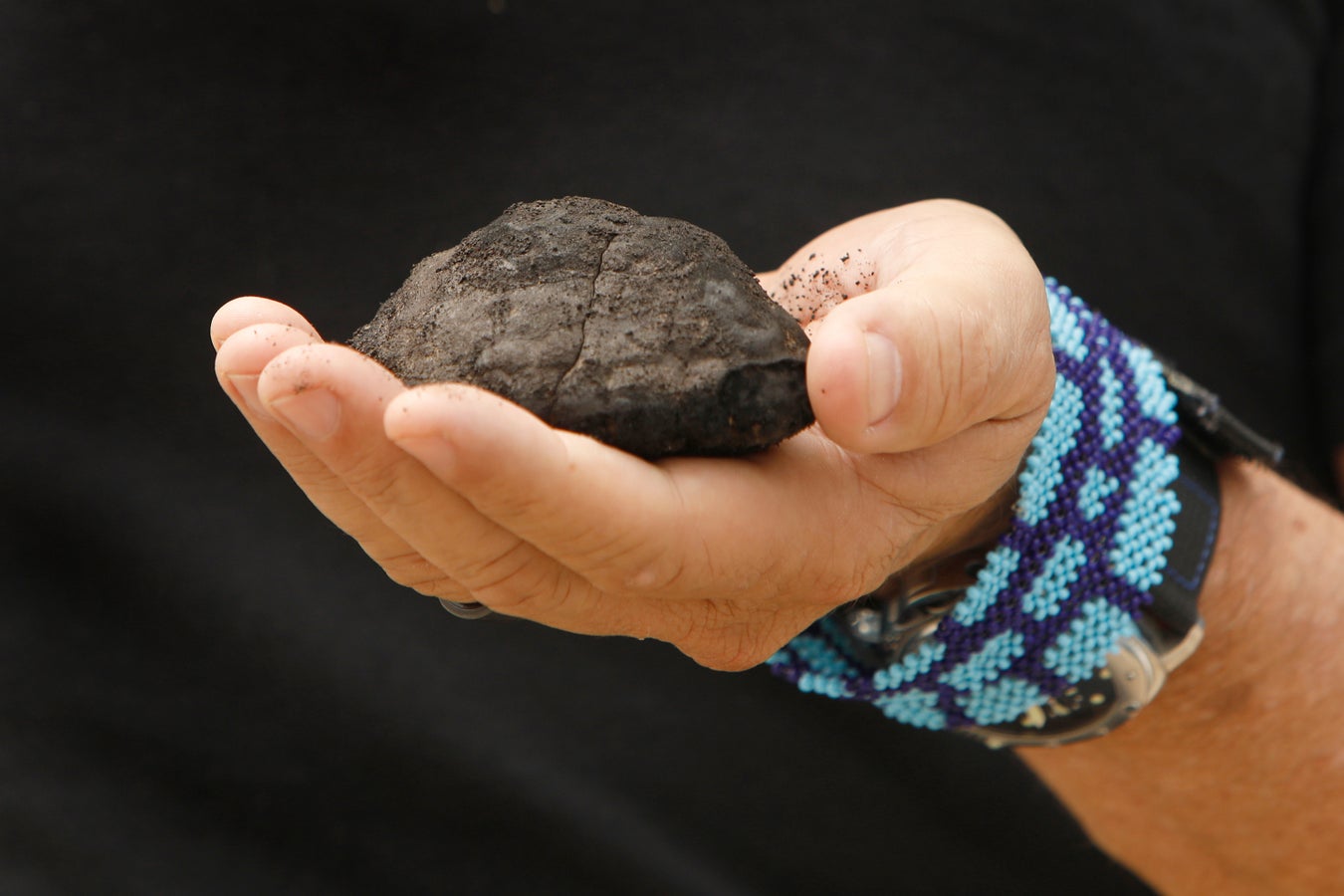
Metal deposited over millions of years forms these nodules, which can somehow generate oxygen.

Sometimes it seems like scientists have all the fun. In today’s story, certain researchers of the deep ocean thought their instruments were at fault and complained to the manufacturer. Then one day, ironically, an ad from a deep-sea mining company struck a chord in one scientist and led to some creative thinking.

Allison Parshall writes at Scientific American that some rocklike mineral deposits in the deep sea may have more to them than meets the eye.

“The dark seabed of the Pacific Ocean’s Clarion-Clipperton Zone (CCZ) is littered with what look like hunks of charcoal. These unassuming metal deposits, called polymetallic nodules, contain metals such as manganese and cobalt used to produce batteries, marking them as targets for deep-sea mining companies.

“Now researchers have discovered that the valuable nodules do something remarkable: they produce oxygen and do so without sunlight. ‘This is a totally new and unexpected finding,’ says Lisa Levin, an emeritus professor of biological oceanography at the Scripps Institution of Oceanography, who was not involved in the current research.

“According to Boston University microbiologist Jeffrey Marlow, the idea that some of Earth’s oxygen gas may come not from photosynthesizing organisms but from inanimate minerals in total darkness ‘really strongly goes against what we traditionally think of as where oxygen is made and how it’s made.’ Marlow is a co-author of the new study, which was published in Nature Geoscience.

“The story of discovery goes back to 2013, when deep-sea ecologist Andrew Sweetman was facing a frustrating problem. His team had been trying to measure how much oxygen the organisms on the CCZ seafloor consumed. The researchers sent landers down more than 13,000 feet and created enclosed chambers on the seabed to track how oxygen levels in the water fell over time.

“But oxygen levels did not fall. Instead they rose significantly. Thinking the sensors were broken, Sweetman sent the instruments back to the manufacturer. ‘This happened four or five times’ over the course of five years, says Sweetman, who studies sea­floor ecology and biogeochemistry at the Scottish Association for Marine Science. …

“Then, in 2021, he returned to the CCZ on a survey expedition sponsored by the Metals Company, a deep-sea mining firm. Again, his team used landers to make enclosed chambers on the seafloor and monitor oxygen levels. They used a different technique to measure oxygen this time but observed the same strange results: oxygen levels increased dramatically. …

“The researchers initially thought deep-sea microbes were producing the oxygen. That idea once might have seemed far-fetched, but scientists had recently discovered that some microbes can generate ‘dark oxygen‘ in the absence of sunlight.

In laboratory tests that reproduced conditions on the seafloor, Sweetman and his colleagues poisoned seawater with mercury chloride to kill off the microbes. Yet oxygen levels still increased.

“If this dark oxygen didn’t come from a biological process, then it must have come from a geological one, the scientists reasoned. They tested a few possible hypotheses — such as that radioactivity in the nodules was decomposing seawater molecules to make oxygen or that something was pulling oxygen from the nodules’ manganese oxide — but ultimately ruled them out.

“Then, one day in 2022, Sweetman was watching a video about deep-sea mining when he heard the nodules referred to as ‘a battery in a rock.’ That bit of marketing was only a metaphor, but it led him to wonder whether the nodules could somehow be acting as natural geobatteries. If they were electrically charged, they could potentially split seawater into hydrogen and oxygen through a process called seawater electrolysis. (A battery dropped in salt water produces a similar effect.)

“ ‘Amazingly, there was almost a volt [of electric charge] on the surface of these nodules,’ Sweetman says; for comparison, an AA battery carries about 1.5 volts. The nodules may become charged as they grow, as different metals are deposited irregularly over the course of millions of years and a gradient of charge develops between each layer. Seawater electrolysis is currently the researchers’ leading theory for dark oxygen production, and they plan to test it further.”

More at Scientific American, here. No firewall.

Read Full Post »

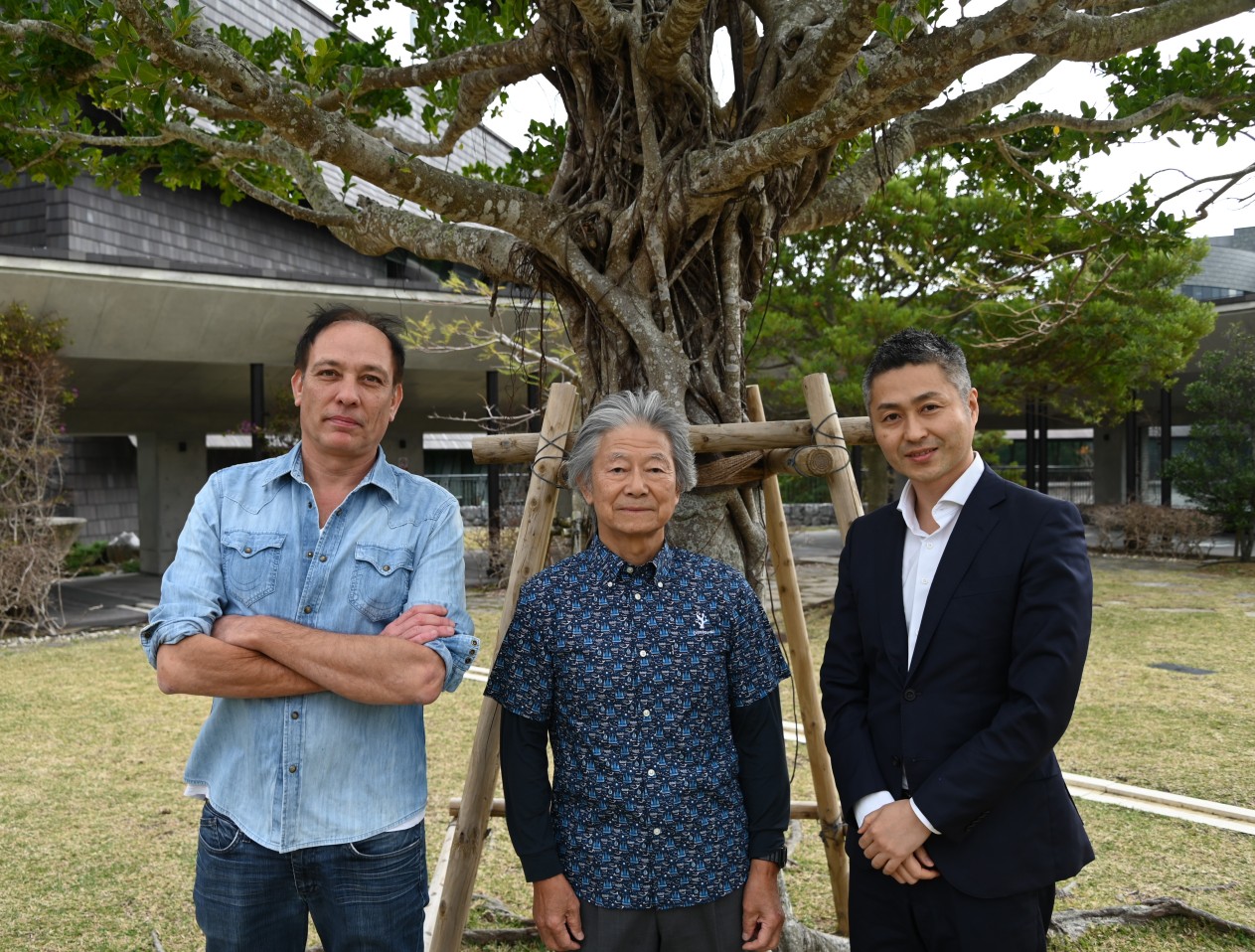
Photo: Okinawa Institute of Science and Technology.
Prof. Timothy Ravasi, Prof. Noriyuki Satoh, and Shimon Sato (L-R) lead the Coral Project at OIST, a nonprofit initiative helping conserve coral biodiversity in Okinawa. 

It is now generally known that corals are important for ocean biodiversity but are in danger from climate change. If you search on “coral” at this blog, you will find a variety of stories about what people are trying to do to help.

Today we look at an organization in Japan that merges the work of local people to that of scientists.

The website of the Okinawa Institute of Science and Technology (OIST) says, “Unlike many global reef locations requiring a boat ride, Okinawa’s reefs are accessible directly from the beach — a simple walk to a nearby beach, a quick dip into the crystal-clear waters, and within moments, you are immersed in a lively ocean community. 

“Yet elders in Okinawa remember a time when coral-filled waters were more abundant, a contrast to the significant coral decline observed in recent years, especially near shorelines. Worldwide, human activities have resulted in an alarming decrease in coral populations in the last decade. Consequently, efforts to plant corals are gaining momentum. 

“The OIST Coral Project, an initiative focused on studying and preserving coral biodiversity in Okinawa, was launched in July 2023 at the Okinawa Institute of Science and Technology (OIST). To date, the project has successfully enlisted the support of 20 companies in Okinawa and mainland Japan. …

“In January 2023, Prof. Noriyuki Satoh, head of OIST’s Marine Genomics Unit, sat down with Shimon Sato, an experienced fundraiser and Advancement Officer at OIST. They came up with an ambitious idea: to use knowledge of genomics and eDNA in a new project to plant and conserve coral in Okinawa. This was the start of an innovative effort to protect local marine life by connecting with locals and companies in Okinawa and Tokyo to establish potential collaborations. 

“Prof. Satoh and his team at the Marine Genomics Unit achieved groundbreaking milestones by decoding the genomes of corals in 2011, zooxanthellae (symbiotic organisms that coexist with corals) in 2013, and the crown-of-thorns starfish (known for devouring corals) in 2017. …

“Using this knowledge, Prof. Satoh identified the best types of coral that can be planted at specific sites in Okinawa. … Permission was granted by Okinawa Prefecture and planting is done by professional vendors, following Japan’s strict coral planting regulations.

Each planting site is overseen by a different fishermen’s organization, each with its own unique team and structure.

“Before planting, Prof. Satoh engages in negotiations with the fishermen’s organizations, explaining the project’s objectives and benefits. These fishermen, who have a deep understanding and respect for the sea, are important allies. …

“Yet this project is not just about planting corals — scientists also conduct eDNA monitoring of corals and study the fish that arrive after the planting, observing which species are on the rise or decline. …

“Cause-related marketing is one of the unique aspects of this project. This is an approach where businesses associate themselves with societal issues or values by working with non-profit organizations to promote a specific cause. …

“ ‘We began with 8 companies, including Japan’s largest mobile company NTT Docomo in Tokyo and several others in Okinawa.’ … Supporting companies can use the project’s [logo]. Ryukyu Cement Co., Ltd., the largest cement company in Okinawa, displays the logo on their cement bags and donates a portion of their cement sales to the project. Another notable supporter is Majun, the leading Kariyushi wear company in Japan. Majun has created an original 100% cotton Kariyushi t-shirt embroidered with the Coral Project logo. …

“In 2018 Onna Village, where OIST is located, was declared a ‘coral village’ or ‘sango no mura’ in Japanese, and in 2019 the Government of Japan declared the village a ‘Sustainable Development Goals Future City.’ Impressively, the practice of coral planting in Onna Village began two decades ago. In 2004, a local organization, Team Churasango, was established by community members with participation from both local and mainland companies. On average, they plant 1,000 corals annually, in response to the observed decline in coral numbers. …

“The project team has recently welcomed a third person – Prof. Timothy Ravasi, leader of the Marine Climate Change Unit at OIST. Prof. Ravasi’s unit uses the latest methods in genomics to study how marine organisms adjust to warmer and more acidic oceans. …

“Shimon attributes the success of the project to two main factors. First, Prof. Satoh’s expert knowledge of corals and excellent people skills. Second, the project has secured the support of numerous stakeholders. … ‘Okinawan people value coral, and they want to return the coral reefs to their previous beautiful and healthy state. We want to support those hopes using the power of science,’ he said.”

More at the Okinawa Institute of Science and Technology, here. And you can click here to read about how OIST got the Isawa Award for this work.

Read Full Post »

Photo: The Salt Lake Tribune.
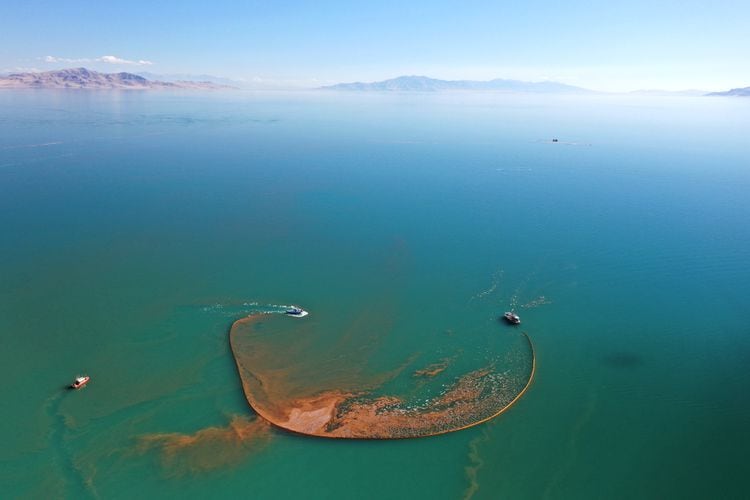
Harvest watercraft encircle brine shrimp in Great Salt Lake using containment booms in preparation for harvesting.

Although today’s story about brine shrimp feeding the world is interesting in itself, the thing that stands out to me is thinking of Uzbek scientists. Uzbekistan feels so foreign to me, it’s like talking about scientists from the far side of the moon. That’s how limited my world view is, alas.

Here’s what Leia Larsen and Levi Bridges have to say at the Salt Lake Tribune about scientists in Uzbekistan and elsewhere who are studying brine shrimp.

“As the rising sun casts golden rays over the Aral Sea, a group of Uzbek fishermen wearing sweatshirts and knit caps gathered on a chilly beach to discuss the day’s plan.

“For two days they had waited in vain for brine shrimp. A dead calm in the first cold days of winter replaced winds that usually blow large slicks of the tiny crustaceans to shore.

“Standing and smoking cigarettes beside ramshackle cabins covered in sheets of plastic to keep out the elements, the fishermen debated whose turn it was to check if any shrimp had drifted in. Two volunteers jumped on a rattling old truck and chugged off miles into the distance to scour the beach.

“When the winds blow just right, Aral Sea fishermen work up to 36 hours gathering brine shrimp eggs, also known as cysts. They often labor with headlamps through the darkness. Winter temperatures can dip as low as minus 40 degrees Fahrenheit.

“ ‘Sometimes we get so sleepy you feel drunk,’ said Miyrbek Mirzamuratov, an Uzbek fisherman who has spent two winters gathering cysts on the Aral Sea.

“The Great Salt Lake remains the world’s largest source of brine shrimp cysts, exporting 40% of the global supply. The shrimp are a key food source used in aquaculture. Seafood is the main source of protein for billions of people across the planet, and aquaculture, fueled by brine shrimp, now produces roughly half of the world’s commercial seafood.

“But drought and decreasing water resources have put new pressure on brine shrimp in both Utah and Central Asia. In 2022, the Great Salt Lake’s shrimp populations almost collapsed due to record-low water elevation and spiking salinity.

“ ‘We’re all starting to realize just how much the lake touches us in many ways that we don’t appreciate,’ said Tim Hawkes, a former Utah state representative and current general counsel for the Great Salt Lake Brine Shrimp Cooperative. …

“Environmental challenges are also forcing scientists in Uzbekistan to devise ways to save their own brine shrimp – and help keep the world fed if Utah can’t ensure its own inland sea survives. Despite being too salty for fish, the Great Salt Lake’s aquaculture industry infuses Utah’s economy with up to $67 million each year, thanks to brine shrimp.

“That’s because their cysts, no bigger than a grain of sand, tolerate extreme conditions.

“ ‘You can boil them, you can freeze them, you can send them to outer space,’ Hawkes said. ‘And still, under the right conditions, if you put them in a little bit of salt water and give them some light, they’re going to hatch out.’

‘It makes brine shrimp cysts an ideal product to package and ship across the world, where they’re raised as an essential food source for the farmed seafood humans eat, particularly prawns and cocktail shrimp.

“Although farm-raised seafood has generated controversy due to its runoff pollution and impacts to wild fisheries, the United Nations issued a 2020 report identifying it as a critical player in global food security. It provides nutritious protein at low cost to rural and developing communities that have a hard time producing other farmed goods. …

“Globally, the average person ate 44.5 pounds of seafood in 2020, up from 31.5 pounds in the 1990s, according to the U.N. More than half of that came from farms.

“ ‘If we lost the Great Salt Lake,’ Hawkes said, ‘or we lost the ability to produce brine shrimp from the Great Salt Lake, it would have a significant impact on our ability to feed the world.’ …

‘Companies on the Great Salt Lake gather brine shrimp cysts from the water with boats and floating booms similar to those used to contain oil spills, but the work is still mostly done by hand in Uzbekistan and other Asian countries. …

‘Islambek Shumomurodov said he earns about $1.50 for every pound of Aral Sea cysts he gathers. The average annual household income in Uzbekistan is around $1,600. ‘Some people even buy new houses and cars from working here,’ Shumomurodov said.

“Although Uzbekistan’s brine shrimp production represents just a fraction of Utah’s output, the crustaceans created an economic opportunity after the Aral Sea’s traditional fishery shriveled.

“The Aral Sea, like the Great Salt Lake, has declined significantly from agricultural demand and human water consumption. Once a freshwater lake teeming with fish, the Uzbek portion of the Aral turned saline — a trend scientists don’t expect will change.

“Neighboring Kazakhstan spent millions damming off their portion of the North Aral Sea to keep the freshwater fishery viable. Brine shrimp, which likely hitchhiked to the region as cysts stuck to the feathers of visiting shorebirds, are the only creatures with commercial value able to survive in the shrinking southern Uzbek portion of the lake. …

“ ‘It’s just a matter of years now before [the Uzbek side of] the Aral Sea can no longer support brine shrimp,’ said Ablatdiyn Musaev, a biologist at the Uzbek Academy of Sciences.”

More at the Salt Lake Tribune, here. No firewall. Nice photos. There’s an audio version of the story at PRX’s The World.

Read Full Post »

Photo: Chris Linder.
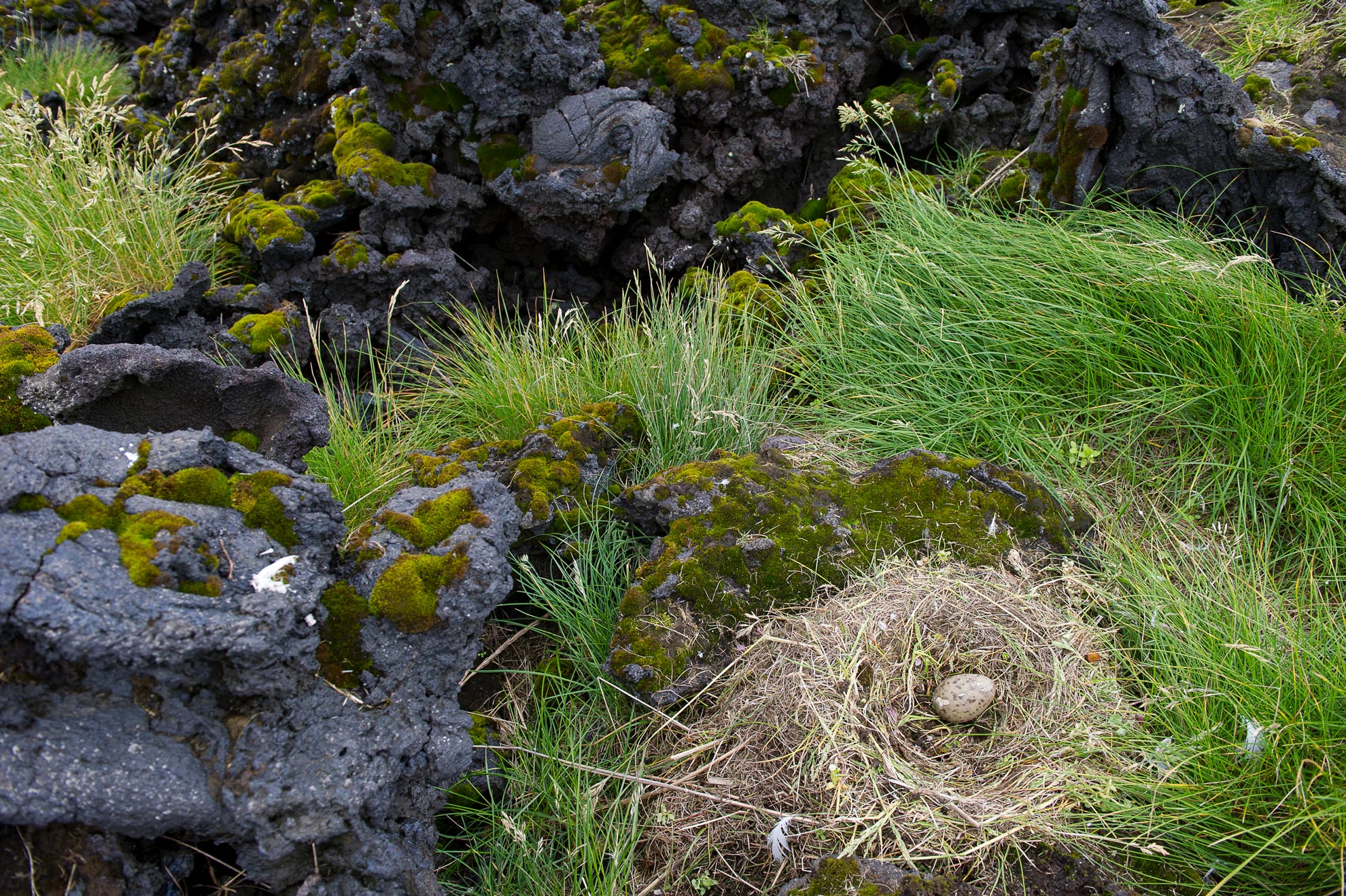
“Though most of [volcanic Surtsey] island is barren,” writes Hugh Powell at Living Bird, “a heart-shaped patch of green in the southwest corner supports lush growth and hundreds of bird nests.”

Anyone who has tried to combat weeds by putting black plastic under paving stones knows how futile that is. The life force has a mind of its own. Weed seeds will blow onto the plastic and colonize it within weeks.

Similarly, a brand-new island of volcanic rock that formed in the North Atlantic is in the process of creating a complex world of its own.

Hugh Powell reports at Living Bird. “Now just shy of 60 years old, the new island of Surtsey, off Iceland, holds clues to a fundamental mystery: What did the Earth look like when it was just born? How does life colonize bare rock?

“In 1963, a volcano erupted underneath the cold waters of the North Atlantic, 10 miles off Iceland’s southwest coast. The eruption lasted for four years. Eventually, the lava and ash cooled into a black-and-tan island named Surtsey, and the first fragile seeds of life started to wash ashore.

“Every year since the island came into being, scientists have visited Surtsey to track its ecological development. Visits to Surtsey require a permit — casual sightseeing stops are strictly prohibited — in order to preserve the island’s ecological integrity. Even today, a researchers’ red-roofed hut and an abandoned lighthouse foundation are the only buildings on Surtsey. …

“The scientists’ annual visits have generated a fascinating timeline of the pace of colonization by plant, bird, and even insect species.

“The first plant to arrive, a sea rocket (Cakile maritima), washed ashore in 1965, while the island was still erupting. By 1970, Black Guillemots had begun to nest, using the black volcanic cliffs as a foothold while getting their food from the sea.

“Over the next two decades, about 20 other plant species arrived, some by wind and some on the feet or in the stomachs of seabirds. A few additional birds set up nests as well, including Northern Fulmars and Black-legged Kittiwakes. But it wasn’t until 1985 that both plant and animal diversity started to shift into a higher gear, thanks to the arrival of an unexpected hero: the humble seagull. …

“Plant diversity had plateaued by the 1970s with fewer than 20 species established, and it didn’t take off again until a gull colony developed in 1986. The gulls — mostly Lesser Black-backed along with Great Black-backed, Herring, and Glaucous — carried with them not just new kinds of seeds, but also fertilizer in the form of nitrogen-rich guano.

“At first the gulls nested on bare black rock, but soon a lush green meadow encircled the colony, fed by gull droppings. By 2013 the meadow spread across 12 hectares (about 30 acres), supporting twice as much plant diversity and five times more biomass than the rest of the island. The number of plant species soared to 64 by 2007. …

“A more complex food web started to develop. Graylag Geese first arrived in 2001 and fed on the thick grasses. As insects like springtails, moths, and beetles began to thrive among the plant growth, insect-eating birds began to appear as well, such as Snow Buntings, White Wagtails, and Meadow Pipits. In 2008 the first ravens arrived, feeding in part on stolen seabird eggs.

“At almost 60 years old, Surtsey is still a geologic infant — its sister islands in Iceland’s Westman archipelago are about 40,000 years old. Researchers think much of the island will erode away. …

“The hard crater walls will become steep-sided seacliffs where murres and Razorbills will nest alongside the fulmars and kittiwakes already present. Atop the island, a thick turf will develop, dominated by just a few grass species. In perhaps a century or two, Atlantic Puffins will nest in the deep soil that develops.

“For now, researchers describe Surtsey as living in something of a golden age. Plant diversity has peaked at 64 species, but it’s beginning to decline as ecological competition starts to squeeze out some of the initial colonists. As the plant community develops, birds continue to find footholds. Some 17 species have nested here so far, with nearly 100 species recorded overall — including tired or off-course migrants for which jagged Surtsey is a welcome piece of terra firma in the North Atlantic.”

More at Living Bird, here. No firewall.

Read Full Post »

Photo: Photoquest/Getty Images.
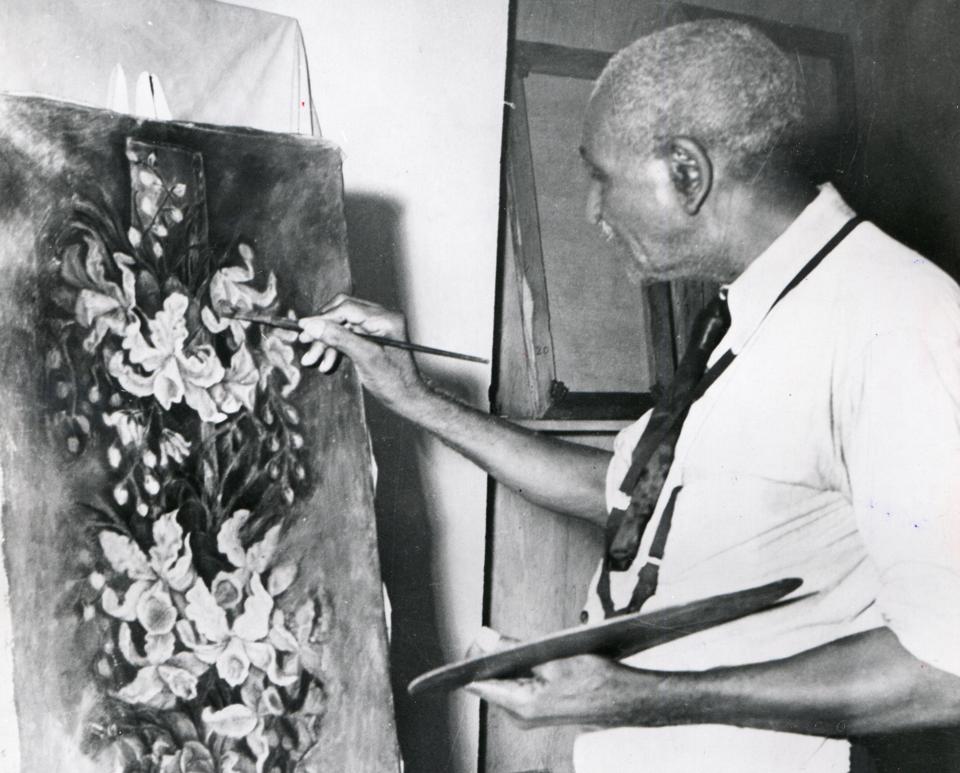
American scientist and educator George Washington Carver (1864 – 1943) was also an artist. Above, he works on his painting “The Yucca.”

It’s reasonable to ask, Why celebrate women or Black Americans only one month a year each? But one advantage is that there’s an incentive for the media to dig out stories about interesting people we either wouldn’t know about at all or wouldn’t know about in detail. For example, most Americans know that a Black scientist called George Washington Carver did research on peanuts that helped farmers in the South. But I, for one, didn’t know anything about his paintings.

Eva Amsen reports at Forbes, “Last month, the Getty Foundation announced the grant recipients for the 2024 exhibit series ‘Pacific Standard Time 2024: Art x Science x LA.’ This event will include different galleries and institutes in California, which will each focus on the theme of science and art. While some of the planned exhibits focus on current and future science, one grant recipient is featuring an artist from science history. The California African American Museum received $120,000 for their exhibit ‘World Without End: The George Washington Carver Project.’

“Although George Washington Carver is best known for his research on new uses for peanuts, he was also an artist. In 1941, two years before his death, Time Magazine featured a piece about Carver in which they mentioned that 71 of his paintings were being shown at Tuskegee at the time.

“Carver spent most of his career as an agricultural researcher at Tuskegee, but he didn’t start his university career in science. When he initially enrolled in college (after searching for a place that would accept Black students in the 19th century) he studied art and piano at Simpson College in Indianola, Iowa. He’d always loved plants and particularly excelled at painting them. …

His art teacher, Etta Budd, encouraged him to enter one of his paintings to a local art exhibit, where it was selected as one of the artworks to represent Iowa at the World’s Fair in Chicago in 1893. Carver’s painting, ‘Yucca and Cactus,’ got an honorable mention at the fair.

“Despite his talents, Budd worried that Carver wouldn’t be able to make a living as an artist, so she suggested that he take his plant illustration skills to the botany department at Iowa State Agricultural College. After receiving his bachelor’s degree here in 1894 and his master’s in 1896, Carver took on a research position at Tuskegee Institute. 

“One of his initial interests was to help farmers increase the yield of their crops. Besides doing research, he invested a lot of time in talking to farmers and explaining the benefits of fertilization and crop rotation to restore nutrients to the soil.

“Partly thanks to Carver, crop production in the South did indeed increase, but this led to a new problem. Now farmers were stuck with an agricultural surplus of crops they had harvested but could not sell. … Carver invented more than a hundred new uses for sweet potatoes and over three hundred different ways to use peanuts. …

“Unsurprisingly, considering his art background, one of the new uses he found for peanuts was to develop paints.  He didn’t just use peanuts to make dyes, but other natural resources as well. Carver even created a line of household paints using pigments from Alabama soil that he envisioned would be more affordable for poor families.

“Carver used some of his self-created paints for his art as well. In the 1941 profile about his art, Time Magazine noted that he used a series of plant-based earth tones created by his assistant A. W. Curtis Jr.”

Using Alabama soil to make dyes caught my attention because I love the work of natural-dye scarf artist Jamie Bourgeois. Sometimes she augments nature to document the polluted waters of Cancer Alley in order to help the Louisiana cleanup efforts. It’s amazing to see how pollution changes the colors. Read about that work here. And support the pollution cleanup here.

More at Forbes on George Washington Carver, here.

Read Full Post »

Maria Popova at the blog Brain Pickings is an endless source of inspiration. Whether she is posting about art, nature, philosophy, or children’s books, she’s a treasure. 

Today I want to dip into her report on an out-of-print book featuring an artistic rendering of the wonders of the Great Barrier reef. Considering how fast the optimal conditions for the reef are being lost to global warming and the ocean’s higher carbon levels, it might be a good idea to think about how it looked in 1893.

Popova begins, “While the German marine biologist Ernst Haeckel was salving his fathomless personal tragedy with the transcendent beauty of jellyfish, having enraptured Darwin with his drawings, his English colleague William Saville-Kent (July 10, 1845–October 11, 1908) was transcending his own darkness on the other side of the globe with the vibrant, irrepressible aliveness of the Great Barrier Reef and its astonishing creatures. 

“By the end of his adolescence, William had survived the unsurvivable. The youngest of ten children, he lost his mother when he was seven.”

Suzanne’s Mom pauses here to let you read what else was “unsurvivable,” including murder most foul.

“William was shaken by the inordinate share of loss, violence, and public shame he had accrued in so young a life. Taking refuge in the impartial world of science, he came to study under the great biologist and comparative anatomist T.H. Huxley, who had coined the term agnosticism and who had so boldly defended Darwin’s evolutionary ideas against the reactionary tide of opposition a decade earlier.

“Upon completing his studies, Saville-Kent received an appointment in the Natural History department of the British Museum as curator of coral. He grew enchanted with these beguiling, poorly understood creatures; he also grew bored with the museum position — he longed to do research, to contribute to the evolving understanding of these living marvels. …

“As Saville-Kent approached forty, his old mentor T.H. Huxley — by then the most prominent British life-scientist after Darwin’s death a year earlier — recommended him as inspector of fisheries in Tasmania. Saville-Kent left England and the dark specter of his youth for the bright open seas of the South Pacific, where he grew newly enchanted with the lush underwater wonderland of strange-shaped corals and echinoderms, frilly anemones and tentacled mollusks, fishes in colors that belong in a Kandinsky painting, creatures he had marveled at only as dead and disjointed museum specimens or segregated aquarium captives, creatures he had never imagined. 

“Determined to bring public awareness and awe to this otherworldly ecosystem — an ecosystem that in the century since his time has grown so gravely endangered by human activity that it might not survive another century — he authored the first popular science book on that irreplaceable underwater world. In 1893, several years before the German oceanographer published the gorgeously illustrated first encyclopedia of deep-sea cephalopods, Saville-Kent published The Great Barrier Reef of Australia: Its Products and Potentialities — a pioneering encyclopedia of one of Earth’s most luscious and delicate ecosystems, illustrated with a number of Saville-Kent’s black-and-white photographs and several stunning color lithographs by two artists, a Mr. Couchman and a Mr. Riddle, based on Saville-Kent’s original watercolors.” More at Brain Pickings, here.

One thing I love about Brain Pickings is the way Maria Popova’s own brain makes such interesting connections. At the end of almost every post she links to other posts on topics that may seem unrelated on the surface but play off each other in an interesting way. Her approach is a bit like suggesting an unusual cheese to go with your wine.

Illustration from William Saville-Kent’s book Fishes from The Great Barrier Reef of Australia, 1893. (Maria Popova at Brain Pickings makes it available as a print and as a face mask!)

Read Full Post »

Photo: Catherine Smart for The Boston Globe
Steelhead trout from the University of New Hampshire aquaculture program.

As the tension between traditional fishing and the sustainability of the marine environment increases, so do hopes that some fishermen will get interested in the new approaches to aquaculture.

One new approach is being tested at the University of New Hampshire in collaboration with a New England chef.

Catherine Smart writes at the Boston Globe, “About a year ago, Jeremy Sewall — chef and partner of Row 34 and Island Creek Oyster Bar restaurants, and the recently opened Les Sablons — was scrolling through his Instagram feed when he spotted a glistening, speckled Steelhead trout from Greenpoint Fish & Lobster Co. in Brooklyn. The caption read that it was raised through the aquaculture program at the University of New Hampshire.

“As Sewall tells it, ‘I screenshot that picture and send it to my purchaser Phil and say, “Find me this fish, I own a restaurant in New Hampshire and I need to find this fish.” ‘

“The rainbow trout in question was raised by Michael Chambers, a research scientist at UNH’s School of Marine Science and Ocean Engineering.

It was grown in an offshore pen that bears little resemblance to the stagnant, antibiotic-filled fish ponds people might associate with aquaculture.

“Many phone calls to the marine biology department later, purchaser Phil found Chambers and set up a meeting with Sewall. The scientist and the chef sat down to lunch. ‘Come to find out, that was kind of the end of the project. They had raised the fish [he saw on social media] and they weren’t sure what they were going to do next year, and I was like, “We have to do this, it’s incredible,” ‘ says Sewall.”

So they partnered.

Smart describes meeting Chambers and Sewall at the Judd Gregg Marine Science Complex and heading out with them to feed the fish.

Chambers said, “ ‘As a biologist, you want to see your chicken, your cows, every day — so you can see if they are healthy. If something is up, you can catch it right away.’  …

” ‘What’s unique about this is that we have a floating system that’s designed to hold fish at the center. And we have these,” he says, pulling up tubes of nylon netting, filled with mussels and seaweed growing on rope. ‘These act as biological filters, or a biological curtain, which are now taking nutrients that the fish give off and are absorbing them, taking that nitrogen out of the system.’  This Integrated Multi-Trophic Aquaculture system, known as IMTA, is a big part of what sets Chambers’s project apart. …

“As a restaurateur, Sewall sees a major business opportunity, likening Chambers’s method of fish farming to the small organic farms that chefs patronize to get the best meat and produce. He is willing to wait for the fish to grow and is eager to create new dishes to showcase the end product.”

More at the Globe, here.

Read Full Post »

I’ve put off writing about sprites because I’m not sure I can explain what they are  — powerful upward lightning flashes that send electricity around the earth and were originally going to be photographed by an astronaut on the ill-fated Columbia.

A team of scientists and a few daredevil pilots flew repeatedly into storms to prove the visions were real. The television show Nova covered the quest.

“NARRATOR: On a stormy night, in Denver, a team of scientists takes to the air to investigate a mystery.

“RONALD WILLIAMS (United States Air Force): I reported it, and nobody believed me.

“NARRATOR: They’re trying to catch a burst of energy so fleeting and hard to see that scientists call it by the ethereal name of ‘sprite.’

“EARLE WILLIAMS (Massachusetts Institute of Technology): The bolts that cause sprites are superbolts, the kind of lightning that’ll blow your T.V. sky high. …

“KERRI CAHOY (Massachusetts Institute of Technology): You can see airglow that’s more diffuse and just in layers than the curtain-like aurora.

“NARRATOR: NOVA takes to the air, on a quest to record these elusive events.

“GEOFF MCHARG (United States Air Force Academy): Sprite!

“NARRATOR: And the effort also continues above, from the vantage point of space, where the work had it’s beginning during the ill-fated Columbia mission, with Israeli astronaut Ilon Ramon.

“YOAV YAIR (The Open University of Israel): I asked him, ‘Please bring me one sprite image.’ He said, ‘Don’t worry, I’ll get you a couple.’

“NARRATOR: Ramon’s colleagues now continue where he left off.

“SATOSHI FURUKAWA (Japanese Astronaut): We must take over their work. I thought that was the survivors’ duty.

“NARRATOR: Their dramatic discoveries are revealing that we live on an electrified planet, surrounded by a global circuit that rings the earth. And like a planetary heartbeat, we can now detect it.”

More here.

 Image: Nova

Read Full Post »

When you take pretty much the same walk every day, camera in hand, you may have trouble finding new things to photograph. You may look in vain for something different, puzzling, or mysterious.

But there is something to be said for combing the same territory over and over, as scientists are finding from studying the detailed record keeping of Henry David Thoreau.

“ ‘As far as I know, there is more information about the effect of climate change in Concord than any other place in the United States,’ said Richard Primack, a Boston University biologist who calls Concord a living lab for his research. …

Primack, writes Kathleen Burge at the Boston Globe, “has researched how climate change has affected the flowering times of plants, comparing modern data with the information Thoreau collected between 1852 and 1860. Primack and his lab found that for every 1 degree Celsius increase in mean spring temperature, plants bloom about three days earlier. …

“Primack came to his work about a decade ago, when he decided to change the direction of his research. He had been studying the effects of climate change on plants and animals in southeast Asia and decided, instead, to focus on his home state.

“But when he began searching for older records of plant flowering times in the United States, he came up short. Finally, after six months, someone told him about Thoreau’s journals.

“This was kind of a gold mine of data,” Primack said. “As soon as we saw it, we knew it was amazing.” More from the Globe.

Keep an eye open for the upcoming Thoreau exhibit at the Concord Museum April 12 to September 15, described here.

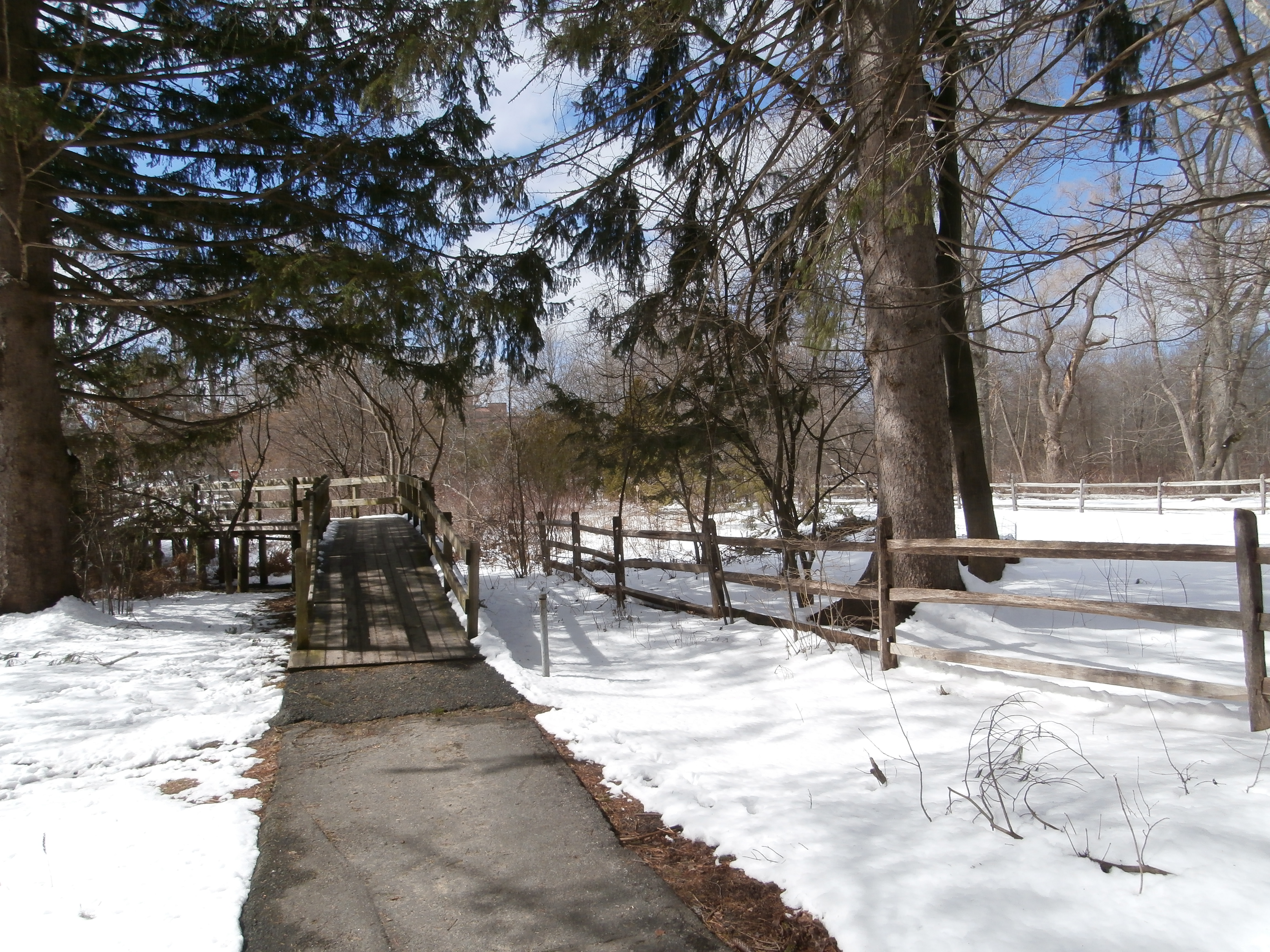
cross over the bridge

Read Full Post »