Feeds:
Posts
Comments

Posts Tagged ‘scotland’

Photo: Robert Ormerod for the New York Times.
Graham Maxwell performing “The Flying Bubble Show” during the Edinburgh Festival Fringe.

Nowadays, hearing or reading about something cool is generally good enough for me. As interested as I might be in a foreign country or a new play or a natural wonder, I don’t often think, “I wish I had been there.”

But today’s story on bubble art is different. I would have loved to see these performances and be in the midst of audience reactions. They took place at the Edinburgh Festival Fringe in August.

Alex Marshall wrote at the New York Times, “In McEwan Hall last week, the atmosphere was riotous. For about an hour, some 400 adults and children were gasping, screaming and laughing as Louis Pearl, the Amazing Bubble Man, encased girls and boys in huge soapy globules, made bubbles levitate and wobble, filled many of the fragile spheres with smoke, and karate-chopped others in half.

“For the show’s finale, Pearl, 68, grabbed a long plastic stick with a ring on one end, dipped it into a vat of soapy formula and waved it above his head so that thousands of bubbles drifted over the audience. Children throughout the theater leaped out of their seats to pop them. …

“This year, four bubbleologists, as they like to be called, have shows on the Fringe. … Ray Bubbles has a show for disabled children and an ‘Ultimate Bubble Show‘; an act called the Highland Joker has the simply titled ‘Bubble Show‘; and Maxwell the Bubbleologist has a ‘Flying Bubble Show,’ largely performed midair.

“After his gig last Monday, Pearl posed for photos with fans and sold bubble-making kits outside the venue. ‘Bubbles are like dreams,’ he said later in an interview: ‘When you blow one, you go out of normal reality and this magical thing captures your attention until — boom! — it pops.’ …

“Born in San Francisco, Pearl said his bubble fixation began in the 1970s at Dartmouth College in New Hampshire when a roommate showed him a bubble pipe and they tried out some tricks like filling the bubbles with marijuana smoke.

“While working odd jobs after college, Pearl sold toy bubble pipes on the streets of San Francisco, and sometimes sold pot, too. His life changed in 1983 when he saw Tom Noddy, a bubble artist who once appeared on The Tonight Show, perform at the Exploratorium, a San Francisco science museum. Noddy’s tricks included creating a cube-shaped bubble, making smoke spin tornado-like inside a bubble, and blowing piled-up bubbles to form the shape of a goblet.

“Pearl said he spent ‘hours and hours’ replicating Noddy’s tricks and developing his own. During that time, Pearl recalled, he also had to work out the ideal mixture for bubble blowing. (His current recipe, he said onstage, calls for dish soap, water — and lube to make the bubbles stretchy.)

“At this year’s Fringe, Pearl is performing versions of some of Noddy’s best stunts. ‘In the bubble community, if you present tricks in a new way, it’s cool, Pearl said. ‘If you steal, it’s not. …

“When Pearl first took his ‘Amazing Bubble Man’ act to the Fringe, in 2007, he played a 100-seat venue. Now, he’s in an over-1,000-capacity hall, although he said a full house could be disastrous, in part because the heat generated by larger crowds creates air currents that make it harder to control the bubbles. …

“Yet Pearl is up against an even bigger challenge this year. For the first time, the most hyped bubble act at the festival isn’t his, but ‘The Flying Bubble Show,’ in which Maxwell the Bubbleologist blows hundreds of the iridescent orbs while flying on a harness around a circus tent.

“The spectacle’s performer, Graham Maxwell, 32, said in an interview that he had been putting on traditional bubble shows around the world for about a decade when, in 2024, he had ‘a vision’: He pictured himself suspended midair while using tai chi movements to make bubbles levitate, bulge and spin. That inspired him to train in a circus tent in Goa, India, where he learned how to use a wired harness. …

” ‘There’s a whole, deep world to bubbles, he said: Seeing one pop could prompt adults to recall their youth or dwell on their mortality, he said. How bubbles form and move can be used to understand fundamental scientific properties, he added, and for him, the act of blowing bubbles can induce a meditative state. …

“Last week, Maxwell performed his flying show to an audience of about 500. … As graceful classical music played, Maxwell — wearing a top hat and billowing velvet shirt — swooped overhead as the audience sat around a circular stage. Trailing behind him were elongated bubbles that he created by blowing through his soapy fingers or using ropes he had dipped in bubble-making fluid. During the hourlong show, he juggled bubbles midair, tried to create ‘the biggest bubble ever’ and performed his bubble-levitating trick.

“ ‘Bubbles, it’s such a lovely word,’ he said at one point. ‘You can’t ever say it without smiling.’ “

More at the Times, here. Amazing pictures!
Read Full Post »

Photo: Jim Stephenson.
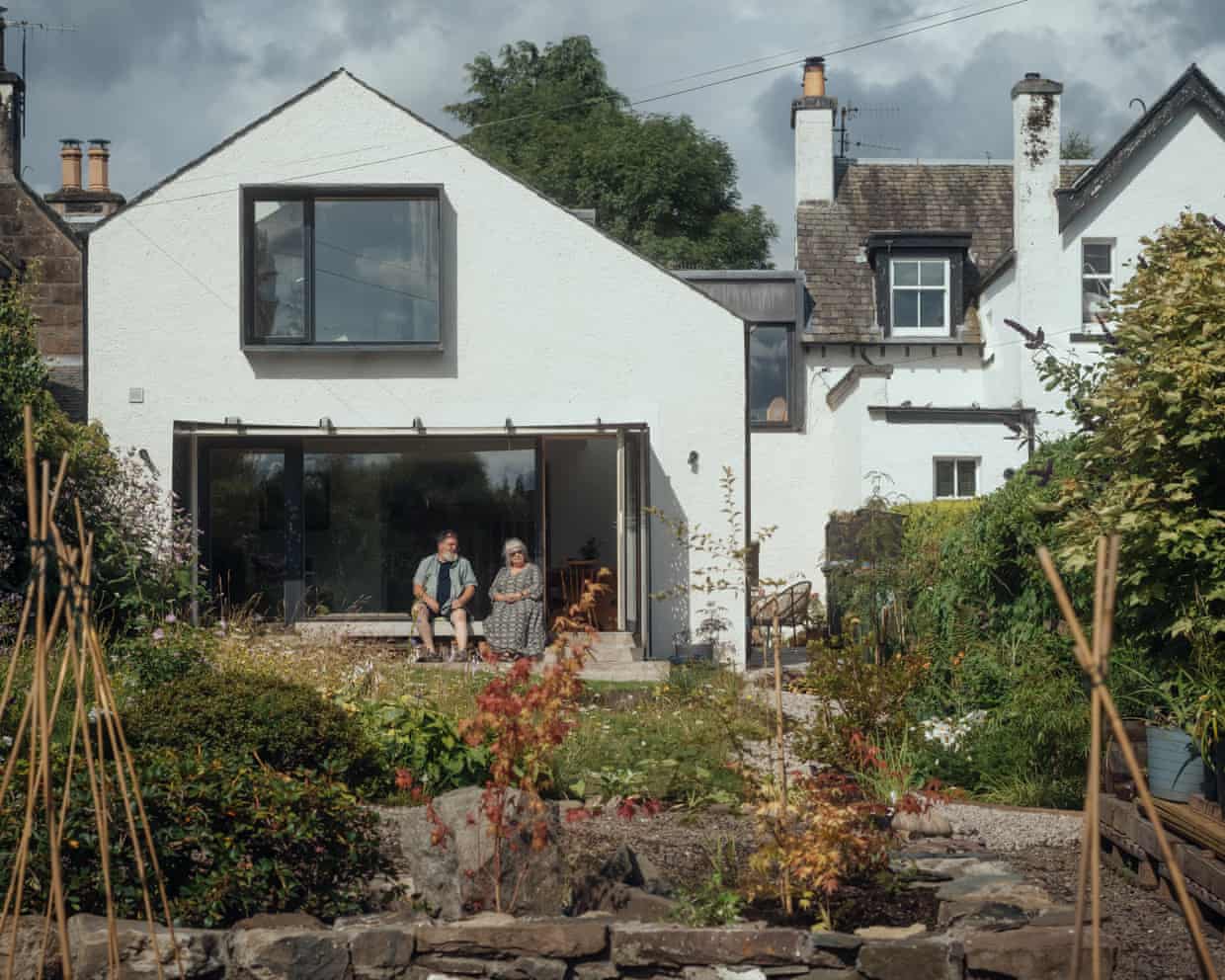
The yard of a cottage in Comrie, Scotland. More and more architects are designing for people with dementia — and their families.

People who want to stay in their homes to the end are braver than I am, and they are in the majority. I think the most impressive are those who are determined to care for a disabled loved one until they can’t manage anymore. I have known a few caregivers adapting to life with a dementia victim.

To help them do that, some architects are designing “dementia-friendly” houses. Charlotte Luxford writes at the Guardian about a home like that near Glasgow.

“Glaswegian retirees Jim McConnachie and Frances McChlery had always dreamed of building their own home with a waterside view, and had even toyed with buying a plot on Scotland’s west coast. However, when McChlery’s sister was diagnosed with young-onset dementia, they had to rethink their plans.

“ ‘The prospect and implications of supporting my sister-in-law became a key consideration,’ says McConnachie, ‘and we decided to build a home closer to the facilities of the city so she could live with us and be closer to extended family.’

“McConnachie embarked on a tour of Scotland’s lochs, but after making a pitstop at Comrie in Perthshire on a sunny day he passed a ‘for sale’ sign on the way out of the village that piqued his interest.

“ ‘Looking at the cottage from the street it was tiny and worn, but to the rear was a lovely south-facing garden that backs on to the River Earn,’ says McConnachie. Excited, he brought McChlery and her sister for a viewing. They both saw potential in the property and were charmed by the bustling village with its valley views and thriving community.

“Last used as a dental surgery, the 18th-century cottage didn’t have any insulation and suffered from water damage and structural decay. McConnachie, who trained as an architect, embraced the challenge of transforming it into a warm and adaptable home that could also accommodate extended family. ‘We wanted the house to remain flexible and welcoming as a family hub, while also ensuring Frances’s sister felt safe, independent and engaged,’ he says.

“McConnachie sought guidance from architecture firm Loader Monteith on maximizing the layout, navigating conservation area restrictions and incorporating dementia-friendly design principles. For example, accessible kitchen shelving to allow her sister to navigate the space with some independence and open views through living spaces, so she feels connected but not surveilled.

“[Director] Matt Loader … wanted to respect the ‘honesty’ of the original cottage, so the front two rooms were maintained as cosy living spaces, each with its own fireplace and lime-plastered walls.

“The kitchen is at the heart of the home, with a small courtyard … providing a sheltered spot for morning coffee. ‘The relationship between Frances and her sister is rooted in cooking, baking and gardening, so the kitchen and its connection to the outside spaces was key,’ adds Loader.

“A defining feature is the marble-topped island, crafted from a piece of stone passed down through the family. As both sisters are short, ‘the island was set low to allow Frances’s sister to help with baking and food preparation, which is an important occupational therapy,’ says McConnachie. …

“Seating [nooks] are a recurring theme; upstairs is a thoughtfully positioned window seat surrounded by shelves displaying ‘memory anchors’ Loader says: ‘Housing artefacts that hold historical significance can help those with Alzheimer’s recognize that this is their home, and it’s important to retain that sense of familiarity.’

“McChlrey’s sister’s living quarters have been sensitively designed to cater for her needs without making it feel at odds with the rest of the house. The upstairs landing also includes a small servery, complete with sink and washing machine, that is designed to facilitate social interaction while also aiding practical care. …

“On the ground floor, the front of the cottage is currently a home office on one side and a sitting room on the other, each with full-width sliding doors and sofa beds so they can be transformed into sleeping spaces when family visit or permanently if need be later.

“One of the biggest benefits of the layout, McChlery has discovered, is its ‘intervisibility,’ allowing her to keep an eye on her sister without making her feel she is under supervision.

” ‘The deterioration of people with Alzheimer’s isn’t predictable,’ says McConnachie. ‘The best-laid plans to leave clear space and simple-to-use facilities to allow for independence can be quickly taken over by the continuing onset of the condition, so it’s worth allowing space for supervised sharing tasks.’

“McConnachie ensured they left room for the introduction of fittings such as stair lifts and bathroom aids, as well as planning a simple and level route through the house – you can get from the front door to the garden without a step [up or down].

“ ‘Caring for another adult with dementia is very difficult emotionally and physically – the grief and injustice are always in the back of your mind,’ adds McChlery. ‘Everything about this house helps – it provides a beautiful and safe space that enables us all to be at home for as long as possible.’ “

More at the Guardian, here.

Read Full Post »

Photo: Nicholas J.R. White.
A night sky above a copse of trees on Guirdil Bay on the Isle of Rum in Scotland.

In the summer, when we are staying in New Shoreham, we can see the stars at night, including the Perseid meteor showers. But the rest of the year, newspaper alerts about cool things happening in the night sky are wasted on us. I would love to see, at least for a little while, what the residents of the Isle of Rum can see.

Kat Hill writes at the New York Times, “Rum, a diamond-shaped island off the western coast of Scotland, is home to 40 people. Most of the island — 40 square miles of mountains, peatland and heath — is a national nature reserve, with residents mainly nestled around Kinloch Bay to the east. What the Isle of Rum lacks is artificial illumination. There are no streetlights, light-flooded sports fields, neon signs, industrial sites or anything else casting a glow against the night sky.

“On a cold January day, the sun sets early and rises late, yielding to a blackness that envelopes the island, a blackness so deep that the light of stars manifests suddenly at dusk and the glow of the moon is bright enough to navigate by.

‘For this reason, Rum was recently named Europe’s newest dark-sky sanctuary, a status that DarkSky International, a nonprofit organization focused on reducing light pollution, has granted to only 22 other places in the world. With the ever-increasing use of artificial lighting at night, places where people can gaze at the deep, ancient light of the universe are increasingly rare.

“Rum’s designation is the result of a long, meticulous bid by the Isle of Rum Community Trust. The effort was led by Alex Mumford, the island’s former tourism manager, and Lesley Watt, Rum’s reserve officer, with the support of Steven Gray and James Green, two astronomers who started Cosmos Planetarium, a mobile theater offering immersive virtual tours of the night sky. Rum ‘stands for something greater,’ Mr. Mumford said, and aspires to be ‘a haven for others to experience the darkness and the Milky Way.’

“A seven-mile walk from Kinloch through the wild and empty heart of the island leads to a Greek-style mausoleum, built in the 19th century, above Harris Bay on the west side of Rum. Locals regard it as the best spot on the island to take in the night sky; on a cloudy night with no moon, one resident said, ‘you can’t even see your hand in front of your face.’ But this night was clear, and stars and meteors wheeled spectacularly overhead as the Milky Way drew a glistening smudge above the brooding mountains, Askival and Hallival. Venus, Saturn and Jupiter stood in a line above the mausoleum’s sandstone pillars.

“Plans are in motion to renovate an abandoned lodge nearby into a place where tourists could stay in their quest for celestial splendor. ‘What you are seeing is not just a 2-D map, but the four dimensions of space and time,’ Dr. Green said. ‘You are looking back into the past.’ …

“On Rum, human life is lived in the small pools of light that spill from windows or glow from headlamps. One key to attaining dark-sky sanctuary status has been to help residents adapt to and embrace the darkness. Porch lights are recessed into doorways and point down; the pier has LED lights, also pointing downward, that provide just enough illumination for marine safety; a shop’s outdoor motion-sensor lights come on only for a few minutes when needed. When the community trust started its sanctuary application in 2022, roughly 15 percent of homes and shops followed the lighting recommendations outlined by the initiative; compliance is now at 95 percent.

“The blackness of night provides more than a cosmic spectacle for humans to enjoy; it is also essential for the environment. ‘Low light levels are important for nocturnal species,’ Ms. Watt said. ‘And artificial lighting can influence the feeding, breeding and migration behavior of many wild animals.’ …

“Education — of adults and children, locals and tourists — is central to dark-sky awareness. Andy McCallum, a teacher on Rum, showed off the models and maps of stars and planets that his handful of students had designed.

“ ‘For our pupils, it’s a powerful reminder that although we live on a small island, we’re part of a vast and interconnected universe,’ he said. It made them proud, he added, to help preserve a unique environment for future generations.”

More at the Times, here. Wonderful photos.

Read Full Post »

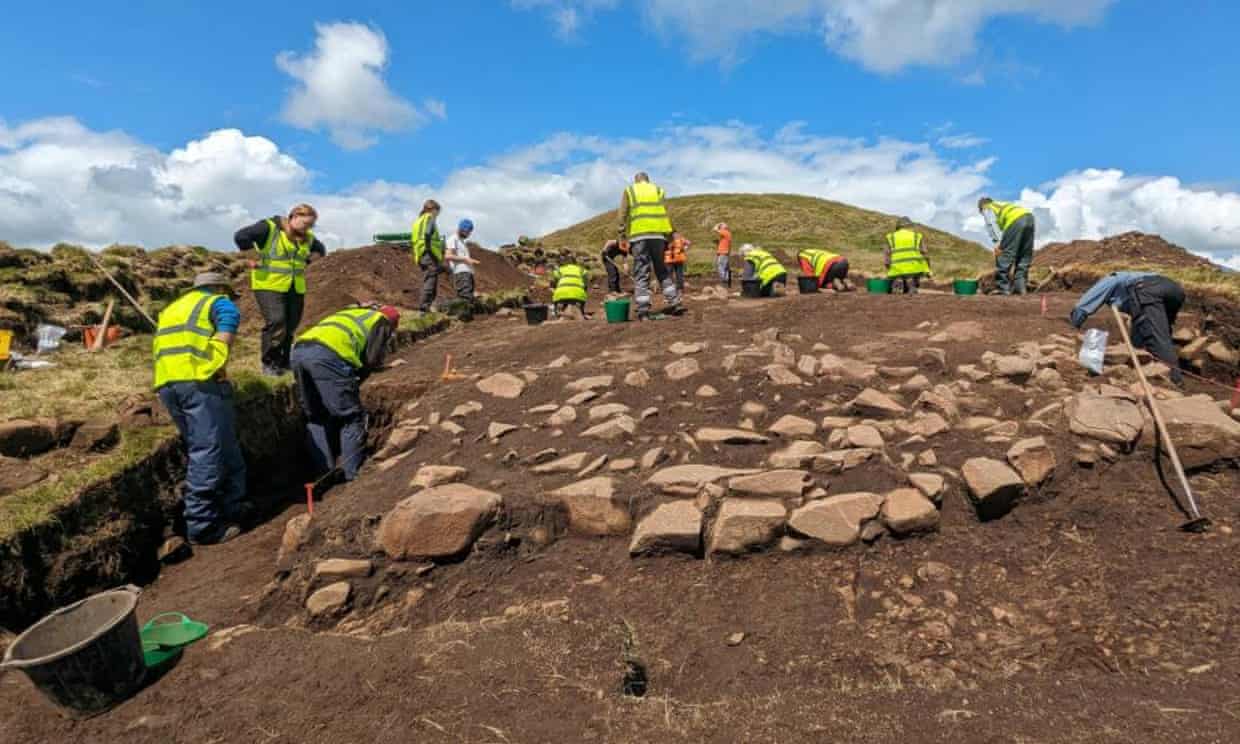
Photo: Gordon Noble, University of Aberdeen.
The community archaeological dig at the East Lomond hillfort site. 

Did you ever want to be an archaeologist? I think there was a period in childhood that it interested me, encouraged by gifts of picture books about the discovery of Knossos in Crete. But then I moved off in other directions.

Perhaps you had that experience, too, always wondering what it would have been like. Today there are opportunities to get a taste of that world as a volunteer.

Libby Brooks writes at the Guardian about the thrill of being a citizen archaeologist in Scotland.

“They were moving forward in a line across the 10 sq metre [~108 square foot] trench, volunteer excavators elbow to elbow with academics, and Joe Fitzpatrick was at the far edge.

“He was digging around the hearth of a building, about 60cm (2ft) below surface level, when he hit the earth twice with his mattock and out it popped – a rare bronze spear butt, a metal fitting placed over the end of a wooden shaft to counterbalance the spear head. Covered in Pictish inscriptions, it had remained buried for more than one and a half millennia, and was one of the most groundbreaking archaeological discoveries of 2024 in Scotland.

‘The hair stands up on the back of your neck and you tingle,’ says Fitzpatrick, of the moment he realized the significance of the find. ‘It is special.’

“Fitzpatrick, who has always had a passion for history, got involved with the regular community dig at the site of the East Lomond hillfort, beside the village of Falkland in Fife, as a retirement activity.

“He was working next to Prof Gordon Noble, the head of archaeology at the University of Aberdeen, who was leading the dig: ‘We just looked at each other,’ Fitzpatrick recalls. ‘Two men with their jaws hanging open, dumbfounded.’

“He helped unearth the artifact in July, during excavations organized by the Falkland Stewardship Trust and the University of Aberdeen, which bring together members of the public and students to help uncover settlement remains dating from around the second or third century AD to around AD700.

“He is one of a growing legion of citizen archaeologists, eager volunteers who are sustaining projects across the country even as volunteering more generally is in decline.

“Fitzpatrick says: ‘A lot of people who retire are more aware of keeping active and outdoors, but we also have young people working out what to do after their studies, and the media has broadened archaeology’s appeal with programs like ‘Time Team’ and ‘Digging for Britain’ – it’s not just Oxford dons doing it.’

“An ‘exceptionally rare’ find like the spear butt boosts team morale … says Noble. ‘Community involvement has really ramped up in the past 10 years,’ he says. ‘There’s the excitement of uncovering the past on your doorstep. These volunteers come from all walks of life.’ …

“Although Volunteer Scotland has warned that last year’s Scottish Household Survey results ‘point to a crisis in volunteering,’ for those participating in culture and heritage the numbers remain constant, compared with a drop of four percentage points elsewhere.

“Jeff Sanders, the head of outreach for the Society of Antiquaries of Scotland, says the cost of living crisis has affected individuals and their ability to participate, but also organizations and their capacity to put things on for volunteers. …

“As well as funding challenges, Sanders says there is a push to diversify volunteering – volunteers are often retirees with more disposable income. Sanders also works on the Make Your Mark campaign, which worked with the Scottish Refugee Council over the summer to co-design archaeology taster sessions to attract people who wouldn’t ordinarily get involved in volunteering.

“This ‘continuing upward trend’ in community involvement has prompted Emily Johnston to chart the citizen archaeologist phenomenon as part of her doctoral research at the University of Edinburgh. She has launched a database of community archaeology activities across Scotland, Outreach in Scottish Archaeology (OScA). …

“Says Johnston, ‘A lot of volunteers have been really interested in archaeology from a young age. It’s about creating a tie to your past and gives people a sense of identity.’ “

I love the idea of “taster sessions” for volunteers — in any field. I imagine more people would take on gigs if they knew there was no embarrassment about dropping out. They would keep trying things until they found the right opportunity for them. I tried volunteering with many ESL [English as a
Second Language] organizations until I found the right fit.

More at the Guardian, here.

Read Full Post »

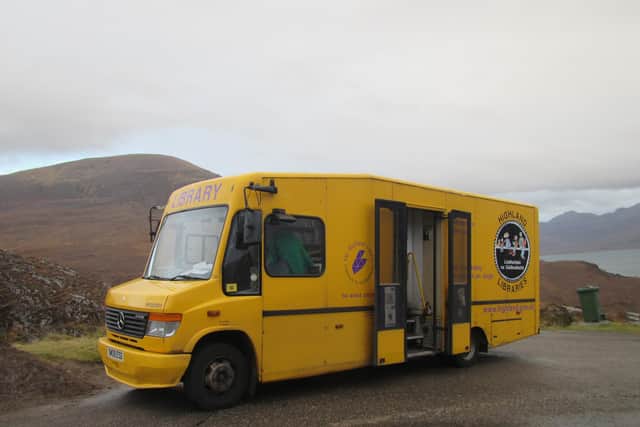
Photo: Scotsman.
A yellow mobile library in the Highlands. The fleet has dwindled from 10 to seven. Transit vans, with fewer books packed in crates, are now filling the gaps.

All over the world, fans of books and libraries have found ways to reach readers in largely inaccessible regions. We’ve had stories here about using camels, horseback riders, vans, carts, and more.

Today’s article from the Scotsman, bemoans the gradual disappearance of Scotland’s yellow library buses.

As Alison Campsie reported in June, “For those living in the most isolated pockets of the Highlands, the sight of the yellow library van coming into view has long been a welcome one.

“But now, concerns for the future of the mobile libraries have been raised after the distinctive vans – complete with desk and bookshelves – dwindle in numbers.

“Mr Preston said a fleet of 10 yellow mobile libraries – plus a spare – has now been reduced to seven vans. Of these, five are standard Transits, which are now packed with crates, carry fewer books and have to be loaded and unloaded.

“The librarian, whose yellow van did not return from the garage in April, said: ‘I am worried that the mobile library service will fizzle out and die.

“ ‘People love the service and they want to see it continue. A lot of the people I serve are single people living by themselves and they might not see people, apart from the postman, for two or three weeks and then the library arrives. …

“Megan MacInnes, a co-opted community councillor for Applecross, said the mobile library was ‘a hugely important service.

” ‘The range of demographics of folk who use it demonstrates that. We have to drive nearly an hour to get to the nearest library at Lochcarron. That is just not feasible for many.

” ‘Personally, I completely rely on the mobile library for my books and as a parent it has been hugely important in helping my son to read and become interested in books. The children at school love being able to use the mobile library and they come out with such a range, from history and geology to novels and cartoons and the latest David Walliams or Harry Potter.

“Everyone here is very aware of the financial pressures that Highland Council is under but when it comes to these lifeline services, we really urge them to be continued.’ We are so far from population centres that we really can’t afford for our outreach services to go.’ …

“A spokesperson from Highlife Highland said it was working with Highland Council, which owns the vans, ‘to better understand how such services can be delivered including accessibility and customer needs. This will also help to inform replacement fleet requirements and to establish specifications and costs.’

“A statement added: ‘High Life Highland is providing an alternative service for rural customers with the option of a drop-off of books to their homes to ensure that they have access to reading material and schools are also given the option of a drop-off of books to their building.

” ‘We recognise that mobile libraries are an essential part of life in the Highlands and while this service is not a like for like replacement, it may help to ease some of the difficulties for the most vulnerable and isolated service users during this time.’ ”

More at the Scotsman, here. PS, if you search this blog on “mobile library,” you could get enough material for a dissertation, almost! Mobile libraries are cherished all over the world.

Read Full Post »

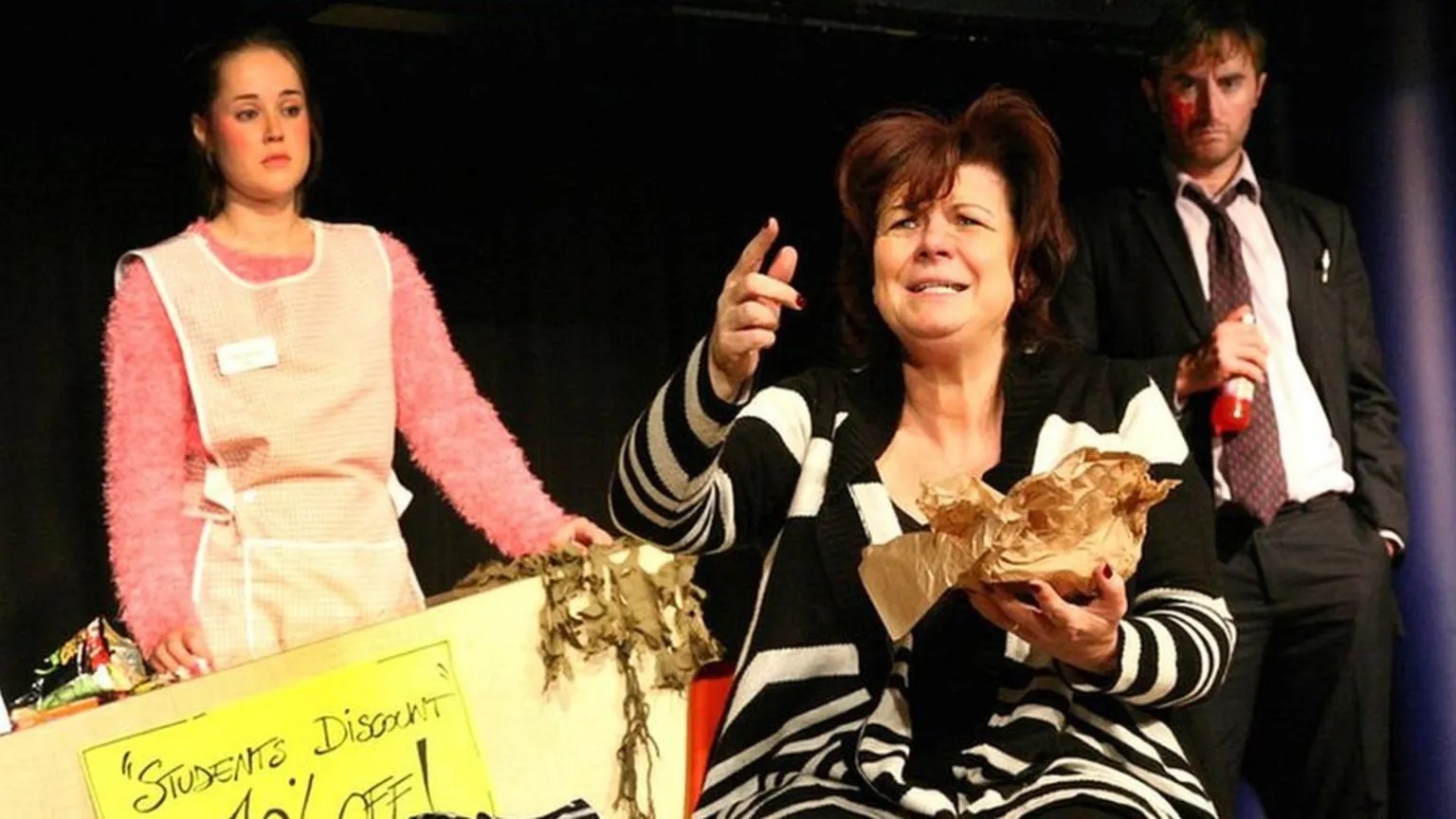
Photo: Lesley Black.
Theater company A Play, A Pie and a Pint produces up to 40 plays a year as well as two pantomimes in the Oran Mor venue in Glasgow, Scotland. Actor Elaine C Smith is pictured above.

I’m in the middle of reading a novel by one of my favorite mystery writers, Ian Rankin, who writes about Scotland. Besides his plots and characters, I love the Scottish slang. Sometimes I even have to look up expressions or words — Teuchter, Slainte, Howff. And it’s not just Gaelic words that are fun, but the Scottish way of putting English words together. For example, “getting mortal” means getting extremely drunk, smashed.

The murder mystery takes place during the offbeat theater festival known as the Fringe, which is why a recent BBC article about a Scottish theater group caught my eye.

Pauline McLean writes, “Established in 2004, A Play, A Pie and a Pint produces up to 40 plays a year as well as two pantomimes in the Oran Mor venue in Glasgow. It has given a platform to established names [and] has also helped new writers get a foothold in the industry, like Liam Moffat, whose play Jack opens the new season. …

“For Juliet Cadzow it is a bitter sweet moment. Her husband David MacLennan was the theatre director who came up with the idea. He died in 2014 after being diagnosed with motor neurone disease. …

“This is what he wrote at the time: ‘The actor Ralph Richardson once described acting as the art of keeping the audience from coughing. And Alfred Hitchcock said the length of a film should be directly related to the endurance of the human bladder. That’s why Colin Beattie and I started “A Play, A Pie, and a Pint.” ‘

“The first show was a play called Hieroglyphics, by Anne Donovan, author of Buddha Da. It was her first stage play. …

“Lunchtime theatre was already popular across Europe but the Scottish offer of a pie made it different, and brought its own challenges.

” ‘It was waiter service when it first started and everyone came and sat at long trestle tables and they were served their pie and It took time when it was busy,’ [actor Linda Duncan McLaughlin] says. ‘They wouldn’t have stopped serving before the play went up. So the waiters were trying to be quiet and and the audience were trying to be quiet but they were still eating.’

“But the concept quickly took off. ‘I think the fact that it was weekly helped,’ says Juliet. ‘If you didn’t like the play that was on that week, there would be a new one next week. And the audience were quite vociferous.

‘They would say to David “I didn’t like that one,” but they’d still come back the next week.’

“Those involved in the shows also liked the challenge of creating a 50-minute show with limited resources and rehearsals. Linda Duncan McLaughlin has written plays, as well as performing in them.

“She says: ‘You’ve got to get what basically is a full play into a fifty minute timeframe. You only have three actors, so if you wanted to write six parts, you’re going to have to be really good at writing doubling up parts and you have to make sure the actors can cope with that. It is limited but it’s a great discipline for a writer. And it really focuses your mind.’

“For some performers, it’s a chance to return to their roots, although Robbie Coltrane admitted his week long run in Peter MacDougall’s play My Father’s Old Suit in 2005 was a daunting one.

” ‘The idea of 500 Glaswegians drinking and having their dinner?’ he recalled in a 2010 documentary. ‘It’s like one of those Frank Sinatra concerts where all you can hear is the knives and forks clattering.’

“[Icelandic] writer Jon Atli Jonassan found the 2009 run of his play The Deep helped him into filmmaking. … ‘No one wanted to make it, but after the production here, we got interest from filmmakers. It was the most expensive film ever made in Iceland and was shortlisted for Best Foreign Film at the Oscars.’ …

” ‘If you’d asked us that first week, I’m not sure we would have been confident that we’d still be going twenty years hence,’ says Linda, who is co-chair of the Scottish Society of Playwrights. ‘It does offer an opportunity for new work to be on every week of the year for forty eight weeks of the year, which no other organization can offer. So it really does have a strong, vital part to play in Scottish theatre culture and long may it continue.’ “

More at the BBC, here.

Read Full Post »

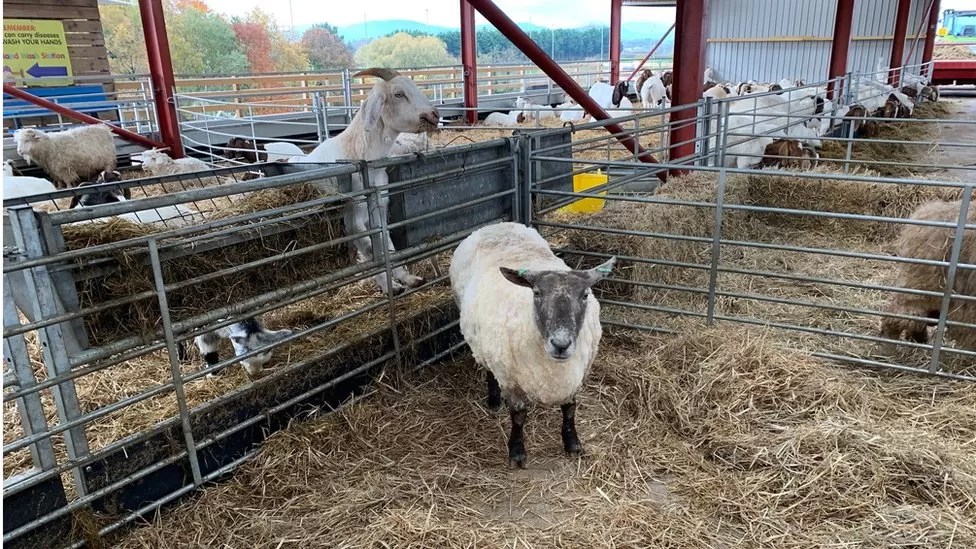
Photo: BBC.
Fiona was called the loneliest sheep, but having been rescued from another winter alone at the bottom of a cliff, she can now look forward to having friends.

You may have seen this story, but I couldn’t resist sharing it anyway. A sheep in Scotland had gotten herself into such an inaccessible spot that the Scottish equivalent of the ASPCA had given up the idea of rescuing her before winter. She was going to spend winter alone. Again. Then local sheep shearers decided that it just wouldn’t do.

Fiona needed first to lose 10% of her weight and become a bit easier to carry. Fortunately, shearers can make that happen.

Giancarlo Rinaldi reported at the BBC, “The sheep described as the loneliest in Britain is said to be settling in well to her new home. The ewe, now named Fiona, was rescued on Saturday after being stranded for more than two years at the foot of cliffs in the Scottish Highlands. …

“She arrived at Dalscone Farm ‘under cover of darkness’ on Sunday and is said to be in good condition.

“The sheep’s plight hit the headlines last month after a kayaker photographed her still trapped at the foot of a steep cliff at the Cromarty Firth, two years after a previous sighting. She was dubbed ‘Britain’s loneliest sheep’ and an online petition to rescue her attracted thousands of signatures.

“Plans to move her to the farm park in southern Scotland provoked a ‘peaceful, non-violent demonstration’ at the site amid concerns she would become a ‘spectacle.’

“Farmer Ben Best of Dalscone Farm said it had been a ‘stressful’ couple of days to get the sheep to Dumfries. [But] ‘she has settled in absolutely brilliantly. She has been eating, drinking. We couldn’t be happier with how she has settled in. …

” ‘Everything is transparent what we do – we are known worldwide for our animal care,’ he said. The farm section of the visitor attraction is currently closed to the public but it posts regular live updates on its Facebook page.

“Saturday’s rescue operation was led by professional shearer Cammy Wilson. He told BBC Radio’s Good Morning Scotland program, ‘I have never worked with a sheep as calm as she is. She has essentially had unlimited grass to eat for two years and she is what we would describe as fat in the sheep world.’ …

“Fiona weighed in at [200 lbs] without her wool, and the wool itself weighed [20 lbs].

“Mr Wilson said the wool was quite poor quality, but it was hoped it could eventually be made into something and used in a raffle for charity.

“He also explained the cinematic inspiration behind the sheep’s name. ‘I came up with the name Fiona because, several years ago now, the world was taken by storm by a sheep called Shrek in New Zealand who had been living alone in a cave,’ Mr Wilson said. ‘I thought Shrek is the male version of this situation so it has to be Fiona. It is also a good Scottish name.’ …

“He said they had waited until the ‘coast was clear’ to take the sheep to the farm park on Sunday night where he was confident she would be well looked after.

“Mr Wilson added: ‘She will live out the rest of her life down there at Dalscone, probably being better looked after than I will be.’ “

Yesterday, I heard rescue leader Cammy Wilson tell Marco Werman at PRI’s The World about being very nervous shearing Fiona at the bottom of the cliff because he knew that people around the world would end up seeing his skill on Facebook.

More at the BBC, here. And you can listen to the Wilson interview at PRI’s The World, here. Wilson’s delight is infectious.

Read Full Post »

Photo: Ann Nisbet Studio designed the house above to make it dementia- and age-friendly. In the kitchen, “there are large letterbox-type slots in the drawers and cupboards to allow someone with dementia to see that there are cups, plates, cutlery and food inside,” Homes and Interiors Scotland reports.

When I was at the Fed, I attended a couple Harvard conferences on housing for the aging. I learned about something called “universal design” and thought how sensible it would be if architects would always ensure that housing features worked for people at any stage of life. Why go to the expense and disruption of putting in wider doorways, higher toilet seats, shower grab bars, ramps, and the like down the road?

In today’s article, architects considered these issues, even taking into account the possibility of someone developing dementia.

Caroline Ednie  writes at Homes and Interiors Scotland, “ ‘We lost all our belongings in the fire and were left homeless,’ recalls Kathy Li, an architect who teaches at Glasgow School of Art. ‘It was pretty traumatic. But after the initial shock wore off, we realized that what was important to us wasn’t necessarily the house itself but its location. It’s close to a beautiful reservoir where you can swim or fish, and forests that are perfect for mountain biking or road cycling.’ …

“So Kathy and her partner Richie Elliot decided to stay on the site, initially in a tiny caravan and then in a larger one-bedroom static caravan. ‘It took five years to resolve with the insurance company and we lived in the caravan the entire time,’ recalls Kathy. …

“Eventually, with the situation settled in their favor, she and Richie could begin to think about replacing their home on the site. …

“ ‘We knew we didn’t want lots of little rooms. There are fantastic views right down the valley, and we wanted to take advantage of these and of the woodland at the front. There is a southerly aspect too, which then got us thinking about a low-energy building. It was time to start again. We had this chance to create a house for life.’

“She approached architect Ann Nisbet. …The brief was essentially for an energy-efficient one-bedroom house, flexible enough to suit both living and working, to be constructed using ‘harmless’ materials.

“An unusual but crucial part of the brief was that the house should be dementia- and age-friendly. Kathy’s mother and stepfather both had dementia, and she was keen to explore and incorporate design features that would make it easier for sufferers to live in the house.

In response, Ann Nisbet attended a dementia design course at Stirling University – one of the world’s leading centers for research into the syndrome.

“ ‘We were keen to take this information, which mostly looked at care homes and hospitals, and apply it to a domestic house in a design-led, non-institutional manner,’ the architect explains.

“ ‘Research shows that you read your surroundings differently if you have dementia – for example, two materials of similar monotonal color when read together will be viewed as the same object. We used this knowledge to try to create a navigation system throughout the building, while still keeping the material palette modern and minimal.’

“As a result, the door and window frames, floors, skirtings and walls are all tonally different. As for circulation, all the key areas of the building are visible from the connection lobby, which helps you navigate the floor plan and prevents confusion.

“Thought was given to the kitchen units too: there are large letterbox-type slots in the drawers and cupboards to allow someone with dementia to see that there are cups, plates, cutlery and food inside.

“ ‘Many people have experienced a close friend or family member being diagnosed with dementia, and as we live longer, the number of sufferers is increasing,’ says Fay Goodwin, project architect at Ann Nisbet Studio.

“ ‘This house demonstrates that buildings can and should be designed to enable people with the condition to live longer in their own home and to help them overcome the day-to-day challenges they face.’ “

More at Homes and Interiors Scotland, here. Check out the close-up of the ktichen cabinets with the see-through slots. No paywall.

Read Full Post »

Photo: BBC.
A group of women from the Western Isles of Scotland perform a Waulking Song while softening wool so it can be woven and made into clothes and blankets.

Have you ever heard of “wool waulking”? It was new to me — a step after shearing the sheep and before turning wool into something usable. It shows up in various parts of the British Isles, and in addition to the delightful idea of working together to prep wool, it involves a special kind of song.

As in the old photo above, the wool “is banged off of a table, or ‘waulked,’ in time to songs that take the form of question and answer type songs. One woman would sing the question and the rest of the group would sing the response.”

A blogger at the website Shepherd’s Dream opines, “One of the most powerful aspects of working with wool is how deeply connected the tradition is with our Ancestors. Learning the traditional ways that our Ancestors worked with wool is a powerful way to connect with the fabric in our lives. Reading about the history of waulking songs is one of those opportunities. …

“Waulking is another word for fulling, a step in woolen clothmaking that refers to the practice of cleansing the cloth to eliminate oils, dirt, and other impurities. Fulling involves two processes, scouring and thickening, and is one of the steps in creating melton cloth.

“Originally, fulling was carried out by pounding the woolen cloth with the fuller’s feet, or hands, or a club. In the Scottish Gaelic tradition this process was accompanied by Waulking Songs, Scottish folk songs which were sung to set the pace.

“One person led the group by singing well-known verses or making up new lines. The rest would then come in on the chorus while the leader took a breath. A fulling session usually began with slow-paced songs. The tempo only increased as the cloth softened. As the fullers sang, they gradually shifted the cloth to the left so as to work it thoroughly.

“In this tradition moving the cloth counterclockwise is unlucky. It is also bad luck to repeat a song during a fulling session, which explains the large number of songs and verses.

“Our washable mattress protectors are made out of our pure melton wool textile and our mattresses are encased in this historical material as well,” the blogger adds.

Wikipedia also talks about “fulling” and adds some surprising details.

“Fulling, also known as tucking or walking (Scotswaukin, hence often spelled waulking in Scottish English), is a step in woollen clothmaking which involves the cleansing of woven cloth (particularly wool) to eliminate (lanoline) oils, dirt, and other impurities, and to make it shrink by friction and pressure.

“The work delivers a smooth, tightly finished fabric that is isolating and water repellent. Well known examples are duffel cloth, first produced in Flanders in the 14th century, and loden, produced in Austria from the 16th century on.

“Waulking could be done with the hands and feet. In Medieval Europe, it was done in water-powered fulling mills. After the industrial revolution, coal and electric power were used.

Felting refers more generally to the interlocking of loose wool fibers; they need not be spun and woven first.

“Fulling involves two processes: scouring (cleaning) and milling (thickening). Removing the oils encourages felting, and the cloth is pounded to clean it and to encourage the fibers to felt, so in practice the processes overlap.

“Urine was so important to the fulling business that it was taxed in Ancient Rome. Stale urine, known as wash or lant, was a source of ammonium salts and assisted in cleansing and whitening the cloth and having its fibers intertwined.

“By the medieval period, fuller’s earth had been introduced for use in the process. This is a soft clay-like material occurring naturally as an impure hydrous aluminium silicate. Worked through the cloth, it absorbs oils and dirt. …

“The second function of fulling was to thicken cloth by matting the fibres together to give it strength and increase waterproofing (felting). … After this stage, water was used to rinse out the foul-smelling liquor used during cleansing. Felting of wool occurs upon hammering or other mechanical agitation because the microscopic scales on the surface of wool fibres hook together, somewhat like hook and loop fixings. …

“There are several Biblical references to fulling (2 Kings 18:17Isaiah 7:3 and 36:2Malachi 3:2Mark 9:3). …

“Scotland, then a rather remote and un-industrialized region, retained manual methods into the 1700s. In Scottish Gaelic tradition, this process was accompanied by waulking songs, which women sang to set the pace.”

More here, at Shepherd’s Dream, and here, at waulk.org. No firewalls.

Read Full Post »

Photo: Emily Turner.
Emily Turner (pictured) planned to take 16 buses in total, traveling exclusively by buses that fall under the government’s £2 [$2.40] local bus program. 

The other day, a friend asked me what I will do if I decide to give up driving: for example, how will I get to the Providence grandchildren from Massachusetts. Public transportation, I said. It will take all day, and I’ll have to go there less often and stay longer, but it’s doable. I’ve tested it.

Because public transportation in the US is not the best, I think you really have to reorganize your life around using it. And you have to assume everything will take a lot longer. But what’s the hurry?

Here’s a woman in the UK who decided to test how far she could go just using public buses. She’s been buoyed by all the people following her adventure on social media.

Sophie Zeldin-O’Neill reported last month at the Guardian, “A British woman undertaking an epic three-day expedition from London to Scotland using only local buses has expressed her surprise at the level of support from thousands of people following the chronicles of her journey on Twitter.

“Writer and podcast host Emily Turner, from London, began her nearly 400-mile journey in the early hours of [Feb. 10], announcing on Twitter: ‘I’ve been wanting to do this for YEARS!!’ …

“She plans to arrive at her destination, Edinburgh, on Sunday, taking 16 buses in total, and traveling exclusively by those that fall under the government’s £2 [$2.40] local bus program. …

“Turner, who hosts the Roundel Round We Go podcast about the London underground, planned her trip to coincide with her 35th birthday on Friday, and is attempting to keep the total cost under £35 [$42].

“On Friday night, she tweeted: ‘And that concludes my 35th birthday. When my mother turned 35, she was about to give birth to me, but I feel like today I have given birth to a whole Twitter bus lover community, so to each their own.’

“In response to one Twitter user who commented ‘I bet it’s going to cost more than a single megabus ticket,’ Turner replied, ‘Oh definitely! It was more about the journey than saving money.’

“Upon arriving in Leeds, she explained some of the background to her penchant for public transport, saying: ‘Leeds is a city I’ve spent about three weeks in previously. They were while I was doing intensive teacher training, and I was spending a lot of time with large groups of people, which I found exhausting, so I’d escape and go ride buses.’

“Thousands of people around the UK have followed her account before and during her journey, providing tips and encouragement – and sharing their own bus-related anecdotes. One Twitter user said: ‘Looks like you passed my house on the Stagecoach 59 from Barnsley this morning. Wish I’d known, I’d have got you a coffee and a sandwich from Noble’s at Busy Corner.’ …

“Turner has been compiling a bus-themed playlist, with songs including Erica Banks’ ‘Buss It’ and ‘Vengabus’ by the Vengaboys.

“In response, she has been offered tips for audio accompaniments to the voyage: ‘I hope you liked the 16-minute @GratefulDead song I recommended earlier,’ said one follower. ‘If you’ve got another long bus ride still to come, I’ve got a 30-minute one ready for you.’

“A newer follower added: ‘Very much enjoying the @ETWriteHome bus tour … I did a similar hitchhike to Paris from Edinburgh in 2010. If you can muster the energy down to @NewbarnsBrewery when you make it to Edinburgh there will be a drink on the bar for you.’

“Despite trying to adhere to a strict schedule en route to Scotland, Turner’s journey has been disrupted and delayed at various points. On Friday, she boarded an unplanned bus at Luton, and on Saturday, she got stuck after her card was declined – something which, it transpired, was because she had carried out more than the permitted number of Apple Pay transactions in a single day.

“At the time of writing, Turner is in Newcastle. She plans to get the train back to London on Sunday evening.”

Have you had public transportation adventures worth sharing? I seem to recall that blogger Asakiyume tweeted that her son had planned a similar trip in the US. And the reason I learned that public transportation to and from Providence was doable was a blizzard.

I left my car in the Amtrak garage in Providence and trained it to South Station in Boston. From there, I took the subway to Porter Square, Cambridge, and hung around for the commuter rail to my town. When I got to town, I walked across the snowy street to my house, a block from the train.

It was the only moment I needed my snow boots.

More at the Guardian, here.

Read Full Post »

Photo: Musicians In Exile.
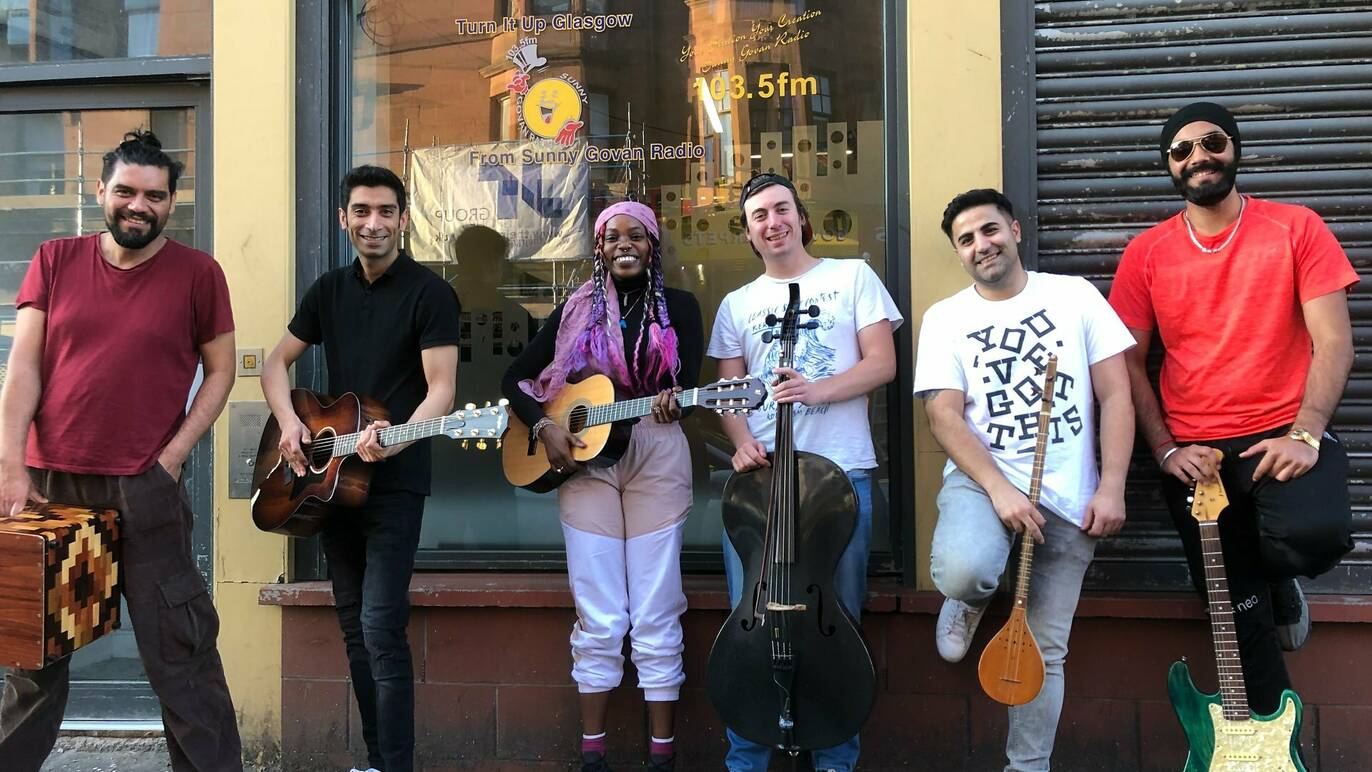
The Glasgow Barons.

When musicians bring their music to a new country, they influence and enrich the local music scene while healing themselves from the trauma of uprooted lives. Consider Musicians in Exile, a refugee orchestra in Scotland. Malcolm Jack wrote about it for Time Out.

“When Angaddeep Singh Vig arrived in Glasgow from India as an 18-year-old asylum seeker in January 2020, without any of his beloved musical instruments, he remembers feeling like ‘a guy without a soul.’ …

” ‘Music is part and parcel of my life,’ he says, and it has been ever since his father bought him a set of tabla hand drums aged just four. By his mid-teens Singh Vig had mastered not only that instrument but also the harmonium and flute, as well as singing. He had even begun teaching music. But when he and his parents were forced to flee India due to violent persecution by criminal gangs, they left with next to nothing, arriving in a strange and faraway land unable to work, study or begin rebuilding their lives.

“More than two years later, Singh Vig lives with his mother and father in temporary accommodation in Govan, as they continue their long and agonizing wait for leave to remain in the UK. But thanks to Musicians In Exile – Glasgow’s asylum seeker and refugee orchestra – he has got his soul back, and then some.

“Started in 2019, the project is the brainchild of Paul MacAlindin, a freelance conductor who has worked with orchestras and ensembles all over the world, from the New Zealand Symphony Orchestra to the Armenian Philharmonic and the Düsseldorf Symphoniker. From 2009 to 2014, MacAlindin was music director of the National Youth Orchestra of Iraq – a maverick mission to help young musicians in the country pull themselves out of the horrors of war. ‘And it worked,’ he says, ‘until the invasion of Islamic State.’

“The orchestra collapsed, and so did MacAlindin, ‘mentally and physically,’ he says, ‘because after investing all the energy of keeping that thing alive and then having it stopped in such a dramatic fashion, I was just left completely floored.’ He moved back to his native Scotland to heal, choosing Govan purely as a cheap place to put a roof over his head. There, quite by luck, he suddenly found himself among the diverse and in many cases displaced communities of the former shipbuilding district on the south bank of the River Clyde – which is also the location of a branch of the Home Office, and thus is home to a lot of asylum seekers and refugees.

“MacAlindin founded The Glasgow Barons – an award-winning ‘regeneration orchestra’ set up to help revitalize Govan through performances in local venues by musicians of all backgrounds. Musicians in Exile grew out of that, as a way of helping to give musician asylum seekers and refugees in the area a chance to gather every Tuesday evening to sing, play and share their talents, experiences, stories and songs. …

“If members don’t have instruments, then MacAlindin – who receives funding from the People’s Postcode Trust, the Robertson Trust, and Creative Scotland Lottery – sources and buys them one, however rare it may be (he’s currently in the market for an Albanian two-string plucked instrument called a çifteli).

During lockdowns, when sessions had to be moved online, he also helped his members to buy digital devices and access to the internet so they could keep communicating and playing together.

“Through Musicians in Exile, as well as the generosity of others in his local community, Singh Vig now not only has a tabla again, but also a harmonium, a violin, a mandolin and an electric guitar (which he quickly learned to play, despite never having touched one before). ‘Now I’ve got many souls,’ he laughs. His father and mother, who are also musicians, come along to sessions too – Singh Vig credits it with helping to pull them both out of a deep malaise and, in his father’s case, even clinical depression.

“Singh Vig and Musicians In Exile have played several high-profile concerts. They included … a pre-recorded video performance for the opening of the new parliamentary session in October 2021. It was broadcast in the chamber to an audience of dignitaries including, among others, The Queen. Singh Vig was impossible to miss, sat at the centre of the ensemble in a bright red turban and denim jacket. ‘The Queen is watching me,’ he remembers thinking. ‘I cannae believe it.’ “

More at Time Out, here.

Read Full Post »

Photo: Murdo MacLeod/The Guardian.
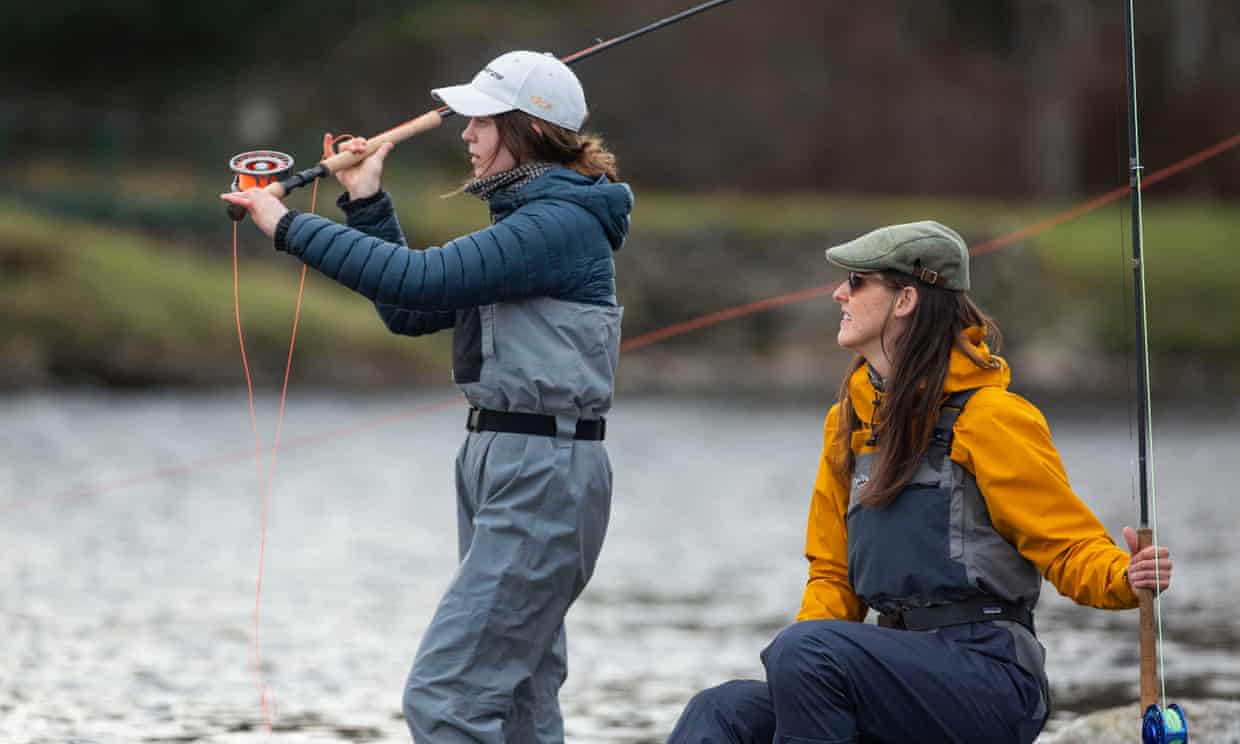
Camryn Stewart, 14, and Naomi Bell (right) open the salmon season on Scotland’s River Dee with the first casts.

So many good people trying to make the world better! Each one has their own area of action. It may be health, sports for kids, peace, housing, justice, the environment, art, teaching school. You name it. Today’s story is on people doing something about the effects of global warming where they live — along Scotland’s rivers.

Severin Carrell reports at the Guardian that “millions of trees are being planted beside Scotland’s remotest rivers and streams to protect wild salmon from the worst effects of climate heating.

“Fisheries scientists have found rivers and burns in the Highlands and uplands are already too warm in summer for wild Atlantic salmon as they head upstream to spawn, increasing the threat to the species’ survival.

“Fisheries on the River Dee in Aberdeenshire, one of the country’s most famous salmon fishing rivers, have planted 250,000 saplings along key tributaries. They plan to plant a million in the Dee’s catchment by 2035. …

“In 2018, the year Scotland recorded the lowest rod catch for salmon since records began, climatic changes meant water temperatures in 70% of salmon rivers were too warm for at least one day that summer. They exceeded 23C [73.4 Fahrenheit], a temperature that induces stress and behavioural change. …

“Marine Scotland scientists found that only 35% of Scotland’s rivers, which stretch for 64,000 miles (103,000km), have adequate tree cover.

“Lorraine Hawkins, the river director for the Dee District Salmon Fishery Board, a statutory body, said: ‘These rivers and burns are the nursery grounds for young fish and it’s the young fish which will be affected by summer temperatures – their feeding and growth rates are affected. If it gets hotter, we will see fish dying.’

“Fishery boards across Scotland have similar tree-planting programs, to provide essential shade to lower water temperatures. Many will be fenced off to prevent the saplings from being eaten by deer. Hawkins said these projects improved the overall health and biodiversity of rivers across the uplands, increasing insect life, leaf fall, managing essential nutrients and flood control.

“Alan Wells, the director of Fisheries Management Scotland, an industry body, said climate forecasts were clear that water temperatures would continue to climb, even if governments succeed in limiting climate heating. …

“He said, ‘This will get worse. We need to grow trees now to create that cooling shade.’

“The dramatic decline in wild salmon numbers is blamed on numerous factors: climate change affecting food availability; weirs and other obstructions in rivers; predation by soaring seal populations; sea lice attracted by fish farms; bycatch by trawlers at sea and poor river quality. Wells said that while Scottish ministers were proposing new conservation strategies, he remained frustrated with the slow pace of change.

“The Dee marked the start of its angling season [in February] by inviting two female anglers who won a fundraising competition last year to make the first cast, an annual ceremony at Banchory. …

“Camryn Stewart, 14, one of the first cast fishers, said she had been brought up fishing by her parents, Deirdre and Jim. The sport is targeting women and children as it strives to expand its participation and appeal. …

“ ‘I have been surrounded by people who fish, and I’ve wanted to fish all my life,’ she said. ‘We need more people fishing. … We gain so much from it. Just being outside and being in the wild. Even if you don’t catch anything, you come back from the day fulfilled.’ ”

More at the Guardian, here. No firewall.

Read Full Post »

Photo: Dougie Barnett/NatureScot.
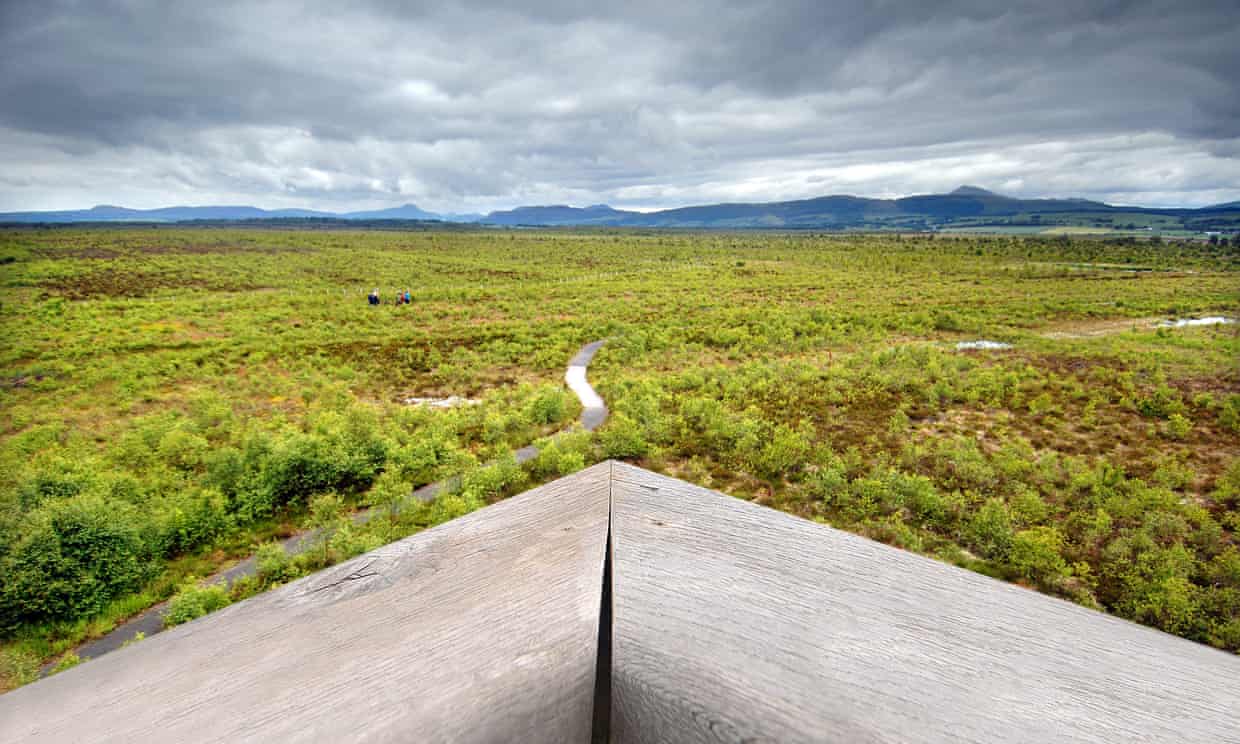
Flanders Moss in Scotland has seen the return of key bog plants such as sphagnum (peat moss) and cottongrass — so important now that we know bogs can store the carbon we don’t want in the atmosphere.

My father-in-law sold peat moss, among other agricultural products, for his entire career. He usually got the peat from Canada, although other people source it from places like Germany and Ireland. In Moat, Ireland, our friend James Hackett relied on peat for warming the house. (Burning it was not the best thing for his health.)

Today’s story is about Scotland’s heightened focus on protecting peat bogs so they can store carbon and fight global warming.

Phoebe Weston reports at the Guardian, “Flanders Moss bog is slumped on the flat, farmed landscape of the Carse of Stirling in Scotland like a jelly fungi. It wobbles when you walk on it, and a metal pole goes down eight metres before reaching hard ground. This lowland-raised bog is a dome of peat fed mainly by rainfall and it acts like a single organism – the whole thing has to be looked after for any part to be in really good shape. If it is drained in one area it will affect the water level across the entire bog.

“For much of human history peat bogs have been thought of as wastelands. This 860-hectare [~2,200 acres] site has been hacked away and drained since the early 1800s to make space for fertile farmland below. …

“It is now recognized that peat bogs are among the greatest stores of carbon and, after decades of restoration, the holes in the peat at Flanders Moss have been patched up. Areas that used to be purple with heather are turning green as key bog plants such as sphagnum (peat moss) and cottongrass come back. The bog rises out of the land like a sponge and ‘breathes’ as changes in the weather and water level cause it to swell and contract.

“Researchers in Scotland are tracking ‘bog breathing’ using the latest satellite technology that can detect just a few millimetres of change. … Thanks to the restoration work, the water table has risen [and] is now at the surface. As the bog draws in water from the surrounding land, it helps manage flood risk. Flanders Moss bog has removed [about 2,200 acres] from the Forth catchment, reducing flooding downstream. …

“The Scottish government-funded Peatland Action project, which started in 2012, is helping revive 25,000 hectares [~61,776 acres] of degraded peatland. In 2020, the Scottish government committed [about $300 million] over 10 years to bog restoration in a bid to lock carbon in the land. …

“It takes about a month to process the satellite data for a third of Scotland, which is available through the Copernicus Open Access Hub. The technology is still in development but is likely to be cheaper than ground-based mapping. …

“Despite these restoration efforts, Flanders Moss is still a net emitter of carbon. … Stopping these emissions and preventing further degradation are the primary objectives of the restoration project.

“Bogs work on a different timeframe than humans. They form slowly … taking up to 1,000 years to grow one metre. But [David Pickett, who manages the site with his National Nature Reserve] team has jump-started recovery. ‘We’ve done most of the big work here,’ he says. ‘Now, it’s a question of waiting. The process of fixing this site will last 100 years, and the benefits of work being done now will only be seen by the next generation.’

“It’s easy to see why bogs weren’t popular. They are stores of partly decayed organic matter, which are too acidic and devoid of nutrients to support healthy trees. But this bog is colorful and has a fresh, earthy smell. As well as being a fantastic store of carbon, this ancient, watery land – healthy peat is about 90% water – is also rich in wildlife, including rare lizards, dragonflies and even snakes.

“ ‘There isn’t headline sexy stuff like puffins and seals but you go around the boardwalk and it’s a fantastic place,’ says Pickett. ‘I always used to think bogs must have been named on a Friday after a really bad week. We’re trying to change the perception of bogs but it’s a hard sell.’ ”

More at the Guardian, here.

Read Full Post »

Photo: SGW3 Club.
Glasgow club recycles dancers’ body heat for energy.

Today’s dance article was written by my former boss’s daughter, Margaret Fuhrer, in December, after the environmental summit in Scotland. (Her father was a wonderful boss, by the way, and a good sport. His daughter’s dance-writing career has roots in her childhood Nutcracker performances in which he gamely played Mother Ginger.)

Fuhrer reports at the New York Times that a club in Glasgow is using the heat from dancers’ bodies as alternative energy to power the building.

“At SWG3 — an arts center in Glasgow, Scotland, that hosts some of the city’s largest dance parties — tickets for club nights sold briskly during the summer and fall of 2021, before the arrival of the Omicron variant. ‘The appetite for these events has been stronger than ever, and it’s fueled by the long period of time we were all denied it,’ said Andrew Fleming-Brown, SWG3’s managing director. ‘We’ve missed that shared body-heat experience, being packed together in a full venue.’

“What if dance-floor catharsis could be good not only for the soul but also for the planet? This month, SWG3 and the geothermal energy consultancy TownRock Energy will begin installing a new renewable heating and cooling system that harnesses the body heat of dancing clubbers. The plan should eventually reduce SWG3’s total carbon output by 60 to 70 percent. …

“There is poetry in the idea: the power of dance, made literal. ‘Conversations about sustainability can be pretty abstract,’ said David Townsend, the founder and chief executive of TownRock. ‘But if you can connect it to something people love to do — everyone loves a dance — that can be very meaningful.’

“A mutual friend introduced Townsend and Fleming-Brown in 2019, after Fleming-Brown expressed interest in exploring low-carbon energy systems for SWG3. Townsend, 31, is a regular on the club scene and had been to the location several times. …

” ‘Trying to do a geothermal well would have [cost millions],’ Townsend said. ‘Instead, we thought, why not collect the heat you’ve already got in your customers and then use the ground to store it?’ …

“Dr. Selina Shah, a specialist in dance and sports medicine, said club dance floors can be especially good at creating heat. ‘If it’s really high-energy music, that generally results in very fast and high-energy movement, so you’re looking at a significant level of heat generation — potentially even the equivalent of running,’ she said.

“To capture that energy at SWG3, TownRock developed an application for an already widespread technology: the heat pump. … The SWG3 system, called Bodyheat, will cool the space by transferring the heat of dancing clubbers not into the atmosphere, as in conventional cooling, but into 12 boreholes approximately 500 feet deep. The boreholes will turn a large cube of underground rock into a thermal battery, storing the energy so it can be used to supply heat and hot water to the building.

“Development of the system began in 2019. Pandemic shutdowns, and the financial uncertainty that came with them, paused the project for several months. But with their events calendar emptied, SWG3 leadership had time to develop a larger sustainability plan for the building, setting the goal of achieving ‘net zero’ carbon emissions by 2025. ‘That moment allowed us to pause and really assess what’s important to us as an organization,’ Fleming-Brown said. ‘We decided to make it a priority.’

“Bodyheat became a central component of the plan when work on the project resumed in fall 2020. The first phase of installation should be complete by early spring [2022], and will provide heating and cooling to SWG3’s two main event spaces. Later phases will offer hot water to the bathrooms and heating to the foyer and art studios. At that point, SWG3 will be able to get rid of its three gas boilers, reducing its annual carbon output by up to 70 metric tons.

“The system is not cheap. … Glasgow’s hosting of the 2021 United Nations global climate summit created ‘a lot of momentum behind this kind of project,’ Fleming-Brown said. A grant from Scotland’s Low Carbon Infrastructure Transition Program covered half of the costs for phase one, and a government-backed low interest loan helped with the rest.

Fleming-Brown estimates that savings on energy bills will make the investment recoverable in about five years. …

“Dancing has been used to generate energy before. More than a decade ago, the Dutch company Energy Floors introduced a line of tiles that convert dancers’ steps into electricity. Club Watt in Rotterdam installed the tiles to media fanfare in 2008, and they have since been used in hundreds of other projects. …

“Kinetic dance floors make only small quantities of electricity. Bodyheat should have a more meaningful impact on carbon output, though broadly speaking, dancing isn’t a very efficient way to make body heat. … Gyms, with their emphasis on aerobic exercise, seem like more obvious fits for projects that harness the work of the body. Townsend mentioned that in addition to capturing body heat, gyms could use equipment like stationary bikes to help generate electricity.

“Dancing may not be the best source of renewable energy, but it has proved important in another way: storytelling. There is something vaguely grim about harvesting heat from gym rats pumping away on treadmills. Energy born of dancing — born of joy — captures the imagination in a different way. …

“To help tell the Bodyheat story to the crowd at SWG3, Fleming-Brown and Townsend are considering ways to illustrate the amount of heat dancers create, perhaps with a large thermometer, or a heat map similar to those used on weather reports.”

More at the Times, here.

Read Full Post »

Photo: Andrew Milligan/PA.
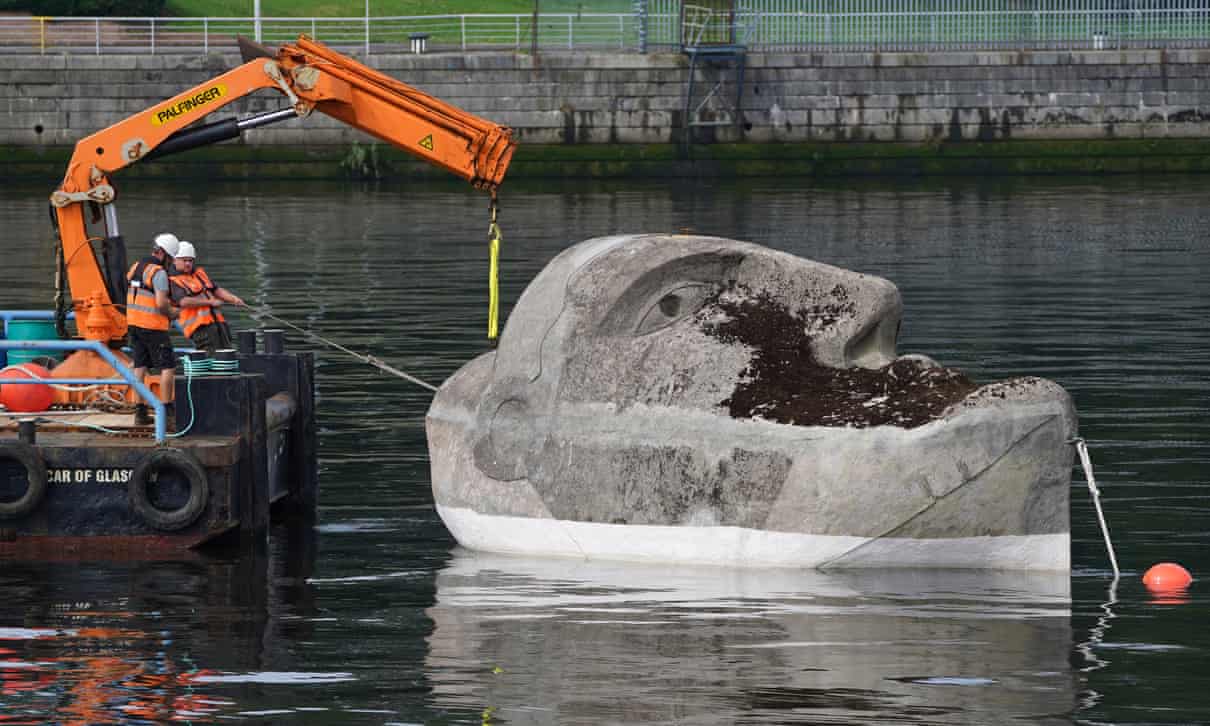
The giant head is grafted onto the hull of a boat and made up of a steel framework and cement. Forgotten after a Glasgow festival in the 1980s, it was sought out by sculptor Richard Groom’s family after his death.

Artworks may be forgotten when no one connected to the artist thinks they are worth keeping track of. It wasn’t until mourners at the funeral of UK sculptor Richard Groom told family members how well they remembered the giant floating head he once made that the family decided to find out what happened to it. Libby Brooks has the story at the Guardian.

“Bobbing in the water in the Canting Basin, by the shiny crescent of the Glasgow Science Centre, the Floating Head remains impassive as a seagull lands on its broad forehead. The seven-metre-long, 26-tonne buoyant sculpture could be a refugee from Easter Island, brought to the Clyde by the tide, only to have a bird peck at the moss covering its cheek and chin like a lopsided beard.

“In fact, it was commissioned from the artist Richard Groom as the centrepiece of Glasgow’s 1988 Garden festival, but then lost for decades – forgotten and unclaimed in a boatyard until a dogged relocation and restoration project brought it back to the spot where it started, three decades later.

“It was a conversation at the artist’s funeral in 2019 that inspired his family to seek out the sculpture.

“His brother Andy Groom said: ‘Myself and my family were so touched at Richard’s funeral where so many of his friends and colleagues commented on all of his work, especially the Floating Head. It became apparent very quickly we had to find it, fix it, float it.’

“Working with the Sculpture Placement Group (SPG), an organisation that aims to bring sculpture to different audiences, the family discovered the head had been stored at the Clyde Boat Yard for more than a decade after being rescued from another dock site where it was about to be bulldozed.

‘We had no idea whatsoever where it was,’ said Groom. ‘It was listed as abandoned on the banks of the Clyde, so I started phoning round scrap and storage yards asking: do you happen to know where a 30ft concrete head might be?’

“The head, which is grafted on to the hull of a boat and made up of a steel framework with a concrete render, was then partially restored – some graffiti was removed, but the natural weathering, and the encroaching moss, remains.

“Kate Robertson, the co-director of the SPG, said: ‘People still remember the Garden festival as a big highlight, they were aware of the focus on Glasgow and the visitors, and it also marked a turning point for the city from post-industrial to a cultural destination.’ … The Garden festival site began the redevelopment of the once booming dry docks that had become a symbol of an industry in permanent decline.

“With an official launch later this month, the head will feature at Glasgow Doors Open Days festival, forming part of a sculpture trail through Govan, while Groom’s family and the SPG seek a permanent mooring. …

“ ‘The scale of it is quite intimidating,’ Robertson said. ‘The best way to see the possibilities there are for the sculpture is to bring it out into public view again.’ ” More at the Guardian, here.

Although I don’t know what ideas the artist himself intended to emphasize with the floating head at the festival, it certainly brings home to me that Glasgow is a city on the water. Fort Point Channel features floating art, too (for example, here). It reminds viewers not only that much of Boston was salvaged from the ocean, but that rising seas want it back.

Read Full Post »

Older Posts »