Feeds:
Posts
Comments

Posts Tagged ‘sea turtle’

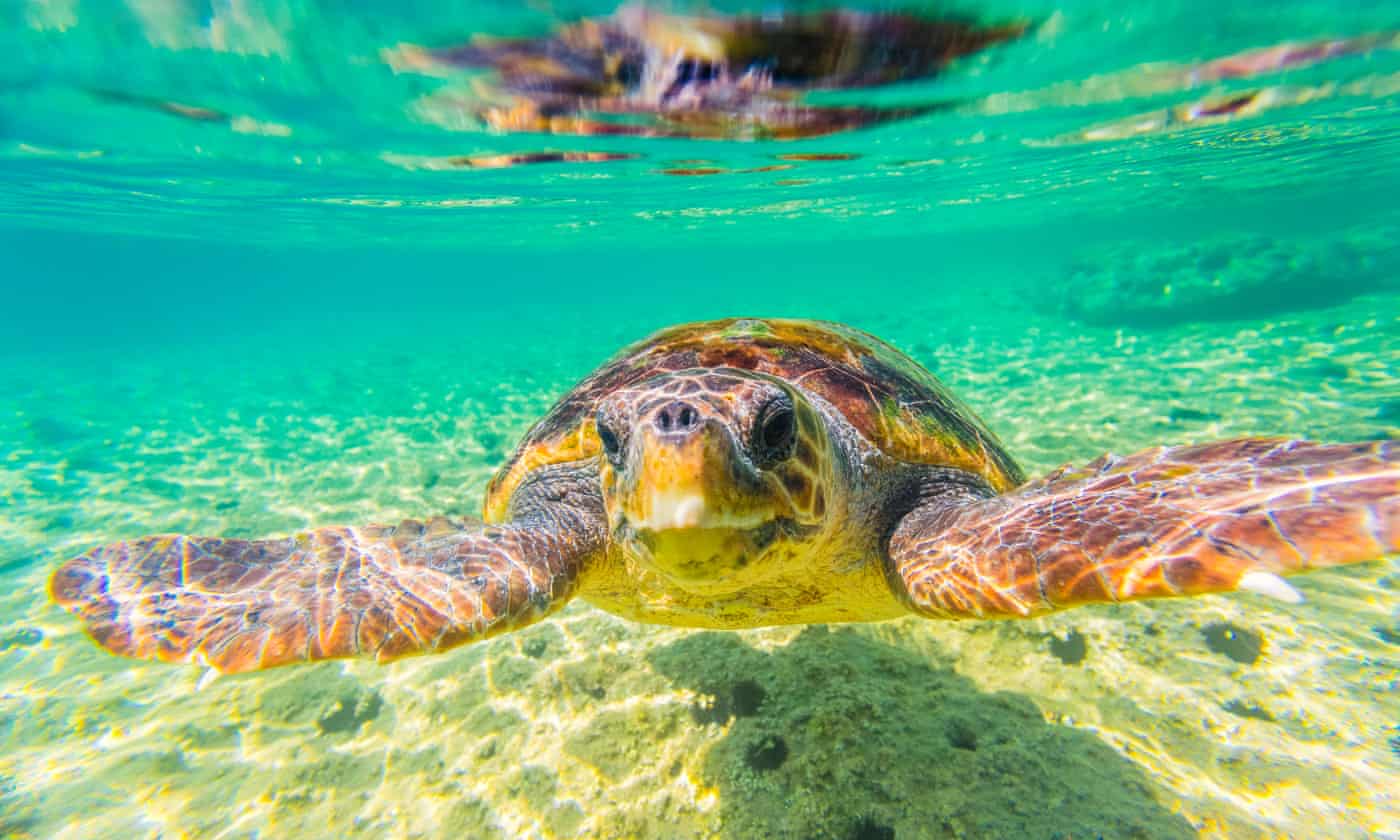
Photo: Giacomo Augugliaro/Getty Images.
A loggerhead turtle (Caretta caretta) off Elafonissos island in Greece, where the rebound in population has been called “phenomenal.”  

Today’s article is about the resurgence of turtles in Greece. But before I get into it, I need you to indulge my current train of thought about turtles.

There are the chocolate, caramel, and pecan-footed “turtles” that my sister-in-law makes every Christmas, turtles that this week have gotten certain farflung relatives wildly excited.

There are songs about turtles like one I just found out my exercise teacher made for a fundraiser years ago, here.

And there are turtle fans all over the world who are bringing real turtles back from the brink of extinction. Slowly but surely.

Helena Smith writes for the Guardian about that.

“After nearly a quarter of a century observing one of the world’s most famous sea turtle nesting grounds,” she reports, “Charikleia Minotou is convinced of one thing: nature, she says, has a way of ‘sending messages.’

“Along the sandy shores of Sekania, on the Ionian island of Zakynthos, what she has seen both this year and last, has been beyond her wildest dreams. The beach, long described as the Mediterranean’s greatest ‘maternity ward’ for the Caretta caretta loggerhead sea turtle, has become host to not only record numbers of nests, but record numbers of surviving hatchlings as the species makes an extraordinary resurgence.

“ ‘The message sea turtles are sending is very clear,’ said Minotou, who coordinates the WWF program in the protected area. ‘And that is the measures we have taken over the past 25 years to ensure conditions are right for the marine turtles to nest here are working … It’s fantastic.’

“One of the oldest living species, sea turtles are believed to have existed for more than 100m years. Although highly migratory – over a lifetime, the reptiles cross thousands of miles of seas and oceans – female turtles always return as mature adults, about 20 to 25 years later, to the habitat where they were born to lay eggs. It is a reproductive cycle that happens with perfect synchronicity. In Sekania and other nesting grounds in Zakynthos and around Greece, turtles tagged at birth by conservationists a quarter of a century ago are now reappearing to nest.

“ ‘It’s hugely moving,’ says Minotou, a sustainable development expert who highlights the importance of technological advances, including the installation of CCTV cameras, in helping to ward off seagulls, ghost crabs and other predators. ‘This year more than 1,200 nests have been recorded in Sekania, which is one every 50cm [~20 inches] of beach. An amazing number.’

“From Spain in the west to Cyprus in the east, the Mediterranean has witnessed a record rise in sea turtle nesting – testimony to the painstaking efforts of environmentalists determined to save an ancient mariner that not that long ago was on the verge of extinction. Only one in 1,000 turtle hatchlings makes it to adulthood, making the turnaround even more remarkable.

“In Greece, which hosts 60% of Caretta caretta nests, the rebound has been phenomenal: from an average of 5,000 to 7,000 nests per year, since 2023 over 10,000 nests have been recorded annually, according to Archelon, the Sea Turtle Protection Society of Greece. …

“Thirty years ago, before the creation of a state-funded marine park on Zakynthos – the country’s biggest sea turtle nesting ground after the bay of Kyparissia in the Peloponnese – Greek authorities appeared oblivious to the plight of a species whose survival is now widely recognized as vital for marine ecosystems and the region’s ecological biodiversity.

“Few have more vivid memories of the dangers the creatures once faced than Lily Venizelos, who founded the UK-based Mediterranean Association to Save the Sea Turtles (Medasset) in the 1980s.

“The doughty campaigner, now in her 90s, spent years lobbying successive Greek governments to legislate policies to protect Caretta caretta from the then nascent threat of tourism and other perils posed by speedboat propellers, beach furniture and human activity in marine turtle habitats, conservationists say. …

“ ‘It’s been the most wonderful news, at my age, to find out that the Caretta caretta are no longer so threatened, but it’s crucial protective measures continue to be enforced. One false move and everything could be lost.’ ”

Do you have any thoughts on why turtles are so beloved? I think for me it’s their patience, the way they get everything done that they need to do while moving slowly.

More at the Guardian, here. No firewall.
Read Full Post »

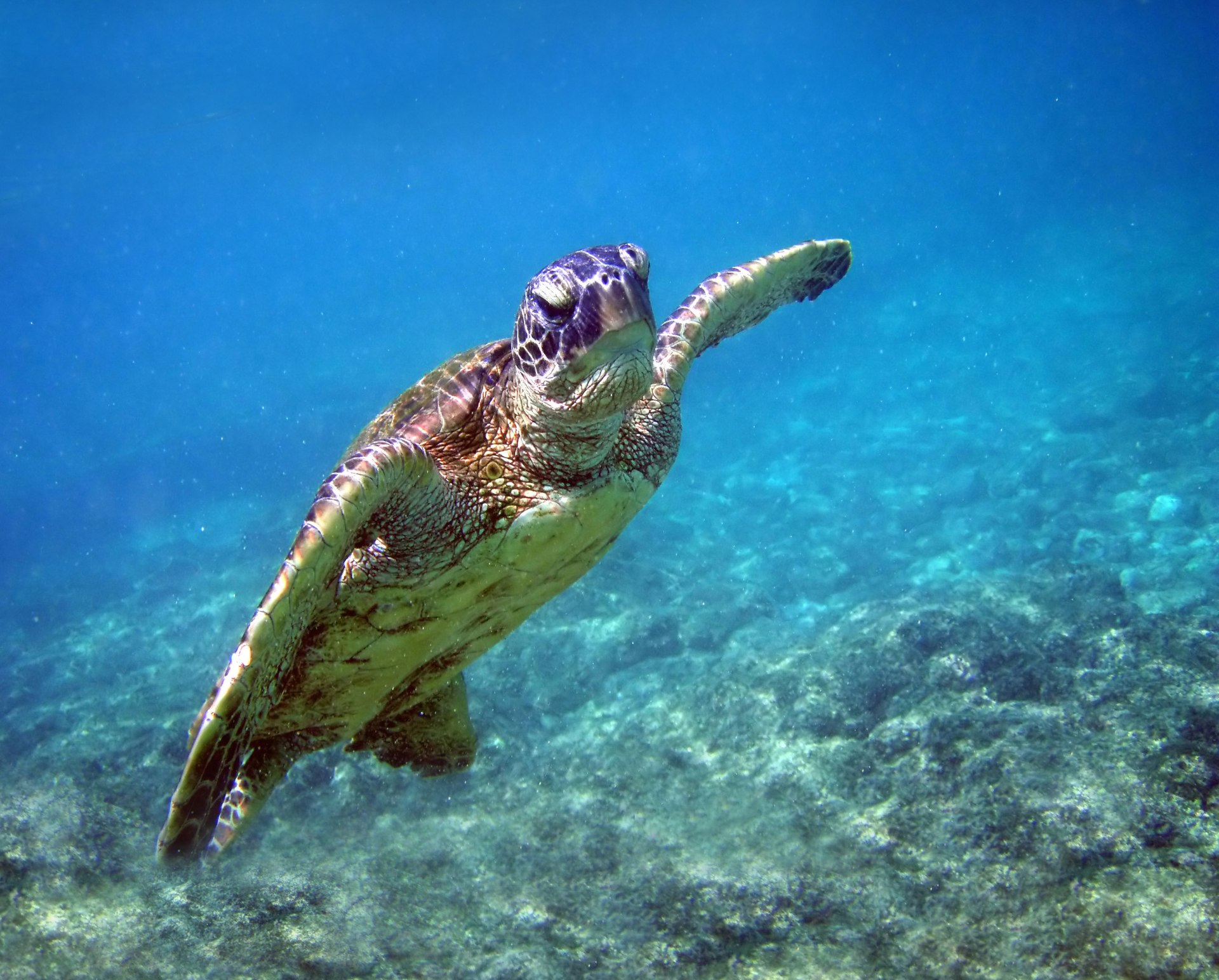
Photo: Brocken Inaglory/Wikimedia.
The green sea turtle above is in Hawaii. Others are in Florida, Egypt, and around the world. When threatened species like these get in trouble, they may receive care at a New York rehab center.

Americans are pretty good at volunteering, and there are so many ways to volunteer that everyone should be able to find something that suits them. I like assisting in English classes for immigrants. The volunteers in today’s story get involved with sea turtles under the guidance of scientists.

Dodai Stewart reports at the New York Times, “On a recent Thursday morning, Maxine Montello was at work making breakfast for 48 hungry diners.

“She had a stack of numbered plastic trays, and a clipboard with a list of corresponding menu orders. Methodically, she placed each tray on a scale, cut up pieces of frozen squid and cold raw herring and added them — including heads and tails — measuring just the right amount.

“Pills were hidden inside some of the fish, and Ms. Montello referred to notes about her customers. ‘Some of them don’t like the tails,’ she said. ‘And Number 7 doesn’t like the squid.’ …

“Ms. Montello is the rescue program director at the New York Marine Rescue Center in Riverhead, Long Island, a nonprofit organization stretched to its limits after receiving a record number of sick sea turtles in urgent need of aid this season. …

“The sea turtle swims under the radar. ‘Even people that might spend a fair amount of time on the water in the Northeast might never see a sea turtle,’ said Barbara Schroeder, the sea turtle coordinator for National Oceanic and Atmospheric Administration Fisheries. ‘But they do use Northeast waters extensively.’ …

“The rescue center mainly sees two types of sea turtles: green and Kemp’s ridley. Both varieties generally travel north in the summer and spend winters in warmer waters down south.

“The green sea turtle, a threatened species with a beautiful starburst pattern on its shell, can be found all over the world. The Atlantic Ocean population often nests in Florida and travels as far as Massachusetts in the summer. They live to about 70 years old, growing to three feet long and 350 pounds.

“The Kemp’s ridley sea turtle, a critically endangered species that nests in Mexico and eats crabs in the waters of New England and the Mid-Atlantic States, is smaller, growing to about 100 pounds.

“Once on the edge of being extinct, the Kemp’s ridley sea turtle has ‘a very positive conservation story,’ said Ms. Schroeder. Shrimp trawling and the killing of nesting turtles and their eggs at their very restricted nesting beaches had caused their numbers to plummet into the hundreds, but the Endangered Species Act, signed 50 years ago, has helped stabilize the population.

“Climate change has created new challenges to the turtles’ survival. Warming waters mean that ‘turtles and other species are expanding their normal territory,’ Ms. Montello explained. ‘So more and more turtles are going further north.’ Then, when cold weather arrives, often suddenly, the turtles are stranded. … Sea turtles are coldblooded, so when the water temperature drops, so does their body temperature. They become cold-stunned — similar to hypothermia — and go into a state of shock, washing up on beaches.

“The rescue center, founded in 1996, usually treats about 30 or 40 cold-stunned sea turtles during the winter. Ms. Montello has looked at records dating back to 1980, and said this year’s numbers are concerning. … ‘This year we had 95.’

“Of the 95 turtles found cold-stunned this season, 48 are still alive and in the care of the rescue center. The others were either dead when they washed up or perished soon after.

‘Their survival is dependent on how quickly they’re found,’ said Ms. Montello. …

“A lot is unknown about these creatures’ lives in the New York area, and much of the data comes from stranded turtles, not thriving ones. Ms. Montello’s research plans involve recording turtle behavior using customized video cameras that will be attached with suction cups to the backs of healthy turtles when they are released. …

“After the raw fish was loaded onto plastic trays, Victoria Gluck, a biologist on staff, carried a tray over to a turtle tank and doled out the meals with tongs, piece by piece, to the corresponding patients, whose numbers were written on their backs with nontoxic paint. Two volunteers, Britney Dowling and Cecilia Gonzalez, used nets to keep the other hungry turtles away as Ms. Gluck placed fish in front of each turtle, ensuring that they all got their allotted share; a turtle is supposed to eat 2 percent of its body weight a day.

“In the wild, sea turtles are solitary, so being in a tank alongside others in the rescue center makes some of the residents grumpy. On a whiteboard in the kitchen, the team had compiled a list of ‘tank bullies’: turtles known to push their tank mates or try to steal their food. …

“A veterinarian visits once a week, but otherwise the staff members — eight total, four full time and four part time, all women — and a small army of citizen scientists and volunteers are responsible for spotting cold-stunned turtles and helping them recuperate.” Read the rest of the story at the Times, here.

Read Full Post »

Photo: Reuters Marketplace/UK World Online Report.
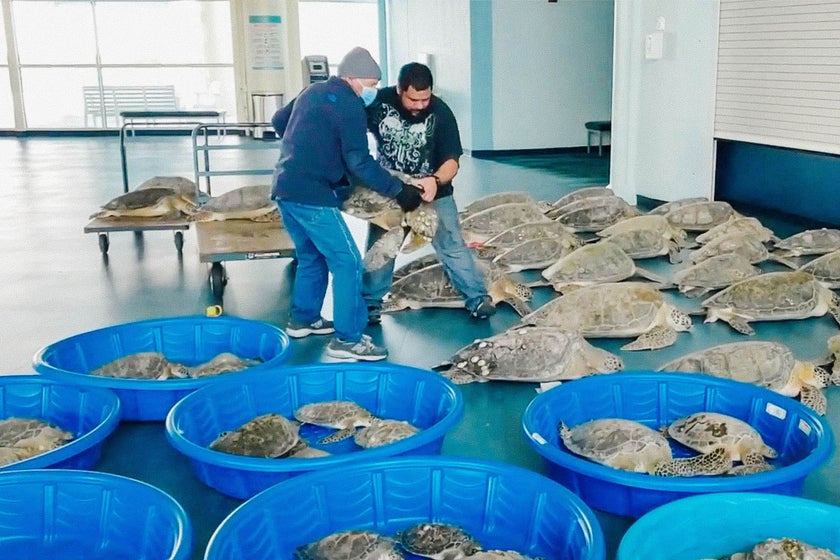
Endangered Green Sea Turtles are placed in bins and kiddie pools to help them warm up gradually.

Sometimes a crisis can bring out the best in human nature. Consider all the people making food for health-care workers in the pandemic or the volunteers manning pantries for 2020’s many unemployed.

This morning, as I was reading about the failure of the Texas electric grid, I learned that one supermarket, having suddenly lost power, couldn’t operate cash registers and let customers go home without paying.

Meanwhile, Texas nature lovers, despite hardships of their own, are rescuing sea turtles from the extreme cold. Many thanks to Hannah for pointing me to the story.

Raechel Allen reports at Slate, “An unprecedented winter storm provoked massive disruption in Texas this week: Millions lost power, hundreds were displaced from homes. [And] because of the temperature, thousands and thousands of sea turtles cannot move.

“An endangered species, these sea turtles usually live off the waters of South Padre Island, which is off the southern coast of Texas. Over the past week, they’ve been loaded into dinner cruise boats and minivans. The rescue center at the nonprofit Sea Turtle Inc. is used to rehabilitating injured sea turtles and responding to minor cold snaps but cannot hold all the turtles — so they’re also filling up a convention center. … Slate spoke to Wendy Knight, Sea Turtle Inc.’s executive director. Our conversation has been edited and condensed for clarity.

Rachael Allen: Can you walk me through what’s been going on this week with the turtles?
Wendy Knight: We are in the midst of the single largest cold-stun event in history. We have approximately 4,800 cold-stunned, federally protected, endangered sea turtles. … On Sunday things really started to hype up and we had local boat owners go out and find hundreds of floating sea turtles.

“What does it mean for a sea turtle to be cold-stunned?
“Sea turtles are cold-blooded so they need the temperature of water to regulate their own body temperature. … If the water gets below a certain temperature, the turtles are no longer able to sustain their own body temperature. Usually, they don’t think about all of their instincts — moving their flippers to swim, eating, diving to the bottom of the ocean, lifting their head up to draw breath. In a cold-stun event, they’re still aware they need to do those things, but because their body is frozen, or cold-stunned, it’s is not reacting to the instinct message. As a result they’re not able to swim, so the turtle floats to the top of the water and because their body is not responding by lifting their head to breathe, they drown in the ocean. I’m sure as we get farther away from the stun event, there will be perished turtles found, regardless of our best efforts.

“How did your team rescue thousands of turtles?
“This is a nesting beach where thousands and thousands of hatchlings are born each season, so everybody is keenly aware that we’re sharing space with sea turtles. We have almost 500 registered volunteers, plus all the city employees, who participate in training at the beginning of cold-stun season. That plan was executed here, just on a much bigger scale.

It’s important to remember that when all this was happening these hundreds of community members didn’t have power of their own. They hadn’t had electricity or running water in days. …

“They had their own personal tragedy happening. And despite that, they took time away to serve an animal that can’t serve itself.

“I can’t explain what it’s like to stand in a convention center that’s probably a football field and a half, and see 4,200 sea turtles laying tip to toe as far as the eye can see. And that’s not even all of them — that’s the overflow. … Nothing happens when they’re stunned — no bodily functions. It’s like a catatonic state. The best thing you can do is to let them rest. As things go along, they will start to wake up, but there are consequences that can come from cold stuns that require antibiotics and IV therapy, like pneumonia. We’ll watch them all closely, and as they recover and become more alert, we’ll start releasing them incrementally back into the Gulf of Mexico.”

I shouldn’t overlook the fact that there are people who volunteer year-round. Which is just to say that it doesn’t always take a crisis to bring out the best in human nature. More at Slate, here.

Read Full Post »


Photo: We Believers

Here’s some good news from Elyse Wanshel at the Huffington Post. It seems that there is an alternative to the plastic six-pack rings that endanger sea turtles and other marine life when trash gets into the ocean.

Saltwater Brewery in Delray Beach, Florida, has created edible six-pack rings that feed, rather than kill, marine life if the rings end up in the ocean and an animal happens to eat it. The rings are created from beer by-products during the brewing process such as barley and wheat and are completely safe for humans and fish to eat. The rings are also 100 percent biodegradable and compostable, which just ups the product’s sustainability game. …

“The only drawback is that edible six-pack rings are more expensive to produce. But the company hopes that customers will be willing to pay a little more in order to help the environment and animal life. …

“The Ocean Conservancy’s 2015 Ocean Trash Index — which enlisted 561,895 volunteers to pick up 16,186,759 pounds of garbage — also offers a few staggering facts. It cites plastic as among the most common trash item ingested by sea turtles in 2015. Volunteers found 57 marine mammals, 440 fish and 22 sharks, skates and sting rays entangled in plastic. The index also explains that littering isn’t the sole culprit for plastic in the ocean. Plastic can also be blown by the wind from a trashcan or dump, end up in a storm drain and then travel through pipes into the ocean. Facts like these makes a concept like edible six-pack rings seem vital.

“ ‘We hope to influence the big guys,’ Chris Goves, Saltwater Brewery’s president, said. ‘And hopefully inspire them to get on board.’ ” More here.

If more breweries join up, the cost to create the rings would go down. Sounds like a worthy idea for a little consumer pressure.

Read Full Post »