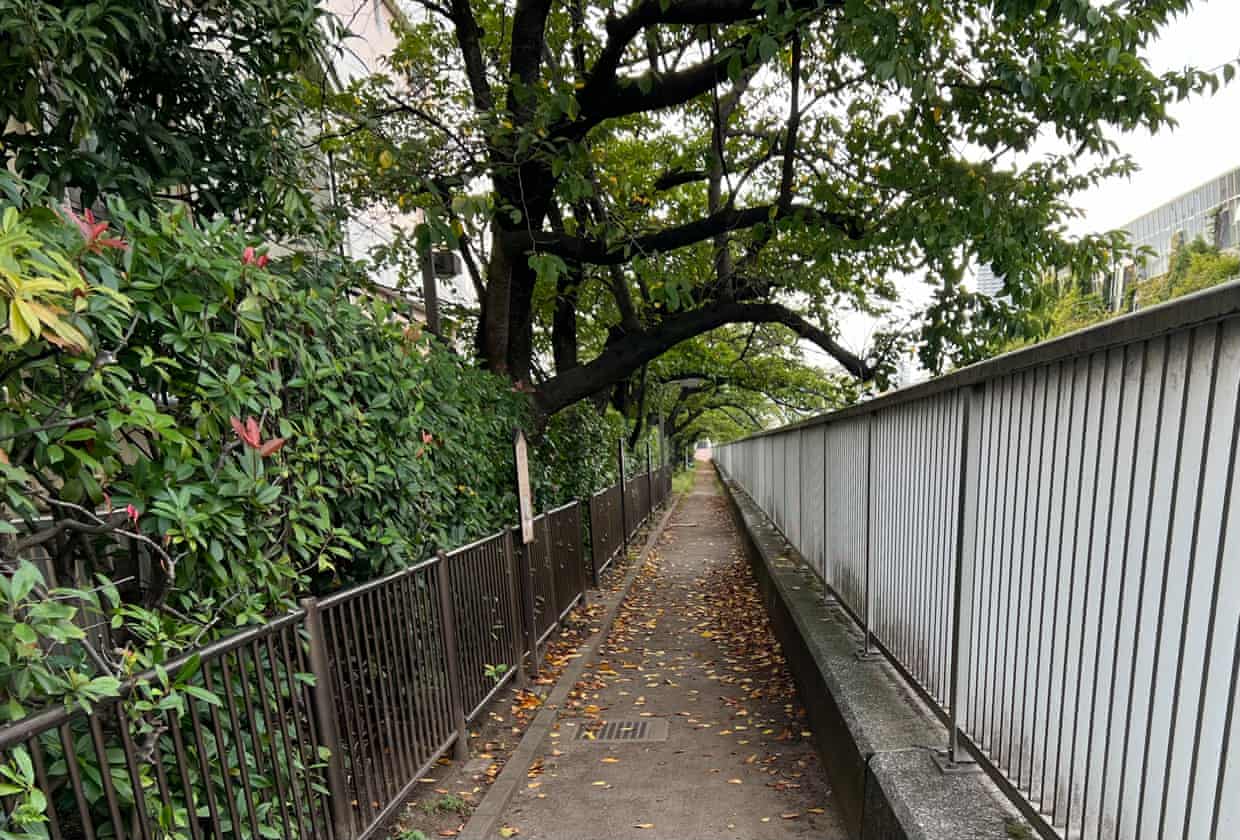
Photo: Justin McCurry/The Guardian.
A path along the Sendaibori river in eastern Tokyo, Japan, that is dotted with tablets showing haiku by Matsuo Bashō, Japan’s most revered poet.
Happy New Year, Everyone! This year I want to do more things to reduce carbon emissions. Eat less beef? Compost more? Drive less? Turn down the heat and air conditioning? Some things are harder to do in community living, but I will find a way to influence group conservation.
Among the many areas threatened by climate change, there is one you probably never have thought about: the haiku!
Justin McCurry, writing at the Guardian, is not entirely joking.
“Wooden tablets dotted along a path between office buildings and the Sendaibori river in eastern Tokyo mark the start of a journey by Japan’s most revered poet that would result in his greatest collection of verse. The tablets showing haiku by Matsuo Bashō are steeped in the seasonal certainties of the late 1600s. There are references to full moons, chirping cicadas and, of course, cherry blossoms.
“Awareness of the seasons, and the seamless transition from one to the next, is found in myriad aspects of Japanese life [including] haiku poetry. Almost four centuries later, Bashō’s words continue to inspire admiration and countless amateur exponents of the 17-syllable form. But they are also a reminder that haiku faces what some of its enthusiasts fear is an existential threat: the climate crisis.
“The poems displayed at regular intervals along the Sendaibori promenade are intended to evoke the cooler climes of autumn, but this year they feel off kilter even though it is late September. …
“One of the poems encapsulates the feeling of seasonal misalignment.
“Ishiyama no
“Ishi yori shiroshi
“Aki no kaze
“A whiteness whiter
“than the stones of Stone Mountain
“The wind in autumn
“Bashō wrote those words after a visit to a hilltop temple in Komatsu, near the Japan Sea coast, on 18 September 1689. Read contemporaneously, they would have evoked the arrival of cooler, crisper days. … Today, though, they belong not just to another century, but to an age of symmetry between culture and the seasons that is being irrevocably blurred by the climate crisis.
“Japan is no stranger to extreme weather, but summers once described as uncomfortably muggy are now so hot that they represent a real threat to human life, especially among Japan’s large and growing population of older people. …
“The climate crisis is wreaking havoc on the Saijiki – the ‘year-time almanac’ of thousands of seasonal words that are widely acknowledged as acceptable for inclusion in haiku. A kigo could refer to a particular plant or animal, the weather, seasonal festivals, the sky and the heavens. When read at a corresponding time of the year, it is supposed to stir emotions in the reader.
“ ‘With kigo, you’re compressing three or four months into a single word,’ says David McMurray, a haiku poet who has curated the Asahi Shimbun newspaper’s Haikuist Network column since 1995. ‘Take the word mosquito … the entire summer is packed into that one word, and it conjures up so many images.’
“The premature first pops of sakura buds in spring and and the arrival of typhoons in the summer instead of the autumn are two notable examples of seasonal dissonance.
“ ‘The seasons are important to haiku because they focus on one particular element,’ adds McMurray, a professor of intercultural studies at the International University of Kagoshima. … ‘The risk is that we will lose the central role of the four seasons in composing haiku, and the Saijiki will essentially become a historical document. The Saijiki is very specific in the way it presents the words. But they no longer reflect reality.’ …
” ‘Take koharubiyori, a kigo of late autumn to early winter used to express a day of warm, mild, sunny, almost springlike weather in the midst of harshly cold days, associated with a sense of soothing and comfort,’ [Etsuya Hirose, a professional haiku poet] told the Nikkei business newspaper. ‘Nowadays, more days are warm at that time of year, so you can’t really empathize with that kigo, that season and emotion.’ …
“According to Toshio Kimura, a poet and director of the Haiku International Association, warmer, more unpredictable weather is blurring the transition from one season to the next, but haiku has the versatility to [adapt]. ‘The purpose of haiku is not to praise seasons themselves, but to try to see the human essence through nature.’ “
Read at the Guardian, here, about how an “understated form of environmental activism is now making its way into haiku.” No paywall.

 Suzanne's Mom's Blog