Feeds:
Posts
Comments

Posts Tagged ‘self-esteem’

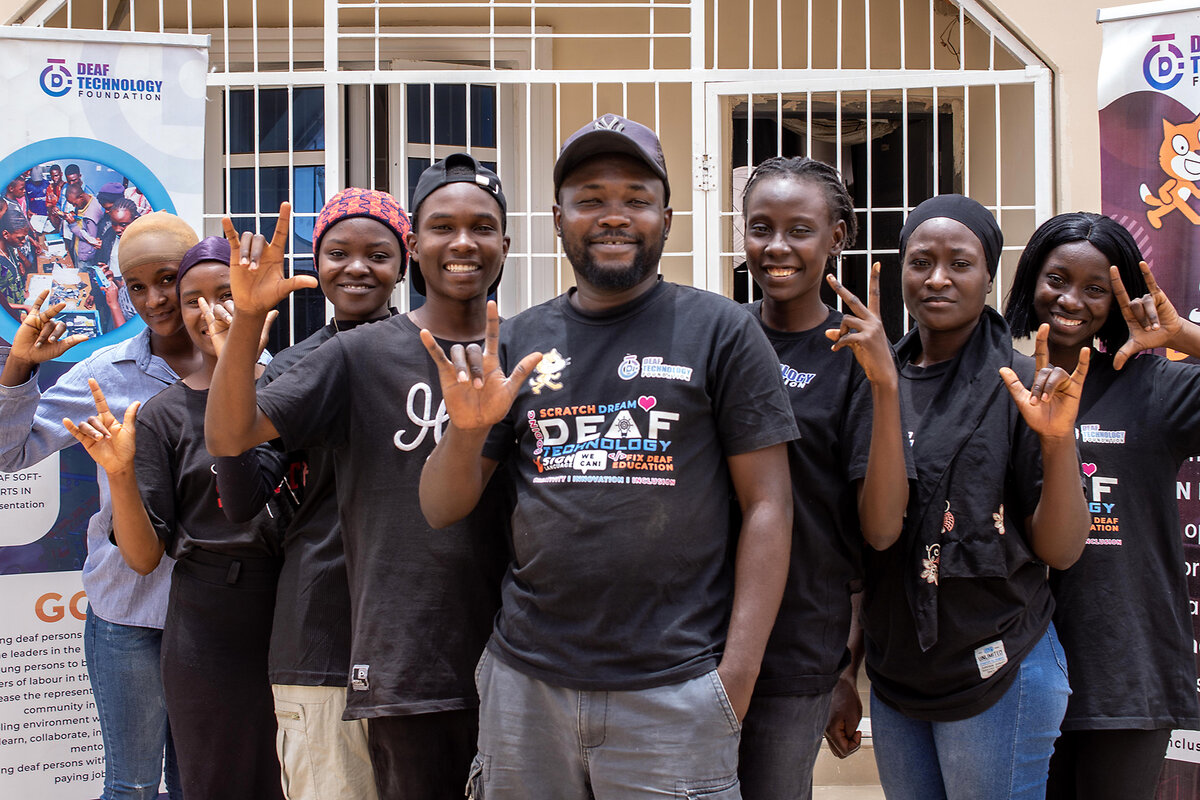
Photo: Nathaniel Bivan.
Wuni Bitrus (co-founder of the Deaf Technology Foundation) and some of his students sign “I love you” in Jos, Nigeria.

Things change so fast in our world that I can only hope a positive story I read in June is still true in August. It’s a worry. At the same time, we do know that people keep a good thing going — somehow — even with turmoil all around them.

I preface today’s story with that observation because I have been hearing about protests and riots in Nigeria that started with grievances about the economy and then went berserk as the government overreacted.

Nathaniel Bivan at Christian Science Monitor wrote in June about progress for the deaf community in Nigeria.

“In a one-room apartment in Jos, Nigeria, instructor Wuni Bitrus and almost a dozen students gather around a table cluttered with equipment – a toolbox, a 12-volt adapter, a coding panel, a set of jumper cables, a mix of colored wires. The students’ idea: to build the prototype for a ‘smart’ door that opens with the touch of a finger.

“The students chat back and forth in sign language, and Mr. Bitrus signs back. The group discusses using Arduino, an open-source electronics platform, and one student wonders how fingerprints can be stored. Mindful of Nigeria’s electricity problems, Mr. Bitrus genially advises the group to use a battery-powered keypad lock system first and incorporate a fingerprint feature later. 

“ ‘It works well, rather than waste time reinventing the wheel,’ Mr. Bitrus says. After nodding in agreement, the students excitedly start working.

“This is just another afternoon in a club run by the Deaf Technology Foundation, a nonprofit co-founded by Mr. Bitrus in 2017 that trains Nigerian children and young adults who are deaf in computer programming and robotics. The students also work to improve their reading skills, and receive career guidance and counseling to help them believe in themselves.

“Mr. Bitrus’ … desire to change the prospects of Nigeria’s deaf and hard-of-hearing community was sparked in 2014 by his encounter with a 13-year-old girl while he was teaching as part of the National Youth Service Corps in Zamfara state. Mr. Bitrus had noticed that the teen faced discrimination, and he became determined to learn sign language and teach her to use a computer. Three years later, he marshaled the resources, including funding from the Massachusetts Institute of Technology, to form the Deaf Technology Foundation.

“One of the darkest memories that Mercy Samson Grimah, a foundation student, has about growing up is looking at the faces of people around her and recognizing insults and negative energy directed at her. 

“ ‘That hurt me so bad because I knew in my heart that I could do anything. They just see us as lesser human beings,’ she says. ‘I wanted to show them that deaf people can become whatever they want to be.’ … 

“Ms. Grimah says her private secondary school did not formally teach sign language to her, nor much of anything else. But there was one teacher who knew how to sign, and she taught Ms. Grimah. … She dropped out in her third year because her parents could not pay her school fees, but fortunately, she had already formed a bond with the Deaf Technology Foundation. …

“Five years ago, Ms. Grimah and several other students made a road trip from Jos to Nigeria’s capital, Abuja, to compete in MakeX, a robotics contest. … Although Ms. Grimah’s team was not chosen to go on to represent Nigeria in the international competition, it emerged fourth among about 15 teams.

“ ‘Our team was the only one made up of the deaf,’ says Ms. Grimah, her eyes lighting up.

“Her father, Grimah Samson, adds, ‘What they are doing changed her.’ …

“Joy Yusuf, another Deaf Technology Foundation student, had wanted to become a doctor. But she was moved to a new school where the principal and staff said there was no way that could happen, even though the school welcomed students with disabilities.  

“ ‘It was a blow for me,’ Ms. Yusuf says. ‘I cried. I had to call Mr. Bitrus and my father to beg them, but [the principal and staff] still refused. For me, Deaf Tech is the only way I can have anything close to [studying] medicine.’  Now, she, too, wants to become a web developer.” 

More at the Monitor, here. No paywall.

The part of Nigeria where this story takes places is Jos. Online I found something interesting about it: “The state has over forty ethno-linguistic groups. Some of the indigenous tribes in the state are the Berom, Afizere, Amo, Anaguta, Aten, Bogghom, Buji, Challa, Chip, Fier, Gashish, Goemai, Irigwe, Jarawa, Jukun, Kofyar (comprising Doemak, Kwalla, and Mernyang), Montol, Mushere, Mupun, Mwaghavul, Ngas, Piapung, Pyem, Ron-Kulere, Bache, Talet, Taroh (Tarok), Youm and Fulani/Kanuri in Wase.” Wow.
Read Full Post »

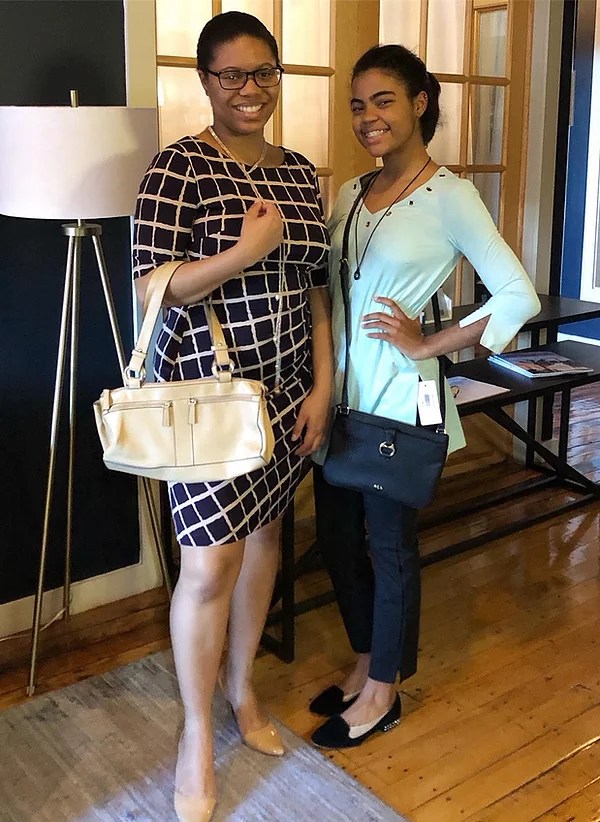
Photo: Uncommon Threads.
Uncommon Threads in Lawrence, Mass., helps “low-income women see and feel their true potential by using clothing and image as tools for building self-esteem.

Some time ago, Grace told me about the Lend a Hand Society, whichprovides emergency financial assistance to low-income families, individuals, seniors and disabled people primarily in the Greater Boston area.” It’s been filling a gap for generations now, and as you can imagine, has been especially needed during the pandemic.

A local nonprofit doing similar work but with a narrower focus is Uncommon Threads in Lawrence, Mass. Liz Neisloss at GBH television reported on the gap that the founder identified almost by accident.

“It’s not hard to find organizations that offer free or low-cost clothing,” says Neisloss, “but Susan Kanoff has created a boutique that uses clothes to transform not only the way women look, but how they feel.

“A social worker by training, Kanoff made her living helping low-income families move out of poverty. In her spare time, she channeled her love of fashion as a private stylist and style blogger. When her style clients began asking her where to best donate their old clothes, she had an idea.

“ ‘I started taking them into my social work office,’ said Kanoff, who lives in Methuen. ‘I had racks set up and (if) one of my clients was having a bad day, we’d put an outfit together; going on a job interview, we’d put an outfit together. And I started to realize how powerful these clothes were and how really important they were to a woman’s self-esteem.’

“Partnering with Family Services of the Merrimack Valley, she opened the non-profit Uncommon Threads [in 2017]. … In late 2019, the retailer Timberland helped fund the renovation of a larger space with dressing rooms, a sitting area in shades of beige and dark blue and a on the entry-way wall a message that reads: ‘Self Confidence is the Best Outfit.’

‘Our main goal is dignity and respect,’ said Kanoff. ‘We want women to feel like they’re in, they’re shopping in a beautiful place versus getting a handout.’

“Kanoff, who previously worked for the North Andover Housing Authority running the family self sufficiency program to help lift people out of poverty, works with a more than a dozen social service agencies who must refer women to be able to shop at the store. Retailers and the public donate clothing.

” ‘We could dress a woman who was maybe a victim of domestic violence and is ashamed to go to their kid’s school conference,’ said Kanoff. ‘Whatever it takes to get that woman to feel strong and powerful through the way she looks.’ …

“Women first meet with an Uncommon Threads volunteer to talk about their clothing needs, as well as their work or life goals. Clients can get up to four outfits and two pairs of shoes in one visit – but they can also get some items not commonly found in donation shops: bras, underwear, pyjamas and even matching jewelry. The meeting looks like one with a personal shopper at a pricey store, but costs just ten-dollars — a fee that can also be waived. Otherwise, the clothes are free.

“[Volunteer] Jen Marin sat down for a ‘styling session’ with 19-year-old JJ Ortiz. Shuttled around between group homes and foster care since she was 12, Ortiz said she struggled to find clothes that fit her as she grew and became self-conscious about her weight.

“ ‘I was kind of uncomfortable in my skin, who I was, how I would like show myself, like my clothes wasn’t the best,’ Ortiz said, ‘But they didn’t see that. They saw me for who I am.’

“Marin helped Ortiz try on a jeans jacket and then moved around to take a look. …

“Another volunteer stepped in to put a necklace over Ortiz’ head. Ortiz smiled, ‘I look so pretty,’ she said.

“With shopping finished, Ortiz stayed to sit in on a workshop called ‘Feminine Rocket Fuel.’ She took careful notes as motivational speaker Rosie Dalton explained to the gathering of clients how to use obstacles as ‘fuel’ to move forward.”

More at GBH, here, and at Uncommon Threads, here.

Are there similar services in your part of the world? But will clothes needed for work be different post-Covid? And finally, what are the chances that low-income people can start getting paid enough not to need charitable services in the future?

Read Full Post »

Photo: Jessica Hinchliffe/ABC Brisbane
The women of Queensland’s Spice Exchange create different spice blends to sell. 

This happy refugee story is from Australia, another country where refugees make valuable contributions, in this case sharing their beautiful foods and recipes with the broader population.

Jessica Hinchliffe writes at ABC Brisbane, “A social enterprise in Queensland is helping refugee and migrant women gain employment and foster community spirit through cooking.

“The Spice Exchange sees these enterprising women come together to create spice blends, condiments and gingerbread. They use recipes and spices well known in their home countries.

“Backed by Access Community Services, the social enterprise in Logan, south of Brisbane, also helps the women practise their English-speaking skills.

“Many of those involved are single women with dependent children, with limited education and literacy skills.

“Organiser Tianna Dencher said the Spice Exchange was helping these women, who sometimes felt isolated, find their voice. …

” ‘We saw that these women were comfortable with food and we decided to create something that would engage women around food.

” ‘Many of the women had such great cultural diversity, had beautiful cuisines that had spices … that’s how we started.’

“The program also teaches the women about workplace culture, marketing and how to price products. …

“Adhel Mawien Ukong began with the Spice Exchange in September and said the program provided her with opportunities for her and her children.

” ‘I’ve learnt so much,’ she said. ‘I start at 9:00 am and finish at 2.30 pm, and it’s given me a job four days a week and it’s helped us.

I love it so much so I come here every day of the week sometimes, and I’ve invited other women to join me.’ “

More here.

Hat Tip to @VictoriaLynden on twitter.

Read Full Post »