Feeds:
Posts
Comments

Posts Tagged ‘Senegal’

Photo: Ayen Deng Bior.
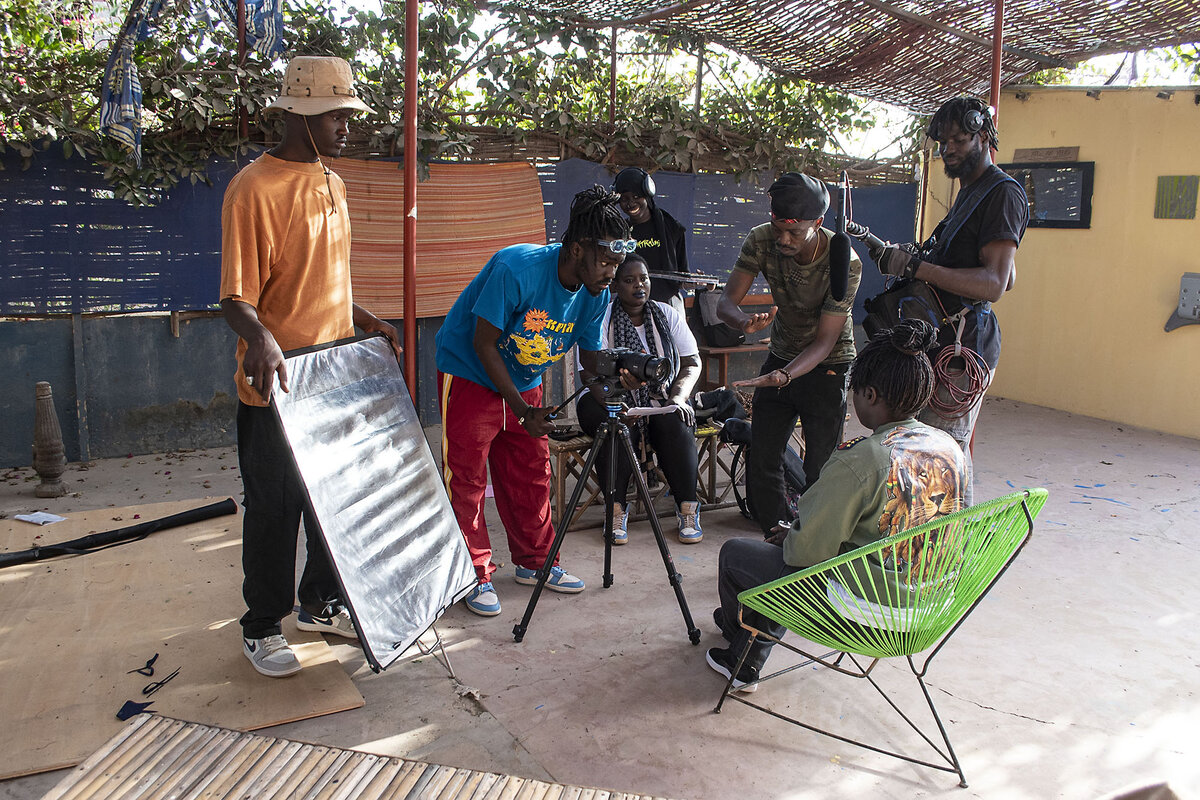
“Assistant director Pape Samba Tine (second from right) yells, ‘Action!’ on the set of a new Senegalese documentary about women’s lives,” the Christian Science Monitor reports.

For generations, films about Africa were written by non-Africans — in effect by the descendants of the colonizers. But over time, Africans have begun to tell their own stories in their own way.

Ayen Deng Bior, reporting from Senegal for the Christian Science Monitor, writes, “On a dusty Monday afternoon, the hallways of the Kourtrajmé film school buzz with nervous chatter and excitement. It is pitch day, and soon everyone files into a classroom to listen to the students present their screenplay ideas.

“The topics cover a wide sweep of Senegalese life, from the story of a 19th-century slave insurrection to a supernatural drama about a woman who can read people’s thoughts.

“When Leida Ndiaye’s turn comes, she is sweating. … But soon, she finds her rhythm, describing her idea for a rom-com about a woman in her early 30s who uses her job in human resources to ‘interview’ prospective dates to her birthday party. Ms. Ndiaye explains that she wants to provoke new conversations about dating and marriage.

“ ‘A lot of financially independent women are living the same situation here in Senegal,’ she says. ‘The tension between her professional life and her chaotic emotional life leads her to a deep introspection on her true desires and the nature of love.’

“Ms. Ndiaye and her classmates at Kourtrajmé are part of a new generation of Senegalese filmmakers who are setting out to tell their own stories on their own terms. With a film about Senegalese migrants, Io Capitano, up for best foreign film at the Oscars [2024], they know the world is eager to hear about their lives. 

“But Io Capitano’s success also highlights the challenges they face. The movie was made by Italian filmmakers, igniting conversation about what types of stories get told about Africa and by whom. 

“ ‘The Italian film is amazing, but it’s another story about migration,’ says Emma Sangaré, an American producer and screenwriter, and Kourtrajmé’s co-founder. For her students, she adds, there is so much more to say.

“Kourtrajmé’s popularity is a testament to hunger of young Africans to showcase a different kind of story. The school, which opened in 2022, gets hundreds of applications from all over the continent for about two dozen spots in its screenwriting and directing courses. Both six-month programs are fully funded.  

“The Dakar school is the third branch of Kourtrajmé, which French director Ladj Ly started in 2018 in a disadvantaged suburb of Paris in order to bring new and different voices into the film industry. Senegal’s Kourtrajmé was founded by Mr. Ly, Ms. Sangaré, and her husband, French Malian director Toumani Sangaré. …

“Last year, Banel & Adama, a magical realist romantic drama by French Senegalese director Ramata-Toulaye Sy, premiered to positive reviews at the Cannes film festival. But for many Senegalese filmmakers, a lack of resources and connections still makes the global film circuit hard to break into.

Io Capitano, for instance, had budget of more than $8 million. … But getting funding like that often means turning to American or European producers. In these situations, Ms. Sangaré says the power dynamic makes it hard for young Senegalese filmmakers to assert their authority about the kinds of stories they want to tell. …

“Mariama Niang is in director mode, supervising her team as it prepares to shoot an interview for her documentary, Elle, on a recent afternoon. …

“For Ms. Niang, an alumnus of Kourtrajmé who has wanted to be a filmmaker since she was a child, this moment has been a long time coming.

“ ‘Cinema is the world,’ she says. ‘In cinema, you can see everything. You can see one movie, and you see all your life in that movie.’

Elle, whose title means ‘she,’ follows five Senegalese women who have made names for themselves in their respective industries – from photography to financial consulting – while challenging the common narrative here that women are ‘just’ homemakers and childbearers. It’s a contentious topic that Ms. Niang has wanted to tackle for years, but she couldn’t figure out how to pay for it.

“Kourtrajmé changed that. The film school funded half the production, and Ms. Niang used the pitch skills she honed there to convince a private investor to pay for the rest.

“Back at Kourtrajmé, Ms. Ndiaye [says] ‘It’s better to tell our own story because if you don’t do it, people won’t know what exactly African people are living. … Westerners are doing it; they share their history; they share their culture. Why not us?’ ”

More at the Monitor, here. No paywall.
Read Full Post »

Photo: Jack Thompson.
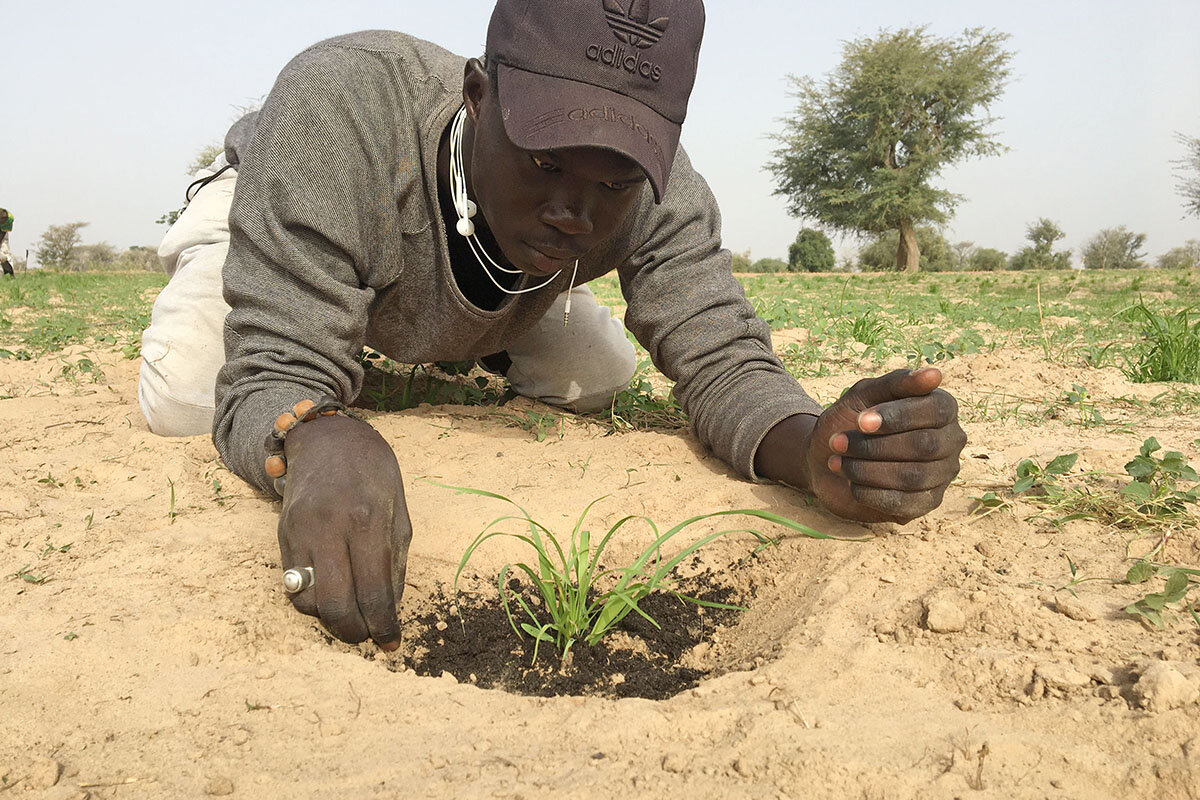
From the Christian Science Monitor: “Farmers in Ndiob, Senegal, are experimenting with ‘zaï’ planting pits, an ancient practice to conserve moisture even during acute droughts.

With climate change and drought in Africa affecting crop yields, some farmers are adopting ancient techniques for conserving water.

Jack Thompson writes at the Christian Science Monitor, “Rain is like alchemy for farmer Thialla Badiane in the Sahel region of Senegal. Suddenly, it transforms dusty dunes into rich verdure, barren plains into crop-laden fields. 

“But rain is increasingly scarce here on the edge of the Sahara desert. Temperatures are rising by 50% more than the global average and threatening Mr. Badiane’s most precious resource to feed himself and his seven children. 

“Annual rainfall could drop by 38% in Senegal in the coming decades, a threat to the way of life for the nation’s 8 million farmers. Already the growing climate emergency means rainfall has become more unpredictable, water scarcer, and droughts longer.

“So in Mr. Badiane’s hometown of Ndiob, hundreds of farmers seeking to combat those effects have revived an ancient farming technique – with a 21st-century twist. ,,,

“Mr. Badiane [drills] repeatedly into the thick crust of the earth with a giant motor-powered corkscrew, leaving a pattern of perfectly spaced holes. In one hectare, he will drill 10,000 holes for his millet seeds, a planting technique known as zaï

“Originally from neighboring Burkina Faso, zaï is the traditional technique of making small indentations in the ground that capture rainfall and increase the fertility of the soil. It’s painstaking work, but a lot easier than digging the holes by hand with a hoe.

“Millet has been making waves on the international stage … because the crop can grow on arid land, can survive extreme heat, and is high in protein and micronutrients.

“And with his modern take on an ancient practice, Mr. Badiane has increased his yield of millet by 50% – though research shows zaï can triple production. If it were to become widespread, this Indigenous technique could help farmers become more resilient to a changing climate. …

Zaï combats [water runoff] by creating pockets for the water, making sure it doesn’t run off and take nutrients and minerals with it. 

“This is the ambition of Ndiob’s Mayor Oumar Ba, renowned in Senegal for his commitment to agroecology, a form of sustainable farming based on millennia of Indigenous knowledge and innovation. …

“Across the continent, many officials, scientists, and ordinary citizens are already looking to adapt. Faced with increasingly unpredictable weather in Ndiob, Mr. Ba traveled to Burkina Faso, a landlocked nation that gets even less rain than Senegal, to search for ways to beat intensifying drought. Four years ago, he brought back zaï

“ ‘Before, it used to rain consistently for five months; it would start in June and end in November,’ says the mayor’s agricultural advisor, Mame Kor Faye. ‘Now, not one farmer can tell you when the season will start.’ …

“Drought is a vicious circle for farmers: As rainfall decreases, the soil compresses. When it finally does rain, the dehydrated, packed  land cannot absorb the water and the top layer of fertile topsoil washes away. … ‘Zaï is a solution to this scarcity of water and to restore the fertility of our soils,’ Mr. Faye says.

“For Mr. Badiane, the planting plots are a double win.  Under the burning November sun, he bends over each small pit and delicately places a handful of rich, dark fertilizer. It’s a far smaller amount than he used when he composted his entire field. 

“Prices of fertilizer have skyrocketed since Russia, the world’s top exporter, invaded Ukraine and supplies were squeezed. Since then, animal manure, an alternative to chemical fertilizer, has been in short supply.

“ ‘The reason zaï interested me is because I wanted to save on organic manure,’ Mr. Badiane says. ‘Before, you didn’t have to pay for manure – livestock herders would give it to you. Now it’s hard to find, and you have to pay.’ 

“ ‘When the rain falls on the manure, it retains the humidity that the plant needs,’ says Isidore Diouff, an agronomist from the Senegalese nongovernmental organization Enda Pronat and who has been leading the zaï experiments in Ndiob. He kneels down to inspect a newly planted seed in its pit. ‘You can go 20 days without rain, and the pit will still be damp.’ 

” ‘Four months later, Mr. Badiane admires his ready-to-be-harvested, fingerlike plants. Nurtured by the moist soil, their soaring leaves tower over the 6-foot-tall farmer. Assessing the plant’s density and weight, Mr. Badiane predicts a good yield.”

More at the Monitor, here. No firewall. Subscriptions encouraged.

Read Full Post »

Photo: Guy Peterson.
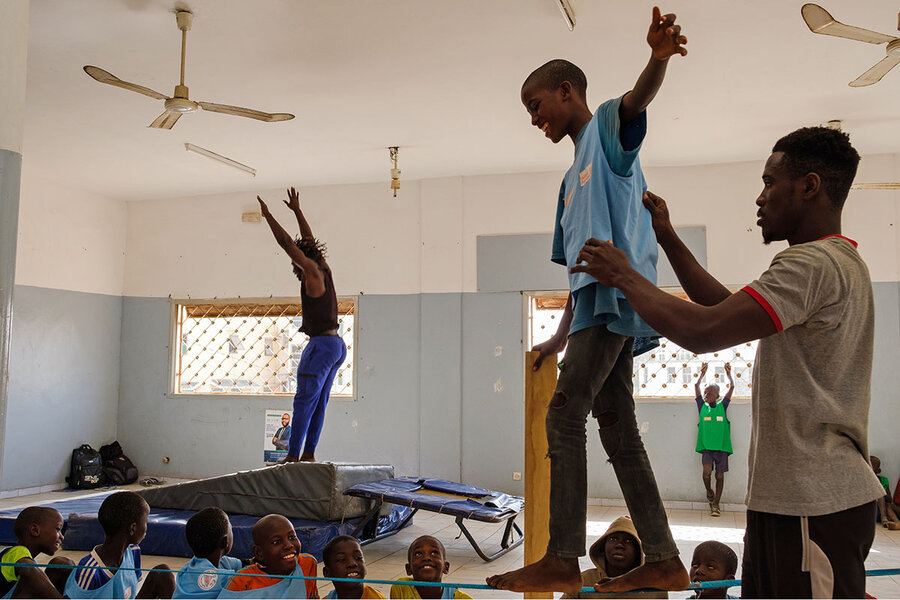
A circus troupe offers hope to Senegal’s street children.

Poor children in Senegal often have a heartbreaking life, but one who rose above years of deprivation figured out a way to help others by sharing something that helped him. Today I’m drawing from three sources about what that was.

The BBC writes, “Every year, thousands of young Senegalese children are sent to the cities to study the Quran, only to find themselves forced into begging for money and food on the streets.”

DW.com reports about help coming from a man who was once one of their number. “In Senegal, circus skills were not really seen as a ‘proper’ or ‘respectable’ job. But that didn’t stop a former street beggar from founding Senegal’s first circus company in 2010. Today, Sencirk teaches circus acts to underprivileged kids. [The kids have even] represented Senegal with their juggling and acrobatic skills on the acclaimed TV show Africa’s Got Talent.”

Guy Peterson expands on the initiative at the Christian Science Monitor. “Under the shade of a dusty canvas tent in the sweltering heat, five men rehearse for a circus tour of France the following week.

“They make up Senegal’s only circus troupe, and each of them took long roads to get here, overcoming difficult childhoods, facing rejection by their families after they escaped abusive religious schools, and living on the street. …

“According to human rights groups, the talibés, as the boys are known, are vulnerable to exploitation and abuse from teachers. Talibés are forced to beg for money each day, and if their quota is not filled, they can be beaten and starved.

“Senegal has seen increasing youth unemployment, which leads many young adults to consider emigration if they can’t find opportunities at home. Sencirk helps them see those opportunities. 

“Modou Touré escaped [and] after taking up circus training in Europe, he returned to Dakar and founded Sencirk in 2006, providing free training to teens who escaped from their schools. The program allows them to work through traumatic experiences and to see paths toward a better future, whether that means working in the circus or reintegrating into society.

“An older performer and teacher at Sencirk, Sammi, explains, ‘We can teach them how to work together, how to grow, to believe in themselves.’ ”

According to the BBC, Sencirk’s founder “trained in Sweden for three months and toured with professional circus troupes around the world, before setting up the Sencirk tent in Dakar.

” ‘Circus is my therapy,’ says Mr Touré, now 31.

“The practice also assists him control his emotions and has the capacity to help others like him, he says.

” ‘It gives them confidence and helps them battle their demons.’ “

One 14-year-old trainee told the BBC, that “he loves everything about the circus: ‘It helps me learn and it makes me aware.’ …

“He hopes to join Sencirk as a full-time performer one day.

“Mr Touré’s troupe conducts regular free workshops at rescue homes for street children and women’s shelters to provide entertainment and identify talent.

” ‘It shows them they can go from the streets to making a living in the circus,’ Mr Touré says.

“Out of both necessity and the desire to preserve what they call the ‘Africanness’ of their shows, Sencirk uses locally found materials to make its equipment, such as trapezes, safety mats and juggling balls.

“Sencirk’s unique approach to circus is to share personal stories that other West Africans can relate to.

“One performance portrays the draws and dangers of clandestine migration to Europe. Another shares the experience of living as a talibé runaway.

“It’s a community built on resilience – a group of people working through shared trauma who are strengthened by their ability to overcome it together.”

More at the Monitor, here.

Read Full Post »

Photo: Obinna Obioma via BBC.
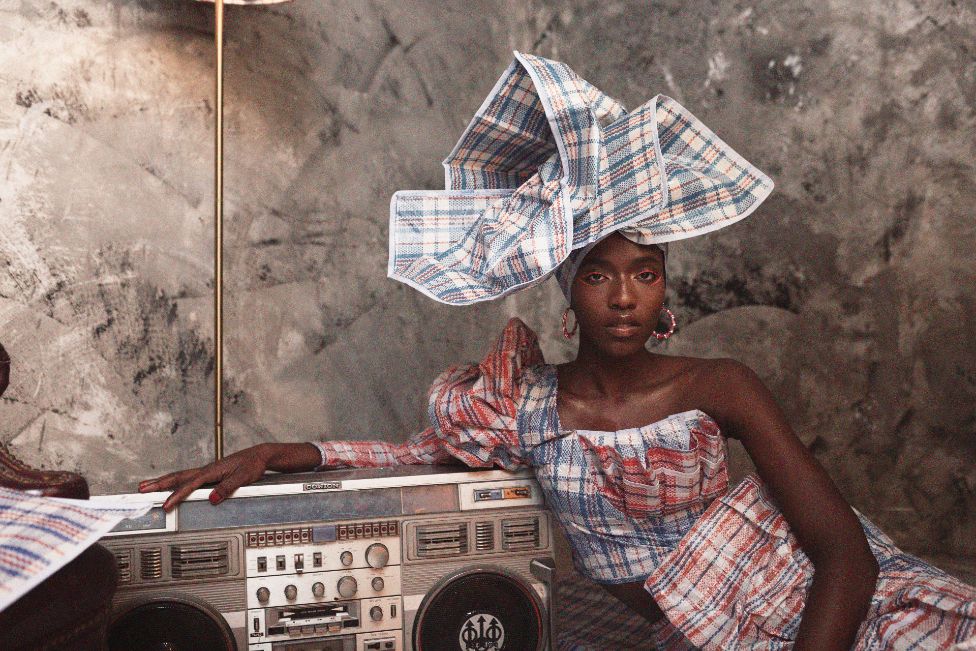
Nigerian photographer Obinna Obioma using creative ways to display an iconic West African plastic bag.

Suzanne liked a recent plastic-recycling article in the New York Times, and we thought you would like it, too. (The Times blocks people from sharing photos, so the one above is from the BBC. You can also check out fashions made of plastic at the Guardian, here.)

Times reporter Ruth Maclean writes from Senegal, “A crowd of people holding curved metal spikes jumped on trash spilling out of a dump truck in Senegal’s biggest landfill, hacking at the garbage to find valuable plastic.

“Nearby, sleeves rolled up, suds up to their elbows, women washed plastic jerrycans in rainbow colors, cut into pieces. Around them, piles of broken toys, plastic mayonnaise jars and hundreds of discarded synthetic wigs stretched as far as the eye could see, all ready to be sold and recycled.

“Plastic waste is exploding in Senegal, as in many countries, as populations and incomes grow and with them, demand for packaged, mass-produced products.

“This has given rise to a growing industry built around recycling plastic waste, by businesses and citizens alike.

From Chinese traders to furniture makers and avant-garde fashion designers, many in Senegal make use of the constant stream of plastic waste.

“Mbeubeuss — the dump site serving Senegal’s seaside capital of Dakar — is where it all begins. More than 2,000 trash pickers, as well as scrubbers, choppers, haulers on horse-drawn carts, middlemen and wholesalers make a living by finding, preparing and transporting the waste for recycling. It adds up to a huge informal economy that supports thousands of families.

“Over more than 50 years at the dump, Pape Ndiaye, the doyen of waste pickers, has watched the community that lives off the dump grow, and seen them turn to plastic — a material that 20 years ago the pickers considered worthless.

“ ‘We’re the people protecting the environment,’ said Mr. Ndiaye, 76, looking out at the plastic scattered over Gouye Gui, his corner of the dump. ‘Everything that pollutes it, we take to industries, and they transform it.’

“Despite all of the efforts to recycle, much of Senegal’s waste never makes it to landfills, instead littering the landscape. Knockoff Adidas sandals and containers that once held a local version of Nutella block drains. Thin plastic bags that once contained drinking water meander back and forth in the Senegalese surf, like jellyfish. Plastic shopping bags burn in residential neighborhoods, sending clouds of chemical-smelling smoke into the hazy air.

“Senegal is just one of many countries trying to clean up, formalize the waste disposal system and embrace recycling on a bigger scale. By 2023, the African Union says, the goal is that 50 percent of the waste used in African cities should be recycled. …

“The recycled plastic makes it to enterprises of all stripes across Senegal, which has one of the most robust economies in West Africa.

“At a factory in Thies, an inland city known for its tapestry industry to the east of Dakar, recycled plastic pellets are spun out into long skeins, which are then woven into the colorful plastic mats used in almost every Senegalese household.

“Custom-made mats from this factory lined the catwalk at Dakar Fashion Week in December, focused this time on sustainability and held in a baobab forest. Signs were constructed out of old water bottles. Tables and chairs were made of melted down plastic.

“The trend has changed the focus of the waste pickers who have worked the dump for decades, gleaning anything of value. …

“The government says that in a few years, the giant landfill will close, replaced by much smaller sorting and composting centers as part of a joint project with the World Bank.

“Then, most of the money made from plastic waste will go into government coffers. The waste pickers worry about their livelihoods.” More at the Times, here.

As great as it is to keep reusing plastic, it would be best not to make it at all for most purposes. It eventually breaks down and ends up in the ocean and our bodies. When I read “plastic mayonnaise jars” in the article, I wanted to remind you that, at least in the US, there are lots of things you can buy in glass if you look: glass mayonnaise jars, glass olive oil jars, glass mustard jars, glass pasta sauce jars, glass lemon juice bottles, and more. I even get milk in glass bottles. Glass is better than plastic. And you can get both laundry and dishwasher detergent in cardboard.

Check out my 2019 post on Cambodian fashion made from recyclables, here.

Read Full Post »

merlin_159839055_96531db4-6471-4426-8d7a-ac42eb8b93d1-jumbo

Photo: Yagazie Emezi for the New York Times
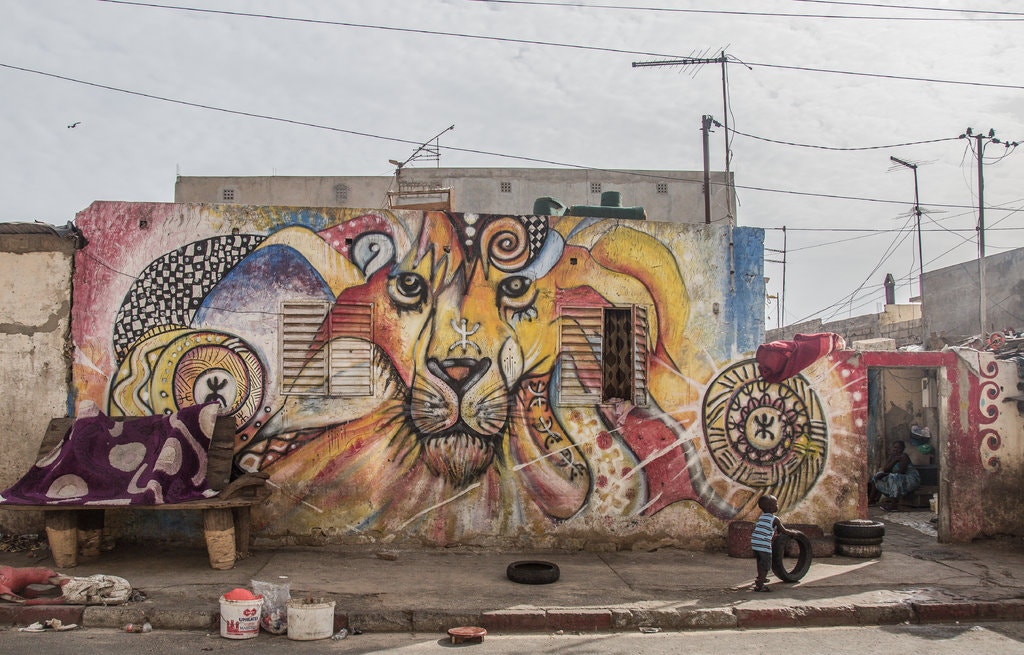
“The neighborhood of the Médina in Dakar has welcomed street artists from all over the world to practice their craft in what the founder of the project calls an open sky museum,” writes the
New York Times.

You can’t keep a good artist down. Art will out. It’s a reassuring thought. In the course of history, we’ve seen governments that think they know best, branding cutting-edge art and architecture as “degenerate.” Fortunately, such governments don’t last.

In Senegal, Anemona Hartocollis of the New York Times discovered a vibrant street art community that has grown up almost spontaneously.

She writes, “On one wall, the painting of a marabout, a Muslim holy man, peers out from behind a line hung with laundry. Nearby, a poster of an African woman in a bustle has been pasted to a house. …

“These are the painted houses of the Médina, a poor and working-class neighborhood near downtown Dakar. The neighborhood has welcomed street artists from all over the world to practice their craft in what the founder of the project calls the open sky museum. …

“Artists from not just Senegal but Burkina Faso, Algeria, Morocco, Congo, France and Italy have come to paint on these walls. They in turn have brought art lovers and tourists into a neighborhood where they otherwise might not go, to mingle with people they otherwise might not meet. …

“Street art seems to come naturally to Senegal, where many small shops are adorned with images of what they sell. Paintings of scissors signify tailors; heads with fancy hairstyles advertise barbers; images of cows and bowls of milk herald the ubiquitous sweet milk shops; a drawing of a sheep broadcasts the presence of a vendor serving grilled meat.

“Shop art is commissioned by the shop owners, and sometimes painted by them too. But to paint on a house in the Médina neighborhood, it helps to go through Mamadou Boye Diallo, known as Modboye.

“Mr. Diallo, 31, was born and raised in the Médina, the son of an elevator operator. He dropped out of school at 15 to become a break dancer and rollerblader. He got to know the art scene by working as a messenger, delivering fliers on roller blades for art galleries.

In 2010, he created Yataal Art, a nonprofit arts collective, and painted the first wall in the Médina with friends. The beauty of it is that ‘you don’t have to take a nice shower and wear perfume’ to see the art, Mr. Diallo said. …

“ ‘You have to pass by him in order to work in the Médina,’ one of the street artists, Doline Legrand Diop, said. ‘He functions a bit like a curator.’ …

“In the beginning, it was not always easy to convince homeowners to let people paint on their walls.

“ ‘They wanted money,’ Mr. Diallo said. But as the project caught on, they wanted to keep up with their neighbors. …

“The painted-houses project has gotten so big that this year, Delphine Buysse, a Belgian curator, has arranged for artists in residence to live at a luxury hotel in Dakar, the Pullman, for a week, while painting in the Médina.

“One of the most recent wall paintings was a collaboration between Kouka Ntadi, a Congolese-French artist, and Barkinado Bocoum, a Senegalese artist. Mr. Ntadi painted abstract portraits in black-and-white, and Mr. Bocoum added folksier portraits in bright colors.

” Mr. Ntadi loved sharing the neighborhood with the commercial artists of the barbershops and the milk stores.

“ ‘I would say there is not really a border between the two in Africa,’ he said. ‘It’s not like in France or the U.S. where there is a snobbism about art, and you can’t be in marketing. So for sure, we can still be an artist and make a design for a bottle of milk or a side of beef.’ ”

More here.

Read Full Post »

Some African communities are rediscovering the value of mud for building cool, comfortable homes — and sparing trees.

This story is from the Thomson Reuters Foundation by way of the the Christian Science Monitor feature “Change Agent.”

“Building a house in the poorest villages of southern Mali has for years involved cutting trees for timber frames and struggling to save cash for a corrugated iron roof. Now families are turning to an alternative: Nubian-style domed mud-brick homes that are cheaper, protect fast-vanishing local forests, and make homes cooler in the worsening summer heat, experts say.

“Earthen homes with vaulted brick roofs – a style adopted from Nubia in northern Sudan – are being promoted across the Sahel, including in Burkina Faso, Senegal, and Mauritania, as part of efforts to build resilience to climate change.

” ‘Most people, more than half, don’t have the decent housing they dream of because it costs too much to build. This is going to change with the Nubian vault,’ predicted Chiaka Sidibe, a mason in Massako, one of the Malian communities adopting the new building style.

” ‘You just have to make mud bricks that don’t cost money, and fellow villagers help you to build your house,” he said. …

“The local office of the Association la Voûte Nubienne, the international non-governmental organization that is promoting the Nubian vault building style, has helped train local builders in mud-brick construction techniques. The aim is to build a sustainable, self-supporting market for the homes, said Moussa Diarra, the NGO’s local coordinator.

” ‘It can take much time to reach this goal, but I’m confident the initiative will succeed,’ he said.”

More here.

Photo: UN Climate Change Secretariat

Read Full Post »