Feeds:
Posts
Comments

Posts Tagged ‘Sierra Leone’

Photo: Caitlin Kelly.
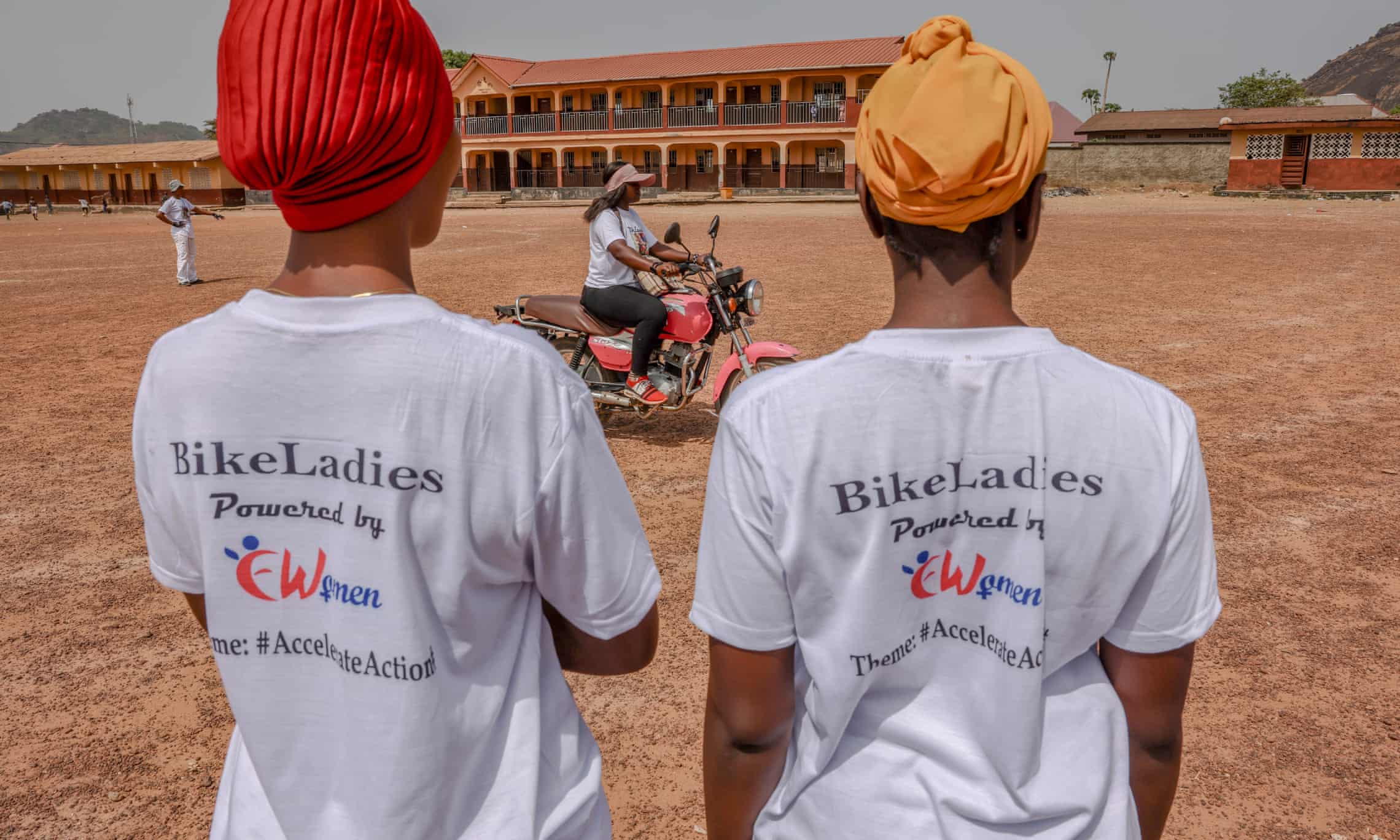
The Bombali Bike Ladies of Sierra Leone hope that by learning to ride a motorbike and take up package delivery services it will be possible to improve their lives.

I’ve been reading a mystery about some Minnesota Indigenous women who, fed up with a spate of kidnappings, unite to fight back. Whenever I read stories about women uniting to improve their lives and the lives of other women, I rejoice. After all, the individual women who eventually get to run their countries do not always operate differently from their male predecessors, but women in mutual-support initiatives definitively behave differently.

In today’s Guardian article, Caitlin Kelly writes about Mariama Timbo, the sole female biker in her Sierra Leone province ferrying people and goods to town and “training a new generation of women to follow her lead.”

“Streaming through the green fields of Sierra Leone’s Bombali district, Mariama Timbo sits tall on her pink motorbike. Women selling nuts on the side of the road wave as she glides by; policemen give an approving nod as she passes through checkpoints. ‘They don’t give me any trouble,’ she says – a badge of honor in the rural district. Taking her time on the rocky roads, she brakes, slowly approaching the bumps. …

“The 26-year-old is the sole female motorcyclist in the northern province ferrying people and goods to Makeni, one of Sierra Leone’s fastest growing cities. …

“At a petrol station en route, male drivers greet Timbo with fist-bumps and high fives. ‘At first when I started, people were mocking me,’ she says. ‘Now they see how my life has changed since I started riding the bike.’

“In Sierra Leone, motorcycles are a lifeline. The locally known okadas are often the only accessible and affordable way to reach markets, hospitals and cities. With nearly 60% of the country’s rural population living in poverty, commercial riding offers income to hundreds of thousands – nearly all of them men.

“In her early teens, Timbo left her village, Kagbere, to ‘join society’ and attend school in Makeni, but the opportunity turned into a nightmare when she was sexually abused by a male relative who was helping her financially. ‘I didn’t feel safe,’ she recalls.

“She managed to move out and pay for the last years of school by doing odd jobs in Makeni but couldn’t afford further education. In 2022, she turned to Kisimi Kamara at eWomen Sierra Leone, a local NGO that supports business initiatives for women. One thing she had learned during her time away was how to ride a motorbike. The NGO helped Timbo get funding for a motorbike via a World Bank grant.

“ ‘I decided to ride because I knew I could survive,’ says Timbo.

“Defying stereotypes, Timbo has since started transporting goods and people – earning about 50NLE [$2.42] a day.

“Since the civil war in the early 2000s, okadas have become a popular mode of transport after the fighting destroyed public infrastructure. A recent survey by the Institution of Civil Engineers found that women make up almost half of motorcycle taxi passengers in rural Sierra Leone – but the drivers are almost always men.

“Timbo makes the 45-minute journey between Makeni and Kagbere twice a day, mostly to the market. Like many rural villages in Sierra Leone, Kagbere is isolated, agriculture-dependent, and cut off from mains electricity and water. As she arrives, women flock to greet her.

“ ‘We are exchanging things – we are constantly giving to each other because we are family,’ says ‘aunty Marie,’ one of the women in the village.

“Marie hops on the back of Timbo’s bike to sell pepper and groundnuts at the market, but she also helps tend the land Timbo has recently been able to invest in.

“ ‘Mariama has changed over the past few months … because of that motorbike,’ says Kamara. According to him, more than 60 local women – including sex workers in search of alternative work – have shown interest in learning to ride after seeing Timbo on her bike in Makeni.

“On International Women’s Day in March, a group of young women gathers in a dusty school playground, watching as Timbo skids around confidently. One by one, they jump on the bike, nervously revving the engine. They are the newly formed Bombali Bike Ladies – under Timbo’s leadership. Timbo recently won a grant from the UNFPA and the government to teach others how to ride.

“ ‘It’s good for women to ride bikes, because they are very patient and caring,’ says Aysha Kamara, a 21-year-old student who hopes the motorbike could help her secure work with an NGO.

“ ‘Job opportunities for young people in Sierra Leone are so difficult … unless you create one for yourself,’ says Adama Makaloko, 24, who is hoping to master the bike to ’empower herself’ and sell produce.

“Sibeso Mululuma at the UNFPA says: ‘The challenge presented by the group was that young women in Bombali district faced economic hardship, making them vulnerable to exploitation and gender-based violence due to a lack of skills and financial independence.

“ ‘It sends a strong message … that there’s nothing wrong with taking up space or doing things differently. That’s powerful.’ ”

More at the Guardian, here. Great photos and no paywall.

Read Full Post »

Photo: Wikipedia.

There are so many things on this beautiful planet that we’ve never given much thought — things that turn out to be important for our future. Insects, for example, fungi, seagrass.

Allyson Chiu , with Michaella Sallu contributing from Sierra Leone, has written about seagrass research for the Washington Post.

“From the deck of a small blue-and-white boat, Bashiru Bangura leaned forward and peered into the ocean, his gaze trained on a large dark patch just beneath the jade-green waves.

“ ‘It’s here! It’s here! It’s here!’ crowed a local fisherman, who led Bangura to this spot roughly 60 miles off the coast of Freetown. ‘It looks black!’

“Bangura, who works for Sierra Leone’s Environment Protection Agency, tempered his excitement. After two unsuccessful attempts to find seagrass in this group of islands, he questioned whether the shadowy blotches were meadows of the critical underwater greenery he and other researchers have spent the past several years trying to locate along the coast of West Africa.

“It was only once he was standing in the waist-high water, marveling at the tuft of scraggly hair-like strands he’d uprooted to collect as a sample, that he allowed himself to smile.

“The wet, reedy plants Bangura held in his hands were unmistakably seagrass, and the green blades stretched past the plastic 12-inch ruler he’d been using to measure specimens. His grin grew even wider.

“The dense grass swaying in the current appeared to be healthy, and the water teemed with schools of small, silvery fish, making it the best site researchers have documented in these islands since the existence of seagrass was first confirmed in Sierra Leone in 2019. …

“Seagrasses — which range from stubby sprout-like vegetation to elongated plants with flat, ribbon-like leaves — are one of the world’s most productive underwater ecosystems. The meadows are vital habitats for a variety of aquatic wildlife.

Sometimes described as ‘the lungs of the sea,’ the grasses produce large amounts of oxygen essential for fish in shallow coastal waters.

“But, long overlooked, these critical ecosystems are vanishing. In fact, researchers don’t know exactly how many exist or have been lost. One recent study estimated that since 1880, about 19 percent of the world’s surveyed seagrass meadows have disappeared — an area larger than Rhode Island — partly as a result of development and fishing.

“ ‘When you lose foundation species like seagrasses … then you lose fisheries really quickly,’ said Jessie Jarvis, a marine ecologist who, until recently, headed the World Seagrass Association. …

“But locating grasses in the world’s vast oceans is a formidable task. While some researchers are using drones and satellite imaging, in countries such as Sierra Leone, where resources are scarce, the search is painstaking and tedious.

“Without these efforts, though, seagrasses would probably be disappearing even faster.

“ ‘What we don’t know, we can’t protect,’ said Marco Vinaccia, a climate change expert with GRID-Arendal, an environmental nonprofit that helped put together West Africa’s first seagrass atlas. …

“Similar to terrestrial plants, seagrasses have roots, leaves, flowers and seeds. Seagrasses have been discovered in the waters off more than 150 countries on six continents. The meadows are estimated to cover more than 300,000 square kilometers, an area the size of Germany. Along with mangroves, kelp forests and coral reefs, these grasses play a vital role in maintaining healthy oceans, Jarvis said. But unlike those other ecosystems, she notes, the meadows can exist in a wider range of ocean environments and tend to be more resilient than most species of seaweed.

“Critters, such as sea horses, crabs and shrimp, along with juvenile fish — some of which are critical species for fishing — often lurk within the thick meadows, seeking refuge beneath the underwater canopy. Other creatures, including sponges, clams and sea anemones, can be found nestled between the blades of grass or in the murky sediment at the base of the plants. And much as mosses coat trees, many species of algae grow directly on the leaves.

“Seagrass beds can in turn attract larger animals, including turtles and manatees, that stop by to munch on the leaves and stems. …

“From the leaves down to the roots, these unassuming plants work as ‘ecosystem engineers.’ Through photosynthesis, they help fill the surrounding water with oxygen. The leaves also absorb nutrients, including those in runoff from land, while their roots stabilize sediment, which helps to reduce erosion and protect coastlines during storms.

“Seagrasses also have the potential to play a significant role in combating climate change. Just as trees pull carbon from the air, seagrasses do the same underwater. Then, as the carbon-filled parts of the plants die, they can wind up buried in the sediment on the seafloor. Over time, this can help create sizable carbon deposits that could remain for millennia.

“But the grasses aren’t showy like coral reefs or immediately recognizable like mangroves, and they’ve become one of the least protected coastal ecosystems.”

Read more about what is being done here, at the Post.

Read Full Post »

Photo: Nick Roll via CSM.
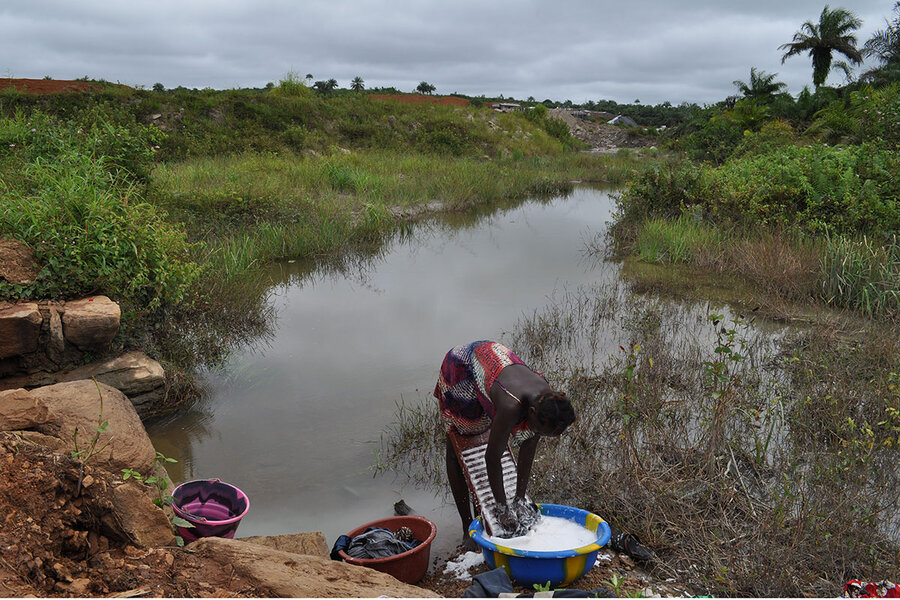
Washing in polluted water. Under new laws, “firms wishing to mine or establish industrial agriculture operations must henceforth strike deals with the ordinary Sierra Leoneans who depend on the land for their survival,” says the Monitor.

I don’t know about you, but I always feel hopeful when ordinary people stick up for themselves. The powerful and selfish don’t always have to win. Capitalism has gotten out of hand and now resembles nothing so much as the monarchies of old.

Meanwhile, in Sierra Leone, folks suffering from the excesses of mining giants and agribusiness are not going to take it anymore.

Nick Roll has the story at the Christian Science Monitor.

“Solomon K. Russell walks down a narrow dirt path, surrounded by teak trees that block out the sunlight and cool the afternoon air. He leaps over a column of fat black ants running across the trail, and the forest suddenly, unnaturally, ends. A denuded strip of beige earth stretches over an area the size of several football fields, pockmarked by pits full of wastewater. 

“Machinery belonging to the Afro-Asia Mining Corp., a Chinese firm, rumbles in the distance. The remnant of a stream, polluted and diverted by the industrial operations, idles underneath a small wooden bridge. 

“ ‘This river really sustained the life of the people,’ says Mr. Russell, who remembers, as a boy, jumping off the bridge into the water just a few feet below. Now, it’s barely ankle-deep. …

“Mr. Russell and his fellow villagers had no say in Afro-Asia’s arrival, nor in its operations. The company signed its lease with the local ‘paramount chief’ who was empowered by a century-old colonial law.

“But a sweeping package of land-rights bills, which went into effect in September, is set to change all that, giving local people who own and live off the land the authority to decide how it is used.

“ ‘Those laws will help,’ says Mary Tommy, a farmer living in this 500-strong farming community made up of brightly painted concrete houses and mud brick homes with traditional high-pitched thatch roofs. ‘For us, the destruction has already been caused, but for other areas that have not witnessed this kind of destruction, I think it will be good.’

“Many parts of Sierra Leone have been ravaged by foreign mining firms seeking gold, diamonds, and bauxite, among other minerals, and by palm oil plantations. Such natural resources accounted for over 75% of Sierra Leone’s exports in 2020, reaping around $400 million in income, according to official figures.

“Yet the wealth has been slow to trickle down. The latest figures on poverty in the country, from 2018, showed that 60% of the rural population was living on less than $1.90 a day.

“People say ‘our land is our bank, our land is our future,’ ” says Eleanor Thompson, deputy director of programs at the Freetown office of Namati, a legal advocacy and land-rights organization. …

“Until last month, only local chiefs and the national government could strike land use and leasing deals with foreign investors. The people whose land was taken could do little about it, and often had to accept rents amounting to only $5 an acre.

“Mr. Russell, for example, says his rent is ‘too meager’ to be able to buy from the market the fish he can no longer catch in the village stream.

“But under the new laws, firms wishing to mine or establish industrial agriculture operations must henceforth strike deals with the ordinary Sierra Leoneans who depend on the land for their survival – and who, for the first time, will have the right to negotiate, or reject, their proposals.

“September’s Customary Land Rights Act and the National Land Commission Act transfer the power to make decisions about land to those actually owning or using it. Companies seeking a lease must win the consent of 60% of a family’s male and female adults.

“Where land is communally held, firms must persuade 60% of the adults in the community to agree to a lease. In the newly created land committees that are supposed to help negotiate those leases, made of local community members, 30% of members are to be women.

“The new laws are not popular with foreign investors, many of whom are especially wary of a provision setting aside shares in international projects for Sierra Leoneans.

‘Nobody will invest in Sierra Leone anymore,’ says Gerben Haringsma, country director for the Luxembourg-based palm oil company Socfin. …

“Ms. Thompson, the land rights activist, says the laws might, however, help investors more than they realize. ‘It’s in the investors’ interest to have the consent of people,’ she says. …

“Acts of sabotage and deadly protests against agribusiness and mining companies have erupted in the past.

“ ‘If people had a say in negotiations they would sell their land for a … value that will enrich them and change their lives, maybe,’ says Emmanuel Saffa Abdulai, executive director of the Freetown-based Society for Democratic Initiatives.

“In Largo, villagers say that Afro-Asia promised to build them a health clinic, a school, and paved roads. Four years after mining operations started, none of that has come to pass, and the locals who have found jobs at the mine earn little more than $50 a month.

“Afro-Asia did not respond to a request for comment. But the company’s lease in Largo is in its final year. To keep operating, it will have to renegotiate – this time with the local community under the new laws.”

More at the Monitor, here. No firewall.

Read Full Post »

Photo: Alhaji Siraj Bah via CNN.
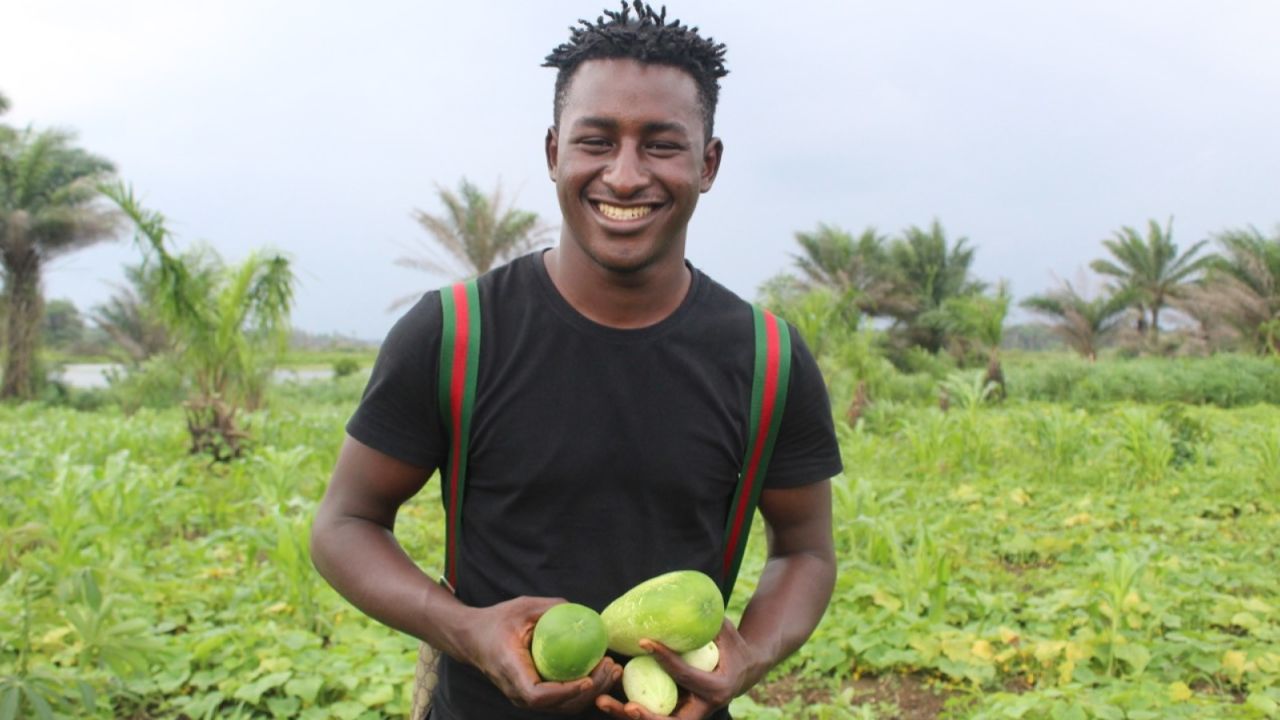
Alhaji Siraj Bah makes eco-friendly products in Sierra Leone.

In many parts of the world, when people have no way to heat their homes or cook, they cut down trees to make charcoal, leading to a whole series of other problems. In Sierra Leone, Alhaji Siraj Bah learned that lesson as a kid, and never forgot it.

Danielle Paquette writes at the Washington Post, “Their house was gone. They weren’t at the hospital or the morgue. Even as he searched the news for their faces, the teenager knew: His adopted family — the people who’d given him a bed when he was sleeping under a bridge — didn’t survive the mudslide.

“Three days of downpours, heavy for Sierra Leone’s rainy season, had given way to reddish brown muck streaming down the residential slopes of Sugarloaf mountain. Sinkholes opened. People in this hilly capital reported hearing a crack— like thunder, or a bomb — before the earth collapsed.

“Alhaji Siraj Bah, now 22, might have been there that August morning in 2017 if his boss had not put him on the night shift. He might have been sharing a bedroom with his best friend, Abdul, who he called ‘brother.’

“Instead he was sweeping the floor of a drinking water plant when 1,141 people died or went missing, including Abdul’s family.

“ ‘All I felt was helpless,’ he said, ‘so I put my attention into finding ways to help.’

“Four years later, Bah runs his own business with nearly three dozen employees and an ambitious goal: Reduce the felling of Sierra Leone’s trees — a loss that scientists say amplifies the mudslide risk — by encouraging his neighbors to swap wood-based charcoal for a substitute made from coconut scraps. Heaps of shells and husks discarded by juice sellers around Freetown provide an energy source that requires no chopping.

“His enterprise, Rugsal Trading, has now produced roughly 100 tons of coconut briquettes, which, studies show, burn longer for families who do most of their cooking on small outdoor stoves. One report in the Philippines found that a ton of charcoal look-alikes fashioned from natural waste was equivalent to sparing up to 88 trees with 10-centimeter trunks.

“ ‘My motivation is: The bigger we grow, the more we can save our trees,’ Bah said on a steamy afternoon in the capital, chatting between coconut waste collection stops. ‘The hardest part is getting the word out about this alternative. Everyone loves charcoal.’

“Researchers weren’t sure what triggered the worst natural disaster in the West African country’s history, but some pointed to Sugarloaf mountain’s vanishing greenery. Deforestation not only releases more carbon dioxide into the atmosphere — it weakens slopes. Canopies are critical for soaking up rain and taming floods. Roots anchor the soil together. …

“ ‘After [the flood], he was always on YouTube,’ said Foday Conteh, 23, who met Bah when they were both living on the street. ‘He became obsessed with looking for ways to stop deforestation.’

“Bah, 17 at this point, saw a video of a man in Indonesia who crafted charcoal replacements from coconut shells. Others were doing something similar in Ghana and Kenya: Collecting coconut scraps, drying them out in the sun, grinding them down, charring them in steel drums.

“He watched the makers mix the blackened powder with binders like cassava flour and then feed the dough into a machine that spits out matte loaves. Next came slicing the loaves into cubes. You could grill with them the same way — except a coconut aroma fills the air.

“ ‘It looked like a great business idea,’ Bah said. ‘I could make fuel with stuff we find on the street.’ …

“He kept researching the concept on his boss’s computer. The [briquette] machine cost about $3,000, so Bah asked for more hours and a raise. … The wages alone weren’t enough, spurring him to follow the blueprint of another young entrepreneur he’d read about in Uganda who’d started a recycled bag business with $18. Bah saved up for scissors and glue. He visited shops around town, offering to sell bags fashioned from discarded paper for customers who would pay half up front.

“One hotel manager agreed, and Bah suddenly had the capital to make a thousand bags. The order took five days to complete and netted him $100. More clients emerged. Within a few months, he bought the machine he needed to churn out the coconut briquettes. …

“ ‘I was a homeless boy,’ Bah [says today], ‘and now, on a good month, we do $11,000 in revenue.’ …

“Deforestation still worries him. Charcoal remains king in Africa — the continent accounts for 65 percent of global charcoal production — and people haven’t stopped hacking down trees on Sugarloaf mountain. Sierra Leone’s president was among the 100 world leaders who vowed to halt deforestation by 2030 at this year’s United Nations climate summit in Glasgow, and Bah hopes he sticks to his word.

“ ‘We have a lot more to do.’ “

Although I would love to see more solar stoves and less burning of any kind of material, I have to admire this young man’s ecological awareness and his determination to improve the world. Read about the challenges he had to overcome at the Post, here.

Read Full Post »