Feeds:
Posts
Comments

Posts Tagged ‘silent film’

Photo: San Francisco Silent film festival.
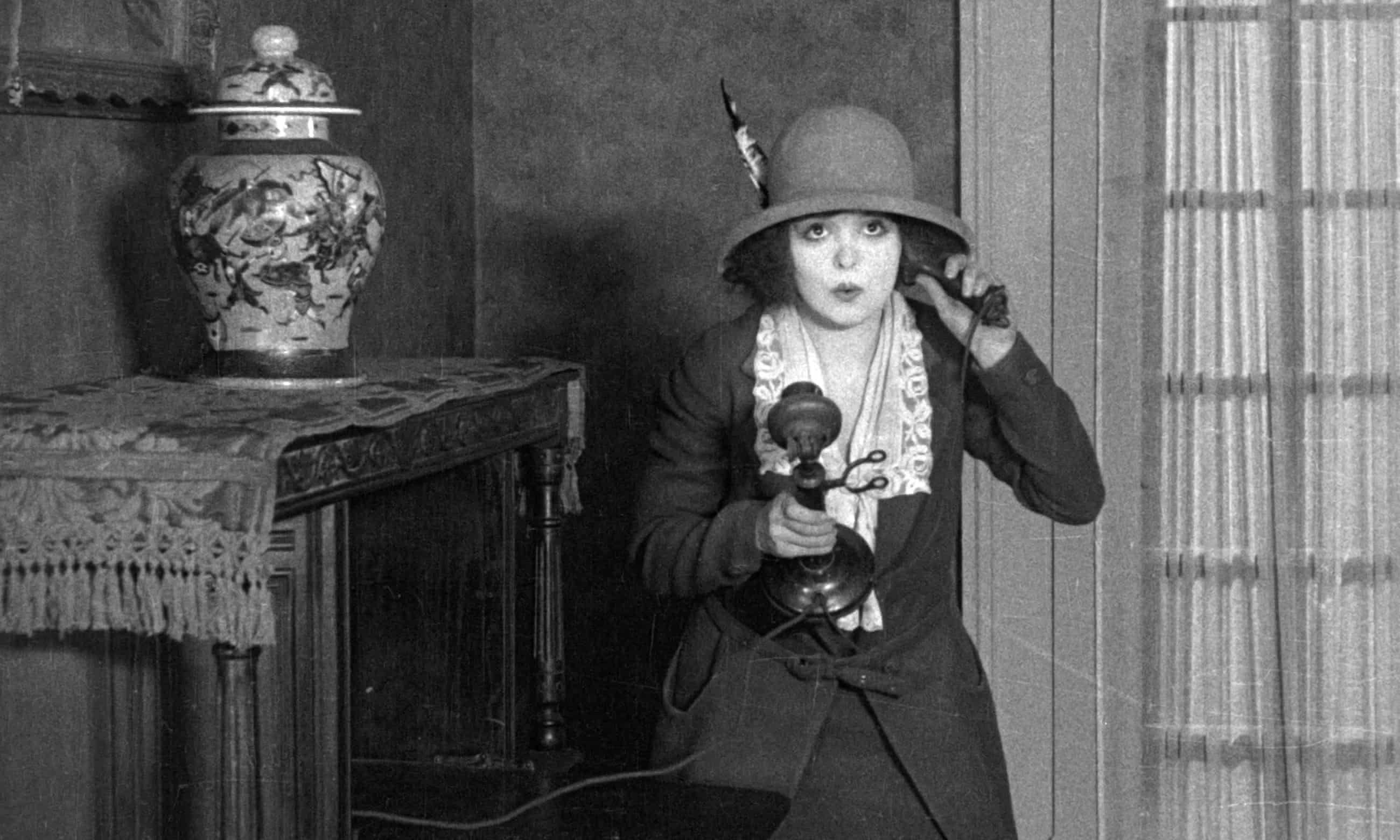
Clara Bow in newly rediscovered The Pill Pounder, a 14-minute film. 

We had one of the first televisions (1948? 1949?) because my father was writing a story for Fortune. It was a Dumont, a big wooden box with a tiny black and white screen. There wasn’t much content available at the time, so we watched lots of silent movies. I can’t remember if I ever saw any of starlet Clara Bow’s films, but I wouldn’t be surprised. I was too young to register names of actors.

Pamela Hutchinson writes at the Guardian, “A century after she first began to turn heads, Clara Bow is ‘It’ once more. The iconic flapper of the silent film era inspired Margot Robbie’s character Nellie in Damien Chazelle’s Hollywood epic Babylon, is name checked on Taylor Swift’s forthcoming album ‘The Tortured Poets Department,’ and yesterday at the San Francisco Silent Film Festival, one of her earliest films was shown for the first time since the days of bathtub gin.

“The story of the film’s discovery has already caused excitement online. Film-maker Gary Huggins inadvertently snapped up a slice of lost silent film history at an auction in a car park in Omaha, Nebraska, that was selling old stock from a distribution company called Modern Sound Pictures. Hoping to bid on a copy of the 1926 comedy Eve’s Leaves that he had spotted on top of a pile, Huggins was informed that he could only buy the whole pallet of movies, not individual cans. The upside? The lot was his for only $20.

“Huggins soon discovered that his new pile of reels included 1923’s The Pill Pounder, a silent comedy that had been thought to be lost for decades. It is a short, two-reel film, shot on Long Island, New York. … The film stars rubber-faced vaudeville veteran Charlie Murray, the so-called ‘Irish comedian’ who was actually from Laurel, Indiana. He plays a hapless pharmacist, the ‘pill pounder’ of the title, who is trying to host a clandestine poker game in the back room of his drugstore.

“What few realized until Huggins watched the film, was that it also features 17-year-old Bow in a supporting role. She plays the girlfriend of Murray’s son, played by James Turfler, who had already appeared with Bow in her second film Down to the Sea in Ships, directed by Elmer Clifton and screened in 1922. …

“In this, one of her earliest surviving performances on film, Bow looks even younger than her years. Although she lacks the sleek Hollywood glamour she later acquired, she has the charisma to turn a thankless bit-part into something of a scene-stealer. The critics took note: based on the evidence of this film, the Exhibitors’ Trade Review described her as ‘perhaps the most promising of the younger actresses.’ …

“The film, which has been restored by the festival’s organizers and was screened with accompanying music from composer Wayne Barker, now looks remarkably good for its age. The festival’s senior film restorer, Kathy Rose O’Regan, said it was in great shape when they received it. She added: ‘We imagined it was screened maybe a few times, but there’s hardly any damage.’ …

“It is still incomplete, being in what Stenn called a ‘beta version.’ That’s because the copy Huggins found was not from the 1920s, but a 35mm print from the 1950s or 1960s of an edit of the film that was destined to become part of a 16mm compilation of old silent films with a comic voiceover poking fun at its archaic aspects. The intertitles have been removed and there are a few scenes and shots missing, too. This process is deeply unflattering to old movies, but it has been responsible for preserving versions of silent films that would otherwise have been lost. …

“ ‘For me, it is a pretty perfect 14-minutes of fun,’ says O’Regan. ‘It would be nice to know what the titles were, but you can certainly get the gist without them.’

“Stenn called the tale of the film’s discovery ‘miraculous’ and … explained that there was reason to believe that some of the discarded material was among the other cans that were sold at the Omaha auction. The hunt is on to round out The Pill Pounder, and several people have joined in the search, combing through thousands of reels.”

More at the Guardian, here. No paywall.

Read Full Post »

636420432157104580-saving-brinton-still-5-mike-zahs-street

Photo: Des Moines Register
Michael Zahs, a retired history teacher, saved rare films that date to 1895 and became the subject of the 2017 documentary “Saving Brinton.” 

Did you ever read Hitty, Her First Hundred Years as a child? It’s about a doll who, through various adventures, ends up in the hands of a series of families in the course of a century. It suggests that old treasures bring joy again and again in new circumstances.

It would be lovely to find some rare, lost thing and give it new life. I know that readers like KerryCan and Deb do that all the time. In fact, Deb recently blogged about rescuing smelly old fabrics from oblivion to make a quilt. She likes to think about the former life of each piece as she works.

Suzanne, meanwhile, has been having enormous fun finding and cleaning up vintage lockets, offering resizing and placement of the customer’s family photos to give the lockets meaning for another generation.

Here’s a story about finding old silent film footage in an Iowa barn by Pamela Hutchinson at the Guardian. “Michael Zahs thinks of himself as a saver. ‘I like to save things,’ he says, ‘especially if it looks like they’re too far gone.’ This retired history teacher from Iowa, now in his 70s, has amassed quite a collection over the years: stray animals, farm implements, even a church steeple. …

“Nothing he has saved, however, has been quite as remarkable as the Brinton Collection – a mammoth set of films, lantern slides, posters and projection equipment from the first years of cinema, and even earlier. There are two exciting things about these artifacts. One is that during the more than three decades after Zahs took delivery of the collection and stored it on his property, he has been showing its treasures to local people and keeping the tradition of the travelling showman alive. The second is the discovery that the collection contains very rare material – films by the French cinema pioneer, George Méliès [remember the 2011 movie about his work, Hugo?] that were once thought to be lost.

Saving Brinton, an absorbing new documentary by Andrew Sherburne and Tommy Haines, tells the story of Zahs and the collection he saved. Between 1895 and 1909,one Frank Brinton crossed the Midwest with his wife Indiana and his travelling show, welcoming locals for a ticket price of just a few cents.

“At first he showed magic lantern slides, some of which ‘dissolved’ between two static images to create an illusion of movement. When moving pictures arrived, Brinton jumped aboard, ordering many films from distributors in France, one of the most prolific and creative producers in the early period. …

“Brinton’s programme included trick films such as those by Méliès, which used in-camera special effects to create fantastical spectacles, and many hand-coloured movies where the dye is applied directly to each frame. Projected in the dark, these vivid, bizarre images have lost none of their original impact.

“Everything the Brintons used was passed down through the family until 1981, when it arrived at Zahs’ front door. He packed all the ephemera away into what he calls his ‘Brinton room,’ while the films themselves were sent to the Library of Congress, which duplicated about two-thirds of them, quickly and simply, and sent the 16mm copies back to Zahs. The remaining third they apparently sent back to Zahs through the US mail, in a box labelled ‘explosive.’ Those original nitrate films, which are highly flammable, were stored alongside the 16mm films in a shed. It’s amazing that they survived.

“The 16mm copies were safe to project, and so Zahs did. He started the Brinton film festival in Ainsworth, Iowa (population: about 600), where he would show the slides and the films to audiences that might never otherwise have dreamed of watching a silent film projection.

“It is typical of Zahs’ commitment to not just preserving but sharing history, says Sherburne. ‘That’s how he engages people, by giving them the genuine article, putting it in their hands, or putting it in front of their eyes. It’s his way of transporting them to a different time.’ ”

Read more at the Guardian, here. And do tell me a vintage story of your own.

Read Full Post »

Photo: Everett Collection 
In the early 20th century, audiences crammed into theaters to see silent films accompanied by piano, organ, or orchestra. This film starred William S. Hart

Do you ever think about what an art it was to accompany a silent film? At the website Atlas Obscura, Jessica Leigh Hester has a great post about people who crave the experience today

“Sitting at a Steinway piano in near-darkness, Bernie Anderson flicks his eyes between the keys and a movie screen. Over his right shoulder, nearly all of the 203 seats in the Bruno Walter Auditorium on New York’s Upper West Side are full.

“These enthusiastic viewers have escaped the biting January wind for a screening of the ‘Silent Clowns’ film series. Anderson is set off in a corner of the stage, so as not to distract from the daring, hapless antics. His fingers fly and flutter, and give the cinematic shenanigans an extra dimension.

“He gamely tackles One Week, a 1920 short starring Buster Keaton, in which the master of physical comedy constructs a home from a do-it-yourself kit. It’s no spoiler to say that it doesn’t go well. The porch roof leans, and the windows are askew. When the house needs to be relocated, it gets lodged on some railroad tracks along the way. Anderson’s live melodies invigorate the charming foibles.

“The music is amiable when Keaton strolls with his new bride. When a storm spins Keaton’s sorry house around, Anderson’s playing evokes a vortex — swirling and insistent. The sound grows frenzied as a train finally reduces the slapdash home to splinters.

“The audience is devouring the century-old hijinks of the bill’s four comedic shorts. Laughter erupts regularly, gut-deep and contagious. ‘Oh nuts! Nuts!’ one man chortles when Laurel and Hardy tread, theatrically, on a heap of nails in The Finishing Touch. Other viewers can’t stop themselves from swapping corny puns as the gags pile up. ‘He got plastered,’ someone whispers to a friend as paint and glue cover a character’s face like meringue. …

“The phrase ‘silent film’ is, of course, a misnomer. Screenings of the 1920s were hardly quiet. The soundtrack for any given showing depended, in large part, on the setting. At deluxe movie palaces, films were often accompanied by entire symphony orchestras. …

“What they played varied by movie and musician. An orchestra conductor might rifle through a large library of sheet music to compile a patchwork score, [Scott Eyman, author of The Speed of Sound: Hollywood and the Talkie Revolution, 1926–1930] notes.

“Some were dashed off quickly, [and] sounded predictably derivative or cheesy. Tawdrier examples relied on snippets of familiar tunes to do some heavy thematic lifting, such as walloping viewers with ‘I’ve Been Working on the Railroad’ when a train barreled past.

“As an alternative, a conductor or individual accompanist might rely on a cue sheet. … One for another Keaton film, Sherlock Jr., for instance, primes accompanists to stay tuned for the moments when a ‘man buys a box of candy,’ or ‘man with black mustache leaves house.’ The sheet recommends measures by Irving Berlin and ‘On the Mill Dam,’ a banjo tune that evokes galloping hooves. …

“Performances are similarly variable today, depending on the accompanist and instrument of choice. ‘I try to be as authentic as possible,’ Anderson says. But there’s a lot of debate about what that should sound like.

“If a score or cue sheet for a given film survive, Anderson tries to track them down. Some never existed, others have been lost to time and neglect, and still more, he has found, just aren’t very compelling. [Anderson says,] ‘Whatever’s there, I try to use.’ ”

Atlas Obscura, here, goes into a lot of additional detail, if you are intrigued. You can also see an impressive pipe organ which, along with a 110-piece orchestra, used to accompany movies at the Roxy Theatre. Wouldn’t you love to go to one of these contemporary reenactments?

Read Full Post »

Pamela and I went to see the movie Hugo. The theater didn’t have 3-D, and one critic said 3-D is essential for full enjoyment of the film, but we found it delightful anyway.

Before I saw the movie, a NY Times review worked its way into my post on the charm of looking out windows. Indeed, as little Hugo peers out of windows and clock faces in the Paris train station where he works, it’s as if he were watching a theatrical entertainment staged for him alone.

A major “character” in Hugo is an old automaton that the boy had worked to repair with his father before a fire left him an orphan. He desperately wants to finish the work. He fancies that if the automaton were to write something, it would deliver a message from his father.

Automatons were apparently quite popular in the early 20th century. They were ingenious robots that could perform feats like writing and drawing.

There is one that can be seen today at the Franklin Institute in Philadelphia. Thought to have been constructed around 1800, it knows how to make four drawings and write three poems — two in French and one in English. “Henri Maillardet, a Swiss mechanician of the 18th century who worked in London producing clocks and other mechanisms” is the tinkerer behind it. Read more.

Read Full Post »