Feeds:
Posts
Comments

Posts Tagged ‘Sing Sing’

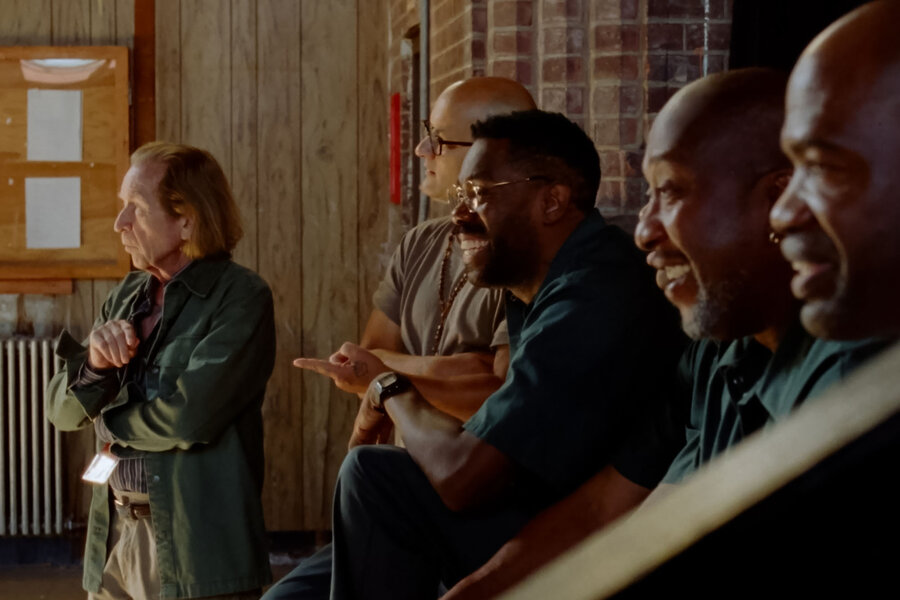
Photo: A24.
From left, Paul Raci, Sean San José, Colman Domingo, Sean “Dino” Johnson, and Mosi Eagle star in Sing Sing.

There are certain kinds of stories that always get my attention, and I’m grateful when other people find the same things interesting. Things like climate change, entrepreneurs, immigration, the kindness of strangers, housing, and life after prison. Just to name a few.

So you may be sure I liked today’s story about a theatrical production at a prison and the movie made about it.

Stephen Humphries writes at the Christian Science Monitor, “The world’s most unpredictable play only had one performance. It was staged inside a prison. The comedy, Breakin’ the Mummy’s Code, is about a man from ancient Egypt who embarks on a time travel adventure. Along the way, he encounters Robin Hood, Roman gladiators, cowboys, Hamlet, pirates, and – because why not? – Freddy Krueger from The Nightmare on Elm Street. It included a Shakespeare soliloquy – plus dance numbers. 

Breakin’ the Mummy’s Code was created by incarcerated men inside Sing Sing Correctional Facility in New York. It received a standing ovation in Cellblock B.

Now, a new movie explores the play’s legacy: the healing effect it had on its participants.

Sing Sing, directed by Greg Kwedar, reenacts the making of Breakin’ the Mummy’s Code. It even stars one of the play’s original actors. Already generating Oscar buzz, the movie … chronicles a budding friendship between two incarcerated men. Thematically, it’s about identity. The characters live in a hypermasculine environment that venerates bravado, toughness, and aggression. But the amateur actors come to discover that empathy, vulnerability, and tenderness are strengths, not weaknesses. The movie makes a case for the rehabilitative impact of arts programs inside prisons.

“ ‘I was a witness to it,’ says Mr. Kwedar, who taught an acting class in a prison with his creative partner, Clint Bentley, as part of their research. ‘I think the greatest teacher is what it’s like to step into another character and move in their shoes and step outside of yourself. That is a process of empathy’. … It gives you a prism to look at all the relationships in your life and to see perspective.’ …

“[Mr. Kwedar] spent seven years developing Sing Sing with Rehabilitation Through the Arts (RTA), the nonprofit that runs the theater program.

“There are dozens of similar theater projects across the United States. Perhaps the most well-known is Shakespeare Behind Bars. That program, which operates in three prisons in Kentucky and in one in Michigan, boasts a 6% recidivism rate for those who have participated in its productions. The Monitor was the first publication to write about that program. Then it became the subject of an award-winning 2005 documentary, Shakespeare Behind Bars

“ ‘Prisons function on shame and guilt,’ says Shakespeare Behind Bars founder Curt Tofteland, who has longtime collegial connections with the RTA. ‘But shame and guilt doesn’t change behavior. Why? Because shame and guilt doesn’t change thinking.’ …

“When change does happen, it’s a result of the actors exploring questions that the scripts raise, including ‘Who am I?’ 

“The two men at the heart of the story – John ‘Divine G’ Whitfield (played by Colman Domingo) and Clarence ‘Divine Eye’ Maclin (who portrays himself) – had to grapple with those existential questions. As the film unfolds, the audience learns that Mr. Maclin was one of the most feared men in the prison. Acting freed him to shed the gangster identity he’d clung to. The program helped him learn to express emotions. He even cried onstage. Now, he’s a natural performer on screen. …

“ ‘This is a movie about the landscape of the human face,’ says Mr. Kwedar. ‘It’s about drawing close to someone and looking them in the eyes and hearing their stories, and to know their names. And when you do that, it’s impossible to see that person as anything less than human.’

Sing Sing was filmed inside a recently decommissioned prison in New York. Its cast of established and first-time actors includes 13 RTA alumni. The production employed community-based filmmaking. For starters, it had a nonhierarchical pay structure. Everyone on set … was paid the same rate. …

“Last month, the director screened the movie inside the Sing Sing facility itself. He calls it the most profound theatrical experience of his life.”

More at the Monitor, here. No paywall. Subscriptions encouraged.
Read Full Post »

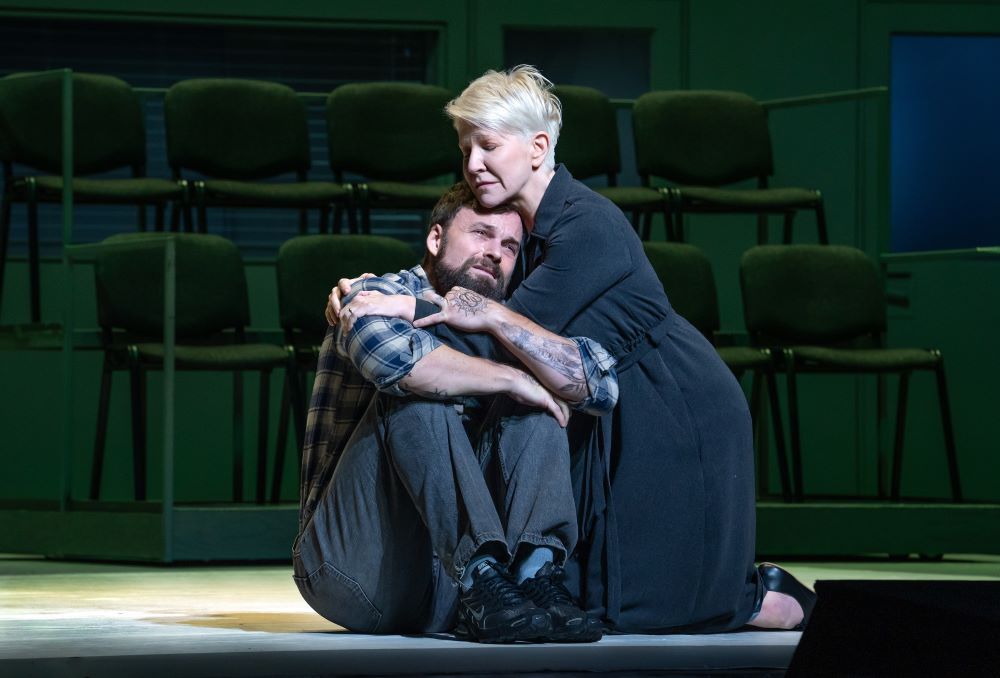
Photo: Met Opera/Karen Almond via National Catholic Register.
Ryan McKinny portrays inmate Joseph De Rocher and Joyce DiDonato portrays Sr. Helen Prejean in Jake Heggie’s opera Dead Man Walking.

My new friend Lynn S. is an opera lover. I met her when I was asked to interview someone for the newsletter at our current residence. She told me about attending a breathtaking Met opera broadcast in a local movie theater, Dead Man Walking. You may know the true story of the nun and the death row inmate.

As Javier C. Hernández reports for the New York Times, the opera generated an extra level of intensity when the Met took it to Sing Sing prison for a special performance.

“One by one, the inmates filed into a chapel at Sing Sing Correctional Facility in Ossining, N.Y. — past a line of security officers, past a sign reading, ‘Open wide the door to Christ.’ Under stained-glass windows, they formed a circle, introducing themselves to a crowd of visitors as composers, rappers, painters and poets. Then they began to sing.

“The inmates had gathered one recent afternoon for a rehearsal of Dead Man Walking, the death-row tale that opened the Metropolitan Opera season [in September]. Together, they formed a 14-member chorus that would accompany a group of Met singers for a one-night-only performance of the work before an audience of about 150 of their fellow inmates.

Michael Shane Hale, 51, a chorus member serving a sentence of 50 years to life for murder, said that he often thought of himself as a monster. 

“ ‘I feel like I’m at home,’ said a chorus member, Joseph Striplin, 47, who is serving a life sentence for murder, as the men warmed up with scales and stretches. ‘I feel I’m alive.’

Dead Man Walking, based on Sister Helen Prejean’s 1993 memoir about her experience trying to save the soul of a convicted murderer at the Louisiana State Penitentiary in Angola, has been staged more than 75 times around the world since its premiere in 2000.

“But the opera, with music by Jake Heggie and a libretto by Terrence McNally, had never been performed in a prison until last week at Sing Sing, which is home to more than 1,400 inmates.

“There were no costumes or props. Chorus members, who were dressed in prison-issued green pants, had to be counted and screened before entering the auditorium, lining up by cell block and building number. …

“Yet the opera, with its themes of sin and redemption — and of the pain endured by victims’ families — resonated with inmates.

“Michael Shane Hale, 51, a chorus member serving a sentence of 50 years to life for murder, said that he often thought of himself as a monster. In the 1990s, prosecutors sought the death penalty in his case. (New York suspended the practice in 2004.) Hale said the opera, which portrays the friendship between Sister Helen and Joseph De Rocher, a death-row prisoner, had taught him to see his own humanity. …

“Not everyone at Sing Sing, a maximum-security prison about 30 miles north of New York City, was enamored. Some prisoners declined to take part in the opera because of concerns about its dark themes, including the portrayal of a prisoner’s death by lethal injection. …

“The idea for bringing Dead Man Walking to Sing Sing emerged several years ago when an inmate promised the renowned singer Joyce DiDonato, who plays Sister Helen in the Met’s production, that the men could sing the chorus parts. …

“Paul Cortez, 43, who is serving a sentence of 25 years to life for murder, worked with [Bryan Wagorn, a Met pianist] to learn the score and held Saturday night rehearsals with small groups of prisoners at Sing Sing. Some were initially hesitant, unsure if the opera advanced prisoners’ rights and fearing they ‘might be exploited,’ he said, but eventually more people started showing up.

“ ‘It was daunting at first,’ said Cortez, who majored in theater in college. ‘I did not know how I was going to get the guys in shape. But they were so diligent. They took it seriously.’

“[In September] DiDonato, joined by Sister Helen, 84, visited the prison to work through the music and to get to know the participants. They discussed life in prison, morality, shame and stigma, as well as Sister Helen’s efforts to abolish the death penalty. Some inmates, saying they were still consumed by guilt about their crimes, asked about seeking forgiveness.

“DiDonato and Sister Helen returned [two days] after opening night at the Met, joined by singers and staff from the Met and Carnegie Hall. … The Met singers introduced themselves, taking pains to remind the inmates that they were only pretending to be prison guards and police officers. (‘Clemency!’ a prisoner shouted, after the bass Raymond Aceto announced he was playing the role of a warden.)

“Sister Helen, standing among the inmates, said that there was love and trust in the room. ‘This is a sacred gathering,’ she added. ‘There is no place on earth at this time that I’d rather be. We’re going to create beauty today, and you’re going to feel it.’

“For more than five hours, the men worked with the Met artists, under the conductor Steven Osgood, practicing rhythm, diction and dynamics in three sections that feature the chorus.

“They stomped their feet and clapped their hands in ‘He Will Gather Us Around,’ a spiritual that opens the opera, which is typically performed by women and children. And they sang with fiery intensity as De Rocher confesses his murder, shortly before his execution. …

“Then, around 6:30 p.m., an audience of inmates and corrections officials took their seats in the auditorium, adjacent to the chapel.

“ ‘The most beautiful thing in the world is a human being that does something and is transformed,’ Sister Helen said in introducing the opera. ‘Everybody’s worth more than the worst thing they ever did.’ ”

More at the Times, here. And there is no paywall at the National Catholic Register, here, where there’s an interview with Sister Helen. Really interesting!

Read Full Post »