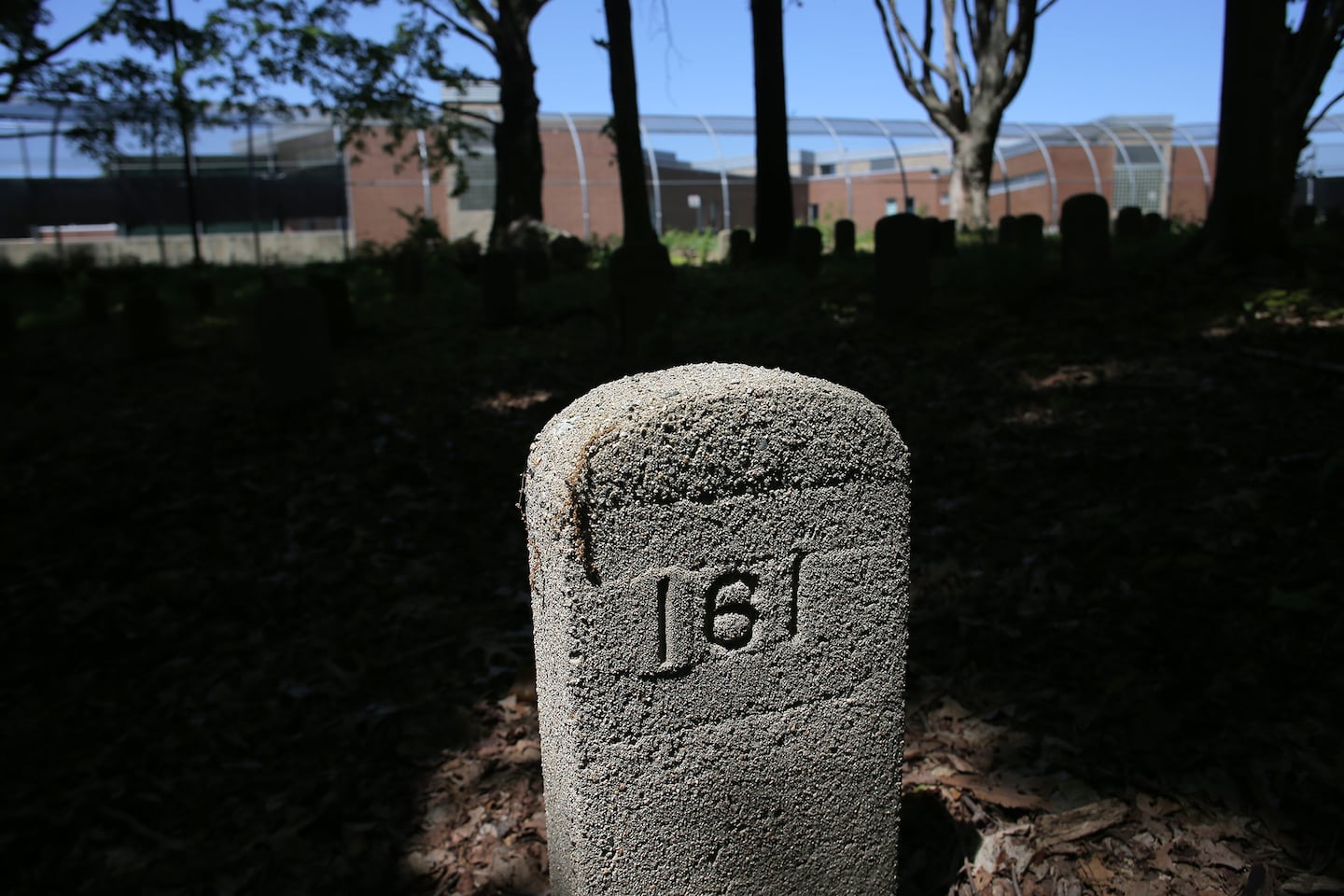
Photo: Lane Turner/Boston Globe.
A numbered grave just outside the Rhode Island Training School Thomas C. Slater Youth Development Center in Cranston, Rhode Island. Teens incarcerated at the facility helped bring the paupers’ graveyard to light, writing obituaries for the forgotten.
Recently, I read a Victorian novel (The Three Clerks, Anthony Trollope) in which the notorious Dickens villain Bill Sykes was favorably compared to a villain who was born with every opportunity to live an upright life. Trollope’s point was that for a pauper raised in poverty with no access to education or higher things it might be considered understandable that he went bad and died in ignominy.
I’m thinking about this in connection with today’s story about how paupers’ graves raised the consciousness of some youths in trouble with the law today.
Amanda Milkovits wrote at the Boston Globe, “Sometimes, as they played basketball outside at the Rhode Island Training School, the teens would glance through the security fence to the woods and brush that shrouded rows of small stones.
“ ‘What are they?’ A 16-year-old boy incarcerated at the Training School remembered asking one of the staff members.
“Graves, he was told. The plain, numbered concrete headstones marked the burial sites of 1,049 people who died a century ago.
“Some had been residents of the state asylum. Some were teenagers who lived at the former Sockanosset Boys Training School. Some had spent their last years in the state poorhouse. Some were stillborn infants who were never given names, factory workers who fell on hard times, immigrants who sought a better life, only to die far from home.
“What they all had in common was poverty and no one to claim their bodies. From around 1915 until 1933, the state gave them a simple burial in this place, known as the State Farm Cemetery Annex, or Cranston Historical Cemetery No. 107. Prisoners made the concrete headstones, which were engraved with numbers instead of the names of those buried 6 feet below.
“ ‘I thought it was just a regular grave site, but I’d never seen a grave with a number before,’ another boy told the Globe. … ‘It’s sad. No one should just be a number.’
“For decades, the cemetery has been a lonely, quiet place, cut off from public access because it’s bordered by the state’s maximum security prison, Route 37, and the Training School. …
“John Scott, a senior community development training specialist at the Training School, had been interested in the cemetery since he first caught a glimpse of it in the 1990s. The teens’ curiosity made him wonder whether those on probation or who needed to perform community service could help restore the cemetery, even if only by clearing some of the brush.
“But Theresa Moore, president of T-Time Productions, saw potential for more. Her company designs educational curriculums with the goal of shining light on untold or little-known stories, and was already working with the Training School on its educational programs for incarcerated youths. …
“ ‘I’ve always looked for projects to enhance their lives,’ Moore said, ‘so when John mentioned it, I thought, “Why don’t we make it happen?” ‘
She called the project: ‘They Were More Than A Number.’
“Moore reached out to the leaders of the Rhode Island and Cranston historical cemeteries commissions, who were delighted to share their knowledge — they’d wanted to restore that cemetery for years, but could never get access. She contacted Secretary of State Gregg Amore, who assisted with resources at the state archives, giving the teens access to records from the state infirmary that include doctors’ notes, reports from the state institutions … and burial records. …
“The students started their research. Records and documents from the state archives, the drone footage, and other resources were used to help them put the history into context. Some materials, such as a video of Lorén Spears, executive director of the Tomaquag Museum, explaining the ‘pencil genocide’ of Indigenous people, were scanned into a Google drive for about 50 students and their teachers. …
” ‘At first, I didn’t really care,’ admitted one 16-year-old boy, ‘but I wouldn’t like it if I was just a number.’ …
“A 16-year-old boy said he chose No. 500, and learned it was the grave of a man named John Holland, who died in 1915. When he wrote Holland’s obituary, ‘It made me feel bad that they didn’t have names,’ he said. …
“One day in late May, the teens and the adults involved with the cemetery project met in person along the security fence at the Training School. The view through the fence was clear now. Brush and saplings and debris had been hauled away, and there were two new signs, marking the site as a state and city historical cemetery. The cemetery was serene, shaded by the old silver maples.
“As the teens in their dark blue uniforms listened, accompanied by their teachers, Scott, Moore, and volunteers from the Cranston Historical Cemeteries Commission thanked them for their work and told them it had meaning.
“John Hill, chairman of the Cranston Historical Cemeteries Commission, had read some of the obituaries written by the students.
“ ‘You’re giving them their names back,’ Hill told them. ‘You are making them human beings again.’ …
“Scott knew why the teens incarcerated at the Training School could relate. ‘If anyone can understand what it means to be a number,’ he said, ‘it’s our students.’”
Read this long, beautiful article at the Globe, here.

 Suzanne's Mom's Blog