Feeds:
Posts
Comments

Posts Tagged ‘snails’

Photo: Ryan Kellman/NPR.
Inside this lab in Hawaii, David Sischo and his team care for 40 species of snails. For some snails, it’s the only place they live, having been brought into captivity to stave off extinction.

If we take care of the least of Earth’s organisms, we ultimately take care of ourselves. That’s one reason why today’s story on some obscure research actually matters, even at a time when humanity seems to have bigger issues on its plate.

Lauren Sommer and Ryan Kellman report at National Public Radio about Hawaii’s “jewels of the forest.”

“When Hurricane Douglas came barreling toward Oahu in 2020, David Sischo quickly packed up and drove to higher ground. But he wasn’t evacuating his family. He was evacuating snails.

“Sischo works with some of the rarest endangered species on the planet, kāhuli — Hawaii’s native tree snails. The colorful, jewel-like snails were once so abundant, it’s said they were like Christmas ornaments covering the trees. Almost all of the 750 different species were found only in Hawaii.

“Today, more than half of those species are gone, the extinctions happening in the span of a human lifetime. Sischo and his team with Hawaii’s Department of Land and Natural Resources have the heavy task of saving what’s left.

“To stave off extinction, 40 species of snails, each about the size of a dime, live in human care inside an unremarkable trailer near Honolulu. For some, it’s the only place they’re found, their wild populations having completely disappeared.

” ‘Most people, when they think endangered species going extinct, they think of pandas and tigers and elephants, but imagine having 40 different panda species that are all as rare as pandas are,’ Sischo says. ‘That’s what this facility is.’

“This winter, one species of snail will inch toward an auspicious milestone. It will be released in a special enclosure in the mountains of Oahu, one that has been painstakingly prepared to give the snails the best chance of survival in their natural environment.

“Still, the outlook for Hawaii’s snails is uncertain, symbolizing a new era in the conservation of endangered species. Around the world, plants and animals are being brought into captivity as a last-ditch effort against extinction. But as the climate heats up and invasive species continue to spread, many have no clear path to return to nature in the near-term. That could mean they stay in human care, isolated in zoos for the imperiled. …

” ‘I don’t think people realize how fast things are changing,’ Sischo says. ‘It’s happening, like right now as I’m talking to you, there’s species blinking out, out in the wild right now.’

“To keep that from happening to Hawaii’s native snails, Sischo never turns off his phone. They rely on life support systems in the Snail Extinction Prevention Program trailer, kept in environmental chambers that control temperature and release mist to simulate their native rainforest habitat. Sensors are set up to detect any problems, alerting Sischo and his team 24 hours a day. …

“Sischo pulls out one with snails the size of a fingernail hiding among the leaves. It’s Achatinella fulgens, a snail with a pale yellow shell and a bold black stripe swirling around it. … Other snails have intricate stripe patterns, almost like they’re sporting a plaid shirt. One snail has a shell like a miniature cinnamon roll. Some are almost iridescent, glowing with golds and greens.

” ‘Our tree snails are known as the jewels of the forest,’ he says. ‘The islands were dripping in snails. They were everywhere.’

“Hawaii’s tree snails play a crucial role in the ecosystem, having evolved over millions of years on the isolated islands. They don’t actually eat leaves, instead eating the fungus that grows on them. That helps keep the native trees clean and recycles nutrients in the forest. The snails also hold an important place in Native Hawaiian culture, their shells used to make lei.

” ‘In Hawaiian tradition, snails sing,’ Sischo says. ‘They represent voice. So they were probably one of the most revered invertebrates in the world.’

“Hawaii’s tree snails were no match for the barrage of changes that humans brought. Rats eat snails, and they arrived on ships, both Polynesian and European. The snails’ habitat disappeared as Hawaii’s forests were cleared for agriculture. But the biggest threat came in the form of another snail.

“In the 1950s, a predatory snail was introduced to Hawaii from Florida. The rosy wolf snail was released to control another invasive snail, but as so many invasive species stories go, it quickly spread. Rosy wolf snails are exceptionally good at eating native snails, hunting them down by following their slime trails and ripping them from their shells.

” ‘When they encounter a slime trail, they know the direction it was going,’ Sischo says. ‘Once they’re locked in on a trail from a native snail, they go right up to it. There’s no getting away.’ “

Oh, gee. That’s exactly what I meant in a recent post about introducing a species to address a problem. What if the fix goes awry and creates new problems?

More at NPR, here. No paywall.
Read Full Post »

Photo: Max Kleinen/Unsplash.
From snail jokes to antique presses, TikTok showcases museum nerds.

Either the anxiety over TikTok is overblown or I’m extremely gullible. Probably both. But so far, the only videos I’ve seen at TikTok are fun.

Suzanne is into the platform, too. At Easter she made a goofy video with the kids’ hands jiggling a rabbit charm from her company, Luna & Stella. For music, she used a strange version of “Here Comes Peter Cottontail” that TikTok had on offer. Even though the video wasn’t meant to be serious, she did get one query about price.

Today’s article by Kelsey Ables at the Washington Post is about how some museum employees are starting to have fun on TikTok.

“Not much has changed since Howard Hatch started working in the creaky, old printing shop at the Sacramento History Museum 22 years ago, writes Ables.

“He always arrives early in the morning so he can focus. In those quiet hours, … the only chatter comes from the machines: the gentle clinks and clatters of a 102-year-old jobbing press, his ‘one-legged StairMaster’ whirring to the beat of his pumping foot. To the tune of rattling ink rollers and clicking gears, he prints museum bags, holiday cards, and facsimile wanted signs and newspapers for visitors.

“Another press, the Washington hand press, works just as well as it did the day it was manufactured in 1852, Hatch says — with such certainty you’d think he used it back then. … Not much has changed these days, except that Hatch has an audience around the world watching.

“On TikTok, a popular app for sharing short videos, Hatch has gone from beloved local museum docent to — in the words of one online commenter — ‘a national treasure.’ Videos of him explaining the printing process or even simply using the equipment, which doubles as an exhibit, have racked up millions of views in a matter of months. With Howard at the helm, the Sacramento History Museum has become the most popular museum TikTok account in the world, boasting twice as many followers as the population of Sacramento.

“Most people associate TikTok with Gen Z, but Hatch is an octogenarian, and the star of the Carnegie Museum of Natural History’s widely followed account — snail expert Tim Pearce — is a baby boomer. The two men’s charm is not a result of keeping up with the latest memes and trends. Quite the opposite. Neither Hatch nor Pearce, who is known for his ‘Mollusk Monday’ jokes, own a smartphone or send text messages. Pearce calls himself ‘a technological klutz.’ …

“While TikTok has been the site of many online trends related to history — such as medieval TikTok and dark academia — the platform still lacks a significant presence from major U.S. museums. … Pittsburgh’s Carnegie museum paved the way.

“The museum began posting videos in early 2020, and it saw quick success with Pearce, the mollusk curator. …

Being on TikTok has allowed him to get closer to achieving one of his life’s goals: to make mollusks as popular as football. …

“There’s no doubt the success has to do with Pearce’s enthusiasm. Wearing a snail-patterned mask, Pearce begins each video the same way: ‘I’m Tim Pearce from Carnegie Museum of Natural History and I’ve got a snail joke for you!’ The way he emphasizes the word ‘snail’ captures an unbridled eagerness as pure as it must’ve been when he started collecting snails as a toddler. …

” ‘Natural history museums can become didactic really quickly,’ says Sloan MacRae, director of marketing at the Carnegie museum. TikTok, he says, allows them to show that scientists are approachable — even silly — and that natural history isn’t all dead animals and dioramas. …

“Still, when Jared Jones, a 28-year-old guest-services associate at the Sacramento History Museum, proposed starting a TikTok account, it didn’t go over well. … But the museum was desperate to stay relevant during the pandemic-induced closure, so the staff eventually gave in and opened an account. And Hatch hit his stride on the app not by dancing but by deadpanning.

“In one early video, Hatch is printing wanted posters on the hand press. ‘Can you explain a little bit more about it?’ Jones asks. ‘I would, but I’m really pressed for time,’ Hatch replies so matter-of-factly that the pun almost seems unintentional. …

“ ‘Some of [the Carnegie museum’s] popular personalities are gray-haired, very wholesome, grandparent-like personas,’ MacRae says, referring to Pearce and Bonnie Isaac, the botany collection manager. He has spotted online comments along the lines of ‘Adopt me, Bonnie!’ and ‘Tim, will you marry my mom?’ …

“Similarly, on the Sacramento videos’ pages, viewers liken Hatch to their grandparents. ‘Protect Howard at all costs’ has become a refrain among commenters, alluding to the ongoing coronavirus pandemic.

“Whenever the museum reaches a new milestone in followers, Hatch prints a newspaper announcement. As he moves around the print shop on those squeaky floorboards, he shakes his head and says, ‘I just don’t get it,’ which has become a catchphrase. And it’s true — Hatch isn’t keeping track of likes or followers. He’s just working in the print shop, as he has for decades — doing his thing in true 19th-century style and succeeding in the most 21st-century way.”

Great photos and video here.

Read Full Post »

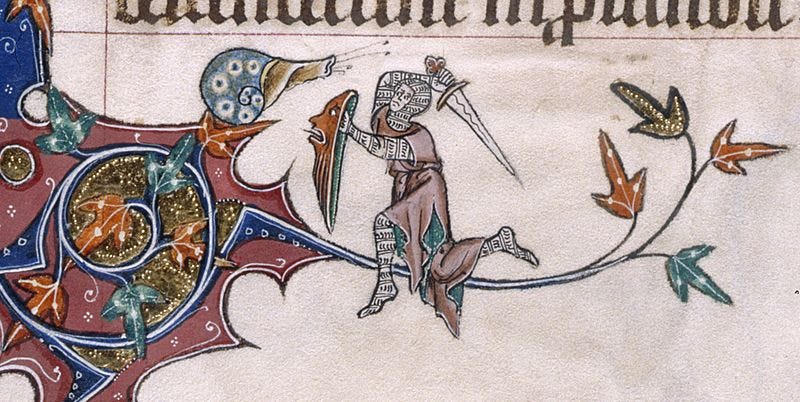
On twitter a while ago, Liz Devlin (@FLUXboston) highlighted a Vox video presenting an explanation of why snails appear in the margins of many medieval illuminated texts.

Vox reports that a Germanic people called Lombards, who had invaded Italy, were roundly scorned in the 1200s. Over time they became less warrior-like and more usurious. That is, they were money lenders, which gave them another kind of power. The theory is that the snail represents both the the hated Lombards’ lack of fighting ability and their power.

A group of librarians in the UK also looked into the research. They report as follows: “There has been much scholarly debate about the significance of these depictions of snail combat. As early as 1850, the magnificently-named bibliophile the Comte de Bastard theorised that a particular marginal image of a snail was intended to represent the Resurrection, since he discovered it in two manuscripts close to miniatures of the Raising of Lazarus.

“In her famous survey of the subject, Lilian Randall proposed that the snail was a symbol of the Lombards, a group vilified in the early middle ages for treasonous behaviour, the sin of usury, and ‘non-chivalrous comportment in general.’

“This interpretation accounts for why the snail is so frequently seen antagonising a knight in armour, but does not explain why the knight is often depicted on the losing end of this battle, or why this particular image became so popular in the margins of non-historical texts such as Psalters or Books of Hours.

“Other scholars have variously described the ‘knight v snail’ motif as a representation of the struggles of the poor against an oppressive aristocracy, a straightforward statement of the snail’s troublesome reputation as a garden pest, a commentary on social climbers, or even as a saucy symbol of female sexuality. It is possible that these images could have meant all these things and more at one time or another; it is important to remember, as Michael Camille, who devoted a number of pages to this subject, once wrote: ‘marginal imagery lacks the iconographic stability of a religious narrative or icon.’ “

Read more at the British Library website, here. Lilian M.C. Randall’s study “The Snail in Gothic Marginal Warfare” can be found here, at the University of Chicago Press journals site. Watch the video, too. It’s quite fun.

Read Full Post »