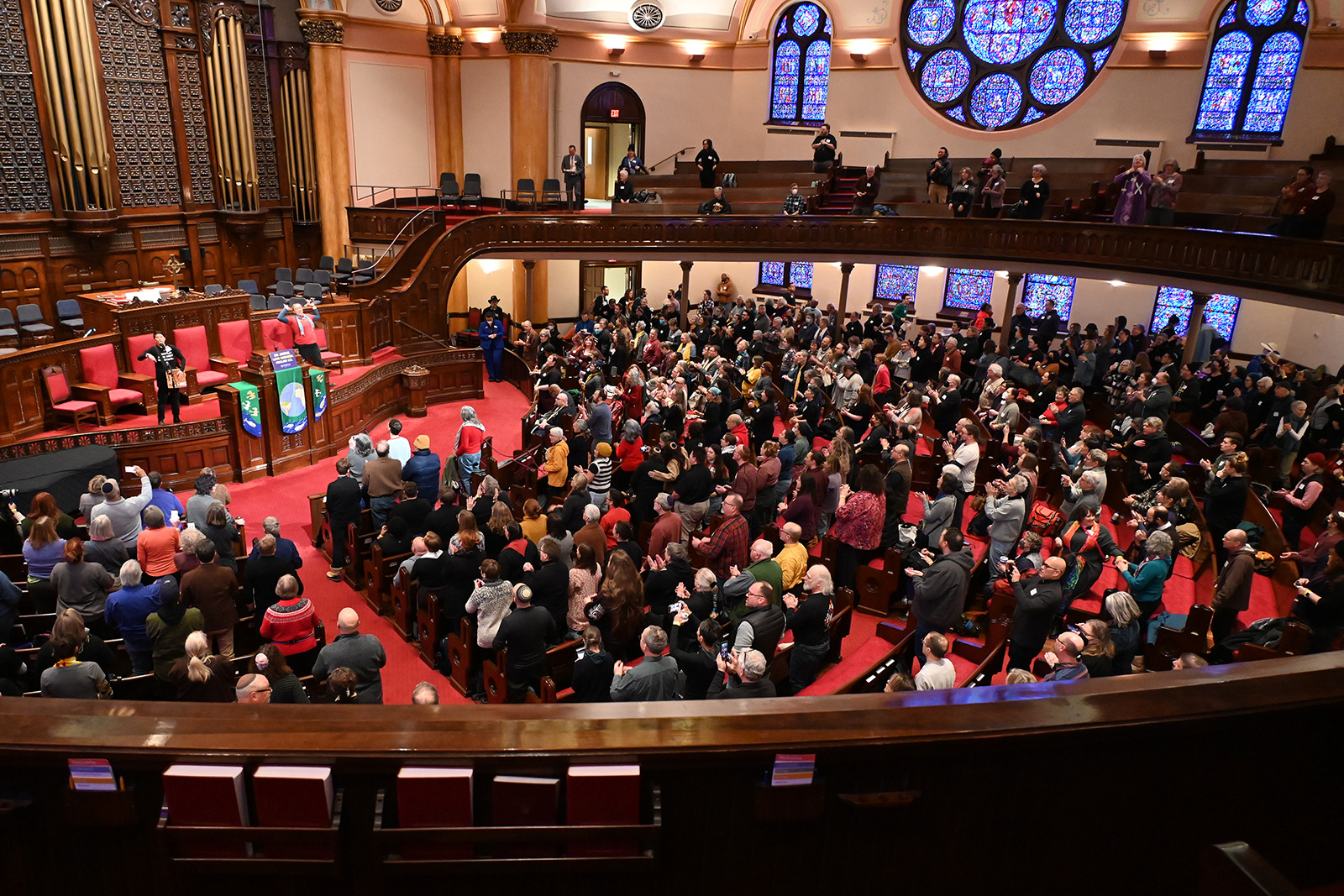
Photo: Religion News Service/Jack Jenkins.
Hundreds of clergy convened at Westminster Presbyterian Church, Thursday, January 22, 2026, in downtown Minneapolis, Minnesota.
Today’s post is about faith leaders in Minnesota and beyond bearing witness to wickedness and standing up for the values they share.
On Sunday, my husband and I heard a report from our own minister, who had just returned from protesting with those leaders in Minneapolis.
Although the largest interfaith demonstration so far was last Friday, mutual support among religious leaders has been going on a long time.
In December 2025, Louis Krauss of the Minnesota Star Tribune, wrote about faith leaders seeing signs that the government was going to start its attacks with the Somali community.
“A broad swath of religious leaders packed into a south Minneapolis mosque on Thursday to show solidarity and condemn ongoing attacks … against Minnesota’s Somali community. The crowd of more than 50 inside of Umatul Islam Center consisted of imams, pastors, rabbis and leaders from other religions who took turns cheering in support of Somali neighbors [amid] reports of the increased Immigration and Customs Enforcement (ICE) presence in the Twin Cities targeting the Somali population.”
As we know, ICE did arrive, reportedly three thousand strong. Even before the atrocities of January 24, a gathering of religious leaders was preparing to bear witness. Here are some results.
Interfaith Alliance posted this message on Sunday, January 25: “Rev. Paul Brandeis Raushenbush, president and CEO of Interfaith Alliance, just returned Friday evening from several days spent in Minneapolis marching, protesting, and rallying together with national and local faith leaders – who answered the call to do everything in their power to challenge ICE and call for them to leave Minnesota and cease terrorizing immigrants and their communities.”
Rev. Raushenbush said, “We echo the urgent demands of activists in Minnesota, including local faith leaders. ICE must leave Minnesota. … Across faith traditions, we are called to protect human dignity, care for the vulnerable, and resist systems that thrive on fear. That is why so many faith leaders and communities, in Minnesota and across the country, are showing moral leadership and courage to reject ICE.” More here.
Jack Jenkins wrote at Religion News Service, “As she stood at the pulpit at Westminster Presbyterian Church on Thursday (January 22), the Rev. Rebecca Voelkel, a United Church of Christ minister, looked out at the packed sanctuary with tears in her eyes.
“Far from the typical flock of Presbyterian worshippers who frequent the church on Sundays, the more than 600 people who filled the pews represented a wide range of faiths — Christians of all kinds as well as Buddhists, Jews, Muslims and Indigenous practitioners, among others. All were religious leaders who had traveled to Minnesota on short notice, spurred by their faith to oppose … mass deportation. …
“The moment marked the beginning of a remarkable two-day religious gathering in Minneapolis. … Constructed as a mix of activist trainings, spiritual revival and direct-action protests, Minnesota faith leaders who have been actively resisting Immigration and Customs Enforcement agents used the assembly as an opportunity to pass along lessons to clergy from other parts of the country. Amid prayers, songs and protest chants, the gathering heralded the emergence of a vast, faith-based network set on resisting the administration’s mass deportation effort.
“Religion News Service was one of only three outlets given access to the conference, which was largely organized by the local religious advocacy group Multifaith Antiracism, Change and Healing, known as MARCH. The size of the event was striking, given how quickly it came together: The public invitation was published on MARCH’s website only a week before the event began, and organizers said so many clergy wanted to take part that they eventually had to halt applications due to logistical concerns.” More at at Religion News Service.
Meanwhile, the Times of Israel noted from afar that a rabbi was among those arrested at a demonstration: “At least one local rabbi was arrested Friday in Minneapolis as hundreds of faith leaders from around the country gathered to protest Immigration and Customs Enforcement activity in the Twin Cities.
“Rabbi Emma Kippley-Ogman, the Jewish and interfaith chaplain at Macalester College in St. Paul, was briefly detained by police alongside leaders of other faiths while staging a protest at the airport. In photos and video from the protest just before the arrest, Kipley-Ogman can be seen delivering brief remarks while wearing a rainbow tallit and standing in a line at the airport’s arrivals gate with several other faith leaders who hold hands and pray.” More.
Jack Jenkins filed a separate report with the National Catholic Reporter, “Around 200 faith leaders fanned out across the city on Thursday (January 22) to observe and document the actions of Immigration and Customs Enforcement, with some clergy confronting Department of Homeland Security agents, adding a visible religious presence to widespread efforts to counter the president’s mass deportation campaign in the region.
“The faith leaders, who are in Minneapolis as part of a larger convening focused on religious pushback to ICE, deployed to neighborhoods with significant immigrant populations, where DHS agents have been most active during an ongoing campaign known as Operation Metro Surge. The clergy, who hail from a range of traditions and worship communities across the country, sang on the buses as they ventured out into the street. They belted out hymns and songs popular during the Civil Rights Movement, such as ‘Woke Up This Morning.’ ” More.
A Hindu writer posted this: “I arrived in Minneapolis on Wednesday (January 21). I had come because local organizers said people were being disappeared: kidnapped off the street, detained, shot in plain daylight. I went because there was a cry for help from a devastated community.
“Nothing prepared me for what I saw. The city was a battleground where ICE feels like an occupying force.
“A Hindu organizer and activist, I went as an ally of a 50-strong Rabbis for Ceasefire delegation, some of whom I knew from our trip to Israel and the Palestinian territories in August, to see the effects of the Gaza war. I saw there firsthand what occupation looks like. Minneapolis felt occupied, too.
“On Friday we participated in Minneapolis’ citywide day of action, a general strike, for which hundreds of local businesses chose to close. Some gave free food and drink to people participating. More than 50,000 people — faith leaders among them — marched to abolish ICE in spite of frigid temperatures. The march culminated in a huge rally in an indoor stadium, where local faith leaders, union leaders, and elected officials offered speeches and prayers of defiance and resilience.
“Within that larger strike, our faith convergence took part in actions of defiance organized by MARCH. At Minneapolis Airport, 106 local clergy were arrested, while some 600 local community members and out-of-town clergy stood witness. Later, I joined a group of multifaith clergy in song, prayer, and presence at the B.H. Whipple Federal Building, where Minnesota’s ICE offices are headquartered.” More.




 Suzanne's Mom's Blog