Feeds:
Posts
Comments

Posts Tagged ‘soundscape’

Photo: Nashville Airport.
Singer Songwriter Joe West is the “house band” for the Nashville International Airport. He’s the son of Sarge and Shirley West, the first and only African American Country and Western Duo.

Remember when going to the airport was fun and even exciting? It’s sad that all the protective measures needed now have made the experience excruciatingly tiresome. Nowadays when I think of wanting to visit someone by plane, I hesitate.

Among the attributes of airports that today’s travelers object to is noise, and today’s story is about how some airports are making an effort to change that unpleasantness.

Dee-Ann Durbin has the story at the Associated Press.

“Background music,” she writes, “is no longer an afterthought at many airports, which are hiring local musicians and carefully curating playlists to help lighten travelers’ moods.

London’s Heathrow Airport built a stage to showcase emerging British performers for the first time this summer. The program was so successful the airport hopes to bring it back in 2025. Nashville International Airport has five stages that host more than 800 performances per year, from country musicians to jazz combos. In the Dominican Republic, Punta Cana International Airport greets passengers with live merengue music.

“Tiffany Idiart and her two nieces were delighted to hear musicians during a recent layover at Seattle-Tacoma International Airport.

“ ‘I like it. There’s a lot of people here and they can all hear it,’ said Grace Idiart, 9. ‘If their flight got delayed or something like that, they could have had a hard day. And so the music could have made them feel better.’

“Airports are also carefully curating their recorded playlists. Detroit Metro Airport plays Motown hits in a tunnel connecting its terminals. Austin-Bergstrom International Airport in Texas has a playlist of local artists compiled by an area radio station. Singapore’s Changi Airport commissioned a special piano accompaniment for its giant digital waterfall.

“Music isn’t a new phenomenon in airport terminals. Brian Eno’s ‘Music for Airports,’ an album released in 1978, helped define the ambient music genre. It’s minimalist and designed to calm.

“But Barry McPhillips, the head of international creative for Mood Media, which provides music for airports and other public spaces, said technology is enabling background music to be less generic and more tailored to specific places or times of day.

“Mood Media – formerly known as Muzak – develops playlists to appeal to business travelers or families depending on who’s in the airport at any given time. It might program calmer music in the security line but something more energizing in the duty-free store. …

“There’s a science to Mood Music’s decisions on volume, tempo, even whether to play a song in a major key versus a minor one, he added. ..

“At the same time, many airports are going low-tech, hiring local musicians to serenade travelers and give them a sense of the place they’re passing through.

“Chicago’s O’Hare and Midway airports have more than 100 live performances each year. Phoenix’s Sky Harbor International Airport began a live music program five years ago and now has two stages featuring local artists.

“Tami Kuiken, the manager of airport music in Seattle, said the Seattle-Tacoma airport launched its live music program about a decade ago after a city commissioner heard live music at the airport in Austin, Texas.

“ ‘The idea was like, “Man, why doesn’t Seattle have music? We’re a music city too,’ Kuiken said. …

“It decided to try live musicians for a 12-week trial. It was so successful that the airport now features live musicians daily and is building new performance spaces.

“ ‘People’s anxiety levels are very high when they’re traveling,’ Kuiken said. ‘The feedback that we started getting was that once they got through the checkpoint and they were greeted with music, all of a sudden their anxiety and stress levels dropped.’ …

“When Colorado Springs Airport announced a live music program in March, more than 150 musicians applied. It now hosts two two-hour performances each week.

“David James, a singer and guitarist who plays at Seattle’s airport about once a week, said waking up in time for a daytime gig took some adjustment. But he’s gained new fans from all over the world.

“ ‘I get really sweet responses from people all the time, saying, “That was so soothing to be able to just sit and listen to [music],” ‘ James said. …

“Country stars like Blake Shelton and Keith Urban have come through Nashville’s airport and interacted with local musicians, said Stacey Nickens, the airport’s vice president of corporate communications and marketing. Shelton even gave one his guitar.

“Otto Stuparitz, a musicologist and lecturer at the University of Amsterdam who has studied airport music, said airports should think carefully about their selections. Music that’s meant to be actively listened to – like live music or catchy pop songs – can be very distracting in an already chaotic environment, he said. He has noticed some airports – especially in Europe – turning off piped melodies altogether. …

” ‘A well-crafted audio strategy is one that people aren’t particularly cognizant of,’ he said. ‘They just know they’re having a good time and that it’s appropriate.’ ”

I think that watching musicians playing live would create a more relaxing ambiance for me than canned recordings by whatever Musak calls itself now. How about you?

More at AP, here.
Read Full Post »

Photo: Masha Karpoukhina for Fondation Cartier pour l’art contemporain.
Soundscape ecologist Bernie Krause. Bernie Krause, 2021.

Spring is a time of year when birds are so vocal, I really do feel accompanied by music on my walk. Today’s story is about turning the sounds of nature into a kind of music that can be heard at any time of year.

Christine Ajudua at Artnet interviewed the artist behind “The Great Animal Orchestra” in November. His show will be at the Peabody-Essex Museum in Salem, Massachusetts, until May 22.

“In the late 1960s, Bernie Krause was at the top of his game as a musician, sound designer, and master of the Moog synthesizer, recording with the likes of Van Morrison, George Harrison, Mick Jagger, Brian Eno, and The Doors, while working on films such as Apocalypse Now. Then, he gave it all up and went wild — literally.

“Krause has been exploring the natural world as a pioneering soundscape ecologist ever since. And his masterpiece —’The Great Animal Orchestra‘ (November 20–May 22, 2022), originally commissioned by Paris’s Fondation Cartier pour l’art contemporain in 2016 — is about to have its North American premiere at the Peabody Essex Museum in Salem, Massachusetts. …

“The exhibition is based on 5,000 hours of Krause’s field recordings from the past 50 years, featuring 15,000 terrestrial and marine species from around the globe — many of them since lost or currently at risk. With the soundscapes reinterpreted as large-scale, animated spectrograms by the London-based collective United Visual Artists, it is an immersive and highly moving experience of the ever-vulnerable sound universe.

“Krause is meanwhile the subject of a new Cartier Foundation–produced documentary directed by the French filmmaker Vincent Tricon. …

ARTNET: What inspired you to move on from your life as a musician to explore the natural world as a soundscape ecologist? What are the biggest differences — and perhaps similarities — between your lives then versus now?

BERNIE KRAUSE: Paul Beaver, my late music partner, and I got invited to record with some awesome artists and groups [in the late 1960s]. But when it got to the point where we were being asked to replicate the sounds produced on previous sessions, something inside snapped — I found myself staring at the padded, windowless walls of studios in L.A., London, and New York, with mixed feelings of terror, boredom, and immobility. It was at that point that I began looking for an escape. …

“As it happened, Paul and I had just been signed by Warner Brothers to do three albums. For our own mental health, we sought to produce something thematic that hadn’t been tried before and where we could explore some of the Moog’s performance options we hadn’t shared with other artists. Our initial album, titled In a Wild Sanctuary, centered on the theme of ecology, and natural soundscapes [were] a main constituent of the orchestration. We needed a quiet rural area or wild forest in which to record.

“I didn’t go terribly far to secure those early recordings — just across San Francisco’s Golden Gate Bridge to a small park in Marin. But when I cranked up my new stereo recorder and heard the numinous impression of a nearby stream, the illusion of larger-than-life sonic space, the edge-tones of a pair of ravens’ wingbeats as they cut an arc across the sky overhead, and a gentle sea breeze in the redwood canopy wafting in from the Pacific to my west …

… something inside me instantly changed. I felt relaxed and present in the living world and amazingly free of anxiety.

“I had discovered for myself a new sense of being and felt obliged to go wherever that reaction took me. I was 30 years old then. …

“I begin by finding habitats that are relatively untouched by human endeavor. Then I identify a local naturalist or biologist that knows intimate details of the area [and its] unique wildlife [to] help facilitate my time on site. But for the most part, I prefer to work alone.

Over the course of a 24-hour day, I’ll likely record four two-hour sessions: a dawn chorus, a midday chorus, dusk and nighttime choruses, times when biophonies are likely at their peak. [These are] the collective sounds coming from all organisms in a given habitat at one moment in time.

“When I return to the studio, the first thing I do is transfer all of the field data related to that recording into my archive. Then I have two basic avenues of expression. The first, through science, is to write and publish a paper related to what I’ve observed given what the data show. The problem with that avenue is that very few people read this literature.

“If I want to reach a much larger audience, I turn to the arts, transforming the data into programs that are widely accessible and emotionally evocative while at the same time keeping the integrity of the message firmly intact. …

“I had written and released a book, The Great Animal Orchestra: Finding the Origins of Music in the World’s Wild Places — basically the story of how we learned to sing, dance, and speak from mimicking the voices of the natural world. [It] was translated into seven languages, one of which was French. Somehow, a French anthropologist, Bruce Albert, who has been working with the Yanomami tribe in northern Brazil for decades, found a copy and gave one to his good friend, Hervé Chandès, director of the [Cartier] foundation. After reading it, Hervé contacted me in 2014 proposing that I take some of the raw field data and transform them into large-scale sonic art pieces. …

“Over the course of a few intense days, we auditioned the soundscapes of many habitats, whittling them down to a couple of dozen. From those, I proposed a selection of 15 or 16 habitat recordings to choose from. With the field recordings from those selections, I began the transformation process, taking raw material representing each location, assembling and mixing the various segments and generating a seamless acoustic narrative that I felt would capture and evoke the essence of each unique biome.

“And because most of what we observe of the living world has been through what we see, we decided to include a visual component — one that illuminated the soundscapes. …

“If the habitats they represented were healthy, that condition [would] show in the structured detail of the spectrograms. Conversely, if the habitats are under stress, then the spectrogram images will appear to be chaotic and incoherent.

“With the expertise and insight of Matt Clark and his team at UVA [United Visual Artists], the problem of converting those sounds into instantaneous streaming spectrograms was solved.”

More at Artnet, here. No firewall.

Read Full Post »

20sci-climattesounds-jumbo

Art: Matt McCann
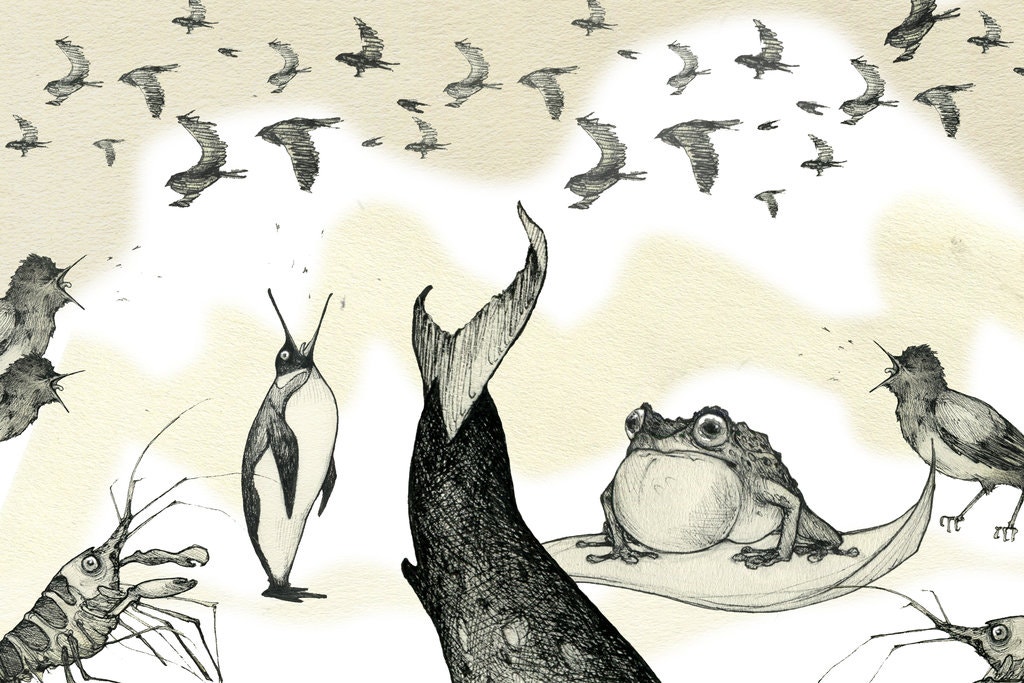
As the planet warms, say scientists, Earth’s creatures are having a harder time making noises needed for survival.

Today is the 50th anniversary of the first Earth Day. Are you old enough to remember what you were doing then? I was teaching sixth grade language arts in a Pennsylvania public school. The science teacher spearheaded our Earth Day and made sure everyone absorbed lessons about pollution.

Pollution was the biggest concern 50 years ago, says Denis Hayes, Earth Day founder. Global warming “was not part of the national discussion,” but that has changed, he adds.

Among the many climate-change topics I could highlight on this Earth Day, I found the altered soundscape of the natural world especially interesting.

Emily Anthes writes in the Science section of the New York Times, “Spring in Sugarloaf Ridge State Park, in Northern California, is typically a natural symphony. Streams whoosh, swollen with winter rains, and birds — robins, sparrows, grosbeaks, woodpeckers and hawks — trill and chatter.

“But in 2011, a yearslong drought set in. By spring 2015, a local creek had dried up and the valley had gone quiet. ‘The park went from an extremely vibrant habitat to one that was dead silent,’ said Bernie Krause, a soundscape ecologist who has been recording in the park since 1993.

‘Nothing was singing, nothing was chirping, nothing was moving. It’s like it was dead.’

“In the coming years, severe droughts are likely to become more common; as the water dries up, bird song could disappear along with it. It is just one example of how climate change may be altering the planet’s soundscapes, or ‘breaking Earth’s beat,’ as Dr. Krause and his colleagues put it in a paper last year. Dr. Krause, who has amassed more than 5,000 hours of natural recordings for his company, Wild Sanctuary, wrote the paper with Jérôme Sueur, an ecoacoustician at the French National Museum of Natural History in Paris, and Almo Farina, an ecologist at the University of Urbino in Italy.

“Climate change will silence some species and nudge others into new habits and habitats, changing when and where they sing, squeak, whistle, bellow or bleat. (In New York, several species of frogs now begin croaking nearly two weeks earlier in the spring than they did a century ago.) It will also alter the sounds that animals produce, as well as how such vocalizations travel.

“These shifts could make it more difficult for wild creatures to attract mates, avoid predators and stay oriented, as well as force them to expend more energy to make themselves heard. …

“Snapping shrimp are some of the noisiest creatures in the ocean. By rapidly closing their large claws, the animals make snaps, crackles and pops loud enough to stun prey into submission. But ocean acidification, which occurs as seawater absorbs rising levels of carbon dioxide, could soften their snaps. … Researchers at Australia’s University of Adelaide found that the shrimp snap less often and at lower volumes when the water becomes more acidic. …

“ ‘It’s not that ocean acidification completely takes away their ability to make loud snaps,’ said Ivan Nagelkerken, a marine biologist who led the study. ‘They can still do that but essentially don’t want to do that any more.’ [Meanwhile] many marine organisms, especially fish larvae, rely on the sound of snapping shrimp to navigate to suitable habitats.”

Other sound research is on the birds of northern Denmark. “In spring 2010, they were singing from positions nearly four feet higher above the ground than in the late 1980s, Anders Moller, an ecologist at the French National Center for Scientific Research, found.

“Dr. Moller suspects that climate-related changes in vegetation could be responsible. Over the last several decades, the spring and summer temperatures in the region rose 20 percent and precipitation increased 30 percent, he found, and other research has demonstrated that spring is arriving earlier than it used to across much of Europe.

“Foliage can interfere with the transmission of bird songs. If trees are leafing out earlier, or the vegetation is denser, birds might seek higher song posts to avoid this interference, Dr. Moller suggested. He found that species that breed in the forest increased their singing height more than those who mate in more open habitats, like grasslands.

But sitting higher in the trees could come with costs, too. ‘A bird that sits more exposed will run a higher risk of being captured by a sparrow hawk,’ Dr. Moller said.

“Climate change will bring extreme weather, including more frequent and intense storms, to many places on the planet. This uptick in wind and rain could drown out animal calls. … King penguins, which rely on acoustic cues to find their mates and chicks in crowded colonies, … cannot fully counteract the noise, and it takes them longer to find their mates when the wind is howling.”

Lots of other curious tidbits about changing soundscapes here.

Are you doing anything particular for Earth Day? Before lockdown, I was thinking of joining a demonstration against fossil fuel expansion, Stop the Money Pipeline. Instead I’ll probably donate to that, the Arbor Day Foundation, or the highly rated Eden Reforestation Projects. Bad air quality has made coronavirus more deadly, and trees remove pollutants.

Read Full Post »


Photo: Ginny Fordham
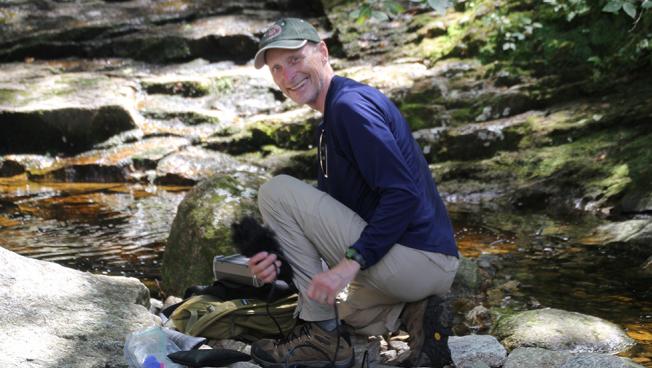
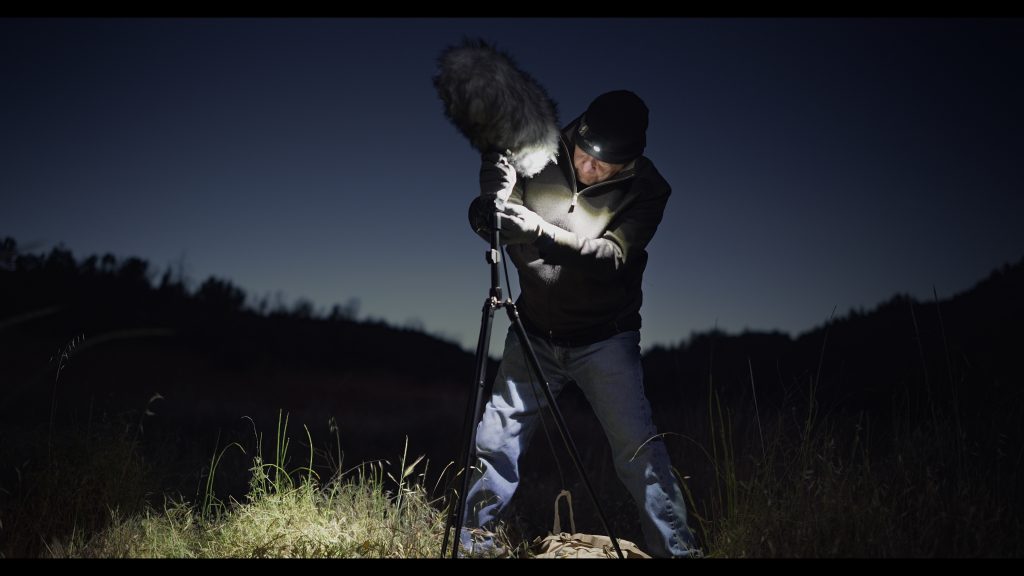
Berklee professor Steve Wilkes gathers sound at the White Mountain National Forest in New Hampshire. A recent project also captures Cape Cod.

Berklee professor Steve Wilkes and his collaborator David Masher have created some amazing soundscapes that capture the music of the natural world. Their work is described at the Hear the Forest website:

“Hear The Forest is an effort to initiate the process of building an aural-map – essentially, an audio time capsule – of New Hampshire’s White Mountain National Forest.  Supported by the National Forest Service and the Arts Alliance of Northern New Hampshire, this work will be performed by Berklee College of Music Professor, Steve Wilkes, as part of the 2017 Artist-in-residence program. …

“In addition to his field ecology and sound recording work, Wilkes will offer several public programs, including workshops that will provide residents and visitors with information on contributing to the ongoing sound file collection on the White Mountain National Forest. …

“ ‘I hope to be able to express and communicate to others this profound sense of inspiration – and to help everyone slow down a bit, and really listen,’ ” Wilkes says. More here.

You might also like hear an interesting interview with Wilkes that was broadcast at WGBH. The station provides this intro: “Nature is rich with dynamic sounds, like the roaring of waterfalls or the sweetness of birdsong.

“Berklee professor Steve Wilkes … captured the still whispers of buzzing bugs, the martian-like atmosphere at the summit of Mount Washington and the laughter of children enjoying the park — all essential sounds to create a ‘digital aural map’ of the forest, which he calls Hear The Forest. Callie Crossley speaks with Wilkes about his project.” More here.

I like the idea of encouraging others to contribute their own nature recordings to the White Mountains project. It feels like something anyone could do if they just paid attention — and paying attention is the whole idea.

Read Full Post »

Do you know about the “Great Animal Orchestra“? Rachel Donadio at the NY Times has the story.

“The bioacoustician and musician Bernie Krause has been recording soundscapes of the natural world since 1968, from coral reefs to elephant stamping grounds to the Amazonian rain forest.

“Now, Mr. Krause’s recordings have become part of an immersive new exhibition at the Cartier Foundation here called ‘The Great Animal Orchestra.’ Named after Mr. Krause’s 2012 book of the same title, the show opens on Saturday and runs through Jan. 8, [2017].

“At its heart is a work by the London-based collective United Visual Artists, who have transformed Mr. Krause’s recordings of the natural world into 3-D renderings. Imagine stepping into a soundproofed black-box theater whose walls spring to life with what look like overlapping electrocardiograms, representing different species’ sounds. …

“The installation includes recordings Mr. Krause made in Algonquin Park in Ontario, where he found himself caught between two packs of wolves; in the Yukon Delta, a subarctic area in Alaska, where birds from different continents converge; and in the Central African Republic, where he heard monkeys. He also captured the cacophony of the Amazon, and whales off Alaska and Hawaii. …

“Mr. Krause is a polymathic musician who performed with the folk group the Weavers and helped introduce the Moog synthesizer to pop music — including songs by the Doors and Van Morrison — and film scores. He hears natural sounds with a studio producer’s ear.”

Read more here about Krause and his efforts to get the word out on the disappearing habitats of his featured animals.

This article inspires me to pay better attention to the music of the natural world on my morning walks. So much beauty goes right over my head.

Photo: Tim Chapman
Bernie Krause on St. Vincent Island, Fla., in 2001.
 

Read Full Post »

Living on Earth, a national radio program produced in Somerville, Massachusetts, has interviewed an interesting guy who makes audio recordings of nature.

He may record, for example, what a woodland sounds like before a logging company comes in and what it sounds like after clear cutting. He may record the sounds of insects in trees. He says it is nearly impossible to get away from man-made sounds when recording nature.

Listening to his recordings early this morning resulted in my listening for the birds more on the walk I took later. (And I turned to see a very jubilant cardinal.)

“Few have heard the world as Bernie Krause has. Originally trained as a musician, he spent years recording the most famous musicians of the 1960s and 70s. Then he left the studio to explore the origins of music in nature. Krause has recorded wild sounds in places few have ever been or even dreamed of. Living on Earth’s Ike Sriskandarajah listens in.” Listen here or read transcript.

Krause calls his field of study soundscape ecology. Here is his new book, The Great Animal Orchestra.

Read Full Post »