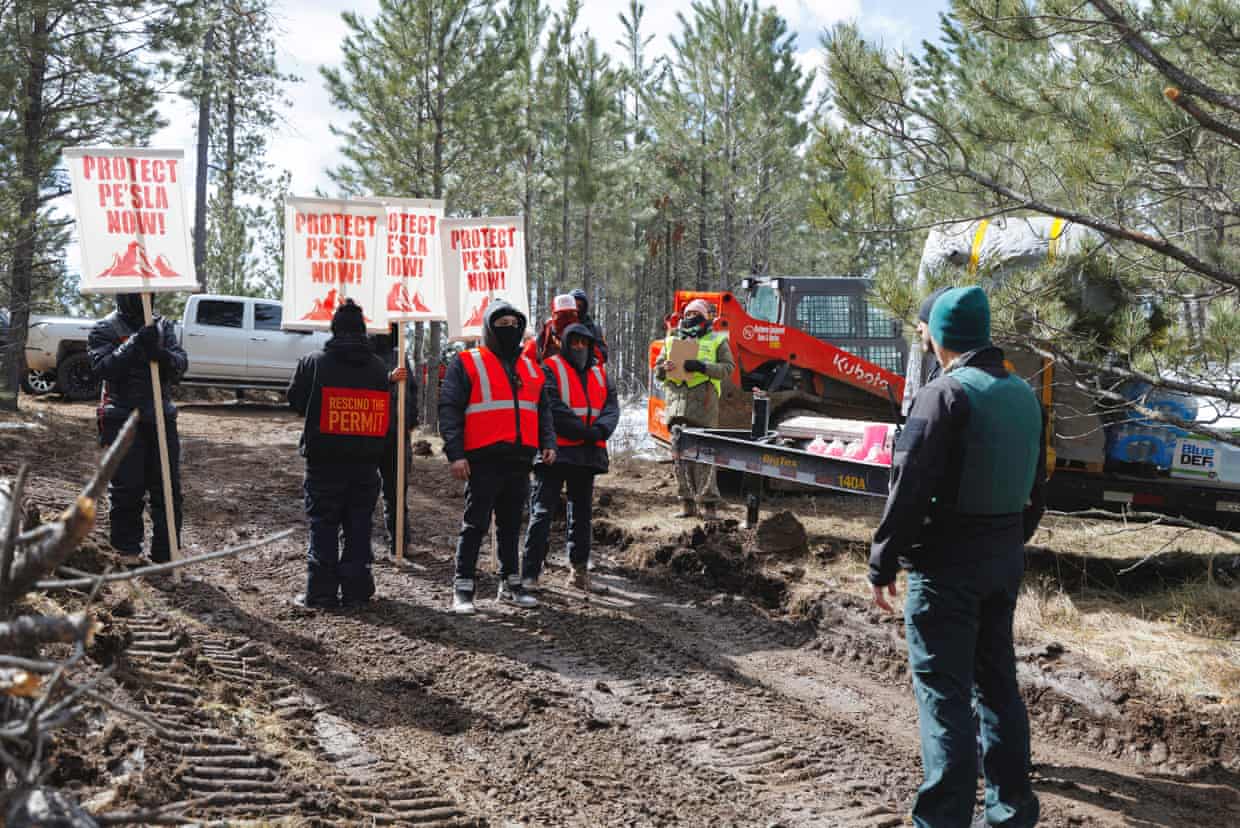
Photo: Angel White Eyes.
At the sacred prairie of Pe’ Sla in South Dakota, indigenous and environmental groups banded together to halt drilling. They chased out the mining company one week.
As one indigenous leader tells the story, “All we had were our prayers.”
But according to Shilpi Chhotray at the Guardian, protesters “knew it was bad optics to drag an Indigenous prayer camp off a mountain on camera.”
She begins, “When two Oglala Lakota scouts heard drilling was expected to begin on Pe’ Sla, the sacred prairie in the Black Hills of South Dakota, they set out on back trails. They needed to find out where. That’s when they saw a deer break ahead and a red-tailed hawk soar above them – less like a coincidence than being led, the scouts said. Over a rise, they came upon a road freshly cut to the dirt. They followed it, past a parked truck. ‘Oh my god,’ one of them said, seeing a drill turning. ‘They’re drilling now!’
“What happened next was something that almost never happens in Indian country: a coalition of tribes and organizers banded together and drove out a mining company in a matter of days.
‘We’re just not used to winning,’ said Dr Valeriah Big Eagle, who directs the Black Hills work of NDN Collective, an Indigenous-led advocacy nonprofit based in Rapid City. …
“The fight to protect ancestral land from mining is a common one, and the struggles are often long, hard and lost. In March, the government handed Oak Flat, an Apache holy site in Arizona, to a copper company to gouge out one of the largest mines in North America – a transfer the tribe is still in court trying to reverse. In April, the Senate voted to strip protections from Minnesota’s Boundary Waters, a watershed in Ojibwe treaty territory where the bands still hunt, fish and gather; the battle has since moved to the statehouse. The consequences of losing aren’t abstract: poisoned water, sacred ground turned to open pit, and the lasting health toll extraction leaves on Native land while the profits flow elsewhere.
“But at Pe’ Sla, what the Great Sioux Nation calls the ‘heart of everything that is,’ the coalition broke the pattern, moving on every front at once. It was a lesson, they said, in what organized power can still win.
“The threat arrived the way these things usually do: as paperwork. On 27 February, the US Forest Service quietly approved exploratory drilling by Pete Lien & Sons, a local mining and construction-materials company. They could drill 18 boreholes on national forest land, at least 10 of them inside a two-mile buffer around the central meadow that the tribes and the agency had agreed to protect. It was waved through with a ‘categorical exclusion’ that skipped environmental review on land prayed over for thousands of years.
“Pe’ Sla holds a sacred place in the world of the Great Sioux Nation. Wizipan Little Elk Garriott – the president of NDN Collective and a former Interior department official – describes it beginning with the sky. It is where Fallen Star came to Earth, and where, in a world scoured by fire and water, the people went inside to survive and later emerged. It’s also where traditionally foraged plants like the timpsula, the prairie turnip with its short spike of purple flowers, grow, and its root, high in calcium, is the real gift. Pe’ Sla is a church, a pantry and a pharmacy at once – the ceremony, the food and the medicine all right there in the ground. The ground that was almost drilled open.
“What the company was drilling for only sharpened the insult. Graphite is a ‘critical mineral’ of the energy transition, the stuff in electric-car batteries. Which means the drills boring into the birthplace of a people were there to help save the planet. …
“Even though the permit drew broad opposition – from tribes, local officials and the public – the Forest Service granted it anyway. So the coalition of tribal nations, the NDN Collective and two environmental groups escalated.
“The legal front moved first: in early April, NDN Collective, the Black Hills Clean Water Alliance and Earthworks sued the Forest Service, and nearly every tribe in the Dakotas filed a second suit of their own. But the courts were slow and the company was quick. When Pete Lien & Sons learned a restraining order had been filed, it went to round-the-clock drilling, boring as many holes as it could before a judge ruled. …
“Before dawn on 30 April, organizers sent up a drone and found the company had moved overnight, its crews now on two lit pads across the highway. The convoy had already set out – a caravan of about a dozen vehicles strung along the highway under a high, bright moon. With the ground still frozen, they climbed the Forest Service roads. At the only road in, 40 of them blocked the way behind them and put their bodies on the drill pads so no rig could run.
“ ‘It was supposed to be one day, to make a statement,’ Robert Bordeaux, a Sičáŋǧu Lak̇ot̄a poet who joined the occupation, told me for Peace & Riot. ‘It went so well we decided to stay.’
“For seven days, they lived on those pads – intergenerational by design: a youth council out front and elders anchoring the camp. They held it through helicopters overhead, three lines of police and private security, and a night that fell to 10 degrees with no fires because the hills were experiencing a drought. They stayed warm with hand warmers and each other. Even then, the scouts said, the camp felt strangely calm – held, protected – as if the relatives they’d prayed to were with them. …
“On 4 May, a federal judge halted the drilling, finding the plaintiffs were likely to prove that the Forest Service had unlawfully waved through a supposedly under-a-year project whose permit required three years of work. Still, the organizers didn’t leave – they didn’t trust a company that could pay a fine to stop. Days later, Pete Lien & Sons wrote to the Forest Service withdrawing its plan.”
More at the Guardian, here. The Guardian notes that “the story was supported by the journalism nonprofit the Economic Hardship Reporting Project.“


