Feeds:
Posts
Comments

Posts Tagged ‘space’

Photo: Martin Nuñez-Bonilla.
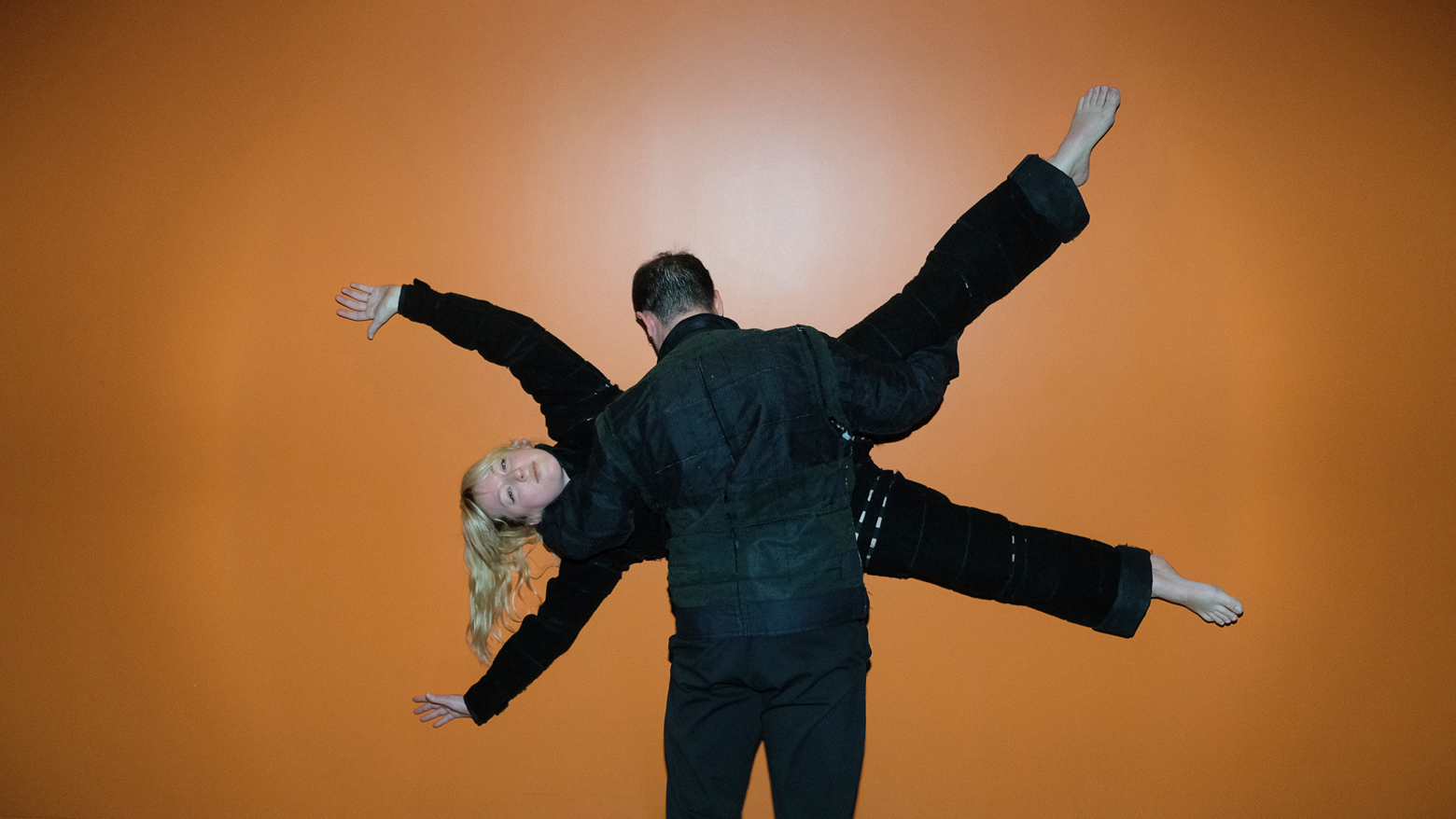
Sasha Peterson and Michael Figueroa in “Slapstuck” at the Conference for Research on Choreographic Interfaces last June.

Usually it’s people with science backgrounds who go into space. But artists are curious about everything, as we know, and some wonder what their own role in space travel might be. Some dance artists who have looked seriously into the possibilities of weightless choreography are now starting to rethink the ramifications.

Chava Pearl Lansky writes at Dance Magazine, “In a performance at the Conference for Research on Choreographic Interfaces [CRCI] this past June, Sasha Peterson leaned the side of her body onto Michael Figueroa’s shoulders, sharing weight in a traditional contact-improvisational lift. But rather than disembark back to the floor, Peterson rolled down Figueroa’s back — and stayed there, her body perpendicular to his, suspended in space.

“How? The answer in this case was Velcro-covered suits, lent by choreographer David Parker, who created ‘Slapstuck.’ … Velcro is just one form of technology that dancers are using to simulate the effects of weightlessness here on Earth. But for some, the end goal is to experience a true lack of gravity by bringing dance to space.

“ ‘Dance in zero gravity completely transforms how we think about choreography and performance,’ says Sydney Skybetter, the founder of CRCI and director of the Brown Arts Institute at Brown University. ‘When you remove the floor, which is the fundamental organizing principle of terrestrial dance, bodies become three-dimensional sculptures moving through space multi-axially.’ …

“There are a number of ways to simulate dance without gravity here on Earth, and dancemakers are experimenting with several of them. Last March, Peterson, Figueroa, and fellow dance artists Laila Franklin and Kate Gow came together for CRCI’s Movement in Microgravity residency, in which they created a base dance phrase and tested it in environments with varying gravitational relationships. In addition to working with Velcro suits, the group ventured to a trampoline park, an anti-gravity yoga class, float tanks, a pool, and a spatial-orientation laboratory. …

“Some dancers are interested not in bringing codified dance steps into space, but in taking the gravity out of a gravity-based practice. In 2022, dancer, geologist, and planetary scientist C. Adeene Denton wrote an essay in this magazine about her dream of dancing on the International Space Station. She’s spent a great deal of time both watching and speaking with astronauts and has enjoyed learning about the movements in microgravity that these experts already find fun.

” ‘What they like to do in their spare time is to try to crank up the momentum and shoot themselves through different passageways, or figure out different ways that they can spin,’ she says. Denton is also fascinated by effort. Astronauts living on the ISS, for example, learn how much energy they need to exert just to stay put. In order to stay still to work or eat, they grip a railing with just one or two toes.

“When she imagines what it would be like to dance on the ISS, Denton dreams about dueting with the space station itself. ‘Astronauts there are constantly drifting and following the motion of the space station as it orbits the Earth,’ she says. ‘So, I think it could be really interesting to try to do the microgravity equivalent of standing in one place.’

“[Multidisciplinary artist Sage Ni’Ja] Whitson is now beginning research in aerial performance techniques, with a goal of continuing their research via parabolic flight — the closest thing to space travel currently available on Earth — and, eventually, actual space travel. …

“[But now] the dancers are questioning the cost of parabolic flights, where dedicated research space can cost tens of thousands of dollars, and some artists have expressed concern over the privatization of space travel by billionaires like Elon Musk and Jeff Bezos. ‘Right now, space exploration is being shaped by people with some extremely problematic ideological stances,” says Skybetter.

“[Denton adds] ‘I would still love to dance in microgravity, but I think that is ultimately kind of a selfish dream that needs to be superseded by doing the kinds of good things on Earth that we can do.’ “

More at Dance Magazine, here.

Read Full Post »

Photo: Jessica Rinaldi/Globe.
Janelle Emmanuel, a Watertown resident, opted to rent out her driveway on Spacer, a parking app that’s gaining users around Boston.

When my friend Sara was a professor at Harvard and Stanford tried to lure her to the West Coast, the most irresistible thing that Harvard offered her was a parking space in Cambridge. There was a spot next to her office building that used to change hands every year among the faculty. It could be hers permanently. Sara stayed.

Although I myself always took public transportation when I worked in Boston and Cambridge, I learned that on a day when I needed a car, parking could be a real problem. There are public garages, of course, but the cost is a king’s ransom. No one who commuted to work in a city would want to pay that every day.

A new app makes it easier for someone with an unused parking space to help out someone who needs a space — and make some money at the same time. Today, using a driveway as an income generator is not just for people who live near the beach.

Collin Robisheaux writes at the Boston Globe, “Everything is pricey these days, and a little extra income can go a long way.

“Enter Spacer, an app that strives to be the ‘Airbnb of monthly parking‘ by connecting commuters in need of an empty space with locals who have an unused parking spot or driveway.

“It works like this: Someone with an empty driveway can download Spacer, input some personal information and details about the spot, and list it on the app or website for renters to reserve in month-long periods. Renters can then snag the parking spot for their personal use. …

Spacer Technologies was founded in Australia in 2015, before expanding to North America and acquiring Where I Park Inc. earlier this year. With more commuters returning to the office, parking has become a more pressing need — and Spacer has been a beneficiary, with Boston receiving more booking requests in October than any other city on the app. …

“With snow causing headaches for drivers with outdoor parking, some users may be thinking ahead, with booking requests for covered spots in the Boston area up 77 percent since July.

“Spacer said it has about 300,000 users globally, and hundreds of rentable spots in and around Boston. It makes money by taking 25 percent of transactions; the remaining 75 percent goes to the users who rent out their spaces.

“Daniel Vernick, 25, in Somerville [said,] ‘It was quite straightforward. It definitely took away some of the rent burden.’ …

“Vernick was able to net $220 per month. That kind of extra cash is what sets Spacer apart from other parking apps, according to Jeremy Zuker, chief executive of North America for Spacer Technologies.

“ ‘You can actually take something that you’re not using, like your driveway or your garage, and you can just turn that into a revenue stream,’ Zuker said. …

“Spacer is relatively new to the rental scene and has plenty of competition. Websites like Facebook and Craigslist have long served as platforms for advertising and renting out parking spaces.

“But Janelle Emmanuel, who joined both Spacer and Craigslist to rent out her driveway last year, says she feels more secure on Spacer than she did digging through Craigslist.

“ ‘I feel like with Craigslist, you don’t really always know what’s going on there,’ Emmanuel said. ‘But Spacer, I felt very safe.’

“Emmanuel rented out her driveway in Watertown, capable of fitting up to three cars, after a friend recommended the rental service as a side gig. Emmanuel said the app adds an element of separation between the renter and the host, which made her feel more secure.

“Residential neighborhoods like Allston, Brookline, Somerville, and parts of Cambridge are all popular locations on the app. Spots in the downtown and Seaport areas are fewer and pricier, but executives at Spacer hope the app can help with parking congestion in the city.

“ ‘This whole idea of efficiency is about both the infrastructure and the spaces,’ Zuker said. ‘But also just in getting people where they need to get without wasting time and fuel.’ “

All my friends in rural America must be laughing now. But you know, it’s a good thing that humans can figure out how to do what they have to do. I will say that better even than a rented parking space is an employer that subsidizes your use of public transportation. I sure missed that perk after I left MIT.

More at the Globe, here.

Read Full Post »

Looking for an affordable venue for your chamber music group, your living-room theatrical production, your poetry group’s public readings? Need a performance space with a cat to give your book promotion that certain je ne sais quoi?

Nidhi Subbaraman has a nice piece at the Boston Globe‘s betaboston site on a tool that can help you find the perfect space.

“Gregorian Oriental Rugs opens at 10 a.m. every weekday, and with wood floors and high ceilings, this converted paper mill in Newton is an airy showroom for antique Turkish flat-weaves, Ikats from India, and countless other intricate, handmade imports from the Far East and Middle East. Some evenings, however, the expensive carpets and rugs are folded, stacked, and put aside, and the store is transformed into an intimate performance venue for local artists. …

“Most people hear about this unusual event space from friends. But to reach community art groups, Gregorian recently listed his venue on SpaceFinder Mass, a kind of Airbnb for the performance world that came to Massachusetts in January. The service connects artists hunting for budget performance or rehearsal space with unusual, informal, and affordable venues.

“ ‘We talk about SpaceFinder being a discovery tool,’ said Lisa Niedermeyer, its program director. Venues can share their calendar for availability, and artists can search by square footage, rates, and timing. The website also handles payments for the bookings.

“Started in New York three years ago, SpaceFinder was developed by Fractured Atlas, a nonprofit group that supports artists. SpaceFinder lists more than 6,600 spaces in 11 cities in the United States, plus Toronto, where you can rent a pirate ship. In Philadelphia, artists can rent a mosaic sculpture garden. …

“SpaceFinder was launched in Massachusetts in partnership with the Arts and Business Council of Boston, and more than 200 venues in the state are listed, most of which are themselves in the arts business — small museums and theaters, for example, dance studios and art galleries.

“In addition to Gregorian, other outliers include a fitness club in Dorchester and a winery in Southampton. …

“To connect with active art communities in far-flung corners of the state, Fractured Atlas reached out to Seth Lepore, an independent artist in Easthampton, to spread the word about the service among artists and to enlist venues.

“ ‘Space is a huge issue here in Western Massachusetts,’ said Lepore, who helped connect SpaceFinder with local studios.” More here.

Photo: Jessica Renaldi/Globe staff
Gregorian Oriental Rugs on a regular work day.

Read Full Post »

My husband pointed out this cool story about how NASA is using 3-D printing. I have had a couple posts about using 3-D to create food, but this is the first use of the technology that really makes sense to me. It’s sending design instructions to someone you have no physical access to so they can create a needed tool.

Janet Fang writes at IFLScience, “For the first time ever, hardware designed on the ground has been emailed to space to meet the needs of an astronaut. From a computer in California, Mike Chen of Made In Space and colleagues just 3D-printed a ratcheting socket wrench on the International Space Station. ‘We had overheard ISS Commander Barry Wilmore (who goes by “Butch”) mention over the radio that he needed one,’ Chen wrote in Medium [in December]. So they designed one and sent it up.

“ ‘The socket wrench we just manufactured is the first object we designed on the ground and sent digitally to space, on the fly,’ he adds. It’s a lot faster to send data wirelessly on demand than to wait for a physical object to arrive via rockets, which can take months or even years.

“The team started by designing the tool on a computer, then converting it into a 3D-printer-ready format. That’s then sent to NASA, which transmits the wrench to the space station. Once the code is received by the 3D printer, the wrench is manufactured: Plastic filament is heated and extruded layer by layer. The ISS tweeted this photo earlier this week, and you can see more pictures of the very cool wrench-printing process here.” More here.

Photo: NASA
Commander Barry Wilmore, traveling in space, shows off a 3D printed ratchet

Read Full Post »

Joe Palca, at National Public Radio, recently had a nice report about astronomy and optics.

I thought of John and his OpticsForHire team.

“It used to be that if astronomers wanted to get rid of the blurring effects of the atmosphere,” says Palca, “they had to put their telescopes in space. But a technology called adaptive optics has changed all that.

“Adaptive optics systems use computers to analyze the light coming from a star, and then compensate for changes wrought by the atmosphere, using mirrors that can change their shapes up to 1,000 times per second. The result: To anyone on Earth peering through the telescope, the star looks like the single point of light it really is.

“The reason the atmosphere blurs light is that there are tiny changes in temperature as you go from the Earth’s surface up into space. The degree to which air bends light depends on the air’s temperature.

“With adaptive optics systems, telescopes on Earth can see nearly as clearly as those in space.” More at NPR.

Photo: Heidi B. Hammel and Imke de Pater
The near-infrared images of Uranus show the planet as seen without adaptive optics (left) and with the technology turned on (right).

Read Full Post »

Quoting from The Next Web, Andrew Sullivan posts today about a Canadian astronaut who may be on his last trip to space, given the Canadian government’s cutbacks.

“Commander Chris Hadfield is one of the most memorable astronauts to have gone into space, so it was fitting that his farewell moment to the world saw him record the first ever music video from space.

“Ahead of his return to Earth on Monday after five months at the International Space Station (ISS), the 53-year-old Canadian astronaut fittingly covered the David Bowie classic ‘Space Oddity’ in a poignant video.

“Hadfield has maintained strong links to folks at home, having entertained his 700,000-plus Twitter followers with regular photos and commentary, and taken part in a Reddit AMA interview, but music was always a focus for him.

“He recorded the first song in space last December, and, speaking before his latest mission, he admitted that he would record a range of songs in space.”

Read more at AndrewSullivan.

This video is really, really wonderful.

Read Full Post »