Photo: Thejavikho Chase.
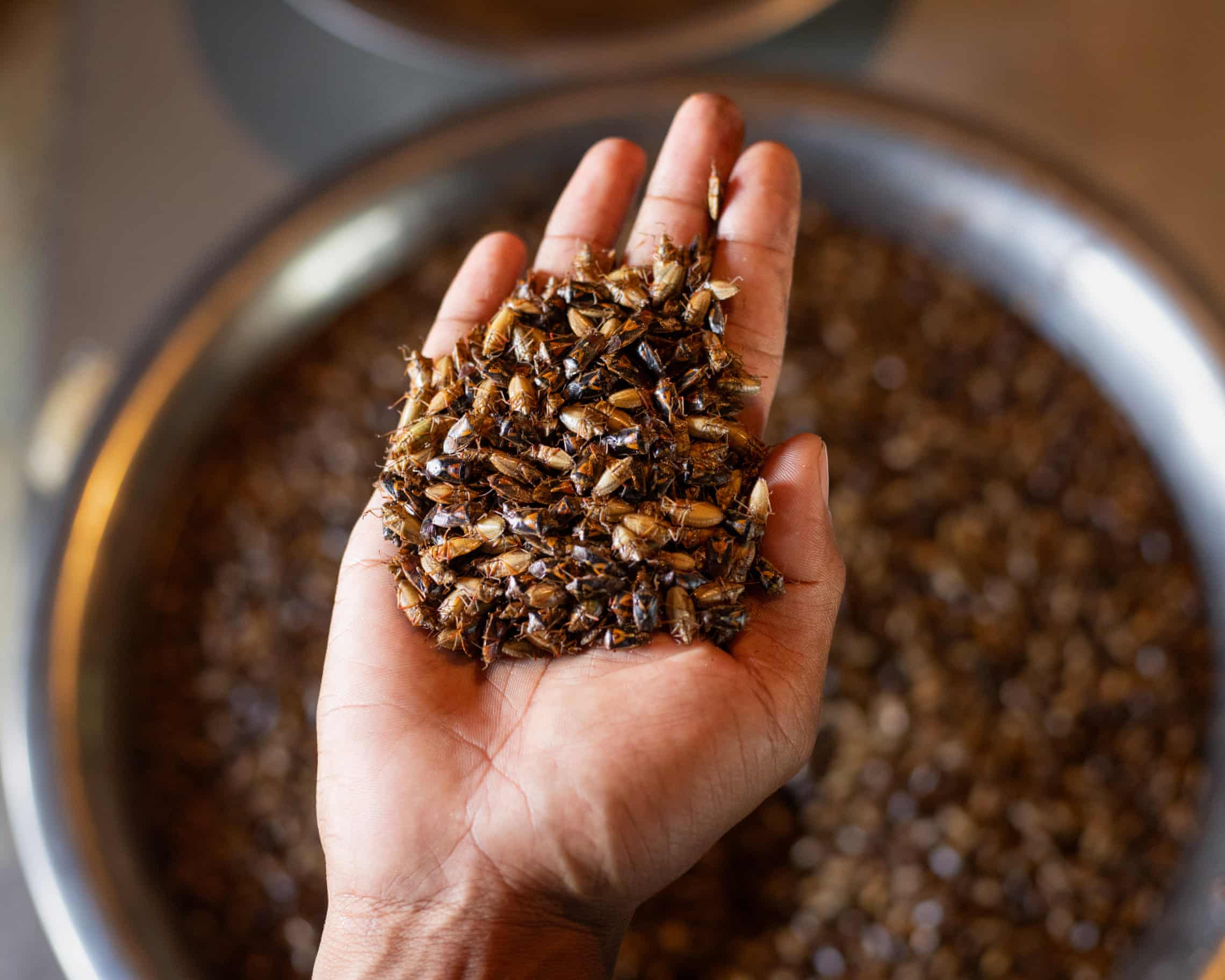
Today we learn that stink bugs can be ground into a thick paste and used to make valuable products.
OK, this food may be nutritious, but it sounds pretty gross to me. I suppose that eating unfamiliar foods outside your culture takes extreme hunger — or a sense of adventure.
But as Femi Ezhuthupallickal Benny and Thejavikho Chase report at the Guardian, the people who routinely eat stink bugs are doing it because they like it.
“Every few years when Udonga montana, a bamboo-feeding stink bug, erupts in massive swarms,” they write, “the people of the Mizo community in northern India don’t reach for pesticides. Instead, they look for baskets.
“Locally, this small brown stink bug is called thangnang. Outsiders see them as an infestation but in the bamboo forests of Mizoram state this small brown bug has long been woven into the food culture.
“Drawing on generations of traditional ecological knowledge, the Mizo people have developed an intricate system of harvesting, processing and consuming the insects that not only provides high-protein nutrition but also helps control pest populations without harming the forest with pesticides.
“ ‘We have been eating thangnang for more than 100 years,’ says Salemkulhthangi, an elder from the Serhmun village. …
“The big harvesting opportunity comes during mautam, the rare mass flowering of bamboo (Melocanna baccifera) that triggers stink bug outbreaks. ‘There isn’t a fixed date or month; it’s mostly around September-October,’ says Lalvohbika, a conservationist at Dampa tiger reserve in Mizoram. …
“Instead of spreading a sheet on the ground to collect the falling insects, as entomologists might, the Mizo have designed a fishing net-like implement with a long bamboo handle and a conical plastic pocket held open by a strong circular metal wire. As the flowering approaches, the villagers shake the branches, sending the bugs tumbling into the net. Once full, the bag’s narrow end is untied and the catch is emptied into gunny sacks at the base of the trees.
“Hot water is poured over to kill the insects, which are then cleaned and put in a basin where twigs, leaves and other debris are removed by hand. The cleaned bugs are soaked again in warm water, then ground into a thick paste that is processed into two valuable products: a fragrant cooking oil used as food and medicine, and a protein-rich paste used as animal feed.
The taste, it should be said, is an acquired one.
“The stink in the bugs’ name comes from the pungent odor they emit when they are stressed or threatened. … The oil that appears as a top layer as the paste is boiled is carefully skimmed off, bottled and sold in local markets. Nothing goes to waste: even the pulp that remains after oil extraction becomes hmun hlui, a tangy condiment eaten with rice, and the leftover residue is sun-dried and fed to pigs. …
“As global demand for protein rises and climate change threatens food security, the Mizo way of turning a sporadic pest outbreak into protein is a reminder that perhaps the future of food lies not in modern laboratories but in the ancient wisdom. …
“Yes, insects can ravage crops and frustrate farmers, but some of the creatures that chew through leaves and stems are, remarkably, more nutritious than the plants they destroy. … As the entomologist Victor Meyer-Rochow once asked: ‘Why kill insects when they per se are nutritious?’
“It’s a question that resonates deeply in several villages in north-east India where even crop pests find their way into the cooking pot, not out of desperation but as part of a sustainable, seasonal diet that values what their land provides.”
More at the Guardian, here. Have you ever tried chocolate-covered ants or any similar foods that Westerners like me are too squeamish to enjoy?

 Suzanne's Mom's Blog