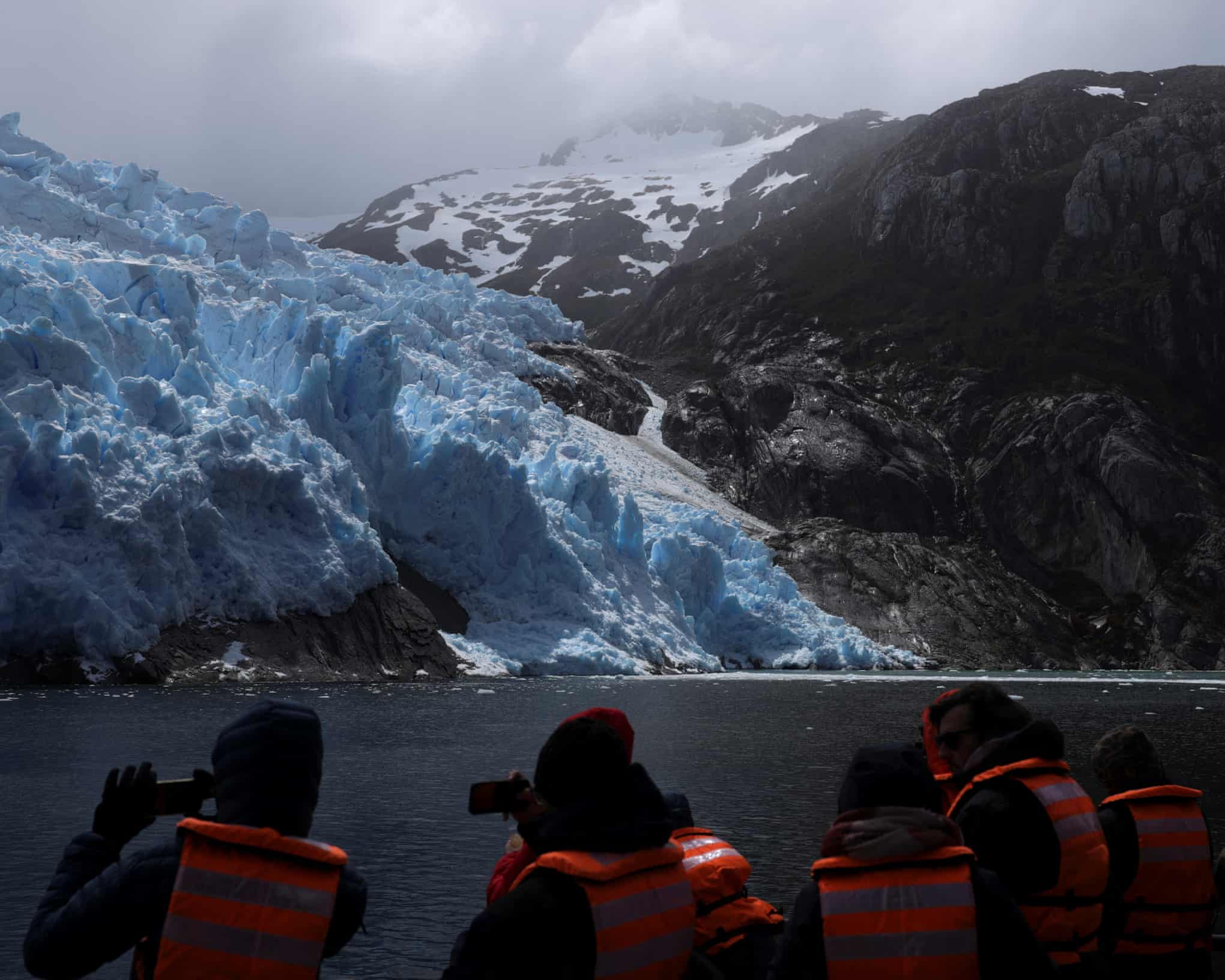
Photo: Pablo Sanhueza/Reuters.
The Sarmiento de Gamboa glacier in the strait of Magellan.
The conservation effort in today’s article would never have been possible without the dedication of many conservation-focused individuals, including donors. The participation of one of those donors, the founder of clothing company Patagonia, should interest my younger grandson. He loves the company for its sustainable policies.
John Bartlett wrote recently at the Guardian about how the dedication of conservation-minded individuals has benefited Chile.
“Chile’s government is poised to create the country’s 47th national park, protecting nearly 200,000 hectares (500,000 acres) of pristine wilderness and completing a wildlife corridor stretching 1,700 miles (2,800km) to the southernmost tip of the Americas.
“The Cape Froward national park is a wild expanse of wind-torn coastline and forested valleys that harbors unrivaled biodiversity and has played host to millennia of human history.
“ ‘I have been to many exceptional places, and I can tell you that the Cape Froward project is the wildest place I have walked through,’ said Kristine Tompkins, the renowned US conservationist at the heart of the project. ‘It’s one of the few truly wild forest and peak territories left in the country, and the richness of the Indigenous history in the region makes a case for these territories to be preserved for all time.’
“It is the 17th national park created or expanded in Chile and Argentina by Tompkins Conservation and its successor organization, Rewilding Chile. The groups have spent the best part of a decade knitting together a patchwork of land purchases and state-held properties to create the park. In 2023, they signed an agreement with the Chilean government to donate the land to become Cape Froward national park.
“[Last] February, a population of 10 huemul, an endangered deer species, was found in the park, and a network of cameras regularly captures wild pumas and the endangered huillín, a river otter. The area also encompasses 10,000 hectares [~25,000 acres] of sphagnum bogs, a spongelike moss which stores carbon deep below the ground.
“Benjamín Cáceres, the conservation coordinator in the Magallanes region for Rewilding Chile, is a native of Patagonia who first visited Cape Froward at the age of 12 with his conservationist father, Patricio Cáceres. ‘My father was always a dreamer,’ he said. ;When he found out about an abandoned lighthouse all those years ago, he brought us here as a family.’ …
“The San Isidro lighthouse is one of seven designed and built by the Scottish architect George Slight along the treacherous strait of Magellan. It was abandoned in the 1970s and itinerant fishers would come by to salvage wood until the roof collapsed. Now, Patricio and Benjamín’s vision for the restored lighthouse is becoming a reality. It has been converted into a museum of the natural and human history of the area and – together with a cafe on the beach below – will become the entry point for the new national park.
“Dotted along the shoreline are delicate archaeological sites that enshrine the history of the Kawésqar, a nomadic Indigenous people who navigated fjords, rocky beaches and forests in canoes carved from trees. …
“ ‘The area was widely inhabited by nomadic canoeists who lived by fishing and gathering food,’ said Leticia Caro, a Kawésqar activist who belongs to the Nómades del Mar community. ‘For our community, it is very important to protect this area, where you can also see the different ways of inhabiting the land and seas, and the interaction with other peoples like the Yagán, Selknam and Tehuelche.‘
“Long after Indigenous communities had settled in the area, the waters of the strait of Magellan, which the Kawésqar call the tawokser chams, became the link between the Atlantic and Pacific Oceans. … The murky depths have claimed many lives and spawned legends. Treasure troves lie in the depths, and sealed bottles of rum have washed ashore over the centuries. …
“There are still a number of steps before the national park officially comes into existence.
“An Indigenous consultation process, a legal requirement for large-scale projects in Chile, was held in September but fell flat. Chile’s environment ministry said it would make ‘every effort’ to advance with plans for the park by March. But if no progress is made after two years, the lands revert to the ownership of Tompkins’ organizations.
“ ‘Each of the park projects we have developed has specific reasons for being considered essential for conservation,’ said Tompkins, who was the chief executive of Patagonia outdoor clothing for 20 years until 1993. ‘And in this sense Cape Froward is a piece of an ecological puzzle that, over time, should ensure that key biodiversity sites within Chilean Patagonia are permanently protected.’ ”
More at the Guardian, here.

 Suzanne's Mom's Blog