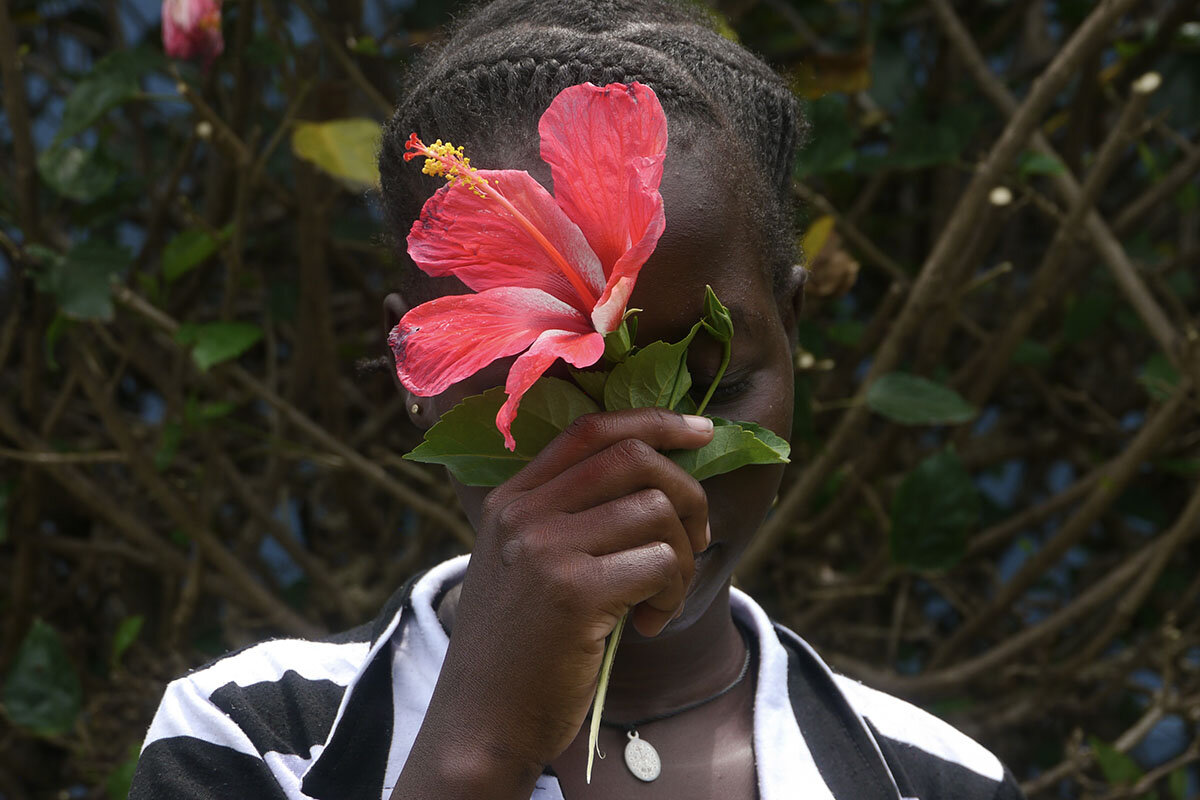
Photo: Sophie Neiman.
Ms. Acogo spent several years on the street before receiving vocational training as a tailor from Hashtag Gulu in Uganda.
Recently, PRI’s The World broadcast a valuable but scary series on orphanages in Uganda, nearly all of which are bad. For children from impoverished or abusive homes, the alternative may be life on the streets.
In an issue last December, the Christian Science Monitor‘s Sophie Neiman wrote about how one city’s concerned citizens began helping street children reach for a better life.
“In the sticky evening,” she begins, “two boys in torn clothes dart between shop verandas and wrestle in the dust, trading jokes that quickly turn to insults. Onlookers grunt disapprovingly, angry at the noise. More groups of rowdy children will soon stream into the back alleyways of [the small city of Gulu] in northern Uganda, eking out a life in its underbelly.
“By day, the children pick through discarded plastic bottles trying to gather enough of them to sell. At night, they hang out in the shadows of dance clubs or sleep under pieces of cardboard between shop shelves that normally hold fruit.
“Steven Onek strolls over to the squabbling boys. Speaking in a calm and quiet voice, he breaks up their argument. A few minutes later, around another street corner, he comforts a teenager sporting a deep cut on his head, providing the boy with some money to see a doctor.
“Such situations are commonplace for Mr. Onek, who is a program officer at Hashtag Gulu, a small organization supporting the city’s homeless children. For him, it is not so much a job as a calling.
‘Helping a child, one child out of the street, I feel like I have helped the whole nation,’ he says, smiling.
“The name Hashtag Gulu points to its history. Friends sharing on social media the problems they saw in their city decided to do more than that. At first, their efforts were all volunteer-based. The friends bought food for homeless children and comforted them when they could.
“ ‘If you were in our network, you were free to do anything, for any young person or child. You didn’t have to report to anyone,’ co-founder and director Michael Ojok said of Hashtag Gulu’s early days.
“Eventually the group grew into a fully registered community organization, as activists attempted to address the added problems caused by the coronavirus pandemic. Now, Hashtag Gulu reunites homeless children with their family members [if possible] and provides them with vocational skills. It is also a rare safe haven, running a free clinic as well as counseling and arts programs.
“Some of the children Hashtag Gulu works with are as young as seven, but its beneficiaries can be as old as 25. Most have nowhere else to go. Others have dropped out of school to make a living on the street, returning to their homes and families only rarely.
“Gulu is a place accustomed to hardship. For some three decades, between the late 1980s and early 2000s, the city was the epicenter of an uprising against the government mounted by the Lord’s Resistance Army, notorious for forcibly recruiting some 20,000 child soldiers. A grim parade of boys and girls would flood into the city each night and sleep under its market stalls and in church yards, hoping to avoid capture by the rebels, before returning to their villages at dawn.
“Today, the children are often escaping family abuse or neglect, hoping to make it on their own. Mr. Dong, who asked to use a pseudonym, fled to the streets when he was six years old. His mother had died giving birth to him, and the women his father brought home with him were physically and emotionally abusive.
“Without parents to look out for him, he fell in with other children for safety. ‘I got a family outside of my family,’ he says. They helped each other find food; they also offered some protection in a community that viewed them as troublemakers, and from police officers quick to make arrests. …
“While collecting scrap metal a few years ago, a blade fell and cut Mr. Dong’s foot. He came to Hashtag Gulu for free medical treatment. After healing his injuries, workers provided him with piglets and agricultural training. Mr. Dong, now 16, lives with an aunt and continues to care for his pigs. …
“Hashtag Gulu also works with other local organizations to provide employment. At Taka Taka Plastics, which transforms waste into home goods, some 20 children who once lived on Gulu’s streets have been given jobs.
“Their Taka Taka earnings have enabled those young people to rent their own rooms, buy and cook their own food, and even start side businesses, says co-founder Paige Balcom, an American living in Gulu.
“A municipal survey conducted two years ago estimated that there are some 2,000 children living rough in Gulu. So far, Hashtag Gulu has managed to reach about half of them with its programs. …
“Looking forward to the holiday is Ms. Acogo, also a pseudonym. Like Mr. Dong, she fled abuse at home, arriving on the streets in her early teens.
“ ‘We would go to night clubs, and there were men who would always support us. That is how we survived,’ she recalls quietly.
“Ms. Acogo became pregnant by one of those men. Hashtag Gulu helped her train as a tailor, and reconnected her with her grandmother.
” ‘I didn’t know where to start from, how to raise this child,’ she recalls, holding her one-month-old baby. ‘Other women at home are now supporting me and guiding me into motherhood.’ “
More at the Monitor, here. No paywall. Subscriptions sought.

 Suzanne's Mom's Blog