Photo: Melanie Stetson Freeman/CSM.
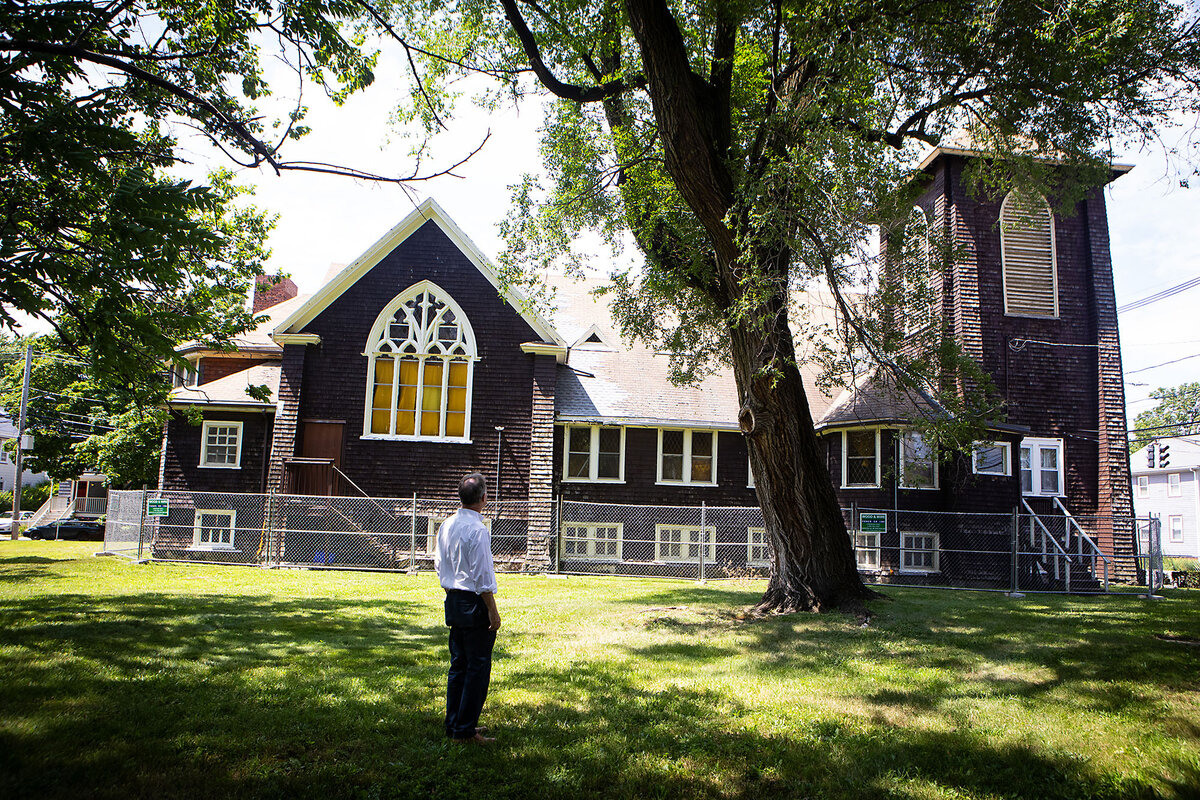
John Woods, director of Allston Brighton Community Development Corp. in Massachusetts, stands in front of Hill Memorial Baptist Church in July. The church and grounds are being turned into a housing complex for older adults.
My 9-year-old granddaughter assures me that the best place to stay overnight in Nova Scotia is a converted church. The light from the stained glass was beautiful, she says, and so was the rest of the building.
Her family’s rental was privately owned, but in today’s story we learn about a Boston-area initiative to turn other unused churches into subsidized housing. And Boston is not alone.
Troy Aidan Sambajon reports for the Monitor, “With its 58-foot bell tower standing sentinel, Hill Memorial Baptist Church has witnessed Allston-Brighton’s dramatic transformation. Upscale apartments and condos now stand on the site of once-bustling stockyards. Gourmet food shops have replaced affordable grocery stores. Now, the 120-year-old church is set for its own transformation. … The church is finding a new role in the community: much-needed affordable housing for older people.
“Churches and faith communities across the United States are increasingly closing their doors. Five years ago, The American Baptist Churches of Massachusetts, noting a dwindling congregation in Allston-Brighton, considered downsizing or repurposing the land. The choice was ultimately left to Hill Memorial’s congregation.
“In a final act of generosity, members chose to sell the land to fulfill the church’s ‘mission of giving back to the Allston community in the form of senior housing,’ says the Rev. Catherine Miller, former pastor, over email. With the blessing of its former congregation, the site will become 50 apartments for older adults on a fixed income. Today, the average price to rent a one-bedroom apartment in Allston is $2,786 per month, according to Apartments.com. The average wait time for senior housing in Boston currently stretches more than five years.
“ ‘Something good needed to happen here,’ says John Woods, executive director of Allston Brighton Community Development Corp., a housing developer. …
“Across the country, more faith communities are opening their doors to creative affordable housing solutions: Some are building homes on underutilized land or converting unused residences.
“In California, the grassroots ‘Yes in God’s Backyard’ movement led to the Affordable Housing on Faith Lands Act. This makes it legal for faith-based institutions to build affordable, multifamily homes on lands they own by streamlining the permitting process and overriding local zoning restrictions.
A federal version, the Yes in God’s Backyard Act, was introduced this spring by Ohio Sen. Sherrod Brown. …
” ‘It’s sad when a church closes,’ says Donna Brown, executive director of the South Boston Neighborhood Development Corp., which is leading the conversion of a former convent. ‘When they sit empty, it leaves a real void in the neighborhood. But when a building can be converted to housing so that people can stay in that community – it can be a wonderful thing to knit a community back together.’
“The U.S. is not building housing fast enough to support America’s aging population, according to Housing America’s Older Adults 2023 report, recently released by Harvard University’s Joint Center for Housing Studies. … By 2030, Americans age 65 and older will make up more than 20% of the population, according to Census Bureau projections. The need for affordable housing for this demographic will only grow. Meanwhile, homelessness is rising among older adults. …
“Sometimes, those being priced out of a neighborhood have lived there for decades. Moving means leaving not only friends but also support structures. Take Allston-Brighton, which was once a very affordable neighborhood, says Karen Smith, president of Brighton Allston Elderly Homes Inc. With rising rent costs and the cost of care, it’s tough for older adults on a fixed income to stretch their budgets thousands of dollars more a year. …
“In densely populated cities, the space to build affordable housing is often far from where it is needed most, says the Rev. Patrick Reidy, associate professor of law at the University of Notre Dame. However, faith communities and former churches are typically located in high-density areas that are accessible to the most people.
“ ‘These kinds of adaptive reuse projects for affordable housing are a win-win-win,’ says Professor Reidy. ‘The local governments that are desperately in need of land for affordable housing are given access by faith communities seeking to live out their religious mission, and those who need affordable housing don’t always have to uproot their lives from their neighborhood.’
“Boston is a prime example of this trend. The transformation of former churches … illustrates how adaptive reuse can unite communities in finding solutions to the housing crisis. The locations of older church properties in New England are unique for other reasons. Many are quite literally older than zoning laws, which were first passed around the 1920s.
“Blessed Sacrament Church sits at the heart of the historic Latin Quarter. It is set to become a sanctuary of affordable living, with 55 income-restricted units, along with a performance and community space.
“The building sat empty for years. High restoration costs prompted its owners to contemplate selling it to developers on the open market to become high-end apartments. Former parishioners and residents opposed the sale and advocated for community input. In the end, after meetings attended by hundreds in the area, the selected proposal from developer Pennrose aimed to preserve the historic exterior of the church while renovating the interior to create affordable housing.”
More at the Monitor, here. No firewall. Subscriptions are reasonable. For more on repurposing old church buildings, see the other part of the Monitor series, here.

 Suzanne's Mom's Blog