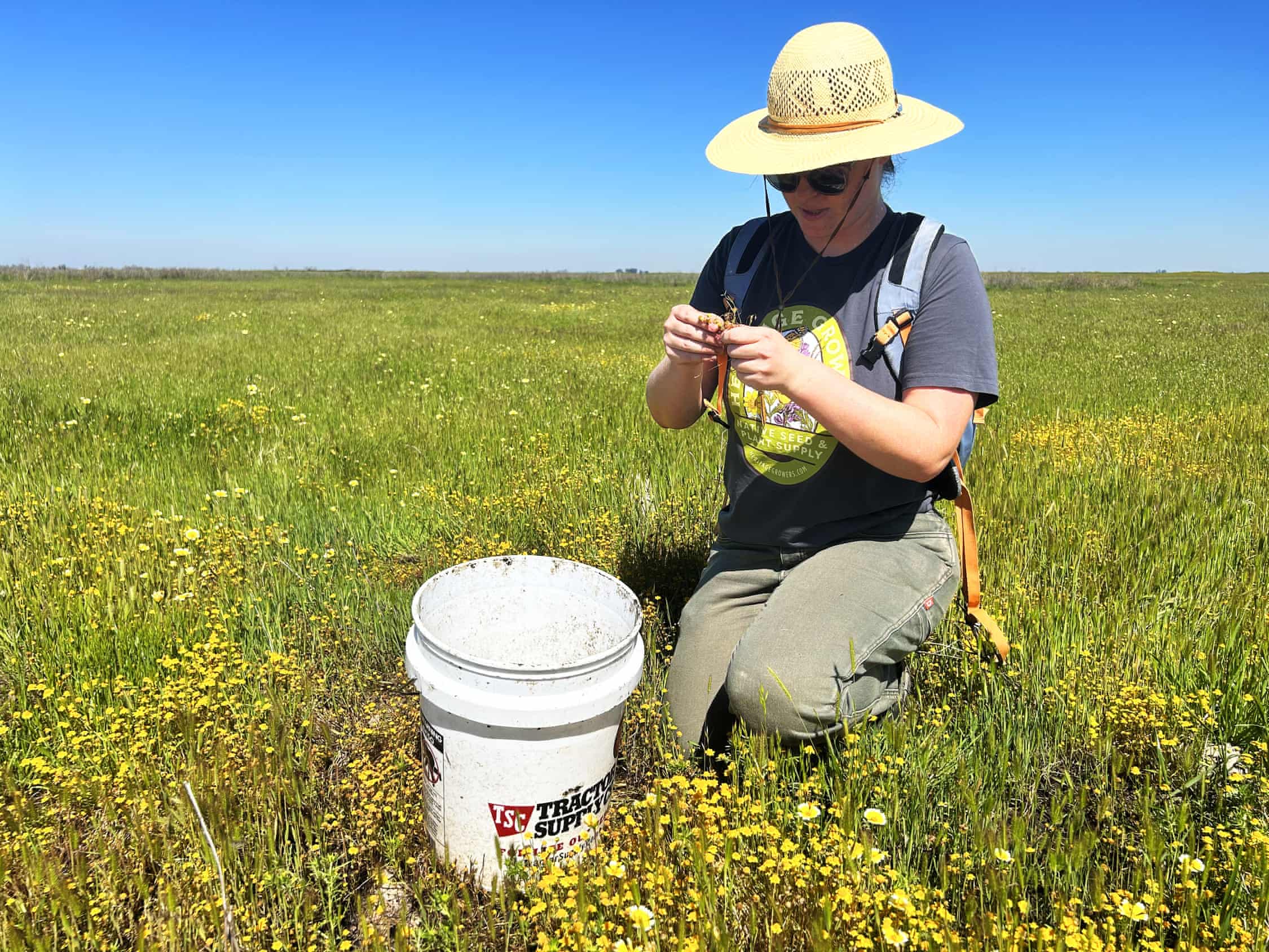
Photo: Dani Anguiano.
Haleigh Holgate, seed collection manager at Heritage Growers, inspects a seed in the San Luis national wildlife refuge complex on March 2025. Only the correct species will do.
I have blogged about seed banks in various countries (search on “seed bank”), and particularly about the global one that will keep seeds safe forever — if it stays frozen.
Today we learn what’s going on in California, where Heritage Growers is focused on local flora.
Dani Anguiano reported at the Guardian, “Deep in California’s agricultural heartland, Haleigh Holgate marched through the expansive wildflower-dotted plains of the San Luis national wildlife refuge complex in search of something precious.
“She surveyed the native grasses and flowering plants that painted the Central valley landscape in almost blinding swaths of yellow. Her objective on that sweltering spring day was to gather materials pivotal to California’s ambitious environmental agenda – seeds. …
“As a seed collection manager with the non-profit Heritage Growers native seed supplier, Holgate is tasked with traveling to the state’s wildlands to collect native seeds crucial for habitat restoration projects.
“The need has become particularly acute as California aims to conserve 30% of its land by 2030, with the governor pledging to restore ‘degraded landscapes’ and expand ‘nature-based solutions’ to fight the climate crisis. …
“But the rising demand for seeds far outpaces the available supply. California faces an ‘urgent and growing need’ to coordinate efforts to increase the availability of native seeds, according to a 2023 report from the California Native Plant Society. There simply isn’t enough wildland seed available to restore the land at the rate the state has set out to, Holgate said.
“Bridging the gap starts with people like Holgate, who spends five days a week, eight months of the year, traveling with colleagues to remote spots across the state collecting seeds – an endeavor that could shape California’s landscape for years.
“That fact is not lost on the 26-year-old. It’s something she tries to remind her team during long, grueling, hot days in the oilfields of Kern county or the San Joaquin valley. …
“Seeds play a vital role in landscape recovery. When fires move through forests, decimating native species and leaving the earth a charred sea of grey ash, or when farmlands come out of production, land managers use native seeds to help return the land to something closer to its original form. They have been an essential part of restoring the Klamath River after the largest dam removal project in US history, covering the banks of the ailing river in milkweeds that attract bees and other pollinators, and Lemmon’s needlegrass, which produces seeds that feed birds and small mammals.
“California has emphasized the importance of increasing native seed production to protect the state’s biodiversity. … Three-quarters of native vegetation in the state has been altered in the last 200 years, including more than 90% of California wetlands, much of them here in the Central valley.
“For the state to implement its plans, it needs a massive quantity of native seeds. … Enter Heritage Growers, the northern California-based non-profit founded by experts with the non-profit River Partners, which works to restore river corridors in the state and create wildlife habitat.
“The organization takes seed that Holgate and others collect and amplifies them at its Colusa farm, a 2,088-acre (845-hectare) property located an hour from the state capital. (The ethical harvesting rules Heritage Growers adhere to mean that they can take no more than 20% of seeds available the day of collection.) …
“Currently, the farm is producing more than 30,000 lbs of seeds each year and has more than 200 native plant varieties.
“The goal, general manager Pat Reynolds said, is to produce source-identified native seed and get as much of it out in the environment as possible to restore habitat at scale. …
“The benefit of restoring California’s wildlands extends far beyond the environment, said Austin Stevenot, a member of the Northern Sierra Mewuk Tribe and the director of tribal engagement for River Partners.
“ ‘It’s more than just work on the landscape, because you’re restoring places where people have been removed and by inviting those people back in these places we can have cultural restoration,’ Stevenot said. ‘Our languages, our cultures, are all tied to the landscape. … It’s giving the space back to people to freely do what we would like for the landscape and for our culture,’ he said. …
“The mission is worthwhile, Holgate said. The seeds she collects are expensive, but if they can be amplified and expanded, native seeds will become more abundant and restoration projects can happen more quickly.
“ ‘We can restore California faster,’ she said. … ‘I know that when I’m dreaming about a certain species, I should go check that population and see what’s happening. And normally there’s something going on where it’s like grasshoppers came in and ate all the seed, or the seed is ripe and ready, and I gotta call in a crew,’ she said. ‘I’ve really put my whole heart into this job.’ “
More at the Guardian, here. No firewall at this outstanding news site, but please support it.


 Suzanne's Mom's Blog