Feeds:
Posts
Comments

Posts Tagged ‘symphony’

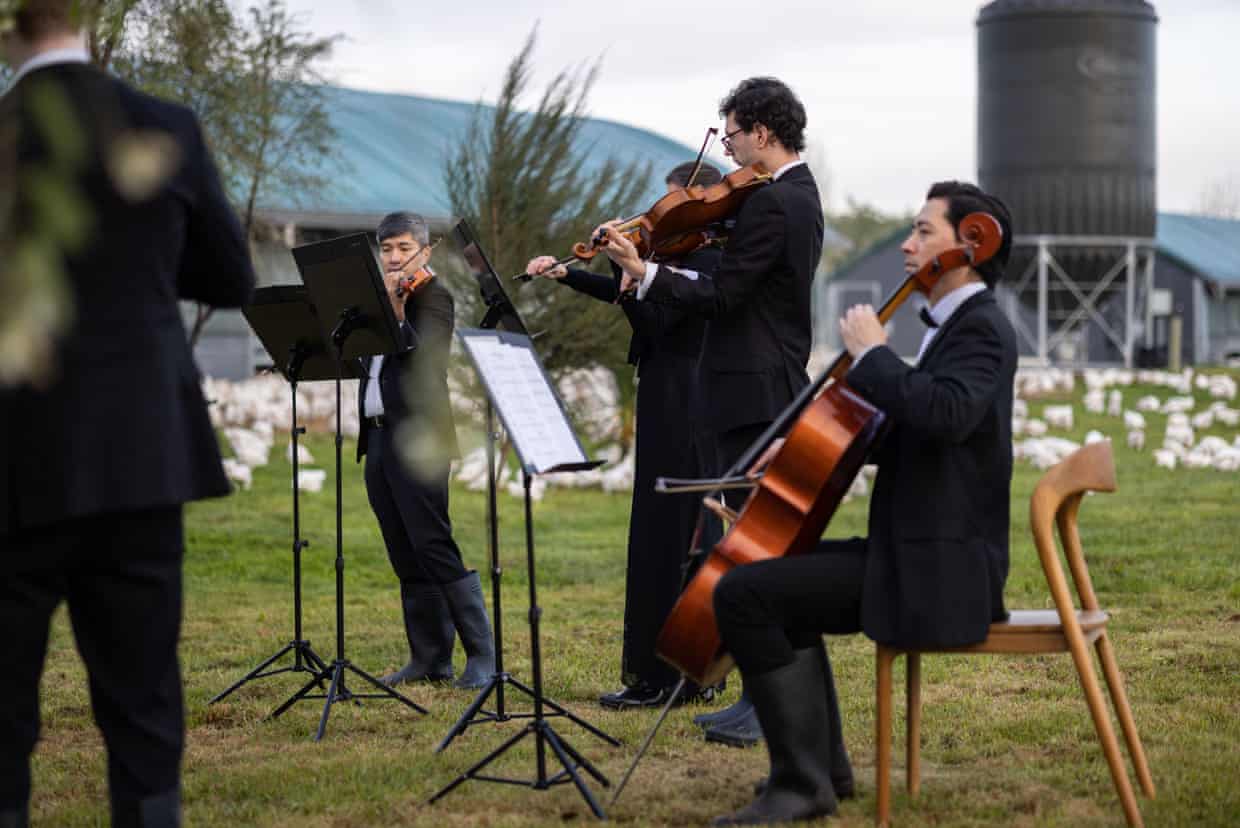
Photo: Bostock Brothers via the Guardian.
A live orchestral performance at the Bostock Brothers’ farm in Hawke’s Bay New Zealand. 

The media really knows how to have fun with a story that is susceptible to wordplay: “New Zealand Symphony Gives World Premiere for Hen-tastic Audience”; “Beethov-hen’s first symphony”; “NZ Symphony Orchestra members perform for thousands”; “im-peck-able.”

Mitchell Hageman at the New Zealand Herald wrote one of several delightful reports you can find online.

“Do chickens like classical music?” Hageman asks. “A Friday morning stunt in Hawke’s Bay proved they most certainly do.Members of the esteemed New Zealand Symphony Orchestra have performed for the likes of Dame Kiri Te Kanawa [and Sir Howard Morrison] but on Friday they faced some of their toughest critics yet: a hungry flock of thousands of Ross chickens.

“It was all part of a collaboration between Bostock Brothers Farm and the NZSO to promote ethical farming.

While slightly hesitant at first, the concert-going [chickens] eventually crowded around the clearly delighted musicians as they performed the world premiere of Chook Symphony No 1, created by composer and sound designer Hamish Oliver.

“ ‘Never could we have imagined producing a composition especially for a flock of chooks, let alone performing for them, but the opportunity was too good to pass up,’ NZSO chief executive Peter Biggs said. ‘The NZSO, like Bostock, is about being world-class and about wellbeing, so the two organizations have combined to create something very different and very new, and we hope it catches on.’

“The orchestra did some research and found instances where chickens responded particularly well to baroque music, which became the basis for the roughly two-minute symphony.

” ‘That’s strings, oboe, bassoon and harpsichord,’ Biggs said.

“After the composition was created, a sound recording was sent so it could be tested on the chickens. ‘They loved it,’ Biggs said. …

“For Bostock Brothers free-range chicken owners Ben and George Bostock, the collaboration was also a way to showcase the organic nature of chicken farming.

“ ‘Chicken farming is incredibly complex and organic farming even more so, and we’re constantly looking for ways to better our practices, ensuring our chickens are happy, healthy and organic,’ Ben Bostock said. ‘[We] know investing in a quality environment for our birds will only further yield quality results.’ …

“[George] said the response so far from the chickens had been great, and they would continue to play classical music in the sheds in future. ‘There’s lots of science that says classical music is really good for animal welfare and the response from our chickens has been really, really good.’ “

More at the Herald, here, at the Guardian, here, and at Symphony.org (the League of American Orchestras), here. No firewalls.

(And speaking of chickens, the Washington Post, here, reports that in Maine, chickens are now permitted as emotional support animals. Not that you asked.)
Read Full Post »

Photo: Toronto Star.
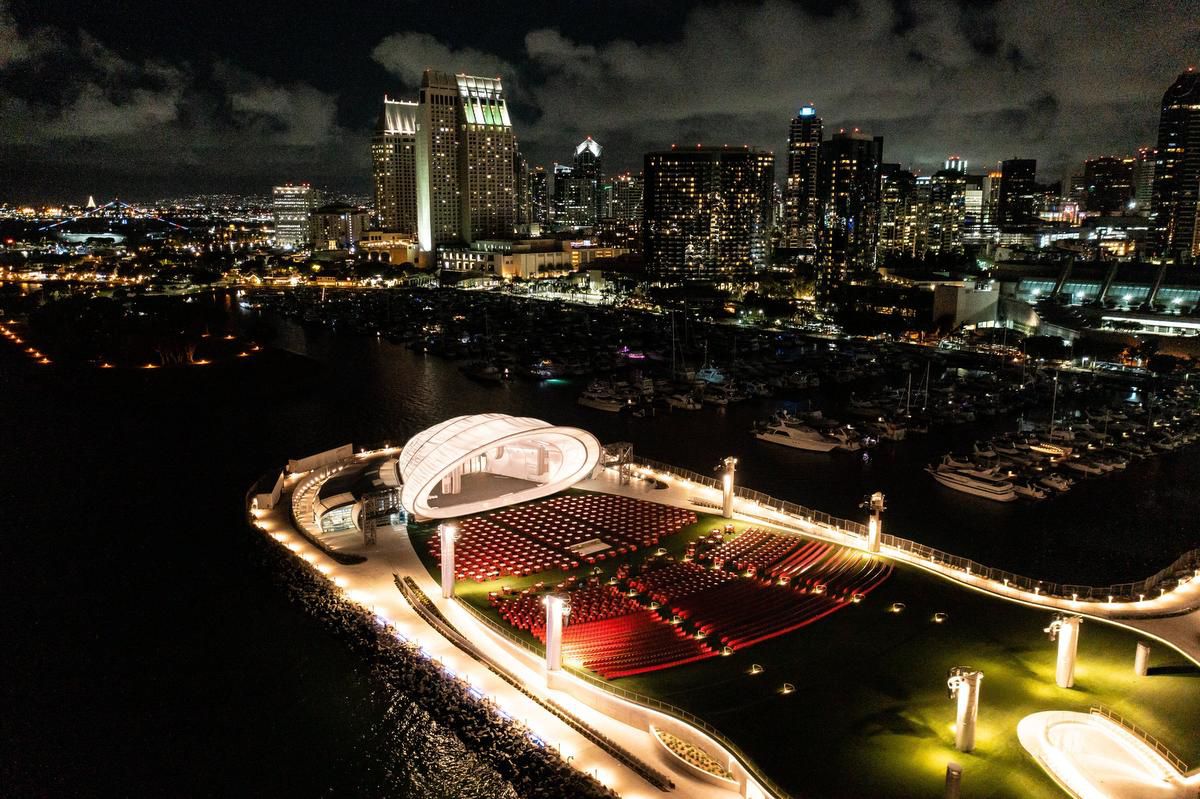
The San Diego Symphony’s waterfront venue, the Rady Shell.

The pandemic made us take a close look at the possibilities of moving the performing arts outdoors. Maybe outdoor performance is a good idea even without a pandemic.

William Littler writes at the Toronto Star, “Yes, San Diego is an outdoors city, blessed with an enviable oceanside location and a climate worthy of a snowbird’s dreams. No wonder the local symphony orchestra wants to come out and play.

“It has an even better reason now, thanks to last month’s opening of Rady Shell in Jacobs Park, a downtown al fresco setting for up to 10,000 people, picturesquely surrounded on three sides by water.

“The setting is nature’s gift, slightly reminiscent of the days when the Toronto Symphony Orchestra had a popular series at Ontario Place. And I say slightly because Ontario Place offered the orchestra a shared residence in a multi-purpose facility, whereas Rady Shell was developed specifically as a home for the San Diego Symphony.

“Described as the only permanent waterfront performance space on the West Coast, the handsome shell stretches forward as if to embrace the audience, with a series of speakers lined up on each side of the upward sweeping, (imitation) grass-covered audience area.

“At an afternoon rehearsal I took the opportunity to walk around and sample the sound from different standpoints and was not surprised to find the best sound — which was surprisingly good — closer to the front, where most of it came directly from the stage. …

“The arrival of COVID-19 has led orchestras to seek ways to enhance their outdoor profiles.

“The Montreal Symphony Orchestra has taken to its city’s parks. The Boston Symphony Orchestra heads for Western Massachusetts and Tanglewood. The Los Angeles Philharmonic has Hollywood Bowl.

“Though never an ideal solution, Ontario Place gave the Toronto Symphony an opportunity to broaden its audience and lengthen its season.

“Rady Shell demonstrates what more can be achieved through years of careful planning. A community effort, because it is part of a park, 85 per cent open to the public, people have routine access to the site.

“According to CEO Martha Gilmer, the orchestra plans to present about 110 events there per year, including the first part of its fall season, thanks to San Diego’s friendly climate. …

“The Southwest is clearly America’s fastest growth area; witness the fact that Phoenix, Arizona, recently passed Philadelphia to become the country’s fifth largest city. A can-do attitude helps explain how the new facility was built almost entirely without government support.

“The architects clearly wanted to design a people place, even providing a 12-foot-wide walkaround with benches just outside the porous perimeter fence for those who would like to hear, if not actually see the concert, without buying tickets. During the opening concert I even saw passing sailboats pause to share the experience.

“Of course I am describing a special place, not the kind of home most orchestras could hope to build in their neighbourhood. But the need is the same, to reach out to more people in a friendly environment.

“The San Diego Symphony has obviously understood this: the opening event at Rady Shell was a full-scale symphony concert, conducted by its popular music director, Rafael Payare, who will add the Montreal Symphony Orchestra to his schedule in 2022, but the second event was a Broadway program presided over by a different maestro, and the third was a concert by Gladys Knight.

“Three substantially different audiences attended these concerts, testimony to the orchestra’s wish to open its doors wide. It is a strategy for survival for symphony orchestras in Canada as well as the United States.

“In the program handed out for the opening concerts, Payare declared unequivocally: ‘From the moment I first stood on the stage of what would become Rady Shell at Jacobs Park, I knew that it was going to be an incredibly powerful acoustic for the orchestra.’ ” More at the Toronto Star, here.

In related news, there’s an interesting New York Times article about an outdoor theater space that was launched by black-listed artists in the McCarthy era and got a new lease on life during the pandemic.

Read Full Post »

7lml4w4k6rdejczc77tdfn7enq

Photo: Hanjun
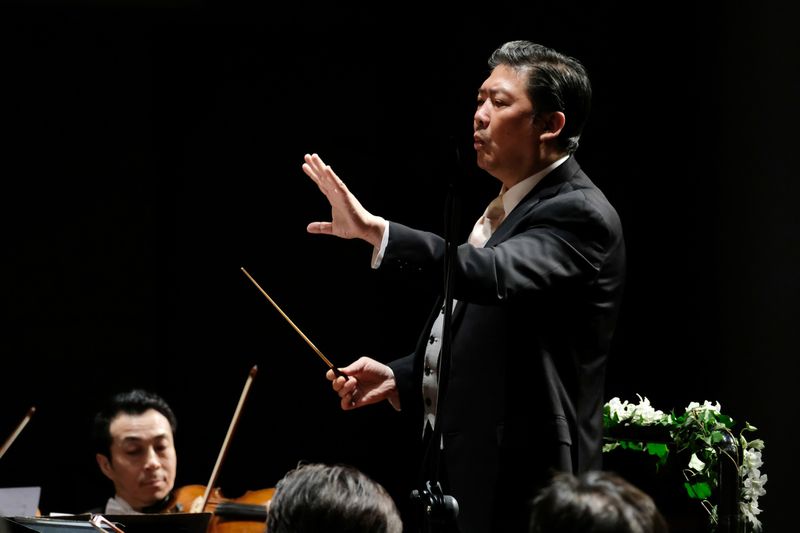
Music director Long Yu with the Shanghai Symphony  This orchestra carried on straight through World War I and World War II. During the Cultural Revolution, they had to play folk songs and songs of revolution. But they played.

This past August the Shanghai Symphony came to Chicago. And thanks to coverage of the visit, I learned something new about a Chinese city I visited in 2007.

Howard Reich interviewed the symphony’s conductor at the Chicago Tribune. “When the Shanghai Symphony Orchestra makes its Chicago-area debut Aug. 16 at the Ravinia Festival, no one will be prouder of the occasion than its music director, Long Yu.

“For to him, the Shanghai ensemble will be more than just a visitor from the other side of the world – it will be bringing with it a legacy stretching back to 1879, when it was established under a previous name.

“ ‘This is the first orchestra not only in China, but in the Far East,’ says Yu, speaking by phone from Hong Kong. …

“In effect, adds Yu, this orchestra ‘introduced most of the classical music to China and to Asia.’ …

“ ‘There is something wrong about how the Western world – I don’t speak about the United States only – the Western world is taking for granted our culture,’ [Chicago Symphony Orchestra music director Riccardo Muti] said. ‘In China, where we performed in this big (arts) center – where they have theater, concert halls and drama – that is so modern and fantastic, they told me that they are building a new hall!’ …

“Few could have envisioned such an embrace of Western classical music when the Shanghai ensemble was founded. But equally remarkable is the fact that it has survived through so many political, social and cultural upheavals.

“ ‘You can see this orchestra for 140 years, you can find all the programs through the First (World) War, Second (World) War, Cultural Revolution and till today – they have not stopped playing concerts,’ says Yu.

‘Especially during the Cultural Revolution, they still played! They did function in the Cultural Revolution – Chinese folk songs, but they still played. …

“ ‘Today it sounds like a very crazy idea. But during the years of the Cultural Revolution in China, it was fashionable to punish people for learning too much Beethoven, Bach and Mozart. I graduated from high school (in 1970) having been trained as a pianist, but my studies were interrupted, and I was sent to the rice fields for four years of physical labor. The government felt they needed to purify my soul, and they believed physical labor was the best way.’

“Musicians who nurtured Western culture suffered severely. Yang Bingsun, the Central Philharmonic Orchestra of China’s concertmaster, spent ‘nine years and four months in prison, my fingers constantly being injured because I was forced to work in cement,’ he told me in 1987. …

“What a difference a few decades make: In May, the First China International Music Competition launched in Beijing with an unprecedented first prize: $150,000 plus professional career management for three years (second and third prizes were $75,000 and $30,000). … Why have the Chinese put so much muscle behind classical music?

“ ‘To be placed on the international music map in a very serious way,’ Richard Rodzinski, the contest’s general director, told me earlier this year.

“Which helps explain why conductor Yu and the Shanghai Symphony Orchestra are bringing their wares here. …

“For his Ravinia program, he’ll feature cellist Alisa Weilerstein in Dvorak’s Cello Concerto, Rachmaninoff’s Symphonic Dances and Qigang Chen’s ‘Wu Xing (The Five Elements),’ a kind of East-meets-West program. But unlike some observers, Yu sees fewer distinctions between music-making in the two hemispheres.

“ ‘I don’t like to put Western music or Eastern music, Western culture or Eastern culture’ in categories, he says. ‘People ask me what is the difference between Chinese orchestras and Western orchestras? Basically, no difference. Eastern and Western orchestras do the same things, we teach every orchestra the same way, we rehearse the same way, we do the same programs.’ ”

More at the Chicago Tribune, here.

Read Full Post »