Feeds:
Posts
Comments

Posts Tagged ‘Taliban’

Photo: Twitter | @latifnaseer.
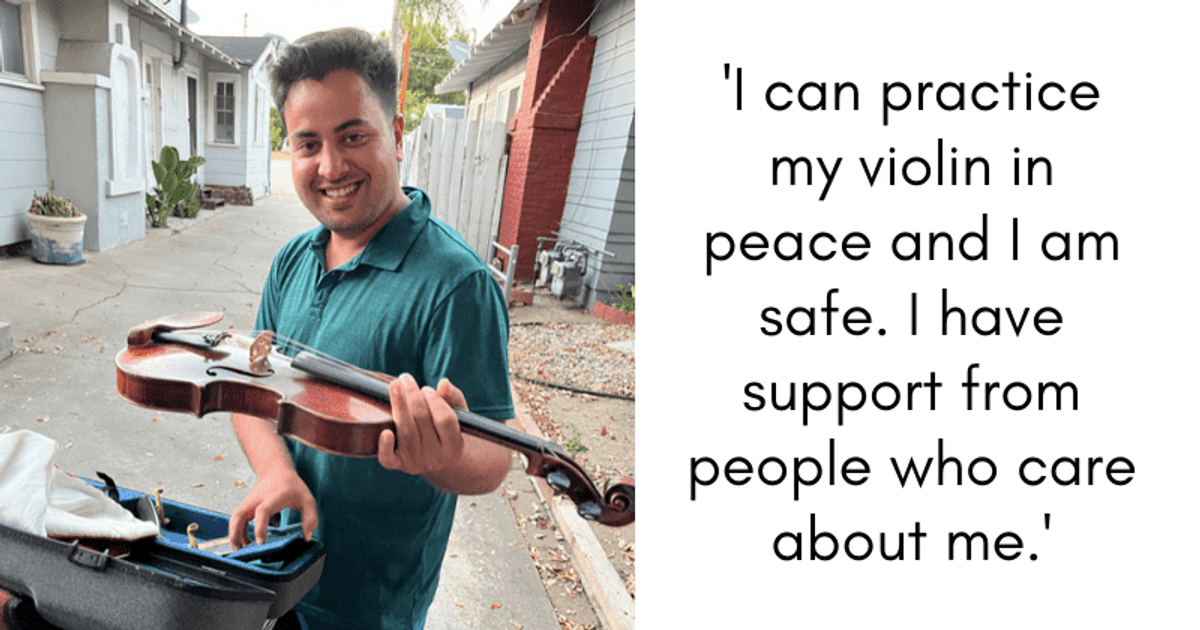
Ali Esmahilzada, an Afghan violinist, fled Kabul in 2022 amid the Taliban takeover. He arrived in Los Angeles without a violin. Latif Nasser delivered an antique violin from Jeremy Bloom and found a friend for life.

There are few positive stories about the aftermath of the abrupt 2022 US departure from Afghanistan. So, in sharing today’s article, I don’t want to minimize the suffering that continues there. For example, my friend Shagufa, the youngest of 11 children in a Herat family, was faced with getting her mother and all her sisters out, working with Marilyn Mosley Gordanier at Educate Girls Now. One of Shagufa’s sisters really had a target on her back, having trained as a police officer for the deposed government.

But at the Washington Post, we do find a nice story by Sydney Page about an Afghan who made it to the US.

“On a work trip in Upstate New York last May, Latif Nasser got an unexpected request from a colleague: ‘Can you hand-deliver an antique violin across the country?’ …

“The violin was going to an Afghan violinist who fled Kabul amid the Taliban takeover, and settled in Los Angeles with almost nothing but the clothes on his back. He left his violin behind.

“Nasser, [science journalist and co-host of Radiolab from] Los Angeles, agreed to help. The request came from Jeremy Bloom, a sound designer based in Brooklyn, who had heard about the struggling musician from a friend.

“Bloom happened to have a 110-year-old German-made violin collecting dust in his closet. He decided to offer it to the Afghan musician, who he knew would put it to good use.

“ ‘I was very lucky to be able to play that violin for a while, but I also felt guilty that it was sitting in a closet,’ said Bloom, adding that older violins are sometimes seen as more desirable than newer instruments. …

“The problem was, Bloom had no way of getting the violin to Los Angeles. ‘You do not want to ship an antique violin in the mail,’ he said, because he feared it would get damaged. …

“It took several weeks to get the instrument to the Afghan violinist, Ali Esmahilzada. ‘It felt like it took forever for us to coordinate,’ said Nasser, who — after several failed delivery attempts — became irritated when Esmahilzada asked if he could bring it to a mall. The musician didn’t seem eager to get the instrument, and Nasser began to wonder whether he even really wanted it.

“ ‘In a way, I was being protective of my friend Jeremy. … ‘This is the most beautiful gesture, giving someone this priceless violin for free.’

“After the mall plan didn’t work out, Nasser and Esmahilzada finally found a time to meet, and … it was immediately clear that ‘he wanted this violin so bad,’ Nasser said.

“Esmahilzada said he did not take his treasured violin with him when he left Afghanistan because he feared if the Taliban found his instrument at armed checkpoints throughout the city, they would ‘hurt me.’ …

“The Taliban has prohibited playing music in Afghanistan, and possessing an instrument is considered a crime. Esmahilzada, who has been playing the violin since he was 13, felt he had no choice but to flee his home country — and leave his family behind. ‘I was so scared.’ … He came to the United States on a Special Immigrant Visa with only a few belongings. …

“He was living in a small house with four Spanish-speaking roommates who he had trouble communicating with. He worked in the stockroom of a clothing store — which is why he asked Nasser to meet him at the mall. He ate eggs for every meal because it was the only thing he knew how to cook. …

“Nasser — whose parents immigrated to Canada in the early 1970s from Tanzania — empathized with Esmahilzada.

“ ‘It was so hard for my parents,’ said Nasser, explaining that kind strangers helped them get settled, and likewise, they went on to assist other immigrants.

“ ‘The more I heard his story and how deeply alone he was, I decided I could be that person for him,’ Nasser continued. … He invited Esmahilzada over to have dinner with his wife and two small children — which soon became a weekly invitation.

“ ‘It clearly meant a lot to him. He both needed it and was grateful for it,’ Nasser said. ‘It seemed like it was a gulp of water to a thirsty guy.’

“Nasser’s family started to feel like his own. … Life in America [had been so] difficult. He worked tirelessly to make a meager living, most of which he sent back to his family in Kabul. …

“Nasser and his wife helped him find an immigration lawyer, a laptop, some clothing and groceries. They also supported him as he sought a more stable job, and got himself a car. …

“For the first time in a long while, Esmahilzada said, he is hopeful about the future.

“ ‘I started from zero when I came to the United States,’ he said. ‘Now I’m happy. I have support from people who care about me. We have really kind people in the world.’ ”

More at the Post, here. To read without a firewall, click on Upworthy.
Read Full Post »

Photo: BBC.
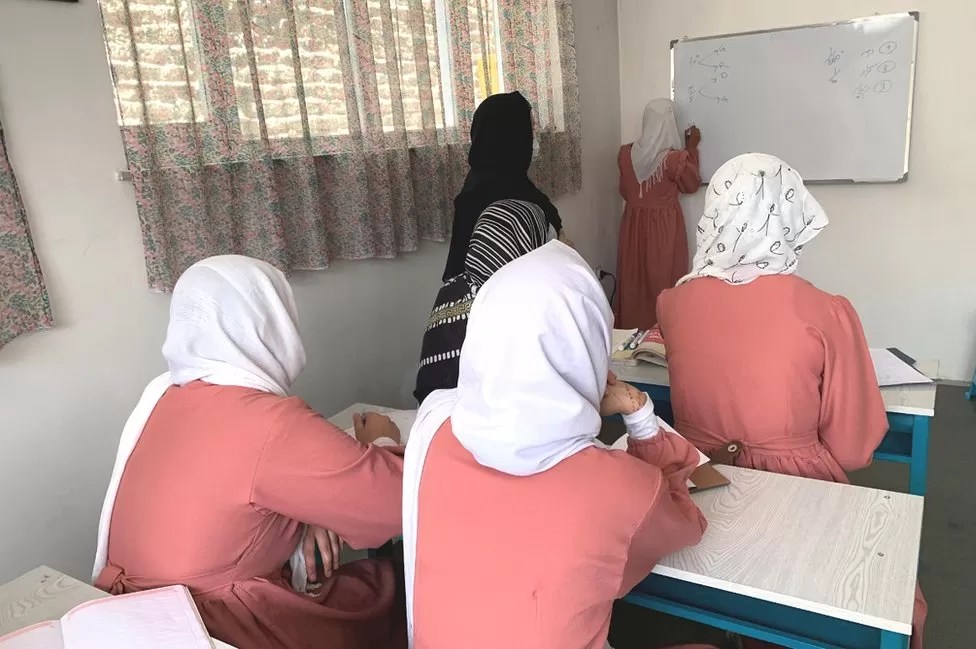
“If you are brave no-one can stop you,” says one girl in the class.

We know we can never completely eliminate rats. Or crime. Or intolerance.

But there are good things that have the same resilience. For example, the determination of young people who have been deprived of education and who — against all odds — persist in learning. Let’s look into the secret girls schools in today’s Afghanistan.

Sudarsan Raghavan has the story at the Washington Post.

“On a quiet residential street, teenage girls with school bags swiftly entered a large green gate. They were dressed in traditional garb, their faces covered, and many were holding copies of the Quran, Islam’s holy book. It was for their own protection.

“The house is a secret school for Afghan girls who are barred by the Taliban from getting an education. If agents raid the house, the girls will pull out their Qurans and pretend they are in a madrassa, or Islamic school, which the country’s new rulers still allow girls to attend.

“ ‘The Taliban are floating around in this area,’ said Marina, 16, a 10th-grader. ‘So, I always carry a Quran in the open. My other books are hidden in my bag.’

“More than a year after seizing power in Afghanistan, the Taliban still refuses to allow girls to attend secondary school, from grades seven to 12. The ban, as well as other hard-line edicts restricting women’s lives, have triggered global outrage and widespread protests by Afghan women.

“But a more subtle form of defiance is also happening. Underground schools for girls have formed in the capital and other Afghan cities, hidden away in houses and apartments, despite the immense threat to students and teachers. For the girls and their families, it is worth the risk. …

“The Taliban has said repeatedly that secondary schools for girls will reopen when there is an appropriate ‘Islamic environment.’ But the group has provided no criteria for what constitutes such an environment.

“When the Taliban first seized power in 1996, it closed schools for all girls —then too, underground schools were formed to fill the void —banned women from working and forced them to wear head-to-toe coverings known as burqas whenever they ventured outside the home.

“The group has been less draconian this time around, and the issue of education has revealed divisions among the Taliban’s leaders and religious scholars. In some areas, local Taliban officials have allowed girls above sixth grade to attend school, bowing to pressure from community leaders.

“[In October], the Taliban’s deputy foreign minister, Sher Mohammad Abbas Stanikzai, made a rare public appeal urging that all secondary schools for girls be reopened, adding that ‘the delay is increasing the gap between [the government] and the nation.’ …

“Abdulhaq Hammad, a top Taliban official in the Ministry of Information and Culture, insisted that ’90 percent of Taliban members are against the closure of the schools.’ But convincing the remaining 10 percent is a delicate process. …

“Five months ago, a woman named Ayesha launched a collective of 45 underground schools around the capital. …

She was motivated in part by her bad marriage, she said: ‘Women should not be dependent on men. Education is the only way out of our difficulties.’

“But within a month, her funds dwindled. Many of the schools closed. Others were shut down out of fear. Only 10 are active today, and Ayesha is struggling to find donors to support them. The girls in her schools come from the poorest families; with the Afghan economy collapsing, most can’t pay tuition or even buy textbooks.

“Worse, she fears the Taliban will come for her. The group’s intelligence agency has summoned her three times, she said, forcing her into hiding. …

“The girls recited a few verses from the Quran. Then class got underway. ‘Today’s lesson is on pages 37, 38 and 39,’ Masouda said, opening a biology textbook. ‘It’s about the types of plants and vegetables. … If someone doesn’t have a book, please take notes.’ …

“ ‘Who would like to come up and explain this?’

“Angila raised her hand. She stood and recited the lesson in a clear, authoritative voice. Biology was her favorite subject, she explained after the class was over.

“ ‘I want to be a physician,’ said Angila, who wore a head-to-toe black gown and a lime-green headscarf. … She was well on her way, part of a generation of girls and women that started attending school during the American occupation. When the Taliban regained power and ordered teenage girls to stay home, Angila was devastated.

” ‘I watched the boys go to school, but I couldn’t,’ she recalled. ‘My heart was broken.’ …

“Three months ago, she stopped classes for 25 days after the Taliban arrested a teacher working in another underground school. If Taliban agents enter Masouda’s school, the girls know to open the cupboard and grab the Qurans.

“Then Masouda will ask Marina, who has memorized the Quran, to come forward.

“ ‘If they come, she will take over the class, and I will pretend to be a student,’ Masouda said.

“Marina, dressed in a traditional purple gown and a black headscarf, said that she’s attending the class ‘to gain courage.’ She wants to become a pilot for Kam Air, an Afghan carrier, because ‘there’s very little representation of women in the aviation sector.’

These girls remind me of Shagufa, who continues to tell everyone about the power of believing in yourself. She, too, was an underage bride of an abusive man. Poor families rely on the bride price.

More at the Post, here. If you don’t have a subscription to the Post, the BBC also has a story about the school, here.

Read Full Post »