Feeds:
Posts
Comments

Posts Tagged ‘teach’

Photo: Riley Robinson/Monitor Staff.
Kawehnokwiiosthe teaches the Mohawk language to students from both sides of the US-Canada border at the Akwesasne Freedom School, St. Regis Mohawk Reservation, northern New York.

Today many languages are in danger of dying out as the elders who speak them die off and young people don’t learn them.

Fortunately, in some places there are efforts to educate new speakers. Consider this Mohawk language school at a reservation in upstate New York.

Sara Miller Llana writes at the Christian Science Monitor, “Students and teachers, as well as some parents, sit on two wooden benches running the length of the hallway of their school, organized not by age or grade but by their clans.

“They take turns reading from the Ohén:ton Karihwatéhkwen, which translates from the Mohawk language to ‘Words before all else.’ These words, which recognize all life forces in creation, mark the day’s start at the Akwesasne Freedom School.

“But the 60-odd students here wouldn’t understand these lessons if it weren’t for this little schoolhouse at the United States-Canada border that for decades has been fighting to preserve Mohawk language and culture. ‘This makes us who we are, and if we don’t have this, who are we going to be?’ asks teacher Kawehnokwiiosthe, whose name in English means ‘She makes the island beautiful.’ …

“Kawehnokwiiosthe turns to her young pupils, who introduce themselves by their clans – Wolf, Bear, and Eel – and state that they are wisk, or age 5. Every class in K-8 that students take is full language immersion.

When a child asks a question in English, Kawehnokwiiosthe responds in Mohawk.

“Most parents pay tuition with a quilt sold at an annual auction in August. The school is run as a co-op, where parents do the cleaning (along with the students) and the maintenance work. Students come from American and Canadian sides of the border, but the school has never accepted funds from either government, says Alvera Sargent, who heads the nonprofit Friends of the Akwesasne Freedom School and is one of the last first-language speakers of Mohawk.

“That makes her precious, says Waylon Cook, former teacher and now project manager of the school’s nonprofit arm. ‘We treasure our first-language speakers,’ he says. … ‘If you lose [Mohawk], you can’t go to France like you could to learn French. There is nowhere else to do it but here.’ More at the Monitor, here.

Meanwhile, in the state of Washington, there’s an effort to bring Native language teaching into public school, too.

Lauren Gallup wrote at Northwest Public Broadcasting, “A number of Washington state public schools are partnering with tribes to bring Indigenous languages into classrooms in an effort to rectify the marred history of Native American boarding schools.

“Rachael Barger is a teacher on special assignment with Bethel School District, one of the districts partnering with the Nisqually Tribe to bring its Southern Lushootseed language into the classroom for a small subset of students. 

“5% of Bethel’s student population identifies as American Indian, Alaskan Native, two or more races or Hispanic and Native. Barger serves over 200 Title VI Indian Education Program students for the district. Title VI is a federal program that aims to meet the specific needs of Native American students. 

“The tribe and district have partnered, so far, to bring the language classes to two elementary schools for students who qualify for Title VI. Bethel School District had 461 qualifying students this last school year, which is around 2% of its student population.  Barger said those students were excited to learn the language because it felt unique to them. …

“The tribe’s partnership with the Bethel schools is part of the Nisqually Language Resource Center which started two years ago.

“ ‘It makes  it chokes me up,’ said Catalina Sanchez, research coordinator for the center. ‘It’s just something new that we’ve always needed in our community. So I’m proud of us for finally getting our own program in our schools and in our community.’

“The language work being undertaken by the tribe is part of broader efforts to expand and uplift culture and identity for the tribe. 

“ ‘You’re starting to see everything kind of awakening right now here in Nisqually,’ said Willie Frank III, chairman of the Nisqually Tribe. …

“Frank said he thinks it’s a perfect time to focus again on the tribe’s cultural traditions. ‘What I was taught was to tell our story, and, you know, keep building our people up,’ Frank said, ‘and that’s what we’re doing with all this great work in here. I think about the art, the culture and the language; that’s going to be something that sustains us.’ ” 

More at Northwest Public Broadcasting, here. No paywall for either article.

Read Full Post »

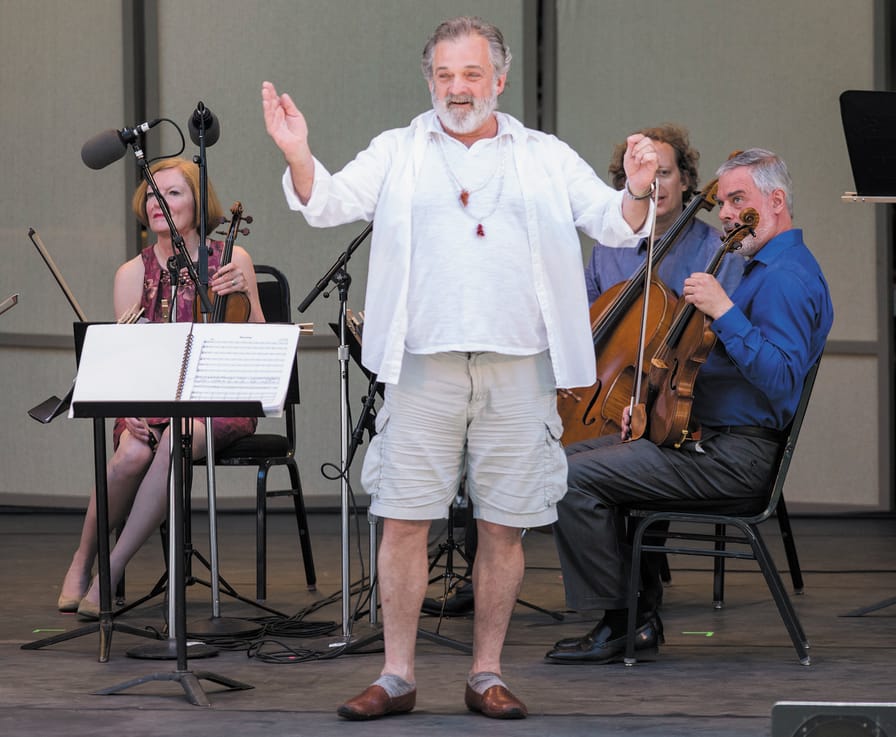
Photo: The Nation.
Choreographer Mark Morris at the Ojai Music Festival.

Many people know Mark Morris as a great choreographer, but much of his success has depended on his devotion to teaching his dancers.

Alastair Macaulay wrote recently about this side of Morris at the New York Times. “New York City has often been called the world’s dance capital. One good reason is that a number of the world’s foremost choreographers not only lived and worked in New York, but also taught class here. Martha Graham, George Balanchine, Merce Cunningham and many others helped to lure dancers to the city.

“Fewer and fewer of today’s top dance-makers carry on that tradition. The foremost exception is Mark Morris. … While there have been seasons when his choreographic inspiration has dipped, his performers have almost invariably looked wonderful. This is a tribute to how he and his teaching colleagues prepare them each day.

“The dancers don’t present themselves as virtuosos. And they’re all such distinct individuals — each exuding what seems natural — that it’s easy to make the mistake of thinking they don’t share training. But it’s precisely their schooling with Morris, whose company, the Mark Morris Dance Group, was established in 1980, that makes them look so natural.

“ ‘I first taught when I was 13 — Spanish sevillanas — and first taught ballet in my later teens,’ Morris, 66, said in an interview at the Union Square Cafe. ‘As an adult, I used to teach modern or jazz or ballet. I would take class all over the city, which is how I met so many fabulous people: We were all dancing together. And when I gave workshops, I’d ask the most talented people to come back and be in my next piece.’ …

“ ‘It’s just the last year or two I’ve cut back,’ he said. He now shares teaching assignments with company alumni. Surprisingly, for a modern-dance master, he teaches a ballet class, with a live pianist. The dancers start by standing at the barre, bringing more and more parts of the body into play with each exercise. Then, after about 40 minutes, they work without support in the center of the room. Finally they move expansively across the room, in phrases involving turns and jumps.

“It’s ballet — though with a difference or two. Like other modern-dance choreographers (he particularly credits Hannah Kahn), Morris will sometimes ask his dancers to articulate and bend the spine in ways largely foreign to ballet — they alternate convex and concave shapes of the spine at the barre — and to phrase in irregular counts. And there’s no work on pointe: the dancers are barefoot or in socks or soft shoes. …

“The Morris class is ‘a very pure form of ballet that strives to be stripped of its affectations,’ Billy Smith, a dancer who joined the company in 2010, wrote in an email. ‘We do use our torsos in a more “modern” way than maybe a ballet company would in class. But at the core our classes are very much oriented toward the purity of ballet technique.’ …

“Morris, an invariably entertaining talker, speaks exuberantly to his dancers, between exercises — about what’s on television, about an unmissable Broadway show (and about the long lines for the ladies room in Broadway theaters), about New York traffic gridlock, about Olive Oyl. But this spiel isn’t just a one-way Morris event: He wants his dancers to be people with lives and interests, not just dance executants, and he enjoys their repartee. …

“Sam Black, who became a full-time Morris dancer in 2005 and is now the company director sharing the teaching assignments, will give his stage farewell during the Joyce season. In an interview at the Mark Morris Dance Center in Brooklyn in July, he recalled how he used to stretch his arms too straight upward in certain positions. Morris would say, ‘You only have three joints in your arm. You have to make a curve with only three joints. That takes imagination.’

“Many dancers have remained with the company more than 10 years, their longevity in part attributable to Morris’s growing concern with anatomical efficiency. …

“It was not until 1988, when the Morris dancers moved for three years to Brussels to become the resident company at the Théâtre Royale de la Monnaie, that he began to teach them a daily ballet class. That was when Megan Williams, now a ballet teacher, joined. She remembers that, in class, he enjoyed giving them one exercise for footwork and one for the upper body.

“ ‘He would show us the feet pattern, and then the port de bras pattern — separately!’ she said. ‘We had to put them together like a puzzle. It was almost impossible, like that exercise of rubbing your stomach and patting your head at the same time.’ “

More at the Times, here.

Read Full Post »

Photo: Conférence PPL 2022.
Brian Maracle shares his technique for teaching the Mohawk language at Canadian conferences such as Multidisciplinary Approaches in Language Policy and Planning (LPP or in French, PPL).

I love learning about other languages and sometimes pick up tidbits through my volunteering with ESL teachers. But languages in danger of dying out are especially interesting to me. If they die out, we lose too much about the ways others see the world.

Today’s story is about a technique for teaching a particular endangered language.

Ian Austen wrote at the New York Times from Ontario, Canada, “When Brian Maracle returned in his mid-40s to the Mohawk community near Toronto that he had left when he was just 5, he didn’t have a job and knew almost no one there.

“But perhaps the biggest challenge facing him was that he neither spoke nor understood much Kanyen’keha, the Mohawk language. More than a century of attempts by Canada’s government to stamp out Indigenous cultures had left Mr. Maracle and many other Indigenous people without their languages.

“Now, 30 years later, Mr. Maracle has become a champion of Mohawk, and is helping revive it and other Indigenous languages, both in Canada and elsewhere, through his transformation of teaching methods.

“ ‘I never studied linguistics, don’t have any teacher training, my parents weren’t speakers,’ he said in his office at an adult language school he founded about two decades ago in his community, the Six Nations of the Grand River territory, southwest of Toronto. Yet, linguistics academic conferences now feature him as a speaker. …

“From the 19th century into the 1990s, thousands of Indigenous students were taken from their homes, sometimes by force, and placed into Canada’s residential schools system. There, they were forbidden from speaking their languages and from practicing their traditions in what a national commission later characterized as ‘cultural genocide.’

“The system failed to entirely eradicate Indigenous languages, but its effect was nevertheless devastating for the 60 Indigenous languages found in Canada.

“Today restoring Indigenous languages has been a component of Canada’s push for reconciliation with its Indigenous people. … Four years ago, the government passed the Indigenous Languages Act, which formally recognizes the importance of these languages and requires the allocation of money — more than 700 million Canadian dollars to date — for teaching them.

“But none of that was around when Mr. Maracle arrived at Six Nations, and the program that was available, he found, was ill-suited for adult students.

“ ‘Indigenous languages are extremely different from English,’ said Ivona Kucerova, the director of the Center for Advanced Research in Experimental and Applied Linguistics at McMaster University in Hamilton, Ontario. ‘But typically what you see is that the local Indigenous language teaching methodologies are designed to teach Western languages.’

“Mr. Maracle said the problem with his first, unsuccessful lesson was that the instructors, generally Mohawk elders without training as language teachers, were tossing out ‘whole words.’

“ ‘They just expected by dropping a word on you and saying it louder that you’d somehow figure it out,’ Mr. Maracle said. ‘They didn’t understand how the language really is structured.’ …

“Mr. Maracle found the answer about 25 years ago in the office of David Kanatawakhon-Maracle, no direct relation, a lecturer at the Western University in London, Ontario.

“ ‘There were little bits of paper all over this big table,’ Mr. Maracle recalled. The lecturer told Mr. Maracle words he had been longing to hear: ‘He said: “I think I’ve got a new way of teaching the language.” ‘

“There were about 60 slips of paper on his office table, and they ‘were the Rosetta Stone of all the things that you need to be a competent beginning speaker,’ Mr. Maracle said.

“Kanyen’keha is a polysynthetic language, where a single word can function as an entire sentence. Those words are made up of morphemes, small elements that change their meaning depending on how they are combined. …

“Understanding that these elements were the key to unlocking the language was the breakthrough Mr. Maracle needed to attain fluency. But other students at the school he helped start in 1999 were still struggling. It became apparent that someone needed to build a curriculum and teaching program around the morphemes, including a color-coded system for grouping them, which Mr. Maracle did through trial and error.

“One essential discovery was figuring out that learning Kanyen’keha requires ‘looking at the world with Mohawk language eyes,’ he said. In comparison with other languages, Kanyen’keha relies heavily on verbs.

Objects are generally described by what they do. The word for ‘computer,’ for example, roughly translates as ‘it brings things up.’

“ ‘We don’t teach you how to say “pencil,” “chair,” ”shoe” for six months,’ Mr. Maracle said. ‘Because the language is a verb-based language, the names of things are less grammatically important.’

“Prof. Kucerova, the director of the linguistics center in Hamilton, regards Mr. Maracle as a linguist despite his lack of formal training. She said tests showed that his students emerged with a university-level fluidity in two years.

“ ‘I have never seen anyone else bring adult learners to that level of language, to be able to speak at this level after two years,’ she said, adding that Mohawk ranks with Arabic in terms of difficulty for English-speaking students. ‘That’s really astonishing.’

“ ‘I became literally mesmerized by the extent of his work,’ Prof. Kucerova said. ‘He’s figured out this improbable, but linguistically extremely smart, method of delivering this radically different language to adults.’ ”

More at the Times, here.

Read Full Post »

Photo: Folger Theatre.
Actor/director Holly Twyford got interested in a new kind of theater project during the pandemic.

How many of us began pandemic activities that we liked enough to keep? In my case, being obliged to do my volunteering via Zoom showed me there is often a greater feeling of individual connection when I can see English students’ faces up close on screen instead of in a large room. What new way of doing things did you decide to keep?

In one example, an actress was invited to teach elderly shut-ins during the down time and found she liked it. Peter Marks reported the story for the Washington Post.

“In the courtyard of an independent living residence in Rockville, Md., Holly Twyford brought her acting class to order. With the script of Spoon River Anthology in front of them, one of her students, 93-year-old Shelly Weisman, recited the words of Lucinda Matlock, a character who speaks of a marriage that lasted seven decades.

“ ‘I spun, I wove, I kept the house, I nursed the sick. I made the garden, and for holiday rambled over the fields where sang the larks,’ Weisman declaimed, as Twyford — long one of Washington’s premier actors — listened.

“ ‘I love that piece,’ Twyford said at last.

“ ‘I do, too,’ Weisman replied. ‘I love her.’

“And so it went for an hour with Twyford and several residents of Ring House, in the Charles E. Smith Life Communities, off Rockville Pike. Organized by Theater J, an arm of the Edlavitch D.C. Jewish Community Center, the class wasn’t just an exercise to nourish the artistic spirits of theater-loving seniors. It was an invigorating lifeline, too, for Twyford. Sidelined by the pandemic from pursuing her customary evenings-and-matinees vocation, the actress was hired by Theater J Artistic Director Adam Immerwahr to teach enrichment courses and earn some needed cash.

“ ‘The pandemic has been a nightmare for us who depend on large, live audiences,’ said Twyford, a ubiquitous presence on Washington stages, in everything from Shakespeare to Sondheim. When covid-19 collapsed the theater industry, Twyford lost two acting and two directing jobs.

‘I can only say Adam subsidized many out-of-work actors and directors by saying, “Hey, you should teach a class.” … That’s what he did for me.’ …

“Theater J, with only a handful of full-time staffers, took on a sizable mission, hiring dozens of theater folk to teach more than 50 classes, most of them virtual. …

“Angela Hughes, a die-hard theatergoer who lives in Northern Virginia, has enrolled in 16 of Theater J’s virtual classes. ‘It was a way to have theater in my life,’ she said in a phone interview. …

“The combination of pandemic isolation, audience fascination and artist deprivation created highly favorable circumstances for Theater J’s initiative: From July 1, 2020, to June 30, more than 700 people from 23 states and Israel, Canada and Australia took the company’s Zoom courses, according to Immerwahr. During that period, he has paid out more than $40,000 in fees to his improvised faculty.

“That might not boil down to a king’s ransom — national philanthropic organizations, such as the Actors Fund, have doled out millions. But every extra paycheck helps when one is scrambling.

“ ‘At times, it’s been serious,’ Immerwahr said of the need in the D.C.-area theater community. ‘We’ve had people who couldn’t qualify for unemployment, because they worked in seven different states.’

“Naomi Jacobson, another familiar talent to Washington theatergoers, has taught six courses for Theater J, including ‘Inside the Actor’s Process’ and ‘Inside the Rehearsal Room: “Collected Stories,” ‘the latter with actor Emily Whitworth and Immerwahr. ‘I had nine months of work lined up, and it all went away,’ she said, noting that she took her pension early to make sure she and her husband, actor John Lescault, could pay their mortgage.

“While Lescault carried on in the recording booth in their basement for his side business, narrating books for the Library of Congress, Jacobson built up a coaching practice for actors and public speakers in other professions. How she’ll balance the pedagogical pursuits with her acting life remains an open question: She is scheduled to return to the stage in September to portray Ruth Westheimer in Mark St. Germain’s one-person Becoming Dr. Ruth at Theater J. …

“It so happens that Twyford is directing Jacobson in the piece, a process they began before the shutdown. When that assignment abruptly ended, Twyford [says] ‘I did apply for a job at a hardware store, and I was turned down,’ she said. ‘I know tools and I build things, and it was really harsh to get that rejection.’

“But Immerwahr came calling, which was why on this warm August day, Twyford had driven to Rockville to teach the weekly sessions of her monologue-preparation class to students in their 80s and 90s, one at Ring House and another at its sister building, Revitz House. …

“The students had been asked to choose speeches from the script, a compendium of the more than century-old poems that make up Edgar Lee Masters’s cycle of ordinary townsfolk, narrating their personal tales from the afterlife.

“Weisman wasn’t sure at first about the material. ‘I said, “Why on earth did you pick this? It’s people speaking from the grave! We’re close to the grave!” ‘ The teacher thereby learned quickly that these pupils were not shy about speaking up. …

“Over several weeks of talking and rereading, though, she came to understand the value of immersing herself in the persona and hardships of her character. ‘As I was reading it over and over, it became much more real to me,’ Weisman said. ‘Every life has disappointment and tragedies. Lucinda didn’t dwell on it.’ …

“[Says Twyford] ‘Shelly asked me, “What have you learned about 90-year-olds?” I gotta say, talk about some role models! … These folks, they just haven’t stopped learning.’ “

More at the Post, here.

Read Full Post »

Erik passed along this story from the NY Times about a mini computer that outgrew its original purpose of teaching computer science students. Goes to show that it’s customers who tell inventors what the market for an invention is.

“The story of the Raspberry Pi begins in 2006,” writes John Biggs, “when Eben Upton and other faculty members at the University of Cambridge in Britain found that their incoming computer science students were ill-prepared for a high-tech education. While many students in the previous decade were experienced electronics hobbyists by the time they got to college, these freshmen were little more than skilled Web designers. …

“The Raspberry Pi — about 3 inches by 2 inches and less than an inch high — was intended to replace the expensive computers in school science labs. For less than the price of a new keyboard, a teacher could plug in the Pi and connect it to older peripherals that might be lying around. But because Pi initially ran only Linux, a free operating system popular with programmers and hobbyists, students would have a learning curve.

“The Raspberry Pi Foundation began selling the computers in February of last year. They soon could not keep them in stock.

“ ‘We honestly were thinking of this as a 1,000- to 5,000-unit opportunity,’ Mr. Upton said. ‘The thing we didn’t anticipate was this whole other market of technically competent adults who wanted to use it. We’re selling to hobbyists.’

“One Pi owner, Dave Akerman, of Brightwalton, England, even sent a Raspberry Pi to the upper atmosphere, floating it 40,000 meters up using a weather balloon.

“There he was able to take live video, photos and measurements.

“ ‘Now every primary school in the world can take pictures from near space,’ Mr. Upton said. ‘You give people access to this tool and they do great things.’ ”

More.

Photograph: Adafruit.
A Raspberry Pi computer, which is about the size of a credit card, was created to teach computer science students.

Read Full Post »