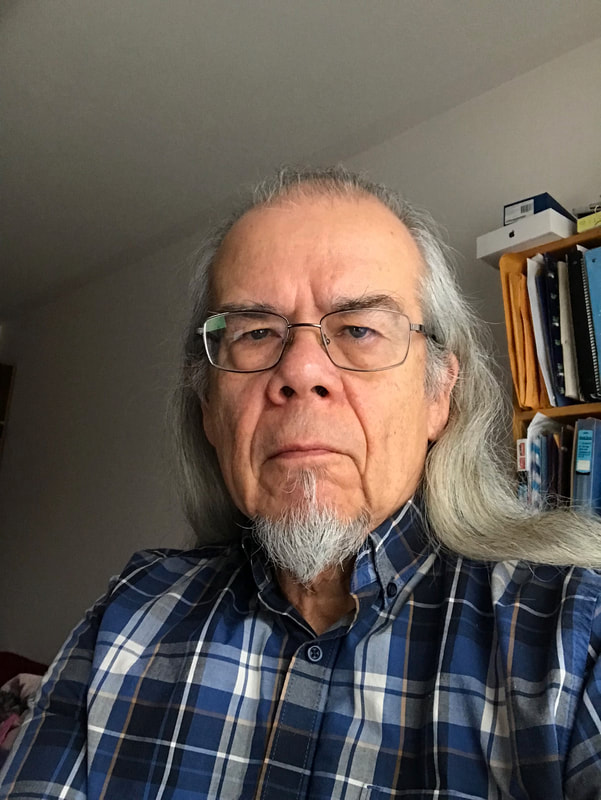
Photo: Conférence PPL 2022.
Brian Maracle shares his technique for teaching the Mohawk language at Canadian conferences such as Multidisciplinary Approaches in Language Policy and Planning (LPP or in French, PPL).
I love learning about other languages and sometimes pick up tidbits through my volunteering with ESL teachers. But languages in danger of dying out are especially interesting to me. If they die out, we lose too much about the ways others see the world.
Today’s story is about a technique for teaching a particular endangered language.
Ian Austen wrote at the New York Times from Ontario, Canada, “When Brian Maracle returned in his mid-40s to the Mohawk community near Toronto that he had left when he was just 5, he didn’t have a job and knew almost no one there.
“But perhaps the biggest challenge facing him was that he neither spoke nor understood much Kanyen’keha, the Mohawk language. More than a century of attempts by Canada’s government to stamp out Indigenous cultures had left Mr. Maracle and many other Indigenous people without their languages.
“Now, 30 years later, Mr. Maracle has become a champion of Mohawk, and is helping revive it and other Indigenous languages, both in Canada and elsewhere, through his transformation of teaching methods.
“ ‘I never studied linguistics, don’t have any teacher training, my parents weren’t speakers,’ he said in his office at an adult language school he founded about two decades ago in his community, the Six Nations of the Grand River territory, southwest of Toronto. Yet, linguistics academic conferences now feature him as a speaker. …
“From the 19th century into the 1990s, thousands of Indigenous students were taken from their homes, sometimes by force, and placed into Canada’s residential schools system. There, they were forbidden from speaking their languages and from practicing their traditions in what a national commission later characterized as ‘cultural genocide.’
“The system failed to entirely eradicate Indigenous languages, but its effect was nevertheless devastating for the 60 Indigenous languages found in Canada.
“Today restoring Indigenous languages has been a component of Canada’s push for reconciliation with its Indigenous people. … Four years ago, the government passed the Indigenous Languages Act, which formally recognizes the importance of these languages and requires the allocation of money — more than 700 million Canadian dollars to date — for teaching them.
“But none of that was around when Mr. Maracle arrived at Six Nations, and the program that was available, he found, was ill-suited for adult students.
“ ‘Indigenous languages are extremely different from English,’ said Ivona Kucerova, the director of the Center for Advanced Research in Experimental and Applied Linguistics at McMaster University in Hamilton, Ontario. ‘But typically what you see is that the local Indigenous language teaching methodologies are designed to teach Western languages.’
“Mr. Maracle said the problem with his first, unsuccessful lesson was that the instructors, generally Mohawk elders without training as language teachers, were tossing out ‘whole words.’
“ ‘They just expected by dropping a word on you and saying it louder that you’d somehow figure it out,’ Mr. Maracle said. ‘They didn’t understand how the language really is structured.’ …
“Mr. Maracle found the answer about 25 years ago in the office of David Kanatawakhon-Maracle, no direct relation, a lecturer at the Western University in London, Ontario.
“ ‘There were little bits of paper all over this big table,’ Mr. Maracle recalled. The lecturer told Mr. Maracle words he had been longing to hear: ‘He said: “I think I’ve got a new way of teaching the language.” ‘
“There were about 60 slips of paper on his office table, and they ‘were the Rosetta Stone of all the things that you need to be a competent beginning speaker,’ Mr. Maracle said.
“Kanyen’keha is a polysynthetic language, where a single word can function as an entire sentence. Those words are made up of morphemes, small elements that change their meaning depending on how they are combined. …
“Understanding that these elements were the key to unlocking the language was the breakthrough Mr. Maracle needed to attain fluency. But other students at the school he helped start in 1999 were still struggling. It became apparent that someone needed to build a curriculum and teaching program around the morphemes, including a color-coded system for grouping them, which Mr. Maracle did through trial and error.
“One essential discovery was figuring out that learning Kanyen’keha requires ‘looking at the world with Mohawk language eyes,’ he said. In comparison with other languages, Kanyen’keha relies heavily on verbs.
Objects are generally described by what they do. The word for ‘computer,’ for example, roughly translates as ‘it brings things up.’
“ ‘We don’t teach you how to say “pencil,” “chair,” ”shoe” for six months,’ Mr. Maracle said. ‘Because the language is a verb-based language, the names of things are less grammatically important.’
“Prof. Kucerova, the director of the linguistics center in Hamilton, regards Mr. Maracle as a linguist despite his lack of formal training. She said tests showed that his students emerged with a university-level fluidity in two years.
“ ‘I have never seen anyone else bring adult learners to that level of language, to be able to speak at this level after two years,’ she said, adding that Mohawk ranks with Arabic in terms of difficulty for English-speaking students. ‘That’s really astonishing.’
“ ‘I became literally mesmerized by the extent of his work,’ Prof. Kucerova said. ‘He’s figured out this improbable, but linguistically extremely smart, method of delivering this radically different language to adults.’ ”
More at the Times, here.

 Suzanne's Mom's Blog