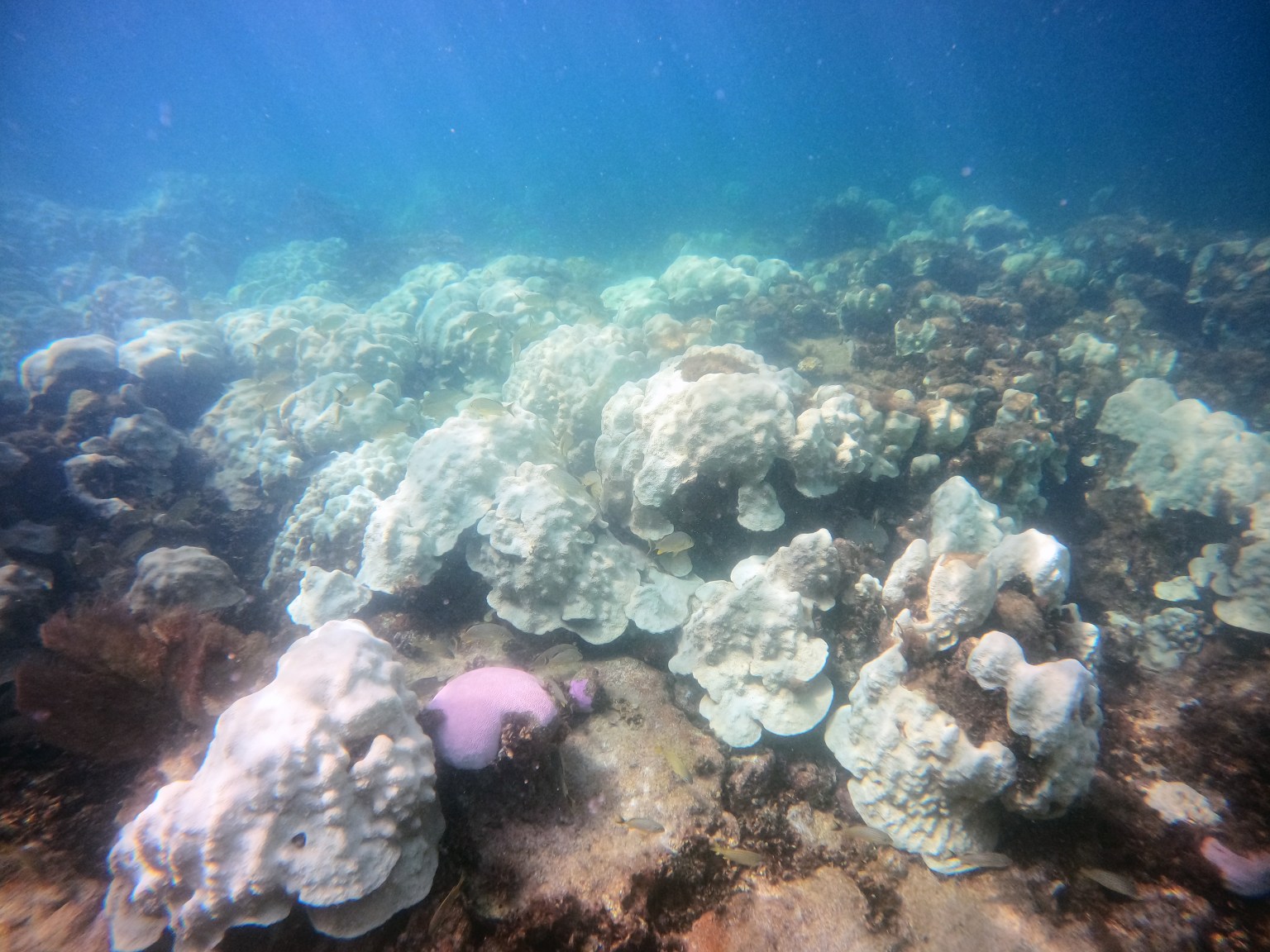
Photo: Coral Restoration Foundation.
Severe bleaching and mortality in the Middle Florida Keys. Photo taken on July 24th.
One doesn’t always think of television news as going deep on a serious and complex problem, but I have to give credit to Florida’s WFLA for taking on dying ocean reefs. The sad tale makes me think we humans are like lobsters who don’t notice the water is boiling until it’s too late.
“Once colorful coral cities overflowing with marine life, transforming into ghost towns, or better stated, ‘Ghost reefs’ seemingly overnight.
“ ‘We are surprised by the pace. It is unprecedented what we have seen,’ said Scott Atwell the communications and outreach manager for the Florida Keys National Marine Sanctuary.
“Atwell told WFLA Chief Meteorologist and Climate Specialist Tuesday: ‘We’ve never seen anything like this. Some are not even bleaching, they are going straight to dead.’
“ ‘Straight to dead’ illustrates just how extreme the marine heatwave is and how quickly it’s evolving. When under stress, typically coral bleach first, expelling their symbiotic algae partners which give them their vibrant hues, and turn white. Then sometime later, if the heat persists, the coral can succumb and die.
“But right now in the Florida Keys, there are reports of rapid mortality. Coral is dropping like dominoes across much of the reef tract from Key Largo to Key West – the third largest tract in the world and the only shallow water reef system in the U.S. mainland.
“About 25% of marine life depends on coral reefs during some stage of their life. If coral reefs vanish it will have cascading consequences across ocean ecosystems and the life that it supports. …
“Mission: Iconic Reefs, a large-scale NOAA-led coral restoration initiative reports that the most recent seafloor temperature at Sombrero Key (off Marathon) is 93.4F and at Looe Key (off Big Pine Key) is 89.6F. According to Mission: Iconic Reefs the ‘optimal’ temperature for reef-building corals maxes out at 84 degrees.
“Although tropical corals live in warm water, they are very sensitive to just a couple of degrees Fahrenheit spike in sea surface temperatures, especially if it lasts for too long. NOAA Coral Reef Watch says at four weeks, coral can begin to show signs of stress. If the heat last eight weeks, a bleaching event becomes likely. [In July, we passed] the eight-week mark. …
“Bill Precht is a coral reef scientist in South Florida. In his 45 years studying coral, he’s never been so concerned about the Keys’ iconic reefs, ‘If things progress as they have started … the likelihood of catastrophic levels of mortality are high.’
“As a result of this unprecedented event, NOAA Mission: Iconic Reefs and their partner organizations are racing against the clock to rescue coral from the reefs and bring specimens into the lab where they can buy some time until the ocean cools back down.
“So the natural question is, when the coral die, can they recover? Dr. Katey Lesneski, the Coordinator of NOAA Mission: Iconic Reefs was asked that question by PBS News Hour and here’s what she said, ‘Once they die there are other reef organisms that will settle on that skeleton, take up space, and the coral tissue cannot grow back, unfortunately.’
“So the teams are taking drastic measures to gene bank two fragments from each unique genetic individual of staghorn and elkhorn corals, listed as threatened under the Endangered Species Act. In other words, they are preserving the genetic material so that if much of the coral is lost, there is a way to restore it.”
More at WFLA, here. Startling graphs. No firewall.

 Suzanne's Mom's Blog