Feeds:
Posts
Comments

Posts Tagged ‘temple’

Photo: Kyodo News/Getty Images.
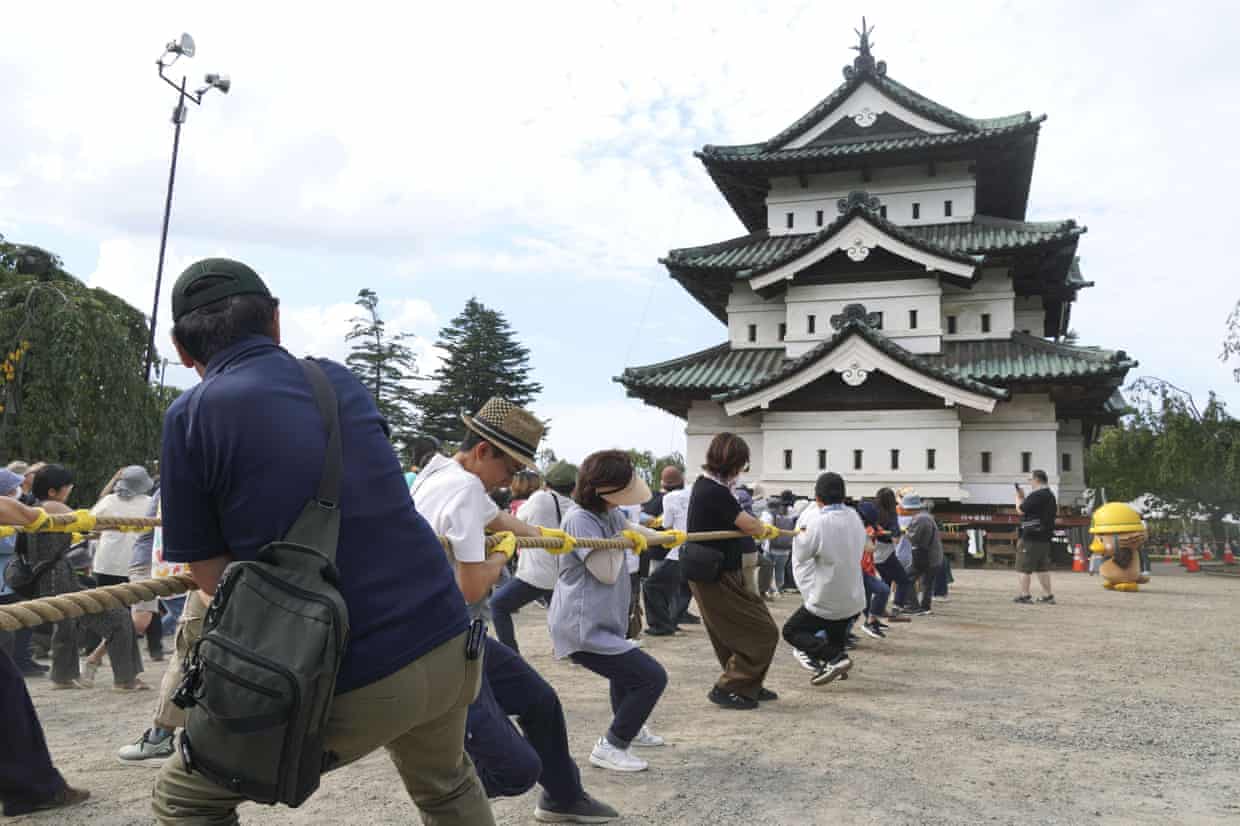
People pull on ropes attached to a platform carrying the Hirosaki Castle keep in northeastern Japan in August 2026.

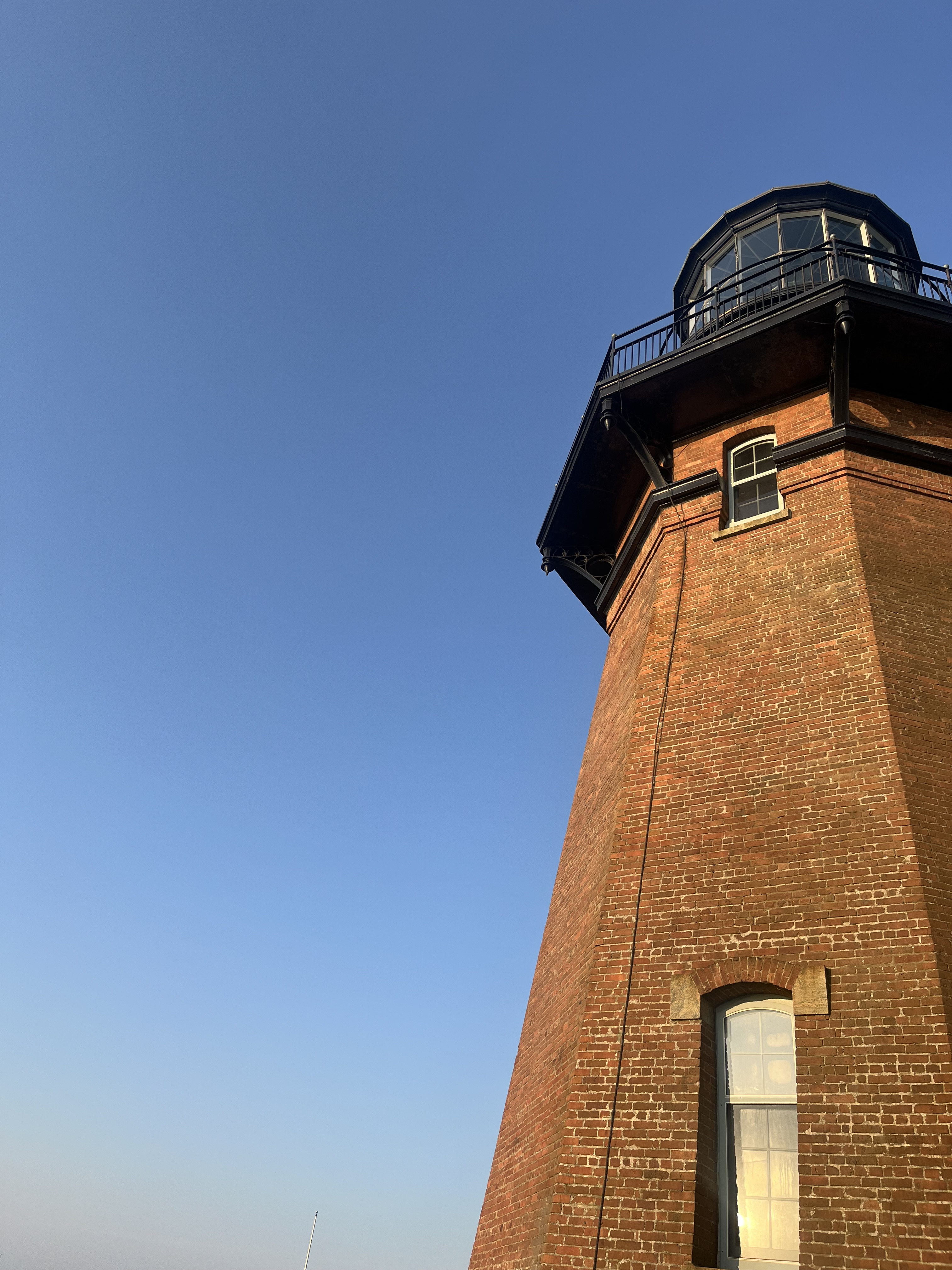
I remember watching when New Shoreham’s 2,000-ton Southeast Lighthouse was moved back from eroding bluffs in 1993. International Chimney Company and Expert House Movers, Inc. did the job, using heavy equipment.

In Japan, they do things differently. Gavin Blair writes at the Guardian about how 1,800 people were enlisted to drag a 360-ton castle keep by means of ropes and rollers. They had to turn away eager volunteers!

“To chants of ‘so-re, so-re,’ about 1,800 people came together in northern Japan [in August] to pull a 360-ton castle keep a little more than two meters [~7 feet] closer to its original resting place as part of ongoing renovations.

“The keep – a fortified tower within a castle – had to be moved to repair a wall that was damaged in a major earthquake.

“Rotating teams of 80 people heaved on 30-meter ropes as the keep of Hirosaki Castle in Aomori prefecture edged closer to its destination. On Saturday participants towed the building – which has been set on rails – 1.13m, while on Sunday it was shifted another 1.09m.

“ ‘We had about 8,000 applications for the 1,800 slots over the last two days, roughly four times oversubscribed, so not everyone could participate,’ Kensuke Hayasaka, head of the parks and green spaces division at Hirosaki City, told the Guardian. ‘Not only from the city, but from across Japan and overseas; a fair number from south-east Asia and from Europe and North America.’

“In order to preserve the historic structure, a technique known as hikiya – whereby buildings are put on rollers and moved rather than dismantled – was used. In 2015 the city put out a call for people to come and participate directly. …

” ‘Because the keep is a nationally designated important cultural property, we didn’t take it apart,’ Hayasaka said. ‘We’re using hikiya, a building-relocation method that has existed in Japan since ancient times.’ …

“Motoharu Nakata, 61, travelled from Hiroshima at the other end of Japan. ‘I pulled it 11 years ago too. It’s very moving to be able to participate again. There’s absolutely no other opportunity to pull a castle – it was fantastic,’ Nakata told the Sankei Shimbun. …

“It is a symbolic, community-building effort and the rest of the about 73m will be carried out using machinery by the end of the year. …

“The current structure was rebuilt in 1810 and the castle is now the centerpiece of a park that draws about 2 million visitors each year during cherry-blossom season. … Hayasaka said, ‘As things stand, we expect it to reopen to visitors in 2033.’ ”

More at the Guardian, here.

Photo:Suzanne and John’s Mom.
The Southeast Lighthouse, moved 3,000 feet inland by International Chimney Company and Expert House Movers in 1993.

Read Full Post »

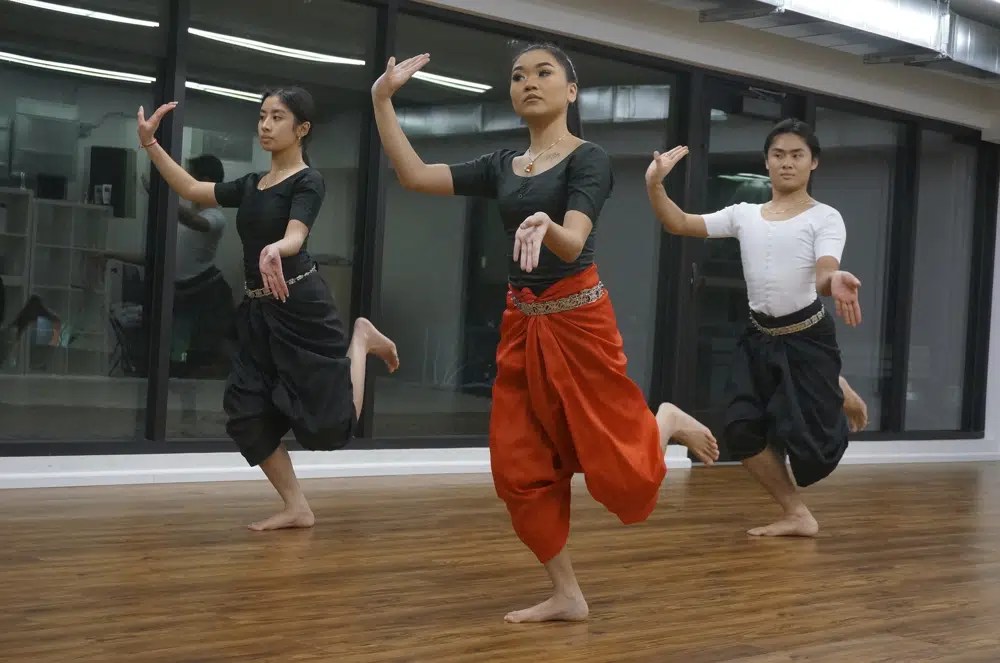
Photo: AP.
A Buddhist community anchored by a temple in Hampton, Minnesota, is drawing dancers of all ages.

It’s interesting to see what draws people to a faith community — besides faith. When we moved to a town where we didn’t know anyone, I visited several churches and chose the friendliest one. As we got involved, we got acclimated. The children made friends, and I got to know parents who filled me in on the best public school teachers.

Other people may join for other reasons. Consider the dance opportunity in today’s story.

Giovanna Dell ‘Orto reports at the Associated Press (AP), “The Buddhist community anchored by an ornate temple complex here in the Minnesota farmland is trying a new way to ensure its faith and ancestral culture stay vibrant for future generations — an open call for the sacred dance troupe.

“Founded by refugees fleeing the Khmer Rouge regime, which sought to eradicate most religious institutions, Watt Munisotaram and its troupe hope that teaching young children sacred dance will strengthen their ties to both Buddhism and Cambodian traditions.

“ ‘The connection is stronger when I dance,’ said Sabrina Sok, 22, a Wattanak Dance Troupe leader. ‘The thing that stays in my head is this dance form almost disappeared with the Khmer Rouge.’

“During their 1975-79 regime, the Khmer Rouge caused the deaths of an estimated 1.7 million in Cambodia. Hundreds of thousands fled, first to neighboring Thailand and later the United States, where Southeast Asians are one of the largest refugee communities.

“They carried this sacred dance tradition with them. On a frigid early February evening, Sok rehearsed for the upcoming Cambodian New Year holiday with fellow troupe leader Garrett Sour and his sister Gabriella, whose parents were among those refugees. …

“While recruitment was by word of mouth, this winter’s enrollment — open to anybody eager to learn the dance form — brought in the highest number ever after being posted on the temple’s Facebook page.

“Clothed in traditional thick silk shirts and pants from Cambodia, the three dancers sinuously stretched and bent every part of their bodies, from joint-defying toe curls on up. …

“ ‘We’re never ourselves, we’re just physical embodiments of higher spirits,’ said Garrett Sour, 20, as he meticulously coached the poses, urging a smaller step here, a deeper calf tilt there. ‘Dance was seen not as entertainment but a medium between heaven and earth.’

“The marketing student at a Twin Cities university started dancing when he was six and has learned Khmer to better delve into the sacred storytelling. He will be one of the teachers for the incoming dancers – about 20, which nearly doubles the troupe, and most of them younger than teens. …

“In the temple’s ornate higher room, where the ten monks in residence chant and meditate daily surrounded by sacred books and large Cambodian-made paintings of Buddha’s life, the Venerable Vicheth Chum also highlighted the importance of what he called ‘blessed dance.’

” ‘Very important to have, and to keep our ancestral tradition even when moved to (Minnesota),’ said Chum, who came to the United States more than 20 years ago from Cambodia. ‘Buddhist teaching is practice for peace and happiness, no matter the nation.’

“Monks at Watt Munisotaram – which roughly means the place to enjoy learning from wise men – practice Theravada, one of the oldest forms of Buddhism rooted in Southeast Asian cultures. …

“Dozens of faithful in equally bright white outfits [met] to celebrate Magha Puja, a holiday marking the gathering of 1,250 of Buddha’s first disciples and the establishment of his rules for the new community.

“Chum and seven other monks in elaborately folded, bright orange robes led a candlelit procession multiple times past an altar with several golden Buddha statues, glittery decorations and a profusion of flowers including lotus blossoms – most artificial, though in more clement weather some are grown locally or shipped from Florida.

“Several children marched along, carrying the U.S. flag and Cambodia’s state and Buddhist flags, before everyone sat in neat rows on the carpeted floor for two hours of chanting in Khmer.

“Chum said the monks worry about young people’s growing disenchantment with religion but believe that life’s inevitable struggles will eventually bring most back to the temple for guidance from Buddha’s teachings. …

“ ‘The world is using them to educate the other communities, I keep on reminding them,’ Sophia Sour said. She hopes to take Garrett and Gabriella to Cambodia to learn even more about the roots of their spirituality, whose fundamental values she listed as respect for the elders and good deeds.

“ ‘If you do good, good will come to you,’ she said. ‘I’m not sure if that’s religion, or just life.’ ”

More at AP, here.

Read Full Post »

There are so many interesting cultures in the world! For example, when I was editor of a magazine about lower-income issues in New England, I heard for the first time about the Karen from Burma (Myanmar). Who? Soon after, I managed to acquire an article on Karen refugees in Waterbury, Connecticut, so I was able to learn something along with my readers.

Recently, I heard of another new-to-me minority, members of which are being resettled in Massachusetts. They are called Mandeans, and their pacifist religious beliefs had subjected them to persecution in Iraq and Iran for millennia.

Here is what Brian MacQuarrie writes about them at the Boston Globe.

“The Mandaeans have found safety and acceptance since they began arriving [in Worcester] in 2008, freely practicing a monotheistic religion that predates Christianity and Islam. But they still do not have a temple — a ‘mandi’ for baptisms, marriages, and birth and death rituals — and whether one is built could determine if they continue to call Worcester home.

” ‘Work is not the anchor, living in an apartment is not an anchor, the mandi is the anchor,’ said Wisam Breegi, a leader of the Mandaean community. …

” ‘It really is a culture that is in danger of disappearing,’ said Marianne Sarkis, an anthropology professor at Clark University. ‘If you don’t have a way of preserving the culture and traditions and even the language’ of Aramaic — what a temple helps provide — ‘it is not going to survive very long.’ …

“ ‘We really don’t have the expertise, the know-how, the connections,’ said Breegi, who also has founded a scientific firm that is developing a low-cost, disposable, neonatal incubator for use in developing countries.

“To help forge the religious connections, Breegi and Sarkis are preparing an application for a nonprofit organization to help raise money for the temple. Worcester Mayor Joseph Petty said in an interview he is willing to help the project where he can.

“ ‘They’re all doing what everyone else is trying to do — working hard and getting their kids a good education.’ …

” ‘It’ll just help make Worcester stronger in the long run,’ Petty said of his city’s embrace of Mandaeans and other immigrants. ‘You can’t build walls between people.’ ”

Worcester held a ceremony of welcome in April that “represented the first time — anywhere, at any time — that Mandaeans had been recognized as a valued, important minority group, Sarkis said.” Wow.

More here.

Photo: Craig F. Walker/Globe Staff
The Kalmashy family (left to right) Lilo, and her husband Mahdi and their daughters and Sura and Sahar, shared lunch at their home in Worcester.

Read Full Post »