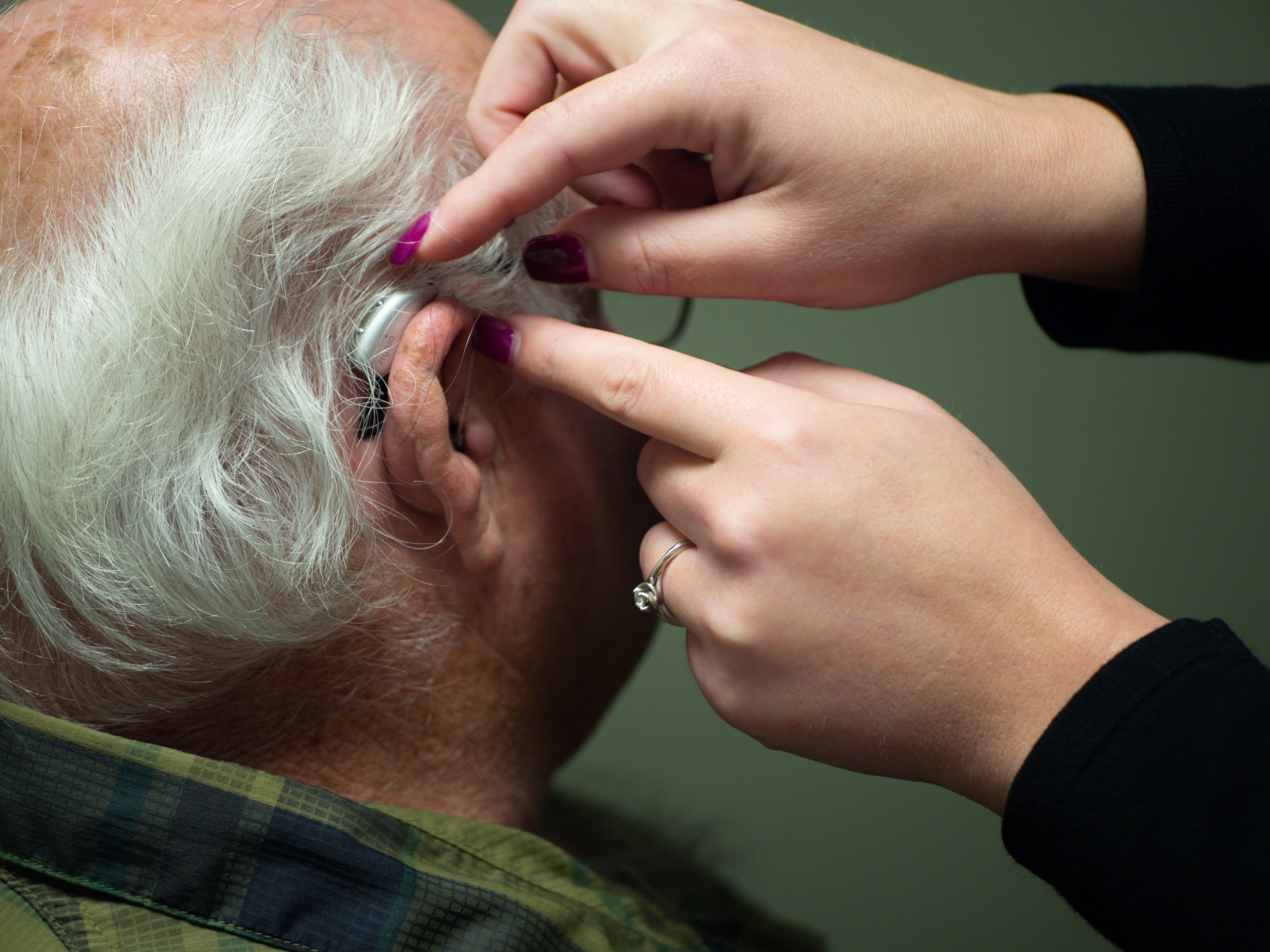
Photo: Anthony Camerlo/Unsplash.
Can you get a hearing test if the only language you know is rare?
Where we live now, it’s more common than not for people to need hearing aids. Whether those people actually wear their hearing aids is another issue, but folks around them seem tolerant of having to repeat — or shout.
One thing I never thought about until I read today’s article is the fact that getting an audiology test can be a problem if you speak an uncommon language.
Lina Tran reports at WUWM, “About four years ago, Maichou Lor was living in New York completing a postdoctoral fellowship, when family members back home in Wisconsin kept telling her that her dad’s hearing was getting worse.
“ ‘He wasn’t responding to conversations even though he had a hearing aid,’ said Lor, now an assistant professor of nursing at the University of Wisconsin-Madison. ‘I brought him in to see his doctor through the ENT clinic here at UW-Health.’
“Lor and her father are Hmong; she joined him at the appointment as an interpreter, since he doesn’t speak English. At the clinic, his physician told Lor there was a limit to what he could offer him.
“ ‘I told her that there was a limitation in the test,’ said Burke Richmond, an assistant professor in the ear, nose, and throat division [at] the University of Wisconsin-Madison. …
“Part of the evaluation is a word recognition test, which assesses when speech is loud enough for someone to understand. It helps doctors identify the severity and type of hearing loss and come up with a treatment plan, such as whether hearing aids will work or if a cochlear implant is viable.
“During the test, patients listen to a recording of words, with instructions to repeat the words as they hear them. But, for the most part, the test is only available in the most common languages. … Few clinics are equipped to treat Hmong-speaking patients. …
“After Lor and Richmond met, they undertook a years-long, interdisciplinary collaboration that resulted in the first Hmong hearing test of its kind.
“Hearing evaluations typically involve a couple different tests. In one of them, patients listen to beeps and tones and press a button when they hear it. ‘That’s easy enough to explain to someone who speaks a different language,’ said Jennifer Ploch, a clinical audiologist involved with the project, then at UW-Madison. …
“When Lor and her father came through his office, Richmond knew about Lor’s research on health disparities. He asked if she wanted to make a Hmong word test with him. …
“The English test is designed to use everyday words like ‘bat’ and ‘kick’ that anyone would understand. At the same time, it shouldn’t be possible for test-takers to predict or guess what the words are without actually hearing them. Historically, one of the ways audiologists have accomplished that is by writing the word list so that it reflects the phonetic make-up of the language.
“ ‘If the language has a bunch of S’s, you want to have a bunch of S’s in the words,’ explained Lynsey Wolter, an associate linguistics professor at the University of Wisconsin-Eau Claire, who led the writing of the Hmong word list. ‘But not too many because then someone will just guess.’
“But no one had studied how frequent different sounds are in Hmong.
“ ‘And there are a lot,’ Wolter said. ‘There are about twice as many consonant sounds in Hmong as in English. Hmong is also a tonal language. The intonation of the word — whether the tone is higher or lower, going up or going down — can change the meaning.’ …
“Wolter said it was critical to work with native Hmong speakers, so she quickly brought two of her students onboard. … Kao Lee Lor, then a senior, was one of the student collaborators. She always loved languages and grew up hearing many of them at home, reflecting the places her parents had lived before immigrating to Wausau, Wisconsin. They were born in Laos and grew up in a Thai refugee camp. They enjoyed television shows, films, and music in Thai, Hmong, and Hindi. …
“To pick words for the list, the students dug through Hmong texts, entering all the words into a massive spreadsheet.
“ ‘We compiled a bunch of different Hmong folklore and folktales, Hmong kids’ books, anything we could find,’ Lor said. Some of the tales were familiar to her and her collaborator, oral traditions that had been passed down from their grandparents and parents. But there was little time to appreciate the stories in a new light; their focus was gathering as many words as they could.
“ ‘Once we were able to extract these words from these texts, we were able to break these words up into [their] parts, and then count the frequency of how much these consonants, sounds, vowels, and tones occurred,’ Lor said. …
“With numbers on how frequent different sounds are in the language, the linguistics team picked words to meet those targets. They wrote four lists of 50 words each, and sent it back to the UW-Madison researchers.
“Word lists in hand, the researchers asked the Hmong community to nominate clear, fluent speakers. Then, to validate the list, they tested the Hmong test against the English version on a group of bilingual speakers. They published their results in December.”
More at Milwaukee’s WUWM, here. No firewall. And for more on Hmong people in America, read the lovely memoir The Late Homecomer.


 Suzanne's Mom's Blog