Feeds:
Posts
Comments

Posts Tagged ‘text’

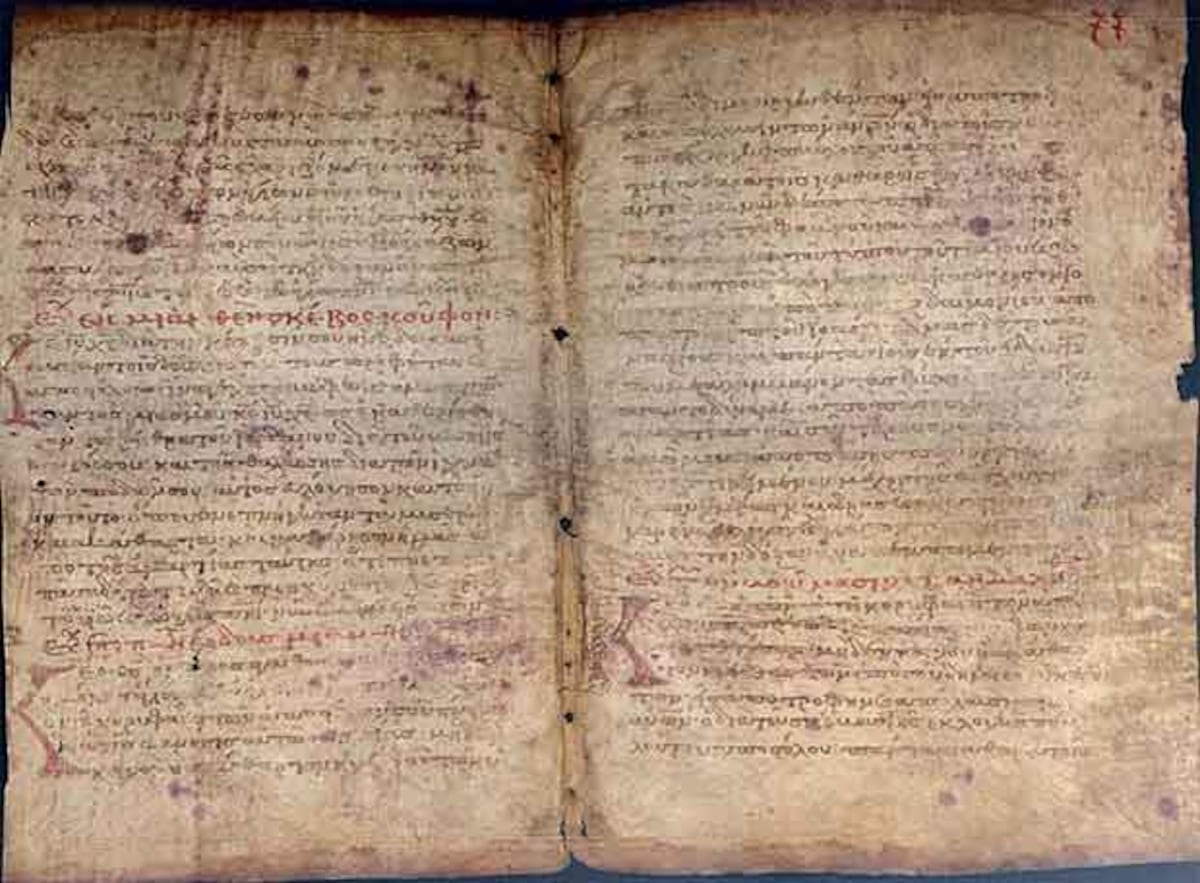
Photo: R.L. Easton, K. Knox, and W. Christens-Barry/Propietario del Palimpsesto de Arquímedes.
AI was used to translate this palimpsest with texts by Archimedes.

In general, I am wary of artificial intelligence, which one of its first developers has warned is dangerous. I use it to ask Google questions, but it’s a real nuisance in the English as a Second Language classes where I volunteer. Some students are tempted by the ease of using AI to do the homework, but of course, they learn nothing if they do that.

There’s another kind of translation, however, that AI seems good for: otherwise unreadable ancient texts.

Raúl Limón writes at El País, “In 1229, the priest Johannes Myronas found no better medium for writing his prayers than a 300-year-old parchment filled with Greek texts and formulations that meant nothing to him. At the time, any writing material was a luxury. He erased the content — which had been written by an anonymous scribe in present-day Istanbul — trimmed the pages, folded them in half and added them to other parchments to write down his prayers.

“In the year 2000, a team of more than 80 experts from the Walters Art Museum in Baltimore set out to decipher what was originally inscribed on this palimpsest — an ancient manuscript with traces of writing that have been erased. And, after five years of effort, they revealed a copy of Archimedes’ treatises, including The Method of Mechanical Theorems, which is fundamental to classical and modern mathematics.

“A Spanish study — now published in the peer-reviewed journal Mathematics — provides a formula for reading altered original manuscripts by using artificial intelligence. …

“Science hasn’t been the only other field to experience the effects of this practice. The Vatican Library houses a text by a Christian theologian who erased biblical fragments — which were more than 1,500-years-old — just to express his thoughts. Several Greek medical treatises have been deciphered behind the letters of a Byzantine liturgy. The list is extensive, but could be extended if the process of recovering these originals wasn’t so complex.

“According to the authors of the research published in Mathematics — José Luis Salmerón and Eva Fernández Palop — the primary texts within the palimpsests exhibit mechanical, chemical and optical alterations. These require sophisticated techniques — such as multispectral imaging, computational analysis, X-ray fluorescence and tomography — so that the original writing can be recovered. But even these expensive techniques yield partial and limited results. …

“The researchers’ model allows for the generation of synthetic data to accurately model key degradation processes and overcome the scarcity of information contained in the cultural object. It also yields better results than traditional models, based on multispectral images, while enabling research with conventional digital images.

“Salmerón — a professor of AI at CUNEF University in Madrid, a researcher at the Autonomous University of Chile and director of Stealth AI Startup — explains that this research arose from a proposal by Eva Fernández Palop, who was working on a thesis about palimpsests. At the time, the researcher was considering the possibility of applying new computational techniques to manuscripts of this sort.

“ ‘The advantage of our system is that we can control every aspect [of it], such as the level of degradation, colors, languages… and this allows us to generate a tailored database, with all the possibilities [considered],’ Salmerón explains.

“The team has worked with texts in Syriac, Caucasic, Albanian and Latin, achieving results that are superior to those produced by classical systems. The findings also include the development of the algorithm, so that it can be used by any researcher.

“This development isn’t limited to historical documents. ‘This dual-network framework is especially well-suited for tasks involving [cluttered], partially visible, or overlapping data patterns,’ the researcher clarifies. These conditions are found in medical imaging, remote sensing, biological microscopy and industrial inspection systems, as well as in the forensic investigation of images and documents. …

“The researchers themselves admit that there are limitations to their proposed method for examining palimpsests: ‘The approach shows degraded performance when processing extremely faded texts with contrast levels below 5%, where essential stroke information becomes indistinguishable from crumbling parchment. Additionally, the model’s effectiveness depends on careful script balancing during the training phase, as unequal representation of writing systems can make the deep-learning features biased toward more frequent scripts.’ ”

More at El País, here. What is your view of AI? All good? Dangerous? OK sometimes? I can’t stop thinking about the warning from Geoffrey Hinton, the ‘godfather of AI,’ that it could wipe out humanity altogether. 
Read Full Post »

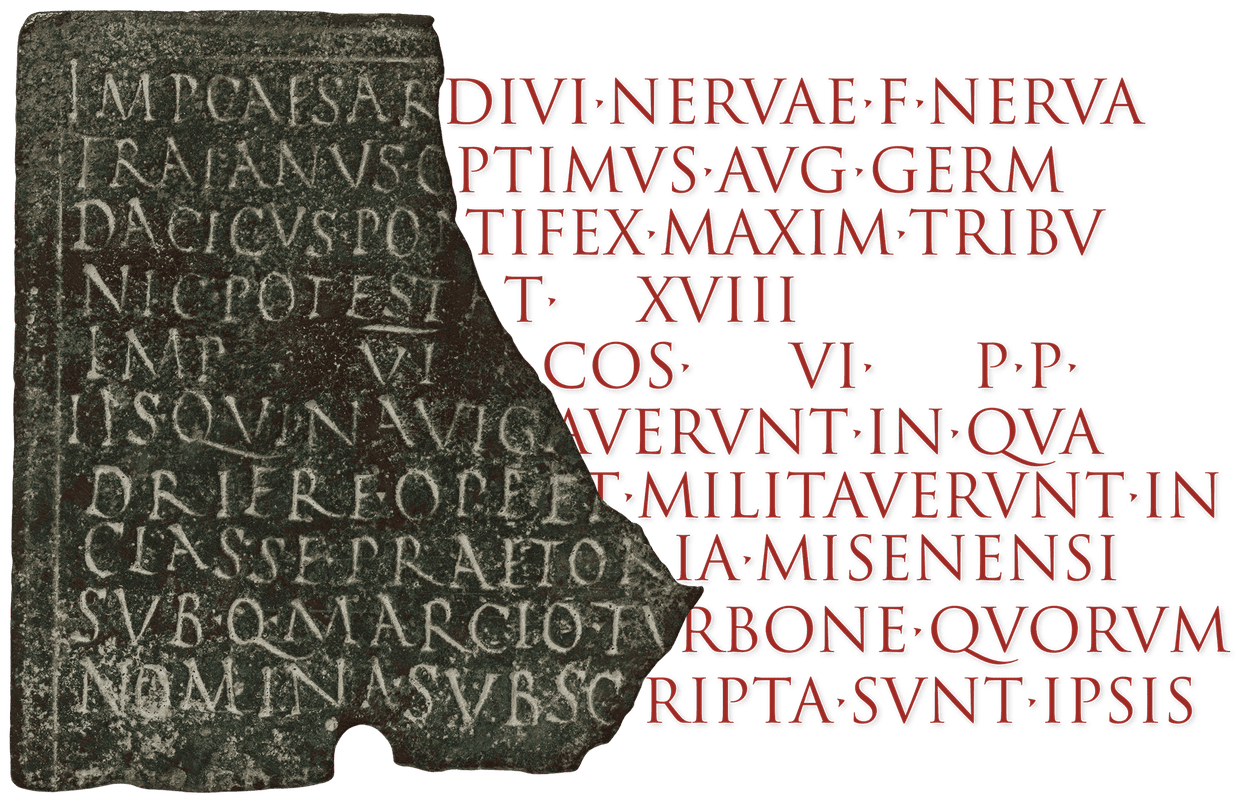
Photo:The Metropolitan Museum of Art.
Google’s Aeneas AI program proposes words to fill the gaps in worn and damaged artifacts. 

Whenever I start to worry that Google has too much power, it does something useful. Today’s story is about its artificial intelligence program Aeneas, which can make a guess about half-obliterated letters in ancient inscriptions.

Ian Sample, science editor at the Guardian, writes, “In addition to sanitation, medicine, education, wine, public order, irrigation, roads, a freshwater system and public health, the Romans also produced a lot of inscriptions.

“Making sense of the ancient texts can be a slog for scholars, but a new artificial intelligence tool from Google DeepMind aims to ease the process. Named Aeneas after the mythical Trojan hero, the program predicts where and when inscriptions were made and makes suggestions where words are missing.

“Historians who put the program through its paces said it transformed their work by helping them identify similar inscriptions to those they were studying, a crucial step for setting the texts in context, and proposing words to fill the inevitable gaps in worn and damaged artifacts.

” ‘Aeneas helps historians interpret, attribute and restore fragmentary Latin texts,’ said Dr Thea Sommerschield, a historian at the University of Nottingham who developed Aeneas with the tech firm. …

“Inscriptions are among the most important records of life in the ancient world. The most elaborate can cover monument walls, but many more take the form of decrees from emperors, political graffiti, love poems, business records, epitaphs on tombs and writings on everyday life. Scholars estimate that about 1,500 new inscriptions are found every year. …

“But there is a problem. The texts are often broken into pieces or so ravaged by time that parts are illegible. And many inscribed objects have been scattered over the years, making their origins uncertain.

“The Google team led by Yannis Assael worked with historians to create an AI tool that would aid the research process. The program is trained on an enormous database of nearly 200,000 known inscriptions, amounting to 16m characters.

“Aeneas takes text, and in some cases images, from the inscription being studied and draws on its training to build a list of related inscriptions from 7th century BC to 8th century AD. Rather than merely searching for similar words, the AI identifies and links inscriptions through deeper historical connections. …

“The AI can assign study texts to one of 62 Roman provinces and estimate when it was written to within 13 years. It also provides potential words to fill in any gaps, though this has only been tested on known inscriptions where text is blocked out.

“In a test … Aeneas analyzed inscriptions on a votive altar from Mogontiacum, now Mainz in Germany, and revealed through subtle linguistic similarities how it had been influenced by an older votive altar in the region. ‘Those were jaw-dropping moments for us,’ said Sommerschield. Details are published in Nature. …

“In a collaboration, 23 historians used Aeneas to analyze Latin inscriptions. The context provided by the tool was helpful in 90% of cases. “’t promises to be transformative,’ said Mary Beard, a professor of classics at the University of Cambridge.

“Jonathan Prag, a co-author and professor of ancient history at the University of Oxford, said Aeneas could be run on the existing corpus of inscriptions to see if the interpretations could be improved. He added that Aeneas would enable a wider range of people to work on the texts.

“ ‘The only way you can do it without a tool like this is by building up an enormous personal knowledge or having access to an enormous library,’ he said. ‘But you do need to be able to use it critically.’ “

More at the Guardian, here. Please remember that this free news outlet needs donations.

Read Full Post »

Here’s a new idea. A couple of young entrepreneurs have found a way to convert sign language into audible speech with their prize-winning electronic gloves.

National Public Radio has the story.

“For years, inventors have been trying to convert some sign language words and letters into text and speech. Now a pair of University of Washington undergraduates have created gloves called SignAloud. Sensors attached to the gloves measure hand position and movement, and data is sent to a computer via Bluetooth and is then converted into spoken word and text.

“Theirs is one of seven inventions recently awarded a Lemelson-MIT Student Prize, with awards ranging from $10,000 to $15,000.

“Inventors Navid Azodi and Thomas Pryor, both college sophomores, say the gloves will help create a communication bridge between deaf and hearing communities. The gloves, they say, will help deaf people better communicate with the rest of the world without changing the way they already interact with each other.

“However, the invention has been met with criticism that the bridge they want to create goes only one way — and it’s not necessarily one the deaf community has been clamoring for. …

“Azodi says he and Pryor are moving beyond their prototype and are working closer with those who use American Sign Language to develop new versions. They’re also working on better understanding ASL, which is more than just hand movements; it also uses facial expressions and body language to convey meaning.” Read more.

I don’t know much about the culture of the deaf community, but I do remember reading about resistance to cochlear implants a few years ago. It’s hard for people who can hear to understand that some people really don’t mind deafness and prefer their own ways of dealing with the world. But kudos to all inventors anyway, especially young ones open to continuous revision!

Photo: Conrado Tapado/Univ of Washington, CoMotion
SignAloud gloves translate sign language into text and speech.

Read Full Post »