Feeds:
Posts
Comments

Posts Tagged ‘tiger’

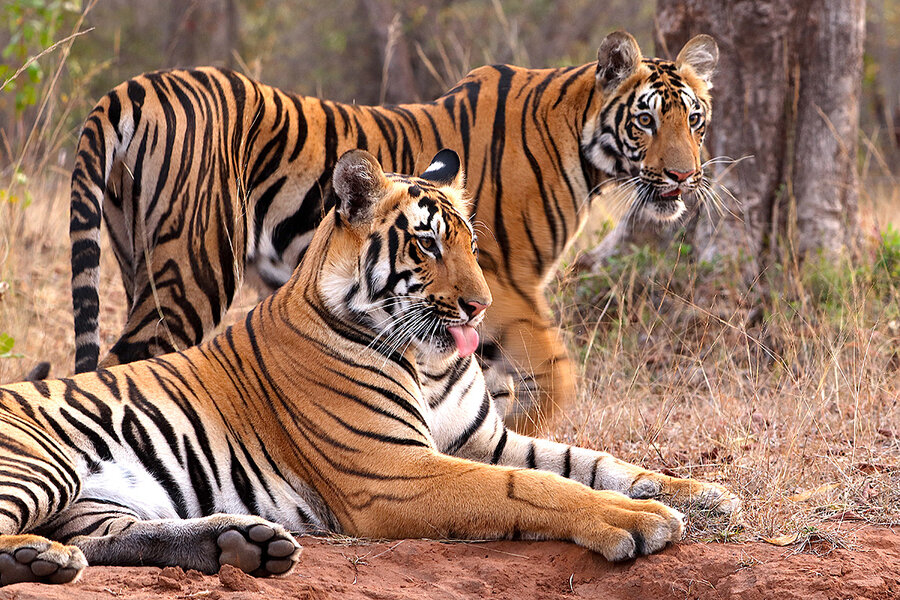
Photo: Charukesi Ramadurai.
Tigers at Kanha National Park in central India.

With its huge population, extremes of wealth and poverty, and religious suppression, India has more than its share of challenges. But one thing it seems to be getting right is its approach to protecting the national animal, the tiger.

Charukesi Ramadurai reports for the Christian Science Monitor, “On a misty winter morning in a central Indian forest, a soft caw-caw punctuates the silence. Dozens of grazing deer perk up their ears, then join in the staccato warning screeches of the langur monkeys and birds high up in the trees. As the chorus of animal alarms reach a crescendo, a frisson of excitement runs through the humans seated on the safari jeeps, bulky cameras and pricey binoculars at the ready. The urgency of these calls can only mean that a predator has been spotted. 

“The tourists let out a collective gasp when the tiger finally emerges from the thickets, the orange and black fur gleaming in the muted morning sunlight. …

“All eyes are on the king of Indian jungles as the country marks the 50th anniversary of Project Tiger, a program founded in April 1973 to save the species from extinction. Five decades later, India houses the world’s only stable and growing tiger population … with numbers expected to pass 3,000. India also now boasts 53 tiger reserves across 18 states, encompassing about 2.4% of the country’s total land. It’s a success story marked by unwavering hope. 

“ ‘Back when it started, nobody could have imagined that we would have more than 50 protected tiger reserves in this country,’ says conservationist and wildlife tourism expert Amit Sankhala, who is also the grandson of Kailash Sankhala, the first director of Project Tiger. ‘These habitats exist just for the tiger to exist.’ …

“India’s tiger population dwindled from over 40,000 in the 1930s to a mere 1,827 by the end of the 1960s, due to organized hunting and habitat destruction. Spurred on by the World Wildlife Fund (WWF), the Indian government announced the landmark Wildlife Protection Act in 1972, paving the way for Prime Minister Indira Gandhi to launch Project Tiger the following year. Authorities established nine tiger reserves and implemented a blanket ban on hunting, and the tiger was declared India’s national animal.

“Despite the program’s early success, progress has been inconsistent. In fact, tiger numbers dipped to an all-time low of 1,411 in 2008 because of continued habitat loss outside protected areas, as well as unchecked poaching, which wiped out tiger populations in major reserves such as Panna in the central state of Madhya Pradesh and Sariska in the west Indian state of Rajasthan.

“That sparked an urgent push to increase public awareness through celebrity campaigns, and the conservation reins were handed over to a special task force known as the National Tiger Conservation Authority. With stricter wildlife policies and improved monitoring, numbers have been rising slowly but steadily since then. Every consecutive four-year census has shown an increase of a few hundred tigers; according to the 2018 census, India has a tiger count of 2,967, a figure which accounts for nearly 75% of all tigers in the wild.

“Reputed naturalist and wildlife guru Hashim Tyabji calls India’s success in preventing tigers’ extinction ‘a miracle in conservation.’ The project, he says, is a testament to India’s expertise in capturing and relocating tigers from their home areas to forests where numbers are lower and more space is available for these solitary, territorial animals to roam freely. … ‘We have modern tools like camera traps to track tigers. And not to forget, there are many many people who are hugely committed to conservation, and practice responsible tourism.’ …

“The uptick in tiger populations is especially impressive considering India’s rapid rate of development, says Aly Rashid, director at Jehan Numa Wilderness, which operates sustainable wildlife lodges in Madhya Pradesh. 

“ ‘We have 1.4 billion people living here, and the [human] population has doubled since 1973. Given all this pressure on land and resources, I would say this is a huge achievement,’ he explains.

“Although the WWF reports that wild tiger populations are growing globally, the solitary predator isn’t out of the woods yet. It’s still classified as endangered, and in India, degradation of critical tiger corridors and human-tiger conflict pose serious challenges. But Mr. Rashid is hopeful that with community buy-in, India can overcome these challenges. …

“That hope extends beyond tigers, which Mr. Sankhala, the conservationist, calls ‘poster boys for wildlife.’ The apex predator has also helped draw attention to India’s other endangered species, he says, including red pandas and Asiatic lions. Recent amendments in the original 1972 wildlife act have made it possible to protect and nurture various animals, from the barasingha (swamp deer) and gaur (Indian bison) in the heart of the country, to the one-horned rhinoceros in the eastern reaches. …

“ ‘Once you save the tiger, you save everything around it,’ Mr. Sankhala says.”

More at the Monitor, here. No firewall.
Read Full Post »

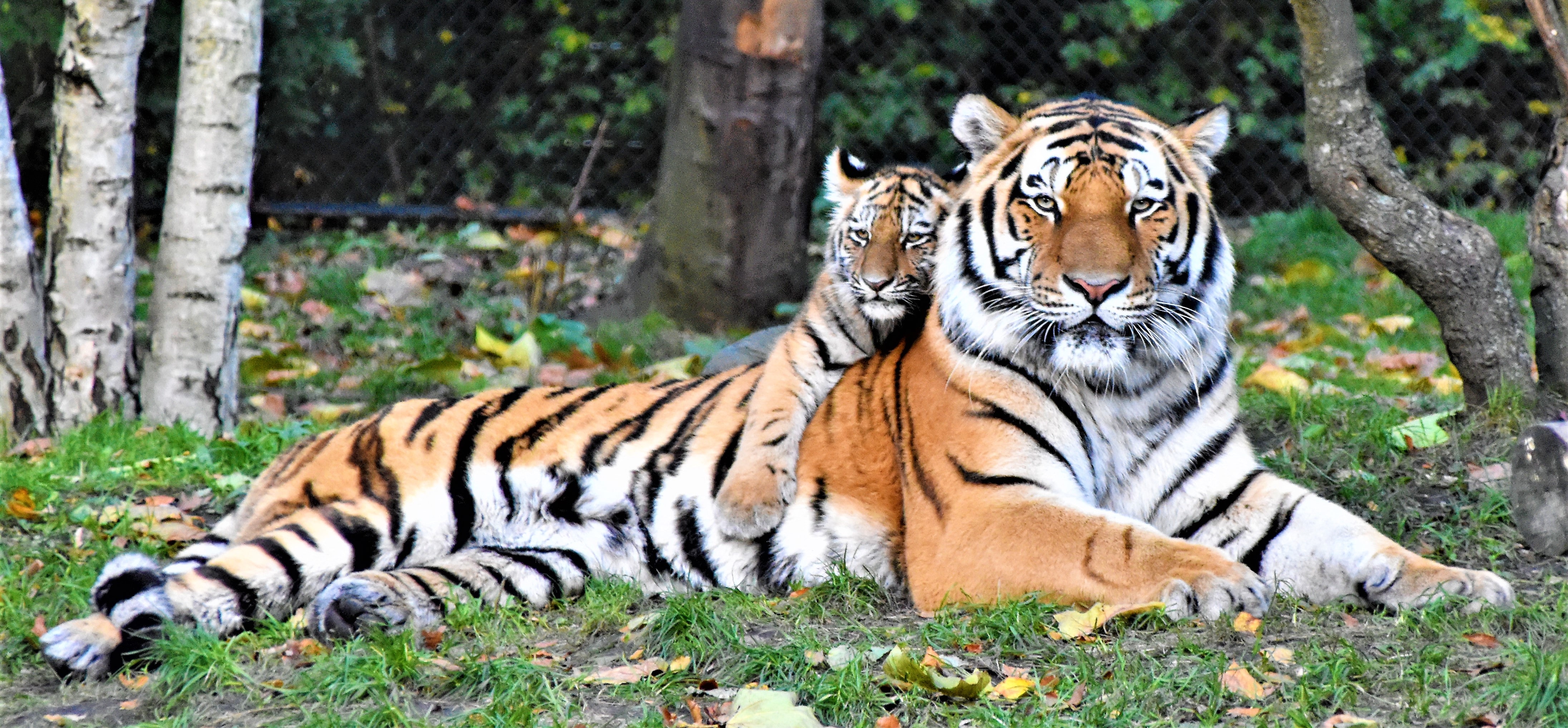
Photo: Waldemar Brandt/Unsplash.
Though still endangered, tigers are doing better this year than last year.

We hear so much about species on the verge of extinction that we have to blink twice get it through our heads that anything is coming back. That’s why I like today’s story.

Dino Grandoni reports at the Washington Post that “tigers are having a good year. Nepalese officials announced [in July] that the top predator’s numbers within the country’s borders have more than doubled in a bit more than a decade. Across Asia, there are as many as 5,500 tigers prowling jungles and swamps, a leading wildlife group said last week, a 40 percent jump from its 2015 assessment.

“The slow but steady rise in the big cat’s estimated population comes as biologists get better at tracking the animal and marks a high point amid a deepening extinction crisis that may see as many as a million plants and animal species disappear worldwide because of habitat loss and climate change.

“Tiger researchers, while optimistic, warn that the fierce hunter remains under threat from both poaching and encroachment into its remaining habitat. …

“ ‘It’s a fragile success,’ said Dale Miquelle, tiger program coordinator for the Wildlife Conservation Society. ‘There are still many pressures on tiger populations, and they are disappearing from some areas.’

“There are between 3,726 and 5,578 tigers in the wild today, according to the International Union for Conservation of Nature (IUCN), which tracks the status of plants and animals facing extinction. Tens of thousands of tigers once roamed Asia.

“One big reason behind the recent jump in tiger estimates: Scientists have simply gotten better at counting the cats, placing motion-sensing cameras in more spots to identify their territory. …

“But a combination of expanding protected areas and targeting poachers who sell tiger parts for use in traditional medicine has allowed tigers to stabilize or recover in China, India and Thailand.

“ ‘In all of those countries, tiger conservation has been a priority at the highest levels of government,’ said Ginette Hemley, senior vice president of wildlife conservation at World Wildlife Fund.

“Asia’s most iconic predator is perhaps doing best of all in Nepal, where the estimated population has soared from 121 to 355 since 2009, its government said Friday, after the small Himalayan country committed to restoring habitat and dispatched military units to patrol for poachers.

“The grassy lowlands between Nepal and India near the Himalayan foothills — known as the Terai — teem with grazing animals, making it among the most productive potential habitats for the carnivore. …

“Tigers once roamed from Turkey in the west to the eastern coast of Russia and from frigid forests of Siberia in the north to tropical islands of Indonesia in the south. But a century of hunting both tigers and their prey has restricted their range and decimated their numbers.

“By the 1940s, wild tigers vanished from Singapore and Bali. By the 1960s, they were gone for good in Hong Kong and Java. In recent decades, they disappeared from Cambodia, Laos and Vietnam. And today, they continue to die out in Malaysia. …

“Both revered and feared across the globe, the tiger is a classic ‘charismatic megafauna’ — a big, regal animal that receives outsize attention and money in the conservation movement. But by protecting tigers, Miquelle said, conservationists end up protecting entire ecosystems on which other animals and people depend.

“ ‘When we talk about protecting tigers, you’re really talking about protecting the environment that people also need to survive and live a better life,’ he said.

“Yet, as tigers rebound, conflicts arise. In India, home to two-thirds of the world’s wild tigers, the big cats killed 383 people between 2010 and 2019, testing the tolerance of locals for living among them. A protest erupted in a Nepalese village this June after tiger and leopard attacks.

“In a bid to bolster incomes and provide economic incentive for tiger conservation, groups such as the WWF are encouraging residents to open their homes to ecotourists hoping to see the animals.

“Further complicating conservation efforts is Russia’s war in Ukraine, which has made it more difficult for researchers to collaborate with Russian counterparts and to attend a major tiger forum in the port city of Vladivostok scheduled for September.

“And rising seas fueled by global warming threaten to inundate tiger-filled mangroves in Bangladesh, though climate change may end up expanding the cat’s range in Russia.

“Despite the gains, tigers are still officially classified as endangered in the IUCN’s Red List of Threatened Species. And countries still are failing to double their numbers.

“ ‘We haven’t succeeded in that process,’ Miquelle said. ‘But we do feel that there are more tigers today than there were 12 years ago — that progress is being made.’ ”

More at the Post, here.

Read Full Post »

The New York Times Science section had a cute piece in January about surprising friendships among different species of animals. Perhaps you saw it.

Erica Goode reported, “Videos of unlikely animal pairs romping or snuggling have become so common that they are piquing the interest of some scientists, who say they invite more systematic study. Among other things, researchers say, the alliances could add to an understanding of how species communicate, what propels certain animals to connect across species lines and the degree to which some animals can adopt the behaviors of other species.

” ‘There’s no question that studying these relationships can give you some insight into the factors that go into normal relationships,’ said Gordon Burghardt, a professor in the departments of psychology and ecology and evolutionary biology at the University of Tennessee, who added that one video he liked to show students was of a small and persistent tortoise tussling over a ball with a Jack Russell terrier. …

“Until recently, any suggestion that interspecies relationships might be based simply on companionship would probably have been met with derision, dismissed as Pixar-like anthropomorphism. That has changed as research has gradually eroded some boundaries between homo sapiens and other animals. Other species, it turns out, share abilities once considered exclusive to humans, including some emotions, tool use, counting, certain aspects of language and even a moral sense. …

Barbara J. King, an anthropologist at the College of William and Mary, said that she hoped researchers would begin to collect examples of cross-species interactions to build a database that would merit scientific scrutiny. ‘I think we’re not even at the point of being able to extract patterns because the database is so small,’ she said, adding that the topic could also benefit from a rigorous definition of what constitutes a ‘friendship’ between members of different species.” More here.

Photo: Noah’s Ark Animal Sanctuary by way of Africa Geographic.

Read Full Post »

The happy faces say it all. The circus is good for Baghdad.

An article by Michael S. Schmidt and Zaid Thaker in today’s NY Times describes the scene. “There were not any tigers because the animals were stuck in Egypt. There were dogs, however, but they were not [the promised] poodles. And the big snake, well, the snake had become sick and had to be evacuated …

“A circus coming to town may be a routine event in most cities. But in battered Baghdad, even if it was not the Greatest Show on Earth, the arrival of the circus was yet another small step in this city’s efforts at building a more normal life. …

“There is not a commanding ringmaster. What it does have, though, are dancers jumping rope, a woman swinging from a trapeze (without a net, but with a harness), and a grand finale of a man clad in an Iraqi flag plunging swords down his throat.  …

“Faisil Falleh, 56, who took his family to the circus on a recent night, said, ‘I haven’t seen anything in my life like this.’  …

“Promoter Jasim Mohammed Saeed said,  ‘Nobody is working in this business in Iraq. It is just us.’ ” Read more here.

If you want to go, it’s $12 for adults, $6 for teens, and free for children. The cotton candy — “lady’s hair” in Arabic — is $1.

Read Full Post »

Back in the day, I was a great fan of Mary Renault. I took her every word as gospel, down to the conversations Theseus had with Ariadne, because the stories generally meshed with what I knew from studying ancient Greek.

The Bull from the Sea was about the sea god Poseidon, who also is the god of earthquakes. I remember Renault’s description of the eerie stillness in the air before an earthquake and the strange behavior of the creatures.

So I am not at all surprised to read in the Washington Post that animals at the National Zoo knew before this week’s earthquake actually quaked that something was about to happen.

“The zoo documented a broad range of animal behavior before, during and after the tremor … . For example, a gorilla, Mandara, shrieked and grabbed her baby, Kibibi, racing to the top of a climbing structure just seconds before the ground began to shake dramatically. Two other apes — an orangutan, Kyle, and a gorilla, Kojo — already had dropped their food and skedaddled to higher turf. The 64 flamingos seemed to sense the tumult a number of seconds in advance as well, clustering together in a nervous huddle before the quake hit. One of the zoo’s elephants made a low-pitched noise as if to communicate with two other elephants. And red-ruffed lemurs emitted an alarm cry a full 15 minutes before the temblor, the zoo said.

“During the quake, the zoo grounds were filled with howls and cries. The snakes, normally inert in the middle of the day, writhed and slithered. Beavers stood on their hind legs and then jumped into a pond. Murphy the Komodo dragon ran for cover. Lions resting outside suddenly stood up and stared at their building as the walls shook. Damai, a Sumatran tiger, leaped as if startled but quickly settled down. Some animals remained agitated for the rest of the day, wouldn’t eat and didn’t go to sleep on their usual schedule.” Read the full story.

And while we’re on the subject, please read about 96 percent of a certain kind of male toad abandoning their breeding ground five days before the 2009 L’Aquila, Italy, earthquake! (That lead came via Andrew Sullivan’s blog.)


Read Full Post »