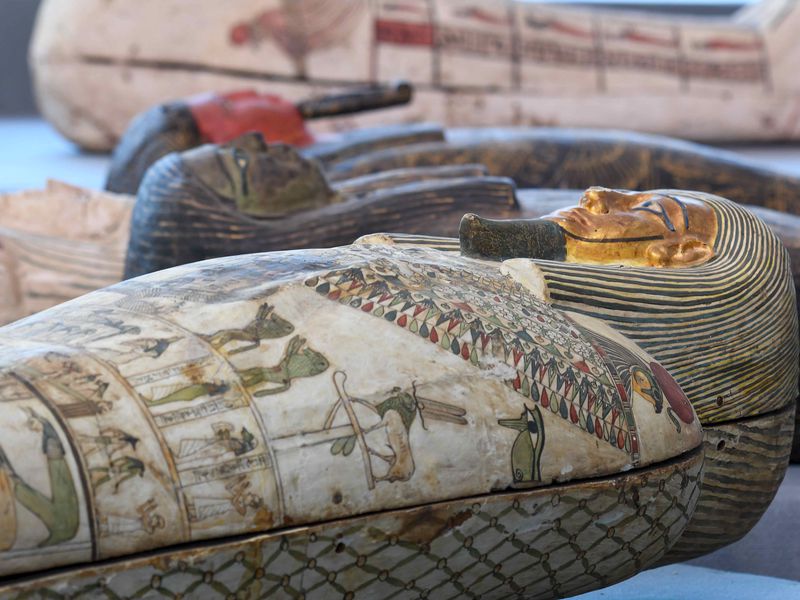
The sealed wooden coffins at Saqqara in Egypt date from between the sixth and first centuries B.C.
On the weekend, when I was indoors with grandchildren for the first time in more than a year, one of the kids read to me from a book of “spooky stories.” One yarn was about mummies, which reminded me of the prepandemic time that grandson and I had visited the Egyptian section of the RISD Museum. Maybe Suzanne will show him the picture from today’s post about a recent discovery in Egypt.
Jo Marchant wrote about this at Smithsonian last November. “A giant trove of ancient coffins and mummies has been discovered at the vast Egyptian burial site of Saqqara. After hinting at a big announcement for days, the Egyptian antiquities ministry revealed the details this morning: more than 100 intact wooden coffins with brightly painted scenes and hieroglyphs, and well-preserved mummies inside.
“The announcement comes after a string of recent discoveries at Saqqara, including 59 intact coffins revealed in September and October. The newly announced coffins were found nearby, at the bottom of three 12-meter shafts revealed when archaeologists led by Mostafa Waziry, head of Egypt’s Supreme Council of Antiquities, were removing debris from the site. Other finds include funerary masks and more then 40 statues of the funerary deity Ptah-Sokar, all untouched for at least 2,000 years.
“Speaking at a press conference at Saqqara with dozens of the coffins displayed on stage behind him, Egypt’s antiquities minister, Khaled el-Enany, praised the Egyptian archaeologists who excavated the finds, which mostly date from between the sixth and first centuries B.C. ‘They have been working day and night and I’m very proud of the result,’ he said. Their story will be told in a Smithsonian Channel docuseries called Tomb Hunters, scheduled to air in 2021.
“As the coronavirus pandemic devastates the tourism industry on which Egypt depends, the recent finds have been publicized in a series of increasingly dramatic events. At a previous press conference in October, Egyptian officials opened a coffin live on stage. This time they went one step further, not just opening a coffin but X-raying the mummy inside, revealing the individual to have been an adult male, perhaps in his 40s. ….
“Egyptologists have welcomed the announcement. To find an unplundered necropolis from this period is ‘extremely significant,’ says Salima Ikram, an archaeologist based at the American University in Cairo, who works at Saqqara. They note that although the latest find is larger, it doesn’t differ significantly from the previously announced finds. ‘This is very impressive, but it’s lots more of what we already have,’ says Campbell Price, curator of Egypt and Sudan at the Manchester Museum in the United Kingdom. Nonetheless, researchers are excited about the possibilities for learning more about this ancient sacred landscape, and the people who were buried there.
“Saqqara, located around 20 miles south of Cairo, is one of Egypt’s richest archaeological sites. Home to the 4,700-year-old Step Pyramid, Egypt’s oldest surviving pyramid that’s about 200 years older than the more-famous Pyramids at Giza, the site was used as a burial ground for more than 3,000 years. Like the previous 59 coffins, the newly announced finds mostly date from fairly late in ancient Egypt’s history, from the Late Period (664-332 B.C.) and the Ptolemaic period when Greeks ruled as Pharaohs (305-30 B.C.)
“During this period, Saqqara was far more than a cemetery, says Price. It was a pilgrimage site, he says, like an ancient Mecca or Lourdes, that attracted people not just from Egypt but from all over the eastern Mediterranean. Buildings such as the Step Pyramid were already thousands of years old at this time; people believed they were burial places for gods, and wanted to be buried close by.
‘Saqqara would have been the place to be seen dead in,’ says Price. ‘It had this numinous, divine energy that would help you to get into the afterlife.’
“Geophysical surveys have revealed the remains of numerous temples buried under the sand. Archaeologists have also discovered millions of animal mummies, including dogs, cats and birds, believed to have been left as offerings. Recent finds of mummified cobras, crocodiles and dozens of cats, including two lion cubs, were reported in November 2019 and feature in a Netflix documentary, ‘Secrets of the Saqqara Tomb,’ released this month. Meanwhile the discovery of an underground embalmers’ workshop, announced in April, suggests a thriving business in dealing with the dead, with coffins and masks to suit a range of budgets.
“But the undertakers weren’t digging from scratch, says Aidan Dodson, an Egyptologist at the University of Bristol in the United Kingdom. They were reusing older, looted tombs, he says, ‘scouring Saqqara for locations’ suitable for placing new coffins, even beneath the Step Pyramid itself. That makes the site a densely packed mix of finds that range thousands of years. ‘One would be hard pressed to dig and not find something,’ says Ikram. The latest coffins come from an area north of the Step Pyramid, next to the bubasteon, a temple complex dedicated to the cat goddess Bastet, where older tombs were reused to hold hundreds of mummified cats.” As Laurie would say, “Holy Cats!”
More at the Smithsonian, here.

 Suzanne's Mom's Blog
