Feeds:
Posts
Comments

Posts Tagged ‘transit’

Photo: Maya Pontone/Hyperallergic.
Grand Central Station hosts the New York subway system’s newest public artwork, “Abstract Futures” (2025) by a collective called Hilma’s Ghost. The work was supported by the city’s Percent for Art program, which has brought more than 400 commissioned public works into the transit system.

Hilma af Klint is having a moment. I hadn’t heard of this mystical Swedish pathbreaker before the Guggenheim mounted a retrospective in 2018.

Now some artists inspired by her work have merged her eerie geometric style with Tarot cards to make beautiful subway art beneath New York’s streets. Maya Pontone at Hyperallergic has a report.

“Celestial motifs and cosmological geometries strewn across a prismatic landscape comprise ‘Abstract Futures’ (2025), the newest public artwork to grace the walls of the New York City subway system. Designed by the feminist art collective Hilma’s Ghost, the 600-square-foot glass mosaic mural now greets transit riders between the turnstiles and escalators at the 42nd Street entrance to the 7 train in Manhattan’s Grand Central Station. …

“The project was commissioned by the Metropolitan Transportation Authority’s (MTA) Arts and Design program through the four-decade-old Percent for Art initiative, which has brought site-specific works by more than 400 artists into the city’s subways, buses, commuter rail stations, and other transit areas. …

‘Abstract Futures’ [fuses] reinterpreted tarot archetypes with classic heroic tales to highlight the shared transformations experienced by commuters on their individual journeys.

“The first segment of the mosaic begins with the story of ‘The Fool,’ a tarot card signifying new beginnings and opportunity. … The next panel is laden with earth-toned tiles as the fool grapples with challenges and spiritual evolution, represented by the symbol for the ‘Wheel of Fortune‘ tarot archetype in the center. Situated closer to the subway turnstiles, the final section of the mosaic traces a spiritual metamorphosis in which the main character discovers a deepened [self-knowledge]. …

“Brooklyn-based artists Sharmistha Ray and Dannielle Tegeder, the founding duo of Hilma’s Ghost, told Hyperallergic that the artwork was developed over two years and executed in close collaboration with master mosaic fabricator Stephen Miotto, who has been working with the MTA since the 1980s. It shares the same name as their first visual art project, which consisted of a limited-edition abstract tarot deck, building on the collective’s commitment to reimagining historically under-recognized spiritual practices and gendered cultural narratives.

“Inspired by the work of Swedish Theosophist artist Hilma af Klint, Hilma’s Ghost has engaged in a variety of art projects since its founding in 2020. …

“Ray and Tegeder described their new mural as ‘both a celebration and a meditation on the city’s perpetual cycles of arrival, growth, and renewal honoring New York’s resilience, ambition, and the shared sense of collective belonging.’

“ ‘Our intention is to create a contemplative space that centers inclusivity, connection, and healing,’ the pair added.”

More at Hyperallergic, here. No firewall, but membership are sought.

Read Full Post »

Photo: Jeremy Siegel/The World.
A Tokyo Metro train during rush hour.

Tokyo seems to have found better ways to get around than by car. Public transit can get crowded, of course — it would have to in a city of that size — but many thoughtful touches make it all run smoothly, with less stress for the traveler. And the travelers contribute with good transit behavior.

As Jeremy Siegel reports at Public Radio International’s The World, “At Tokyo’s Ebisu train station, the first thing passengers hear upon arrival is the theme music from the 1940s noir film, The Third Man

“Every train stop in the city has distinctive jingles, subtly and efficiently letting people know where they are and when to get off. 

“In Tokyo, every little way you can make things run more smoothly counts, according to Tomohiko Taniguchi, a former rail executive and adviser to former Prime Minister Shinzo Abe.

“It includes individual station songs; having train employees literally stuff passengers into train cars during rush hour; and enforcing a unique set of unspoken rules for how passengers should act.

“ ‘One of the first things you might have noticed is that people are dead silent in busy trains and crowded trains,’ he said. ‘It is to make [as little] annoyance as possible.’

“Despite a population of 37 million, there’s relatively little congestion and pollution here since the majority of its residents rely on public transit rather than cars. But while Tokyo’s mass transportation system may serve as a global success story, it may not be replicable, because its organic growth over the decades has fostered a unique culture of transit.

“Taniguchi said that he has been taking the train his whole life. After decades of observing Tokyo’s system, he said, he’s come to the conclusion that in many ways, life in this city revolves around trains. …

“The busiest train station of all, with 3.5 million people passing through every day, is Shinjuku station where Hari — who only provided her first name — met a friend on a recent Tuesday evening. Hari said that she [loves] Japanese transit. Despite the fact that she can drive, she hasn’t since moving to Tokyo.

“ ‘The train is just more convenient,’ she said. …

“Japan’s culture of transit can be traced back to the late 1800s, according to Fumihiro Araki, deputy director of The Railway Museum, which houses dozens of old trolleys, rail cars and bullet trains.

“ ‘When Japan moved from a shogun government [with leaders who were emperor-appointed] to a democratic government in the late 19th century, it was decided that railways were absolutely necessary,’ he said.

“The idea was to keep up with Western countries, many of which were growing — and railways played a big part. But after World War II, the US and European countries began throwing money at highways. Japan, which was rebuilding from the war’s destruction, doubled down on trains.

“The country made massive investments in transit, which coincided with a population boom in Tokyo that allowed the train system to grow organically alongside the city. Additionally, they felt it was easier to build railways because of the mountainous terrain, and because the country itself isn’t as spread out as, say, the US. …

“ ‘In other countries, a railway is just a railway. It’s just a place to ride on the train,’ said Shunzo Miyake, who heads up international affairs at the country’s largest railway company, JR East. 

“Miyake, who has visited 40 different countries, said that he believes that the difference has to do with how Tokyo rail operators compete for passengers. They even develop real estate around stations to turn them into economic hubs — places where people want to stay after they get off the train.

“In fact, busy stations like Shinjuku and Shibuya feel like city centers in and of themselves. People can spend an entire day finding hundreds of restaurants to dine at, places to shop at and bars to drink at, virtually without ever having to leave the station. …

“Miyake said that developing Tokyo’s system, and ingraining transit into the city’s culture, has taken time and money. But for companies like JR East — and the many residents who don’t have to contend with traffic — it’s paid off.”

More at The World, here. I highly recommend this show, which I listen to online at GBH.org. It offers voices from around the world that you rarely hear on US media — and often a more positive perspective.

Read Full Post »

Photo: Nederlandse Spoorwegen
A special book given out as gift to readers during National Book Week is accepted instead of a ticket on the train.

The Dutch seem to be ahead of the curve on many things. I’ve posted about their friendly communities for people with dementia, about their environmental innovation, about their biking culture. This story is on their support for reading books.

Jon Stone writes at the Independent, “Dutch book lovers got free rail travel across their country’s entire network [in March] as part of the Netherlands’ annual book week celebrations.

“Every year since 1932 the Netherlands has encouraged reading with Boekenweek – a celebration of literature marked with literary festivals and book signings across the country.

“Traditionally, a well-known Dutch author writes a special novel – the ‘book week gift’ or Boekenweekgeschenk – which is given out for free to people who buy books during the festivities or sign up to a library.

“But the special book – this year the novel Jas Van Belofte by celebrated author Jan Siebelink, can also be presented instead of a rail ticket on every train in the country on the Sunday of book week.

“Nederlandse Spoorwegen (NS), the Dutch state railway company, has long been a sponsor of the annual festivities – and even organises book readings signings by top authors on its trains.

” ‘It is good to see all those happily surprised faces of travellers,’ author Jan Siebelink said after boarding a train for the city of Utrecht to meet passengers and read his book. …

“This year the book week gift was given out by bookshops to anyone who spent €12.50 on Dutch-language books.” More here.

And check out this cool article by Feargus O’Sullivan at CityLab, in which he describes a wide array of unusual ways to pay fares — ideas from all around the world.

Because of a problem with rail passes, he writes, England’s Virgin Trains let people pay with an avocado for a while. And “Indonesia’s second city, Surabaya, came up with a novel way of clearing its streets of plastic waste last autumn: It has been encouraging passengers to trade in trash for bus tickets.”

Among other creative approaches, Russia promoted the Winter Olympics by offering passes for doing a certain number of squats, Berlin partnered with Adidas to offer sneakers with a pass in the tongue, and Japan started experimenting with cryptocurrency.

Can you think of other ideas cities should try? Maybe on Giving Tuesday, transit systems could allow free travel for proof you gave to a charity.

Read Full Post »

screen-shot-2012-07-15-at-10-09-57-am

Photo: MTA Arts for Transit
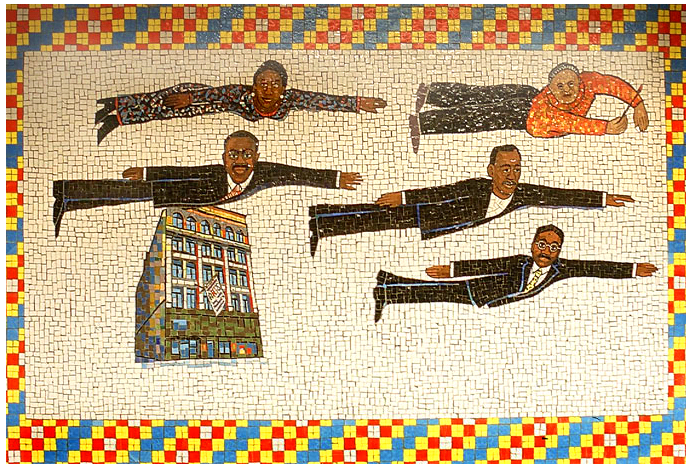
Faith Ringgold’s mosaic “Flying Home: Harlem Heroes and Heroines (Downtown and Uptown),” 1996, is one of the pieces of subway art featured in a PBS documentary.

I’m always amazed by the beauty of the mosaics in the New York subway, even the ones that merely tell you what street you’re at. It makes me happy to see that the city values them, too, and periodically cleans up the oldest ones. They go back as early as 1901.

My sister alerted me to an excellent PBS documentary about recent additions to the art in the subway system. You can read about it at the website Mosaic Art Now.

“For a delightful immersion into the history and current activities of the enormous underground museum that is the New York subway system’s Arts For Transit program, treat yourself to WNET Channel Thirteen’s free one hour video called ‘Treasures of New York: Art Underground.’ …

“Mosaic artist Steven Miotto gets major face time. His decades-long collaboration with artists of all stripes is a fascinating story in itself. When selected by a commissioned artist as a collaborating partner, he gets into their minds and hearts, leading them through the complex process of translating their vision and their graphic designs into mosaic ‘paintings for eternity.’ …

Faith Ringgold, speaks eloquently and nostalgically about the series of paintings – now mosaics – that portray the heroes of her Harlem childhood. Writers and musicians fly across the cityscape in flattened but vivid characterizations. I had the opportunity to interview her when she was in Miami last year, and she spoke about the challenges of trying to ‘make it’ as an African-American artist dealing with political themes at a time when the galleries favored the abstract.  Click here (http://bitly.com/yxGJ3R) to listen to that interview with her.”

See some of the beautiful new mosaics and watch the video here.

If you are up for more on transit-system art, be sure to check out an excellent article by Sarah Hotchkiss at KQED about what’s going on with San Francisco’s Transbay system, here.


Read Full Post »

Laura Bliss at the Atlantic‘s City Lab has a story on young people you may have seen performing in a New York subway car. She reports that in the film We Live This, the teens’ hopes seem hemmed in by poverty.

“ ‘Showtime’ dancing is a hallmark of the New York City transit scene,” writes Bliss. “Hoping for donations, crews of young black and Latino men perform exuberant choreographies for subway passengers, twisting and leaping from pole to pole with artful ‘lite-feet‘ dancing in between—and never before shouting, ‘It’s showtime!’

“Who are these dancers scraping by on their earnings? A new, short cinéma vérité documentary, We Live This, shines a light on the world of one crew, whose four young members perform on the J train. They are talented, hardworking, committed, and full of dreams, the film shows. But for some, the obstacles are high, and the alternatives slim. …

“Forty, is homeless.

‘As I’m dancing on the train, I’m thinking about where am I sleeping at night,’ he says. ‘Who should I call? Who is going to pick up? What if they don’t answer?’

“Showtime is the best way he he knows to a better life, a way into a community, he says. …

“Of course, the subway is no simple launchpad to success. While some passengers love the dancing, many others avoid eye contact, and some even yell at crews to switch cars. …

“ ‘I hope people will watch this and look at these young men as human beings,’ the film’s director, James Burns, tells CityLab. ‘And see the last vestiges of a culture that may be dying out.’ ”

More.

WE LIVE THIS – OFFICIAL TRAILER from HAYDEN 5 on Vimeo.

Read Full Post »

Well, here’s a new concept in energy production: braking regeneration.

Diane Cardwell writes at the NY Times, “Along Philadelphia’s busy Market-Frankford subway line, the trains behave like those of any transit system, slowing to halt at the platforms and picking up passengers.

“But more is happening than meets the eye. In an experimental system that is soon to be more widely adopted, every time the trains pull into certain stations, they recover the kinetic energy as they brake and channel it as electricity to battery banks at one of two substations.

“The batteries, managed by software, can then use that power to push the trains back out or to help modulate electricity flows on the grid.

“The system is unusual because the batteries are being used for more than just powering the trains, said Gary Fromer, senior vice president for distributed energy at Constellation, the power provider that will own and operate the system for the transportation authority.

“The electricity savings alone do not justify the battery costs, he said, so it was important to find another source of revenue, which comes from selling energy services to the grid. …

” ‘We don’t have to front the money and we’re reaping both savings and actually money coming back our way,’ said Jeffrey D. Knueppel, general manager of the transportation authority. The base technology of the system, known as regenerative braking, was one of the breakthroughs that allowed for the development of hybrid and electric cars like the Prius.” More here.

This reminds me of my 2012 post on inmates in Brazil who bike to create electricity — and reduce their sentences. And this post from 2013 about lighting schools by playing soccer. All hail to human ingenuity!

Photo: Jessica Kourkounis for The New York Times
The Market-Frankford subway line in Philadelphia is part of a regenerative braking experiment.

Read Full Post »