Feeds:
Posts
Comments

Posts Tagged ‘tree planting’

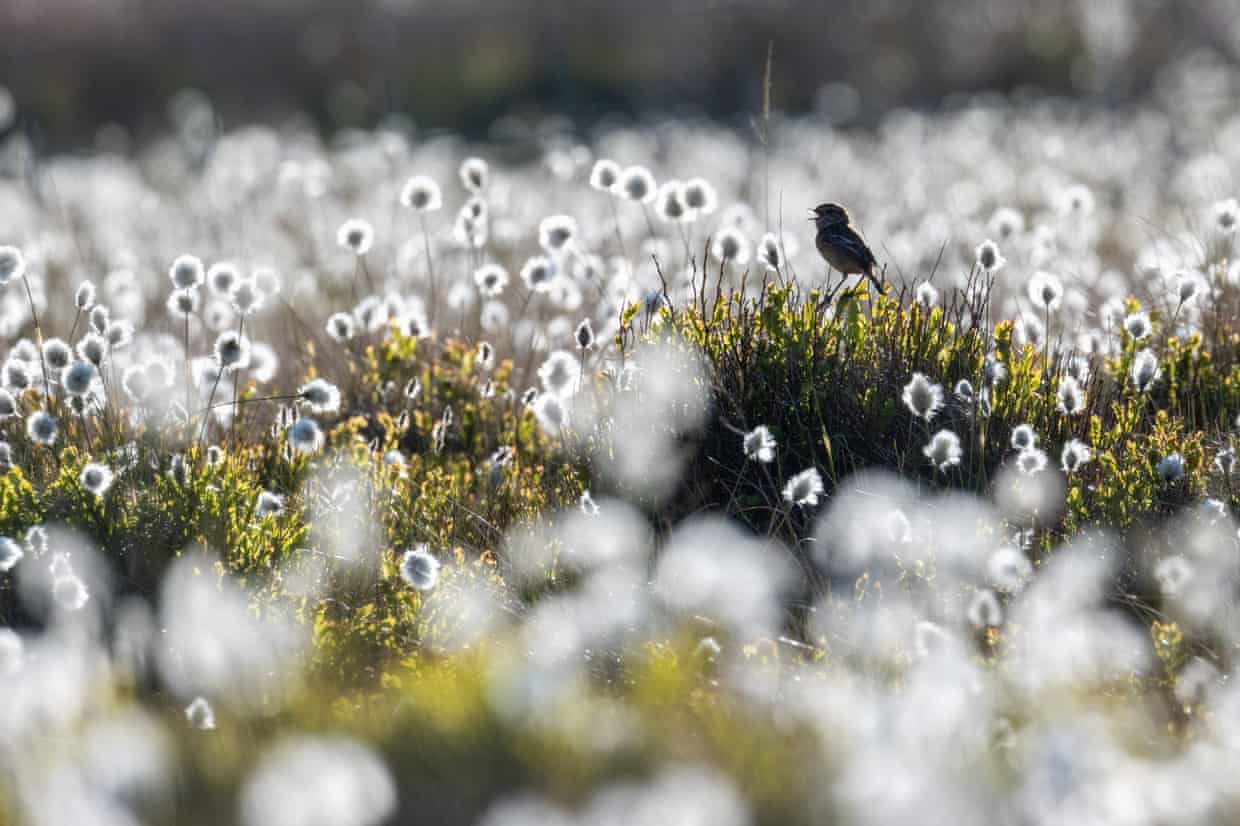
Photo: Rebecca Cole.
A female stonechat calls from a bilberry bush. Cooperation between farmers and conservationists in England is bringing back “ghost woodlands” and wildlife habitat.

When do tree-planting programs accomplish what they set out to do? That is the question as we hear more and more that some massive initiatives haven’t worked. In a story from Yorkshire we learn that cooperation among different interest groups is one route to success. Another is using native species to reawaken ancient species buried deep in the soil.

Phoebe Weston writes at the Guardian about a restoration effort by both conservationists and farmers to transform barren sheep fells.

“The Howgill Fells are a smooth, treeless cluster of hills in the Yorkshire Dales national park, so bald and lumpy that they are sometimes described as a herd of sleeping elephants. Their bare appearance – stark even by UK standards – has been shaped by centuries of sheep grazing. Yet beneath the soil lie ancient tree roots: the silent traces of long-lost ‘ghost woodlands.’ …

“Over the past 12 years, 300,000 native trees have been planted across these hills in sheep-free enclosures. The results are beginning to be seen: birds and flowers are returning. … Says ecologist Mike Douglas from South Lakes Ecology, who is monitoring birds in the enclosures, ‘We are 10 years into what was ecologically very damaged land.’ …

“Big rewilding projects often happen on private land with limited public access. These enclosures are a result of agreements reached between dozens of farmers on common land with public access. ‘Doing so much tree-planting on a common was groundbreaking,’ says Peter Leeson from the Woodland Trust. …

“Bluebells are popping up and there are patches of bracken, which suggest the soils and seed banks retain the memory of being a woodland despite hundreds of years of sheep grazing. “We call these memories ‘ghost woodlands,’ says Leeson. These ancient woodland indicators could offer a blueprint of where trees should return. …

“Last year, there were 14 breeding species here. Before the enclosure was created, he says, just four would have been found: meadow pipit, skylarks, wren and grey wagtails. Eleven new breeding bird species have been recorded since the original 2016 survey, with numbers increasing year-on-year. ‘I’m surprised by how quickly birds have colonized, and the diversity of species,’ says Douglas. …

“The enclosures were possible thanks to a 10-year government agri-environment scheme, signed by farmers with grazing rights to the fell as part of the Tebay Common Grazing Association, and the owner of the fell, Lonsdale Estates, supported and monitored by the Woodland Trust. …

“Across Europe, conflicts between farmers and conservationists are increasing due to the need for maintaining food production while creating space for nature. This conflict tends to be especially pronounced in the uplands because the land is relatively unproductive for farming. ‘Farmer and conservation collaboration is the real joy,’ Leeson says. ‘We want the same things. We want to be listened to, and heard and involved. I’d say we’re friends now.’

“John Capstick, chair of the Ravenstonedale Common Graziers Association, which hosts 187 hectares (462 acres) of fenced off land, says at first some farmers ‘were dead against it being fenced off. They were frightened it was an ulterior motive to get sheep off the fell.’ …

“In fact, the trees are not proving a threat to hill farming. The money is a lifeline for farmers, who earn as little as £7,500 a year from selling sheep and have been reliant on disappearing government subsidies. The Tebay scheme provides payments of £25,600 a year for maintaining the trees and fences and for loss of grazing rights, which are shared equally between the landowner and the farmers.

“Twenty-five years ago, there were 25 farmers on Tebay common. Now there are 10. For those who still graze on the common, the payments are ‘keeping them going,’ says Tim Winder, chair of the Tebay Common Grazing Association, whose father’s family have been farming for as long as they can remember.

“Now Winder is working with researchers on using the fells for peatland restoration and natural flood management. ‘We have to look at different ways of farming,’ he says. ‘We’ll invite anyone to work with us.’

“In the years to come, patches of mature woodland and scrubland will develop here, and common birds such as great tits, blue tits, dunnocks and blackbirds, will move in, says Douglas. It is a mystery what these hills may have looked like hundreds of years ago – no detailed historical records exist. Ghost woodlands speak of not only what has been lost, but what could one day return. ‘This was a leap in the dark for the farmers, as much as anyone else,’ says Leeson. ‘Hats off to them.’ “

More at the Guardian, here.
Read Full Post »

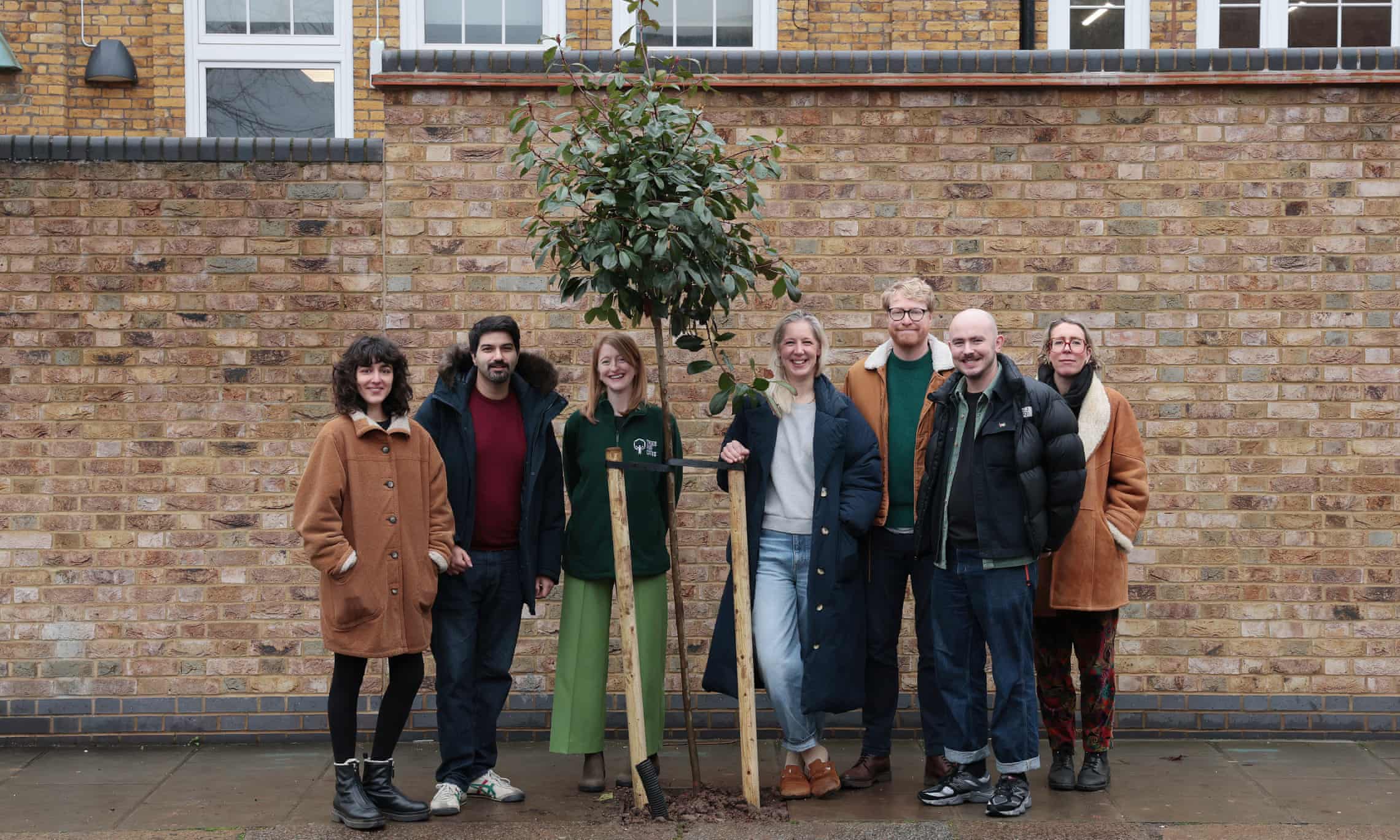
Photo: Martin Godwin/The Guardian.
Residents in Tottenham, north London, with a tree sponsored through Trees for Streets. “City residents are working out how to fill their streets with trees as evidence grows of their benefits,” says the Guardian.

Can you bear another story about planting trees to beautify and bring warming temperatures down in neighborhoods?

Although really in-depth biodiversity efforts go further (read about Miyawaki urban forests here), street plantings are important, too. Each time I read about another community organizing to plant trees, I want to share the news.

Olivia Lee writes at the Guardian, ” ‘I wanted to do something that would benefit as many people from the community as possible,’ says Chloe Straw, pointing at a small but promising sapling visible through the window of her local cafe.

“In 2023, Chloe began chatting to her neighbors in Haringey, north London, about trees. ‘I thought it’d be really nice to raise some money for trees on the main road. Everyone uses West Green Road, regardless of whether you have a lot of money or not, regardless of your background.’

“After getting in touch with Trees for Streets, a sponsorship scheme that guides communities across England on how to plant trees in their local areas with support from local councils, a small group was formed to work out how to do it. As a first step, Straw and friends were provided with an interactive map to choose the location of the trees, and that was passed along to Haringey council.

“Then they got help to set up a crowdfunding campaign, which was shared in local WhatsApp groups and community forums, secured 168 backers and raised more than £6,000 [$8,000] in one month.

“Mohamed Eljaouhari, a co-chair of Haringey Living Streets, said [of WhatsApp], ‘It is a very powerful tool for getting a very simple message out very quickly to a lot of people. I got in contact with, like, a thousand people in a few minutes, because I forwarded on the message with a bit of an explanation to a local group here, a local group there, people who were interested in the environment and maybe wanted to help West Green.’

“The remaining costs were covered by Haringey council. The result? Twenty beautiful trees planted across the neighborhood. …

“Around the world, city residents are working out how to fill their streets with trees as evidence grows of their benefits. As temperatures rise, research has shown that urban trees can play a fundamental role in keeping cities cool, evaporating water to provide a natural form of air-conditioning, cooling air temperatures and reducing the urban heat island effect. Work by Friends of the Earth in five English cities in 2023 showed that areas with more trees and greenery were up to 5C cooler. …

“Public funds are stretched everywhere, and the community model followed by Trees for Streets empowers local people to take their own action without waiting for a government plan.

“The Pennsylvania Horticultural Society (PHS) is a non-profit organization in Philadelphia that trains individuals to lead community groups to plant trees across the US city. So far their program, Tree Tenders, has trained more than 6,500 people, who have led volunteers in planting more than 3,000 trees each year.

“[Andrew Conboy, an urban forester in Philadelphia, says,] ‘There’s a heavy emphasis on native species here in the Philadelphia area, which is good thing because the native species are ultimately better for our wildlife and for our ecosystems, because those are the species that evolved here.’ …

“The Garden City Fund, a charity in Singapore, runs a similar initiative, the Plant-a-Tree program. Individuals and organizations can donate to the cost of a young tree and then plant it in one of their managed green spaces.

“Tree People, an environmental advocacy organization, runs a forestry program that supports communities to plant and care for trees in cities in southern California. The organization also runs the School Greening program, which provides training to parents, students, teachers and district leaders to plant and maintain trees in schools. …

“As the West Green residents take turns discussing their local initiative over cups of coffee, it’s clear that one of the most significant impacts the project has had is in strengthening connections within the community. …

“[Says Dan Snell, an urban forest officer at Haringey council,] ‘There was another tree scheme on my mum’s street who lives in Haringey … suddenly there were all these new street trees and my mum had met a load of neighbors that she hadn’t really met before, even though she’s been there for 30 years. It’s had this really lovely long-term effect on bringing the street together.’ It’s such a wonderful thing to connect over.’ “

Plant a tree, make a friend. More at the Guardian, here. No paywall.

Read Full Post »