Feeds:
Posts
Comments

Posts Tagged ‘trees’

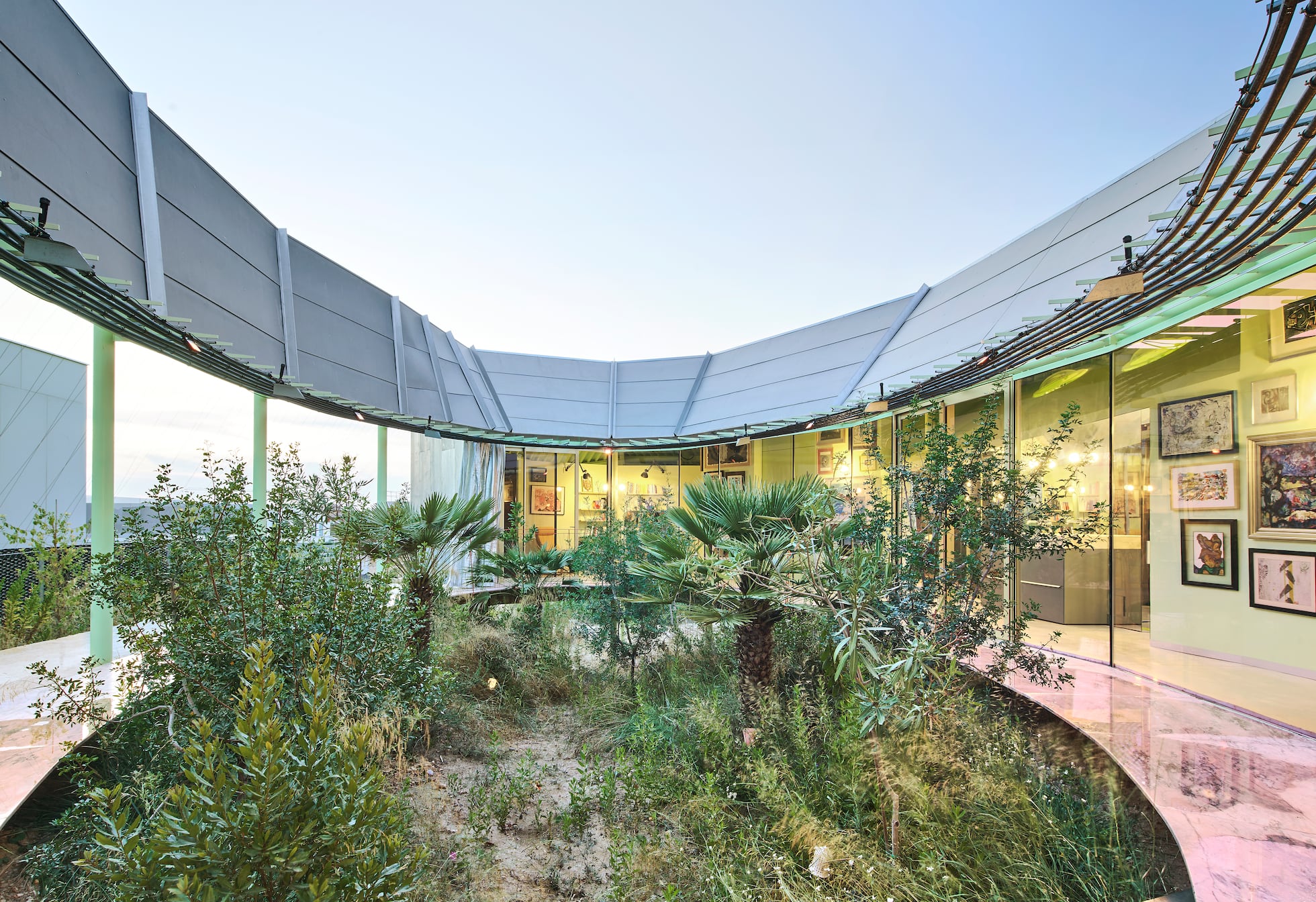
Photo: José Hevia.
Rambla Climate-House by architect Andrés Jaque in Molina de Segura, Spain.

Today’s article addresses how architecture can and should repair our ecological system. How in cities, for example, a comprehensive vision would extend beyond beautifying downtown to embracing the understanding that we are not the only species on the planet.

At El País, Miguel Ángel Medina interviews architect Andrés Jaque about buildings that can be good for the environment.

“For three years,” he says, “Andrés Jaque, 53, has been dean of the Graduate School of Architecture at Columbia University, one of the most cutting-edge centers in architectural innovation. The Madrid-born architect is spending his time at the university rethinking how buildings and cities should face climate change. He believes that we must commit to an ‘interspecies alliance’ and that buildings, beyond just being sustainable, should also contribute to repairing our ecology.

“Jaque has proposed several projects with this concept in mind, such as the Reggio School in Madrid — designed to create life within its walls and attract insects and animals. …

Andrés Jaque
“Architecture is the discipline that has most clearly assumed the responsibility of responding to the climate crisis. In the last 15 years, there’s been a radical transformation [in the field]: materials have gone from being sustainable to [repairing the ecology]. And [the architectural field] has revised its own mission, which is no longer to just build new buildings, but to manage the built environment. Additionally, it has brought about an intersectional vision: understanding that the material, the social, the ecological and the political are inseparable and that climate action has to coordinate these fronts of transformation. This has placed architecture at the center of environmental action.

Miguel Ángel Medina
“Do architects share this interpretation?

Jaque
There’s a part [of the field] that’s anchored in a heroic vision of modernity and another that’s commercial… but there’s another that has a political commitment to the planet. And [those who adhere to this] understand that architecture must respond not only to the most immediate circumstances of a commission, but also to action for the planet. …

“There are two systems: a material world of extractivism — which is a mix of carbonization, colonialism, anthropocentrism, heteropatriarchy and racialization — that’s currently collapsing. And, in the cracks of this system, another kind of architecture is emerging, which seeks alliances between species based on symmetry, which pursues a global regime of solidarity and which advances along a line of decarbonization that marks the esthetics, the materialities [and] the types of relationships that constitute contemporary culture. This is gaining undeniable strength. In the future, we’ll see a change that’s as important as the one that modernity once represented.

Medina
“What do we do with urban planning, given so many extreme phenomena?

Jaque
“We’ve been pioneers in proposing a change of focus, from an emphasis on the city as a kind of stain on the territory, to a trans-scalar approach. This is a way of understanding [the physical structure that is] an urban block of apartments, the microbial relationships that occur in the bodies of those who live on that block, as well as the large networks of resource extraction that make life on that block possible.

“The city has lost the capacity to contain all realities, [which is necessary] in order to think in a climatic and ecosystemic way. And we need a new model that allows us to understand that what happens on a molecular scale has implications on the scale of bodies, buildings, streets, neighborhoods, the planet and the climate. Designing [cities] in a trans-scalar way requires changes in the methodologies of architecture, which we’re exploring. …

“Cities are going through a period of great transformation. A transformation in which the city has to be understood as something physically porous, which allows for the circularity of water, which contributes to multiplying life… a transformation of materiality that promotes a flow of materials that also contributes to the health of bodies. [We require] a very different way of urbanizing the air – in such a way that it’s understood that there’s a direct relationship between our lungs and the climate – and a commitment to the generation of diverse and empowered living environments. The main difficulty is how to do this quickly, so as to mitigate the impact of the climate and environmental crises.

Medina
“What’s this new ‘interspecies diplomacy’ that you advocate in favor of?

Jaque
“Humans are just one of many forms of life. And the idea that humans can decide to sacrifice the rest of the species to serve their own interests has been shown to be harmful. Understanding that we’re dependent on many other species — and that we’re actually inseparable from them — is more realistic. We depend on the quality of the soil, on the ecosystems. An interspecies alliance based on protecting the living conditions of diverse species is beneficial for all life on the planet.”

More at El País, here.
Read Full Post »

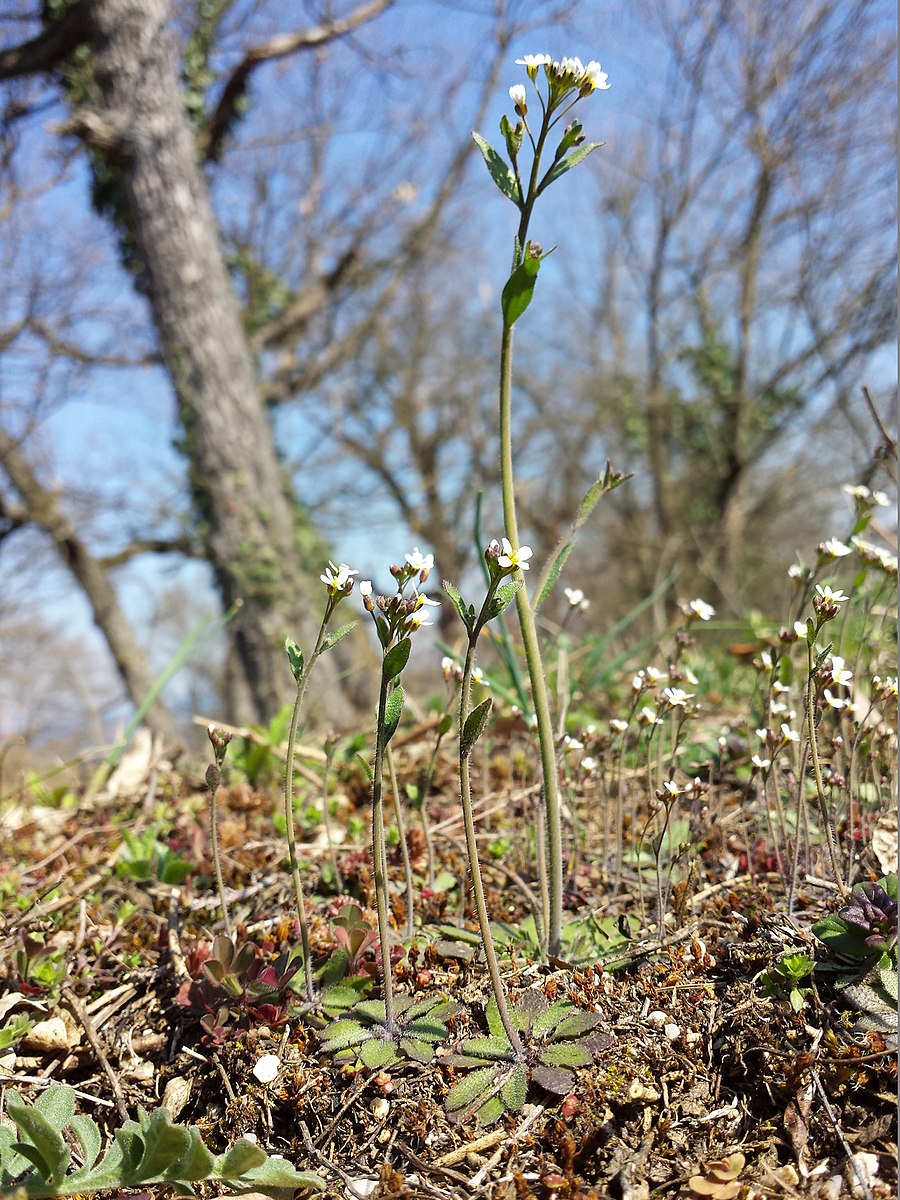
Photo: Stefan Lefnaer via Wikimedia.
In the video below, an Arabidopsis plant warns of danger from a hungry caterpillar.

I think we are lucky to be learning so much about the natural world these days. I didn’t study much science in school, but who wouldn’t love scientific research that reveals such wonders as plants’ communications systems.

Kasha Patel at the Washington Post writes that some plants actually warn their brethren when it’s necessary to increase defenses.

“Trees on our Earth can communicate and warn each other of danger,” she says, “and a new study explains how.

“Injured plants emit certain chemical compounds, which can infiltrate a healthy plant’s inner tissues and activate defenses from within its cells, the new research found. …

“For the first time, researchers have been able to ‘visualize plant-to-plant communication,’ said Masatsugu Toyotasenior author of the study, which was [published] in Nature Communications. ‘We can probably hijack this system to inform the entire plant to activate different stress responses against a future threat or environmental threats, such as drought.’

“The idea of ‘talking’ trees started to take root in the 1980s. Two ecologists placed hundreds of caterpillars and webworms on the branches of willow and alder trees to observe how the trees would respond. They found the attacked trees began producing chemicals that made their leaves unappetizing and indigestible to deter insects. …

The scientists discovered healthy trees of the same species, located 30 or 40 meters away and with no root connections to the damaged trees, also put up the same chemical defenses to prepare against an insect invasion.

“Another pair of scientists around that time found similar results when studying damaged sugar maple and poplar trees. …The trees sent chemical signals to one another through the air, known today as plant eavesdropping. Over the past four decades, scientists have observed this cell-to-cell communication in more than 30 plant species, including lima bean, tobacco, tomato, sage brush and flowering plants in the mustard family.

“But no one knew which compounds were important and how they were being sensed — until now. …

“Plants obviously don’t have ears and eyes, but past research shows they communicate with their surroundings by emitting chemicals known as volatile organic compounds, which we can smell. … Plants can produce an array of these compounds for different purposes. Some are used to attract pollinators or as defense against predators.

“However, one class of these compounds are emitted when a plant is injured: green leafy volatiles. These are emitted by, as the name suggests, pretty much every green plant with leaves, and are produced when a plant experiences physical damage. An example of this compound is the smell released from fresh-cut grass.

“In the new study, Toyota and his colleagues manually crushed leaves and placed caterpillars on Arabidopsis mustard or tomato plants to trigger the emission of various green leafy volatiles. Then, they spread individual fumes to healthy plants to see if the plants would react.

“To track the healthy plants’ responses, the team genetically modified the plants so calcium ions would fluoresce when activated inside individual cells. Calcium signaling is important for cellular functions in most living organisms on Earth, including humans. … Depending on the plant, it can trigger messages to close its leaves or digest an insect.

“After testing many green leafy volatiles, the team found only two seemed to increase calcium ions inside cells. Additionally, they found calcium signaling first increased in guard cells forming the plant’s leaf pores, or stomata — an important finding, because it shows the compounds are absorbed into the plant’s inner tissues. …

“The calcium signaling, Toyota said, is like a switch to turn on the defense responses from the plant. … For example, Toyota said the plant may start producing certain proteins to inhibit insects from munching on them, giving the insects diarrhea. …

“With this new understanding, researchers say plants could be immunized against threats and stressors before they even happen — the equivalent of giving a plant a vaccine. For instance, exposing healthy plants to insect-ridden plants or the associated green leafy volatiles could boost their genetic defenses, so farmers use less pesticides, Kessler said. The revelation could also help make plants more resilient during a drought, signaling the plants to retain more water.”

More at the Post, here.

Read Full Post »

Photo: Emily Piper-Vallillo/WBUR.
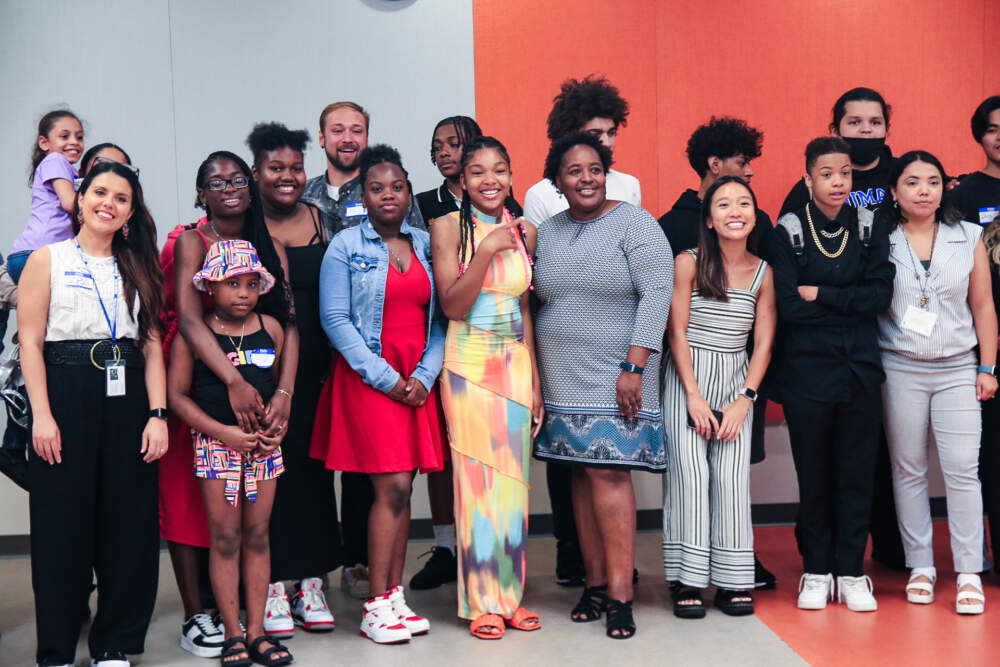
Program mentor Meshell Whyte with students who participated in the 2023 UMass Boston Summer Program in Urban Planning.

Today’s story is not only about addressing troubling effects of climate change in cities but also about encouraging young people in the communities most affected to be part of finding solutions.

Emily Piper-Vallillo reports at WBUR, “Boston students recently wrapped up a month-long study of extreme heat in Roxbury, exploring ways to mitigate the crisis and its impact on residents through the field of urban planning.

“Nearly 30 high school students participated in the University of Massachusetts Boston Summer Program in Urban Planning, which concluded [in July] with a presentation at Roxbury Community College. …

“The program introduces students of color from environmental justice communities like Roxbury and Dorchester to careers in urban planning and design. It’s part of a larger effort to diversify the field of urban planning, which remains overwhelmingly white.

“ ‘Only 5.2% of Boston’s planners are non-white, in a city where just in the city alone, 28% of our population is African American,’ said Ken Reardon, co-founder of the program and chair of UMass Boston’s Department of Urban Planning and Community Development. …

“Built as a working class community at a time when extreme heat was not as common as it is today, Roxbury has densely packed buildings with few trees, according to the students’ presentation. Many spaces are exposed to direct sun. Slides and swings in neighborhood playgrounds were constructed with heat-absorbing materials, making them unusable when temperatures rise.

“In fact, the students found that air temperatures in Roxbury are, on average, 10 degrees warmer than at Boston’s Logan Airport.

“They made this discovery by collecting 135 temperature readings across 38 Roxbury locations to identify the hottest spaces. Readings ranged from 83 to 102 degrees Fahrenheit, with the highest temperatures collected on sidewalks and at bus stops.

“Collecting data was grueling, said Blue Hills Regional Technical student Aidan Luciano. He and his peers hit the streets with remote sensors recording the humidity and heat index during the month of July — when temperatures sometimes rose above 100 degrees.

“ ‘[But] it’s going to pay off in the end because we are going to be helping other people,’ Luciano said. ,,,

“One group designed a new cooling children’s playground on RCC’s campus. Scheduled to open in 2025, the playground will replace a parking lot near the historic Dudley House site. After further community input, the final design will incorporate many ideas from the students themselves, said Ruben Flores, special projects manager at Roxbury Community College.

“Flores was particularly impressed by the inclusion of splash pads and water misters to reduce the temperature of the playground.

“Participating students received college credit from UMass Boston and were paid around $15 an hour.

“Paying students was an important part of making this opportunity accessible to low-income students of color who are less likely to be able to afford unpaid internships, Reardon said.

“Beyond collecting temperature data, students sought to understand how Roxbury residents experience extreme heat, said TechBoston student Neicka Mathias.

“Over the course of July, students interviewed nearly 100 Roxbury residents about coping with rising temperatures. The most common suggestion for improvement they heard was to increase the number of water sources throughout the neighborhood.

“Students also worked with residents to identify public spaces in Roxbury where heat mitigation solutions are most needed. These include areas where  people frequently wait for public transit or line up outside favorite local restaurants. …

“ ‘Give a chance to these communities of color that are outside the spaces where decisions have been made and they will show you great work,’ Flores said.”

More at WBUR, here. No firewall.

Read Full Post »

Photo: Suzanne and John’s Mom.
A tree canopy benefits any community.

After one of my posts on the importance of urban trees, Hannah sent me a 2021 report on what Philadelphia had started doing.

Katherine Rapin wrote at the Philadelphia Citizen, “Imagine, for a moment, it’s 2025 and you have a bird’s eye view of Philadelphia. As you scan the stadiums up to William Penn’s hat and beyond, you see a whole lot of verdant green amid the concrete as much as 40 of the city’s 142 square miles.

“These trees are purifying our air; storing tons of carbon dioxide; and reducing residential energy costs. Their masses of living roots absorb and hold water, reducing flooding, and their leaf canopy lessens the impact of rain drops on the ground, decreasing erosion. Their shade and transpiration magic is reducing temperatures by as much as 20 degrees. And they’re raising property values: Houses on streets with a lot of trees see a 10 percent boost in their sales price.

“The City’s goal is to increase our tree canopy to 30 percent by 2025 as part of the Greenworks program. …

“ ‘The big problem is that, for the last several decades at least, we as a city have not been planting enough trees to make up for the trees that naturally die or are lost to development,’ says Tim Ifill, Director of Trees at the Pennsylvania Horticultural Society [PHS].

“Granted, the decline would be worse if not for the efforts of programs like Tree Philly, launched by the City in 2011 along with Greenworks to give free sidewalk and yard trees to building owners who would care for them, which has given away more than 20,000 trees. … And PHS, which has been fighting to catch up with canopy loss through their Tree Tenders program — training more than 5,000 volunteers who have collectively planted over 25,000 trees in their neighborhoods.

“ ‘Every neighborhood is different,’ says Ifill. ‘Both from a canopy perspective but also for the types of people who get involved and how they decide to set up their tree tenders group.’ In East Passyunk tenders worked with PHS to establish an urban arboretum, mapping about 40 different tree species … in the neighborhood. In Hunting Park, Esperanza partnered with PHS to host the first bilingual tree tender training — their group has been among the most dedicated tenders since, says Ifill.

“If you’re tree tender curious, join the fall tree planting bonanza this week; from November 17th-21st, PHS Tree Tender groups and community orgs and volunteers will plant more than 1,350 trees (60 different species!) across the city. No prior tree-planting experience is required; volunteers will be led by at least one official Tree Tender who knows the ins and outs of this process well. …

“[Here are] some of Philly’s least green neighborhoods, according to conservation nonprofit American Forests’ recently released Tree Equity Score map. The Equity Score measures the gap between targeted tree canopy in a given block group — considering population density and climate as well as income level, employment rate, race, age distribution, health outcomes and heat island impact — and existing coverage. …

“To get all block groups to a score of 75 or higher, we’d need to plant 198,923 trees here in Philly. Compare that to Washington DC, which only needs 28,121 more trees to achieve the same goal. And the city isn’t far from their targeted 40 percent canopy coverage by 2032.

“Planting nearly 200,000 trees here in Philly would save an estimated 106,165 cubic meters of runoff; remove 14.6 tons of particulate matter pollution; and sequester 2,707.4 tons of carbon every year. And they [studies show they] reduce violence and increase mental health. …

“ ‘Even in a built environment like Philadelphia, we’re all part of nature and we have that connection with trees, with plants,’ says Ifill.” More at the Citizen, here.

I was unable to find out how the trees being planted in the 2021 article are doing now, but there were many sites covering the ongoing planting and protection of trees in Philadelphia.

The USDA Forest Service, here, described the work of Michelle Kondo, a Northern Research Station scientist, who “studies the many benefits trees provide and the ways cities are investing in programs to expand tree cover.”

The City of Philadelphia wrote that the Department of Commerce and Philadelphia Parks and Recreation were “collaborating on a new proactive model for community-based maintenance of street trees. The TCB Cleaning Ambassadors scope of work would be expanded to encompass tree care while receiving training and being paid for the additional hours of work involved. For the past two years, the William Penn Foundation also provides funding support to the Overbrook Environmental Education Center (OEEC) expanding their Philly Green Ambassador (PGA) pilot program. The program enhances the careers of PHL TCB Cleaning Ambassadors by teaching tangible skills related to environmental stewardship.” 

And PHS has a lot more as it leads in spreading the word that “the Greater Philadelphia region still needs more trees. While a ‘good’ tree canopy coverage (the area of land shaded by trees) is considered to be 30% of land area, the city of Philadelphia only has 20% coverage and as little as 2.5% in some neighborhoods.” Apparently cities like Washington are much farther along in reaching their canopy goals.

Find your city, here. on a 2023 list of urban areas with the best tree canopy. Minneapolis is at the top.

Read Full Post »

Photo: The American Chestnut Foundation via Living on Earth.
Towering American Chestnuts were once a staple of life for people across Appalachia and elsewhere in the Eastern United States. An initiative in mining country aims to bring them back.

Growing up, I heard from my father about how sad he was as a kid when American Chestnuts began to die off. Children really do not like loss. Thomas Brannon in today’s article was a kid who loved chestnuts, too. He is one of the people working to restore the trees that covered his grandparents’ land before they sold the mining rights.

Elena Shao starts the New York Times story with the director of operations at a tree-planting nonprofit.

“Michael French trudged through a thicket of prickly bramble, unfazed by the branches he had to swat away on occasion in order to arrive at a quiet spot of hilly land that was once mined for coal. Now, however, it is patched with flowering goldenrods and long yellow-green grasses and dotted with tree saplings.

“The sight, he acknowledged, would seem unimpressive to most. Yet it might be Mr. French’s most prized accomplishment. To him, the young trees symbolize what could be a critical comeback for some of the country’s vanishing forests, and for one tree in particular, the American chestnut.

‘I don’t see it how most people see it,’ he said. ‘I look at this and I see how it’s going to be in 80 to 100 years.’

“By then, Mr. French envisions that the chestnut, a beloved tree nearly wiped out a century ago by a blight-causing fungus, will be among those that make up an expansive forest of native trees and plants.

“Billions of chestnuts once dominated Appalachia, with Americans over many generations relying on their hardy trunks for log cabins, floor panels and telephone poles. Families would store the trees’ small, brown nuts in attics to eat during the holiday season.

“Now, Mr. French and his colleagues at Green Forests Work, a nonprofit group, hope to aid the decades-long effort to revive the American chestnut by bringing the trees back onto Appalachia’s former coal mines. Decades of mining, which have contributed to global warming, also left behind dry, acidic and hardened earth that made it difficult to grow much beyond nonnative herbaceous plants and grasses.

“As coal continues to decline and many of the remaining mines shut down for good, foresters say that restoring mining sites is an opportunity to prove that something productive can be made of lands that have been degraded by decades of extractive activity, particularly at a moment when trees are increasingly valued for their climate benefits. Forests can capture planet-warming emissions, create safe harbor for endangered wildlife species and make ecosystems more resilient to extreme weather events like flooding.

“The chestnut is a good fit for this effort, researchers say, because the tree’s historical range overlaps ‘almost perfectly’ with the terrain covered by former coal mines that stretched across parts of eastern Kentucky and Ohio, West Virginia and western Pennsylvania.

“Another advantage of restoring mining sites this way is that chestnut trees prefer slightly acidic growth material, and they grow best in sandy and well-drained soil that isn’t too wet, conditions that are mostly consistent with previously mined land, said Carolyn Keiffer, a plant ecologist at Miami University in Ohio. …

“ ‘We humans brought in the nonnative fungus that killed the tree,’ Dr. Keiffer said, referring to the parasitic fungus that was accidentally introduced to North America in the late 1800s on imported Japanese chestnuts. … ‘Maybe we can be the ones to bring the trees back.’

“That calling has always motivated Thomas Brannon, even as a third grader in the 1940s planting trees with his siblings on his family’s land in eastern Ohio, the property that Mr. French visited in August.

“ ‘If I can make that 230 acres look better, then that’s enough for me,’ Mr. Brannon said.

“His grandparents sold mining rights to parts of the property in 1952, and nearly four decades of coal mining followed. In 1977, the federal government passed the Surface Mining Control and Reclamation Act, requiring mining companies to return land to the general shape it had before the mining activity.

“As a result, mining companies would backfill excavated land, packing rock material tightly against the hillside so it wouldn’t cause landslides, said Scott Eggerud, a forester with the Office of Surface Mining Reclamation and Enforcement, the agency that enforces the mining law. To prevent erosion, mining companies would plant aggressive, mostly nonnative grasses that could tolerate the heavily compacted soil. …

“In theory, compacting land and greening it up quickly was a good idea, in terms of preventing erosion and water contamination, said Sara Fitzsimmons, chief conservation officer at The American Chestnut Foundation. But it made re-establishing forests difficult. …

“When Green Forests Work arrived on the Brannon property in 2013, they focused on undoing some of the damage done to the land, bringing in bulldozers with giant ripping shanks that dig three to four feet deep into the soil, loosening up the dirt and pulling up rocks.

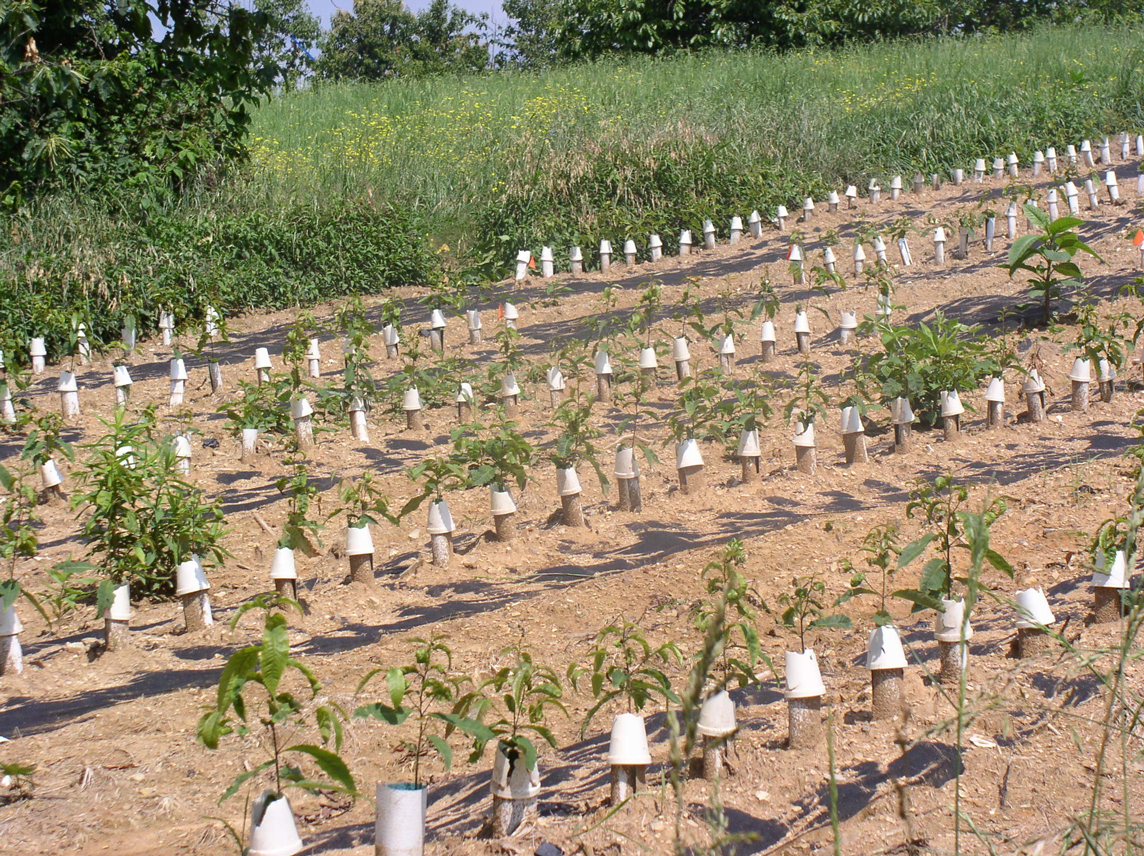
“By springtime, the group had planted upward of 20,000 seedlings, a mix of 20 different native tree species including the American chestnut, the Virginia pine and a variety of oaks.

“They also planted 625 chestnuts in a one-acre space they called a progeny test to evaluate the health of hybridized chestnut trees — fifteen-sixteenths American chestnut and one-sixteenth Chinese chestnut — that were crossbred by scientists at the American Chestnut Foundation, a nonprofit group formed in the 1980s.”

More at the Times, here. Still more at the environmental radio show Living on Earth. No firewall.

Read Full Post »

Photo: Tohumtoprak.
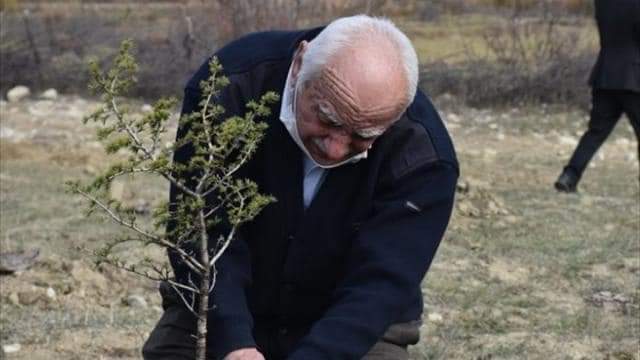
Working with his team and villagers, retired forest chief Hikmet Kaya has helped create a forest on once-barren land in Turkey.

Around the world, people have learned that planting trees can help us fight back against global warming. But it’s not as easy as sticking them in the ground. You have to ensure they live. And thrive.

Jessica Stewart reports on one initiative at My Modern Met, “Hikmet Kaya has proved that good intentions and hard work can yield big rewards. The retired Turkish forest management chief has posed proudly in front of the barren land that he and his team have transformed into a lush forest.

“He began his career in the town of Sinop in 1978 and while he retired 19 years later, his legacy has continued to grow — literally.

“Working together with his team and villagers, he brought in and planted 30 million saplings over the course of his tenure. Long after his retirement, these trees have continued to grow; and today, this barren stepped land has undergone an incredible transformation. … Needless to say, he admits he’s very happy with the results.

“It’s a wonderful example to set for the rest of the country. According to Global Forest Watch, Turkey has seen a 5.4% decrease in tree cover since 2000. … Combatting deforestation often comes down to governmental policy changes, which makes it important for individuals to know who they are voting for and to make sure their environmental concerns are heard. Still, that hasn’t stopped people from taking matters into their own hands and taking action.”

More at My Modern Met, here (where you’ll also find links to tree-planting stories from the Philippines, Pakistan, and Ethiopia).

There’s a tree maven in India who worked without help. You may have read about him. I’ll share Andrei Tapalaga‘s History of Yesterday story in case you missed the news.

“When talking about saving the environment, most people come with the comment of ‘how much difference will I make?’ … In this article, I want to present a man who has defied any kind of odds and showed the world that if you set your mind to something it will become possible.

“Jadav ‘Molai’ Payeng spent 40 years of his life planting trees, gaining the nickname of ‘Forest Man’ in India for transforming a [barren island] into a forest. [At this point] Payeng had covered 1,400 acres with trees. There is no exact number of trees as he never kept track, but we are looking at around 1.5 million trees planted in 40 years.

“Payeng was born in 1963 near the small rural town of Jorhat, India. From a young age, he saw a small island near the coast of the Brahmaputra River suffering from erosion. In many of his interviews taken by the media in India, he described that he had spent some of his [childhood] playing in that forest and it was heartbreaking seeing its vegetation slowly die.

“That is why in 1979, when Payeng was 16 years of age, he decided to plant at least one tree a day for as long as he lives, calling it giving back to Mother Nature. … The start to this incredible journey was difficult, not only [considering] the road ahead, but it was simply difficult to find tree seeds to plant. His vision was not to plant only one type of tree, but many different types. …

“As the years went by, the problem of finding seeds was solved as the trees he had planted years ago started to give seeds. With more seeds, he was able to plant even more trees every day. The island is surrounded by a flowing river, so the water supply was never a problem. …

“There are many people out there just like Payneg who have dedicated most of their life toward an honorable cause but rarely get noticed. The media in India actually discovered Payeng by mistake when in 2008, a herd of over 100 wild elephants strayed into the forest he had created.

“Payeng notified the forest department about the elephants and they thought he was crazy at first as there was no forest on the island. Upon the forest department’s inspection of the island, the community around Jorhat told them about Payeng’s efforts, at which point the media from India bombarded Payeng. [He] was also made an official forester for the forest he had created on Majuli island.

“In 2012 Payeng was interviewed by the Times, where he confessed that he had always asked for help but no one wanted to assist him. … Now the island is greener than ever whilst being inhabited by all sorts of wildlife from rabbits to tigers and even rhinos. The plantation of trees had slowed down as Payeng is becoming old and tired. However, he is trying to make his children continue what he had started.”

For more on Payeng’s initiative, click at History of Yesterday, here.

Read Full Post »

Love for Fungi

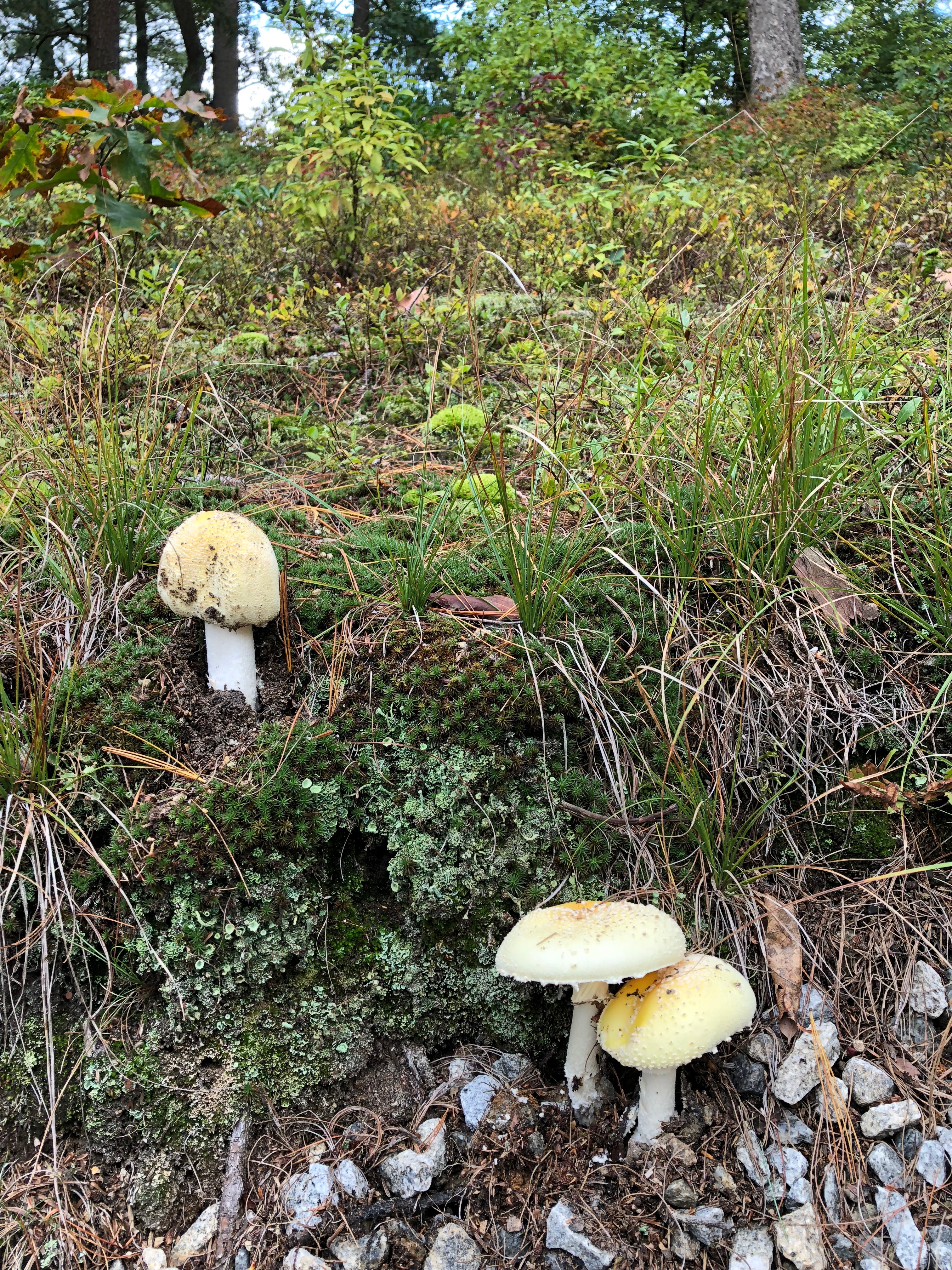
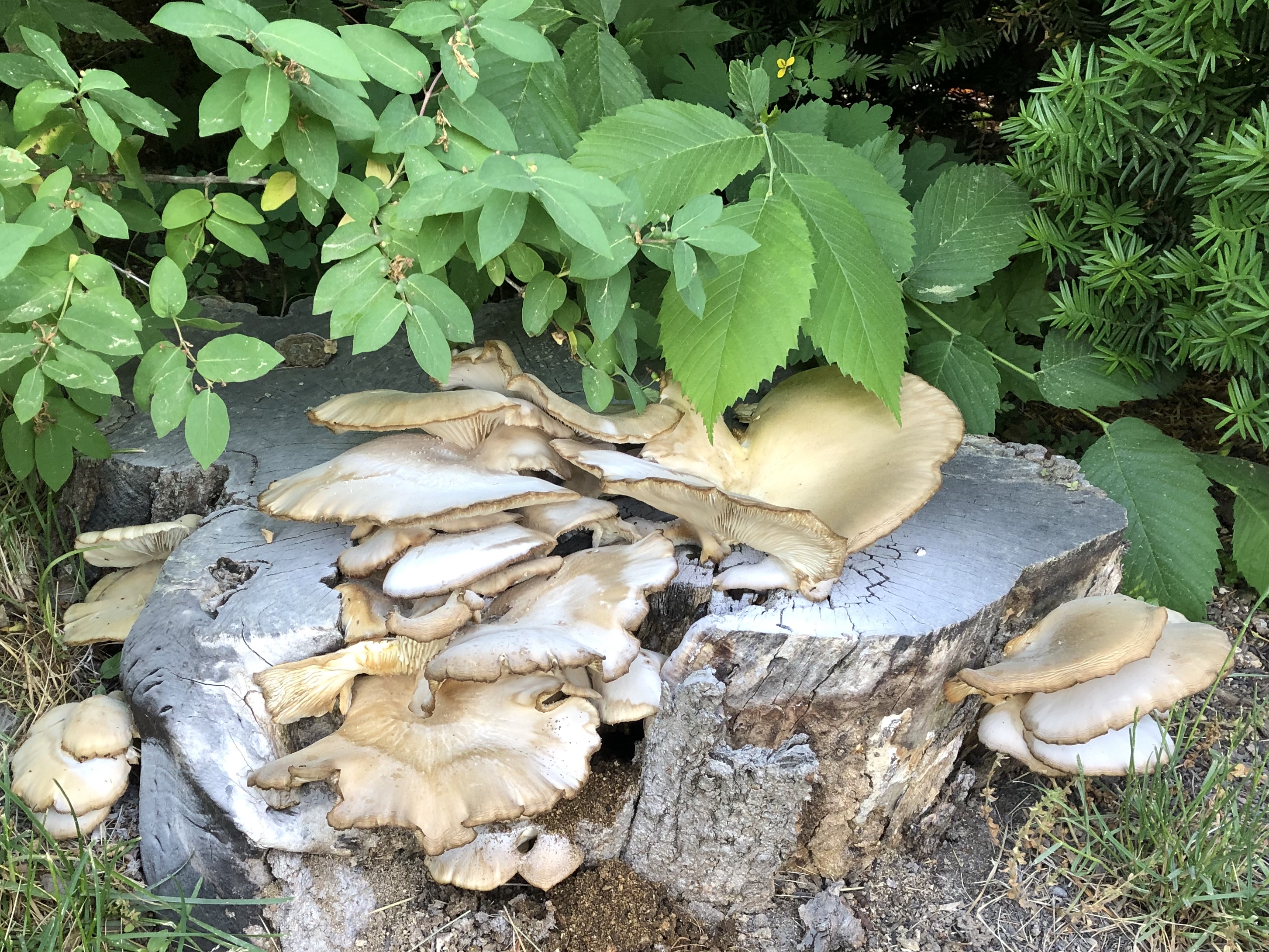
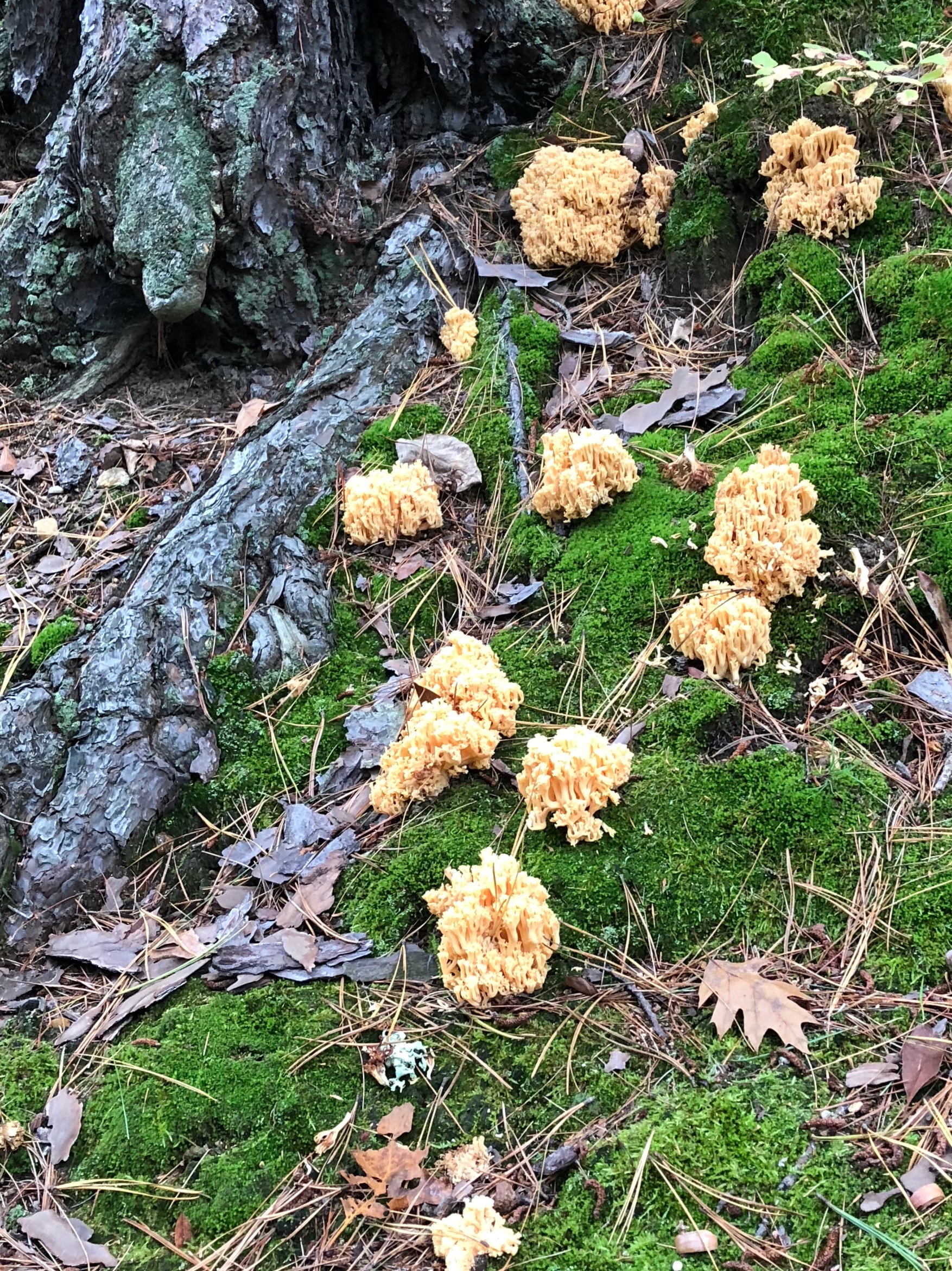
As a kid, I was kind of creeped out by fungi, but in recent years I’ve found myself fascinated by their unexpected beauty and mystery. And I’ve taken lots of pictures, three of which are here.

In an article at the New York Times, Ferris Jabr, describing the symbiotic relationship between trees and fungi, talks to forest ecologist Suzanne Simard about what trees are communicating with one another through their subterranean networks of fungi.

“By the time she was in grad school at Oregon State University, [Simard] understood that commercial clearcutting had largely superseded the sustainable logging practices of the past. Loggers were replacing diverse forests with homogeneous plantations, evenly spaced in upturned soil stripped of most underbrush. Without any competitors, the thinking went, the newly planted trees would thrive. Instead, they were frequently more vulnerable to disease and climatic stress than trees in old-growth forests.

“In particular, Simard noticed that up to 10 percent of newly planted Douglas fir were likely to get sick and die whenever nearby aspen, paper birch and cottonwood were removed. The reasons were unclear. The planted saplings had plenty of space, and they received more light and water than trees in old, dense forests. So why were they so frail?

“Simard suspected that the answer was buried in the soil. Underground, trees and fungi form partnerships known as mycorrhizas: Threadlike fungi envelop and fuse with tree roots, helping them extract water and nutrients like phosphorus and nitrogen in exchange for some of the carbon-rich sugars the trees make through photosynthesis.

“Research had demonstrated that mycorrhizas also connected plants to one another and that these associations might be ecologically important, but most scientists had studied them in greenhouses and laboratories, not in the wild. For her doctoral thesis, Simard decided to investigate fungal links between Douglas fir and paper birch in the forests of British Columbia. …

‘The old foresters were like, Why don’t you just study growth and yield?’ Simard told me. ‘I was more interested in how these plants interact. They thought it was all very girlie.’

“Now a professor of forest ecology at the University of British Columbia, Simard, who is 60, has studied webs of root and fungi in the Arctic, temperate and coastal forests of North America for nearly three decades. Her initial inklings about the importance of mycorrhizal networks were prescient, inspiring whole new lines of research that ultimately overturned longstanding misconceptions about forest ecosystems. By analyzing the DNA in root tips and tracing the movement of molecules through underground conduits, Simard has discovered that fungal threads link nearly every tree in a forest — even trees of different species. Carbon, water, nutrients, alarm signals and hormones can pass from tree to tree through these subterranean circuits.

“Resources tend to flow from the oldest and biggest trees to the youngest and smallest. Chemical alarm signals generated by one tree prepare nearby trees for danger. Seedlings severed from the forest’s underground lifelines are much more likely to die than their networked counterparts. And if a tree is on the brink of death, it sometimes bequeaths a substantial share of its carbon to its neighbors.

“Although Simard’s peers were skeptical and sometimes even disparaging of her early work, they now generally regard her as one of the most rigorous and innovative scientists studying plant communication and behavior. … In May, Knopf will publish [her] book, Finding the Mother Tree, a vivid and compelling memoir of her lifelong quest to prove that ‘the forest was more than just a collection of trees.’ …

“Before Simard and other ecologists revealed the extent and significance of mycorrhizal networks, foresters typically regarded trees as solitary individuals that competed for space and resources and were otherwise indifferent to one another. Simard and her peers have demonstrated that this framework is far too simplistic. An old-growth forest is neither an assemblage of stoic organisms tolerating one another’s presence nor a merciless battle royale: It’s a vast, ancient and intricate society. There is conflict in a forest, but there is also negotiation, reciprocity and perhaps even selflessness. The trees, understory plants, fungi and microbes in a forest are so thoroughly connected, communicative and codependent that some scientists have described them as superorganisms. …

“Together, these symbiotic partners knit Earth’s soils into nearly contiguous living networks of unfathomable scale and complexity. ‘I was taught that you have a tree, and it’s out there to find its own way,’ Simard told me. ‘It’s not how a forest works, though.’ ”

More at the New York Times, here.

Hat tip: Hannah.

Read Full Post »

Photo: Shahzad Qureshi
Shahzad Qureshi, founder of Urban Forest, in Karachi, Pakistan.

Today most people have come to realize the importance of trees for everything from reducing global warming to improving life in neighborhoods. The Amazon rain forest (currently in grave danger from Brazil’s government) is known to cool the planet by soaking up carbon in the atmosphere, and urban forests give city residents a chance to cool off — and calm down.

Sometimes it takes a tragedy, but around the world, more people are feeling they better do something themselves to protect trees.

Anna Kusmer reports at PRI’s The World, “Extreme heat often hovers over Karachi, Pakistan’s largest city, creating insufferable conditions for its 16 million inhabitants. But each time Karachi resident Shahzad Qureshi transforms a barren patch of land into a dense, urban forest, he helps his city adapt to extreme urban heat that has become inevitable under climate change. Over the last four years, Qureshi’s organization, Urban Forest, has planted 14 urban forests in parks, schools, people’s yards and outside of a mosque.

“Qureshi’s quest to plant urban forests started in 2015, when temperatures reached over 120 degrees Fahrenheit in Karachi. About 2,000 people in the region died from dehydration and heatstroke. It was devastating.

‘It was just too hot,’ Qureshi said. …’ And one of the things everybody was talking about is that there’s not enough green cover.’

“Around that time, Qureshi saw a TED Talk that changed his life. He listened to a man named Shubhendu Sharma sharing a method to quickly grow dense urban forests. Qureshi was amazed. …

“Qureshi decided to learn Sharma’s technique and bring it to Karachi, joining a growing global community of urban foresters who want to help their cities adapt to extreme urban heat events created by rapid climate change. …

“Sharma’s organization Afforestt has now helped plant 150 mini-forests in 13 countries.

“ ‘So, there is a quite strong global community right now,’ Sharma said. ‘I am very keen on taking this method to every single country of the world.’

“Sharma’s special technique is known as the Miyawaki method. It involves the close placement of a variety of trees with different growing speeds and light requirements to prevent competition for the same resources. The approach specifically uses native species, allowing trees to thrive in their original climates and environments while supporting native bird and insect populations.

“ ‘Most of the city is roads and buildings and built-up urban area,’ said Nadeem Mirbahar, an ecologist with the Swiss International Union for Conservation of Nature Commission (IUCN) on Ecosystem Management, based in Karachi. His organization did a survey and found that only 7% of Karachi had green cover.

“This contributes to an ‘urban heat island’ effect, Mirbahar said. The phenomenon causes cities to be significantly hotter than the surrounding countryside. He thinks Karachi should strive for at least 25% green cover to avoid catastrophic heat events in the future.

“Qureshi’s oldest urban forest is four years old and already has towering, 35-foot-tall Acacia trees full of big, thorny branches and birds’ nests.

“ ‘I have seen bird species in this park, which I have not seen in my life,’ he said. ‘It’s a habitat for them.’ …

“Policymakers in Pakistan have started to look at planting trees as a solution to the urban heat threat, said Umer Akhlaq Malik, a policy analyst at the United Nations Development Program (UNDP) in Pakistan.

“In 2016, the government launched a plan to plant hundreds of millions of trees as part of a project called ‘the Billion Tree Tsunami,’ in response to the fact that the country had fallen to a mere 2% forest cover.

“Malik said … ‘To take it to scale, you need more practitioners who invest their time and energy into this.’

“Malik said the biggest barriers are cost and space. Each forest can cost hundreds of thousands of dollars to establish.

“But Qureshi remains hopeful that the project can scale up. He is working with the UNDP to form a coalition that aims to bring urban forests to every park in the city. He thinks Karachi could look fundamentally different.”

More at PRI, here.

Read Full Post »

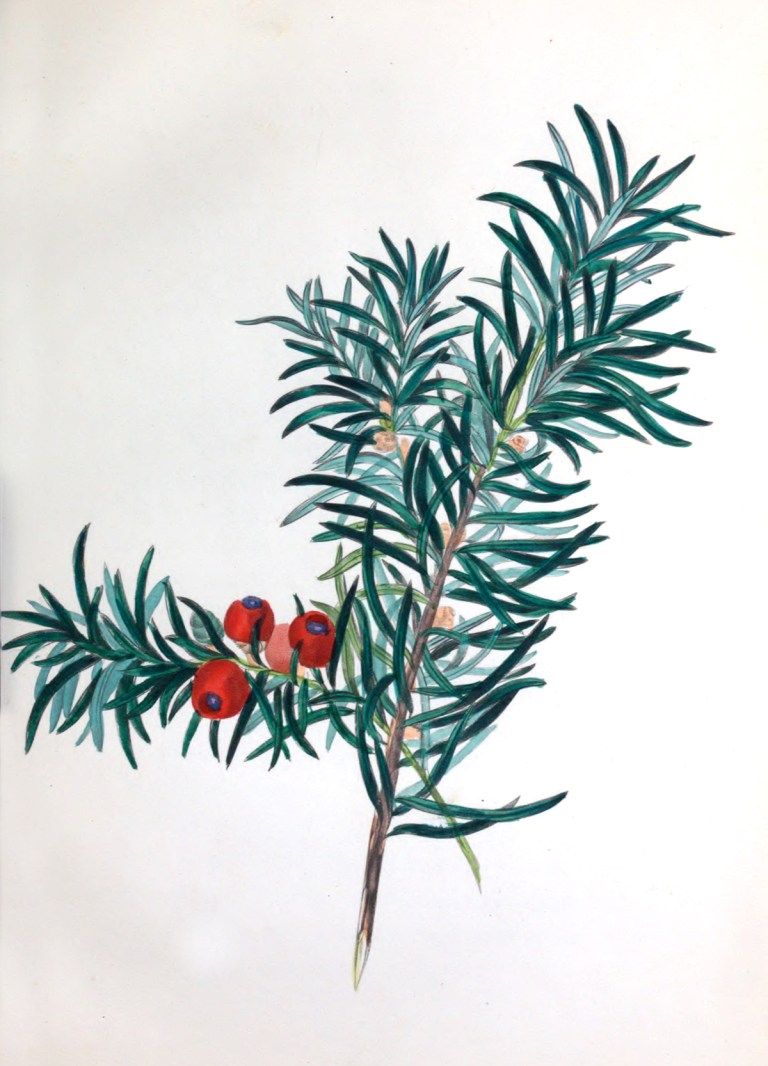
spiritofthewoods_yew_s6

This yew watercolor is one of many lovely illustrations by 19th century poet Rebecca Hey for an encyclopedia of trees. The rare book is reviewed by Maria Popova at Brainpickings. More images from Sylvan Musings, or, The Spirit of the Woods, here.

If you are not already following the blog or Twitter feed of Maria Popova at Brainpickings, you’re missing some very thoughtful commentary on the arts and sciences.

One of the many things I appreciate about her is the way she ties in related topics. For example, at the end of her post about 19th century poet/artist Rebecca Hey’s illustrations for an encyclopedia of trees, she suggests complementing the book with “Art Young’s imaginative Rorschach silhouettes of trees from the 1920s, Walt Whitman on the wisdom of trees, modern-day poetic naturalist Robert Macfarlane on what trees teach us about healthy relationships, and the inspiring illustrated story of Wangari Maathai’s tree-planting as resistance and empowerment, which made her the first African woman to win the Nobel Peace Prize, then revisit the stunning celestial art of the self-taught 17th-century German astronomer and artist Maria Clara Eimmart.” (Wow, talk about someone with a “catholic” taste!)

In her review, Popova quotes William Blake: ” ‘The tree which moves some to tears of joy is in the eyes of others only a green thing which stands in the way. … As a man is, so he sees.’…

“Perched partway in time between Blake’s time and ours, and partway in sensibility between the poetic and the scientific, Sylvan Musings, or, The Spirit of the Woods (public library | public domain) is, as far as I am aware, the world’s first encyclopedia of wild trees.

“Having resolved to face the new year like a tree, I came upon this forgotten treasure through the joyous gateway of serendipitous discovery — a bygone pleasure of atomic literature rarely accessible in our search-governed digital culture, always corralling us toward what we already know we are looking for.

“In the midst of a research project involving Mary Shelley, I acquired a rare surviving copy of the pioneering 1849 encyclopedia to which Shelley spent five years contributing short biographies of eminent scientists; one advertisement in the front matter of this fragile pocket-sized time travel device caught my eye. …

“Of the very few female authors published in the nineteenth century, many appeared under male pseudonyms or ungendered initials. (This tradition would carry well into the twentieth century, leading the young Rachel Carson to publish her revolutionary marine masterpiece under the byline ‘R.L. Carson.’) …

“ ‘Mrs. William Hey’ is Rebecca Hey — a poet, painter, and amateur naturalist. (Lest we forget, all women of scientific bent had to be ‘amateurs’ by virtue of being excluded from both formal higher education and the scientific societies of the time. …

“Each chapter opens with one of Hey’s handsomely hand-colored engravings of the tree’s leaves at the tip of a branch and closes with one of her original poems celebrating the species. Nestled between is the natural history of the tree, punctuated by thoughtfully chosen quotations from literary classics, both poetry and prose. …

“I have endeavored to restore and digitize a number of them, making them available as prints, with proceeds benefiting the Arbor Day Foundation, whose noble reforestation work and sylvan stewardship are more and more needed as we watch fires consume the ancient forests that have long been the lungs of this irreplaceable planet.”

Don’t you love the way the character of this writer shines through in her review? She does request donations at her site, and I think I have borrowed enough from her today to spur me to go there now and do my duty.

Do check out the wonderful array of tree watercolors at Brainpickings, here.

Read Full Post »

5760

Photo: Murdo MacLeod/Guardian 
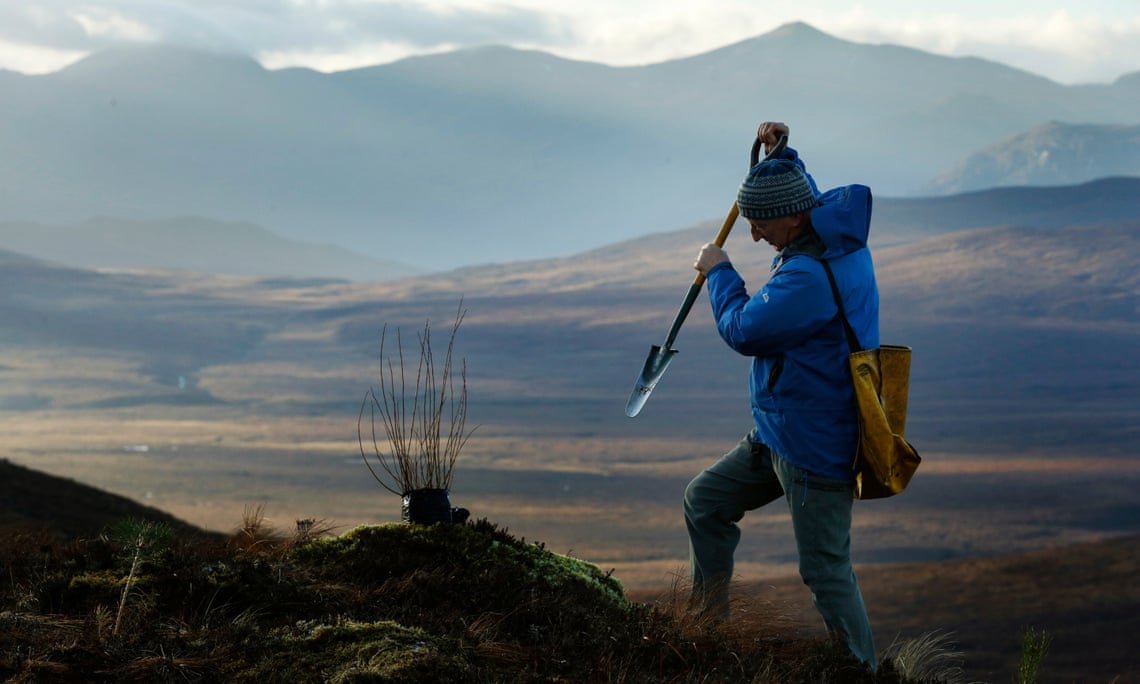
Helped by volunteers, Trees for Life planted nearly 2 million native trees on its Scottish projects.

Sometimes a tree has to be cut down because it’s rotting. But if it’s your tree, you can offset the loss for the planet by donating to an organization that plants lots of trees. Planting a lot of trees is important because it takes a long time before a bunch of little trees has the climate-saving benefits of one big tree.

I gave to the the Arbor Day Foundation last year after sadly saying good-bye to an old, old maple. Then the New York Times suggested Eden Reforestration Projects, which sounded excellent. The Times also provided names of organizations working on other climate-saving activities, including the Coalition for Rainforest Nations and a group providing fuel-efficient stoves in Kenya.

Patrick Barkham, reporting for the Guardian from Scotland, shows what can be done with a dedicated group of volunteers.

“The bracken-clad hills are marked ‘Dundreggan forest’ on the map but this Scottish glen is mostly stark Highland scenery: open, beautiful, and almost totally devoid of trees.

“On a steep-sided little gully, 40 years ago, a few baby silver birches escaped relentless browsing by red deer and grew tall. Now, the nearby path through the bracken is dusted with thousands of brown specks: birch seeds.

‘Each year, this “forest” produces trillions of birch seed,’ says Doug Gilbert, the operations manager for the charity Trees for Life at Dundreggan. ‘Until we reduce the deer pressure, not a single one has grown into a tree. Once we get the deer population right, this forest will absolutely take off. It’s starting to do that now.’

“The charity purchased the Dundreggan hunting estate 11 years ago. Slowly – ‘at tree speed,’ smiles Gilbert – it is rewilding 4,000 hectares (10,000 acres) of this degraded Highland landscape, restoring a diversity of native trees, scrub and associated life, from the dark bordered beauty moth to black grouse and, yes, red deer. …

“During the general election campaign, politicians desperately tried to outbid each other with tree-planting pledges. Who doesn’t love a tree? More trees can tackle the climate crisis – absorbing carbon dioxide – and the biodiversity crisis. But Trees for Life’s efforts reveal it is not quite so simple.

“Since Victorian times, when the sheep estates that followed the Highland clearances were replaced by more lucrative deer hunting estates, the landscape, and economic model, has been shaped by red deer. Around Dundreggan there are also non-native sika and roe deer. …

“The first step at Dundreggan has been to increase deer culling. Ecologists calculate that a red deer population of five per sq km in the wider landscape will allow natural regeneration; in many Highland regions it is 20. But culling deer is controversial because the value of stalking that estates base on deer numbers.

“Trees for Life has proceeded slowly with culling, seeking positive dialogue with neighbouring stalking estates. They’ve also tried non-lethal methods such as bagpipe-playing volunteers acting as nocturnal deer scarers. Trees and deer can coexist and Dundreggan’s deer population is now at a level where some young birches, pines, rowans and junipers will grow tall. …

“All the trees come from Scottish seeds – meaning they are suited to Highland climates and species, as well as being free of novel diseases. Half have been grown from seeds collected around Dundreggan. Its on-site nursery bristles with 94,000 saplings.

“Seed-collecting is not as simple as it sounds. Seed must come from a wide variety of individual trees to ensure genetic diversity. Cones from Scots pines have to be harvested before they drop to the ground, so specialist tree-climbers are employed. Trees for Life specialises in growing non-commercial high-mountain species such as woolly willow and dwarf birch. Surviving specimens are often only found on cliffs and crevices – with seeds or cuttings only retrievable by specialist climbers.

“Because of the deer grazing, every sapling is planted within a fenced enclosure (costing £10 [$12.79] per metre). Fencing is ‘a little bit of an admission of failure,’ says Gilbert. In the long term, when reducing deer numbers becomes less controversial, trees won’t need fences. Gilbert hopes the fences will last 30 years, when the well-established trees and scrub will survive browsing deer.” More.

(By the way, does anyone remember deer stalking in the children’s classic Wee Gillis?)

Read Full Post »

urban20tree2020lead20image

Photo: Melanie Stetson Freeman/ Christian Science Monitor
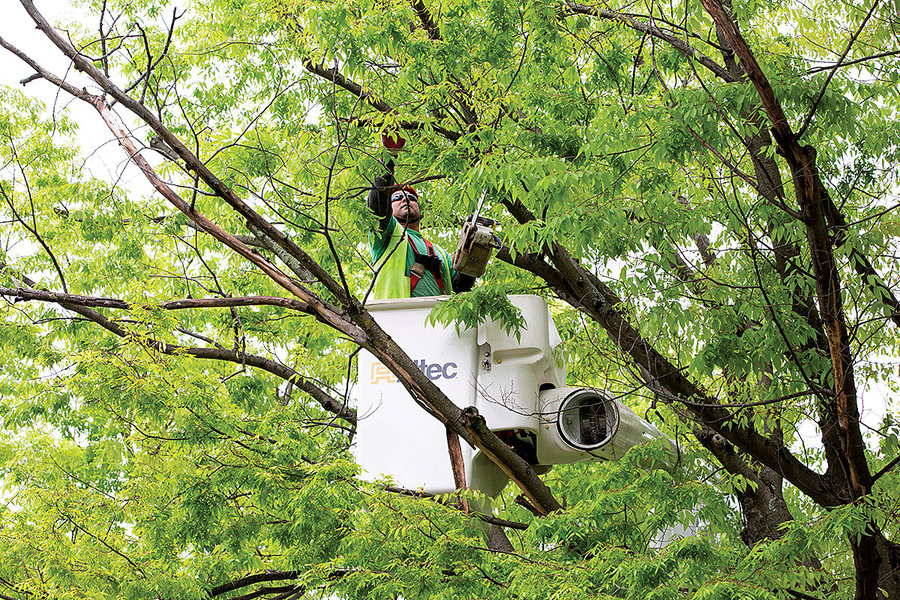
Pruning trees in Baltimore helps to keep them healthy. “We are making a difference,” says Erik Dihle, arborist for the city of Baltimore. … “It ties into social equity, into climate adaption, everything.”

The value of tree canopies in cities is not a new topic at this blog. I’ve written often about efforts around the world to capture the physical- and mental-health benefits of urban forests (for example, in 2014, 2017, and last summer).

I’m not sure, though, that I ever knew how forward-thinking Baltimore has been, a city that was recently disparaged by a kind of leader unfamiliar with actual leadership.

Stephanie Hanes writes at the Christian Science Monitor, “From his headquarters office, Erik Dihle drives into what has become one of the most monitored forests in the United States.

“He begins to point out the trees: There is a tulip poplar, as big as the ones George Washington planted at Mount Vernon. There are the blossoming cherries, with a cotton-candy display that rivals their famous compatriots down the road at the Tidal Basin in Washington, D.C. And there is a white oak, Maryland’s state tree, with its branches gnarling horizontally for yards.

“ ‘This is a good-size one,’ he says, getting out of his truck to pace the area of shade created by the tree’s canopy. ‘I’d be surprised if it was less than 150 years old.’ …

“Mr. Dihle’s forest is in the city. He is the arborist and the head of forestry for the city of Baltimore, which means he monitors all the trees here – those growing in shady parks, in metal grates along busy streets, in backyards, and in relatively untouched forest patches dotting the municipality. Together, these trees make up what is called the city’s ‘urban forest.’ …

“With concern growing about climate change and rapid worldwide urbanization, city forests have emerged as one widely touted solution to a host of social and environmental challenges. Municipalities from Barcelona, Spain; to Melbourne, Australia; to Chicago have put urban canopy coverage at the center of their long-term strategic plans. Community groups focusing on planting, maintaining, and saving trees have blossomed across the U.S. In 2015, the World Economic Forum’s Global Agenda Council on the Future of Cities named increasing green canopy coverage as one of its top 10 urban initiatives.

“Yet at the same time, the U.S. Forest Service, which in the past decade has also upped its focus on urban forests, has found that American cities are losing trees – and quickly. … Urban regions showed a particular decline, along with an increase in what the researchers call ‘impervious surfaces’ – in other words, concrete.

“But not, it turns out, in Baltimore.

“Here, the net tree canopy coverage has increased. Not by a lot, Mr. Dihle is quick to point out – only from 27% of the city’s land coverage to 28% – and not because Baltimore hasn’t lost trees. It has. But overall the tree canopy here has grown, which means that Mr. Dihle has found himself presiding over one of the more successful efforts in the U.S. to preserve and improve the urban forest. …

“New technology has let researchers better understand the urban ecosystem – not just how trees thrive or fail in a city, but how they intersect with humans.

‘[Trees] impact work productivity, wildlife habitats, air pollution removal, carbon sequestration, energy use,’ says David Nowak, senior scientist with the U.S. Forest Service who authored the recent national report on tree canopy loss. … ‘We should be smart about this whole process and use nature to make our lives better.’

Much of the understanding of how, exactly, trees affect everything from climate to criminal justice stems from a technological breakthrough pioneered in Baltimore. …

“By the 1990s, satellite imagery allowed governmental agencies such as NASA to produce visible images of Earth and to show on various scales where trees existed. But there was a limit to those pictures, explains Morgan Grove, a scientist with the U.S. Forest Service who has worked in Baltimore since 1999. Because the data were recorded in pixels, not physical parcels, it was difficult to identify, say, the owner of a particular tree, or to compare what was happening from one city block to another.

“In 2006, though, the Forest Service, working with researchers from the University of Vermont’s spatial analysis lab, put together a new type of land cover map in Baltimore using a combination of aerial imagery, light-reflecting technology, and high-resolution landowner data. This novel approach not only allowed a closer look at trees, it also let scientists synchronize forest maps with other information that was also newly computerized and manipulable – everything from health records to census figures, crime statistics to property values.”

Learn about the amazing array of data they were able to collect, how data helped the city prevent nascent problems like storm sewer overflow, and how the community has organized to protect and expand urban forest benefits, here.

By the way, I thought the photographer on this story, Melanie Stetson Freeman, did an especially good job capturing the faces of these tree huggers. It helps one understand that the individual and the things an individual cares about are what improve the world.

Read Full Post »

offset_forest

Photo: Loren Kerns, Flickr
Many carbon offset projects reduce carbon in the atmosphere by protecting forests. Cool Effect offers other, carefully vetted offsets. The average American creates 17 tons of carbon pollution every year, so at $5 t0 $13 a ton, offsetting your footprint is a real deal.

When an arborist came to our house to remove a dangling limb on our big old tree, I was so sad to learn that the whole tree was diseased and had to come down. Not only was it beautiful, it was removing carbon from the atmosphere, which helps reduce global warming. I made a donation to the the Arbor Day Foundation, as an offset, but that’s not as good as keeping an ancient tree.

Here is what a recent episode of the radio show Living on Earth had to say about some good carbon offsets.

“Carbon-intensive activities, including global air travel, have been growing for decades. For individuals and companies interested in reducing their carbon footprints, carbon offsets promise to mitigate the damage caused by flying and other emissions sources through the investment in projects that either sequester carbon, like reforestation or forest conservation, or develop alternative energy infrastructure that reduce future emissions. Cool Effect CEO Marisa de Belloy discusses her non-profit crowdfunding platform that sells these offsets with host Bobby Bascomb.

“BASCOMB: [What] do people choose to offset with your carbon emissions offset program? …

“DE BELLOY: They’ll offset a flight, they’ll offset their trips to work; some will offset their entire year. The average American emits about 17 tons of carbon pollution every year. And so some people like to wipe that clean by offsetting that at Cool Effect. These are people who are committed environmentalists who are already doing what they can do in their daily lives, to reduce their impact. And that might be eating less meat, it might be traveling less often, it might be having an electric car or solar panels. …

“BASCOMB: [Give] me some examples of projects that participate.

“DE BELLOY: [Each] of these projects will have met the requirements of an independent standard, they’ll have been verified independently of us, and then we do our own very deep due diligence that lasts a couple of months on each project, to make sure that they’re doing exactly what they say they’re doing. …

“We have a project, for example, in Vietnam that installs biogas digesters, which is a very simple technology that takes animal waste, and turns it into clean cooking fuel for homes. We have a project in the United States that’s protecting the forest, or another one protecting grasslands; a project in Honduras that is providing clean cookstoves for families down there who were basically dying from air pollution from cooking over open fires. …

“They all are truly additional, meaning they’re truly having an impact on the planet and then they also all have their own set of co-benefits. [For] the cookstove project, it’s the health of the families. In some cases, it’s local jobs. In some cases, it’s protecting wildlife or a whole forest ecosystem and the people who live there. [The] key thing that underlies all the projects is that we have made sure that they’re actually doing the work of verifiably reducing carbon emissions.

“BASCOMB: And how do you actually verify that? I mean, how do you know that this project wouldn’t have been done anyway without this money? …

“DE BELLOY: [A] couple of different ways, but one is you have to understand what their financial model is, both when they started the business and currently. Is there a profitable way to do what they’re doing without the revenue from carbon offsets? And if the answer is yes, then the project is likely not additional. Another way to look for additionality is regulatory additionality. So, is there a law in place that’s requiring this business or this nonprofit to do what it’s doing? …

“BASCOMB: And then once you’ve identified a good project to work with, how do you guarantee the longevity of that? I mean, I saw that you have one in Brazil, protecting the Amazon, and Brazil is a famously lawless area, especially with the new president that really doesn’t encourage conservation. How can you be sure that those trees will still be standing 10 years from now, or that the landowner won’t take that money and then clear cut in a different area?

“DE BELLOY: [On] the trees still standing portion, that’s built into the methodology, so they will no longer be able to offer credits if those trees start disappearing. And each of the methodologies includes a certain buffer amount of trees, you know, because trees do die, and you can have natural fires and that sort of thing. And we take a particularly conservative approach to these projects, if there’s any doubt that, you know, the cook stove was in use, or the tree was still standing, or, you know, the animals were still having access to these grasslands, then a credit is not issued for that amount. So wherever there’s doubt, the credit is not issued. …

“[The cost for an offset] goes from about $5 to about $13 a ton. So if you think about the average American having 17 tons of carbon pollution every year, it’s a really reasonable amount of money to spend to wipe away that impact that we’re all having.” More from Living on Earth, here.

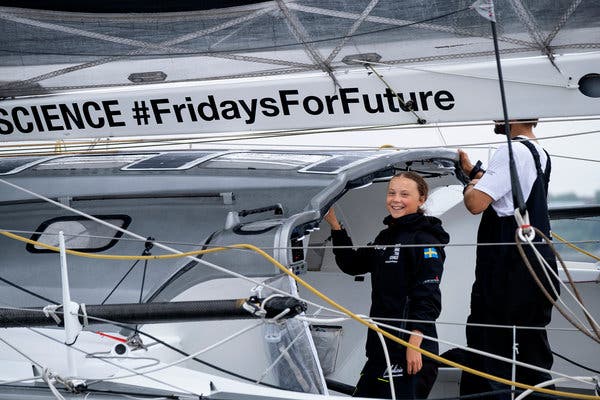
The best example I know of someone practicing what they preach is young Swedish climate activist Greta Thunberg, who is traveling from Canada to Chile without using fossil fuels. Read this.

Photo: New York Times
So as not to use any airplane’s fossil fuels, Swedish climate activist Greta Thunberg crossed the Atlantic Ocean aboard the Malizia II, a zero-emissions racing yacht.
merlin_159839643_94176435-b622-4a9d-a118-aa89da8c425c-articlelarge

Read Full Post »

062120whitefish20lake

Photo: Doug Struck
Access to streams in Whitefish, Montana, was threatened by development, so the town used the increasingly popular strategy of buying rights to the forest.

People can change their minds.

That’s what happened in Montana as property-rights advocates began to see that their water bills would be cheaper if they let government entities buy rights to forests on private lands.

Doug Struck writes at the Christian Science Monitor, “When the appetite for high-priced housing threatened the water source of [Whitefish, Montana], the residents raised taxes and spent money on forests. Three years later, when rising tourism upped the summer demand for water, more money was raised to buy more forests.

“The equation used by local and state officials, nonprofit groups, and private residents was straightforward: It’s cheaper and easier to have the forests cleanse the water than to throw chemicals and machinery at the task.

“ ‘Protecting forests of watersheds makes economic sense,’ says John Muhlfeld, the mayor of this town of 7,000 nestled in Montana’s Rocky Mountains. ‘And it’s a much different way of traditionally looking at a public water supply infrastructure.’ …

“As town planners look at the high cost of building water filtration plants and operating them year after year, the thought of letting the trees do it becomes a budgetary no-brainer.

“And the trees do it well. The natural filtering process that rain and snow undergo in seeping through forest canopies and forest beds, slowly toward streams and lakes, is so effective that five major cities in the United States – New York, Boston, Seattle, San Francisco, and Portland, Oregon – can pump unfiltered water from distant pristine watersheds to customer homes.

“New York is the poster-city example in this country. Twenty years ago, the city engaged in a wrenching political battle over whether to build a $6 billion water filtration plant that would cost $300 million per year to filter water for the city. Instead it gambled and spent $2 billion to protect the forested watershed in the Catskill Mountains, 125 miles away, the source of 90% of the city’s water. It was a bold and controversial decision – and it worked.

“ ‘Here we are, 20 years later they have been meeting the safe drinking water standards through tropical storms and superstorms,’ says Paul K. Barten, one of the junior architects of the original Catskills program who now chairs a current National Academy review of the system. …

‘People are not necessarily doing it because they love trees. … ‘They are doing it because it’s a lot less expensive.’ …

“The state and national park programs that began to emerge in the U.S. 150 years ago, and evolved at the prodding of such visionaries as John Muir, Frederick Olmsted, Gifford Pinchot, and Teddy Roosevelt, now preserve 13% of U.S. land, according to the World Bank. Another 56 million acres are held by various forms of private or public ‘trusts’ that allow some use but prohibit development, according to the Land Trust Alliance in Washington, D.C.

“In the case of Whitefish, that meant keeping land for logging. The Haskill Basin northeast of town was forestland owned for more than a century by the Stoltze lumber company. …

“Over the years, development pressures loomed larger as Whitefish blossomed into a high-end, expensive resort town sprouting multimillion-dollar second homes. … Stoltze ‘could have gotten an offer that they couldn’t refuse,’ says Kris Tempel, a biologist at the Montana Fish, Wildlife and Parks agency. …

“The Trust for Public Land … helped bring together $9 million from federal conservation funds. And Stoltze agreed to take a $4 million cut on the $21 million price of giving away development rights to its 3,000 acres in Haskill Basin. …

“That left a shortfall of $8 million. City residents had balked before about increasing the town’s ‘resort tax’ on restaurants, lodging, and retail. But in 2015, after a ‘Vote Yes for Water’ campaign by the mayor and others, residents gave an overwhelming 84% approval to a 1% tax increase. Late last year, the purchase of another 13,000-acre property helped protect a watershed for Whitefish Lake, a secondary source of water for the town.

” ‘The public support is a change in a place where encroachment on private land is viewed with suspicion, says [Montana Fish, Wildlife and Parks resource conservation manager Alan Wood]. ‘Twenty years ago there was a lot of opposition’ to these proposals.’

“But this deal ‘gave everyone what they wanted,’ says Mr. Wood. The town kept its access to clean and cheap water. Stoltze can keep harvesting timber on the land, employing an average of 110 workers.”

More at the Christian Science Monitor, here.

Read Full Post »

a514c2fcd

Photo: Ville de Paris/Apur/Céline Orsingher
The trees in this rendering of Paris’s Opera Garnier would take the place of an existing bus-parking area. Big ideas are necessary if the city is to meet its ambitious greening goals, part of the international Paris Agreement to tackle global warming.

A January article by Feargus O’Sullivan at CityLab, showed artist renderings like the one above as part of a plan to bring more trees into Paris. The announcement came before Notre Dame burned, so I hope plans are still going forward. Here is the concept.

“Some of Paris’s most treasured landmarks are set to host the city’s new ‘urban forests,’ ” writes O’Sullivan.

“Thickets of trees will soon appear in what today are pockets of concrete next to landmark locations, including the Hôtel de Ville, Paris’s city hall; the Opera Garnier, Paris’s main opera house; the Gare de Lyon; and along the Seine quayside.

“The new plantings are part of a plan to create ‘islands of freshness’—green spaces that moderate the city’s heat island effect. It also falls into an overall drive to convert Paris’s surface ‘from mineral to vegetal,’ introducing soil into architectural set-piece locations that have been kept bare historically. As a result, the plan will not just increase greenery, but may also provoke some modest rethinking of the way Paris frames its architectural heritage. …

“[Such plans] are necessary if Paris is to meet its ambitious greening goals. By 2030, city hall wants to have 50 percent of the city covered by fully porous, planted areas, a category that can include anything from new parkland to green roofs. ..

“The city imagines turning the square in front of city hall into a pine grove, while future springtimes will see the opera house’s back elevation emerge from a sea of cherry blossom. The paved plaza at the side of the Gare de Lyon will become a woodland garden, while one of the two former car lanes running along the now pedestrianized Seine quays will be taken over by grass and shrubs.

“Such plans will require more than sticking saplings in the ground. Creating the new opera house cherry orchard will mean displacing a current parking lot used by tourist buses, a process that the city plans to repeat elsewhere. …

“Intriguingly, the urban forest plans are a slightly different take on the classic Parisian aesthetic. Sites like the areas around the opera and Hôtel de Ville don’t need beautifying — they are already grand, charismatic showcases for the elaborate, even fanciful historic buildings that they host.

“In the past, however, they have been left bare, or at most … fringed with small lines of trees that have been rigorously pruned and trained until they form a narrow, wall-like rampart. …

“Given how charming the designs appear, this seems unlikely to be controversial, but it does suggest a more rustic, quasi-natural approach to greenery than has previously been the rule in Paris.”

There is more information here. And maybe when blogger A Pierman Sister returns to Paris, we will get an eye-witness account of the city’s progress on its plans.


Read Full Post »

Photo: BioCarbon Engineering
Drones can have a peaceful purpose. These are fighting climate change by “bombing” seeds into places that need trees. Trees are essential for decreasing carbon dioxide in the atmosphere.

Drones can have peaceful purposes. Some folks use them for photography or research on birds. Others have tapped drones to plant the trees our planet needs to reduce carbon dioxide and combat global warming.

Leo Shvedsky writes at Good, “Technology is the single greatest contributor to climate change but it may also soon be used to offset the damage we’ve done to our planet since the Industrial Age began.

“In September 2018, a project in Myanmar used drones to fire ‘seed missiles’ into remote areas of the country where trees were not growing. Less than a year later, thousands of those seed missiles have sprouted into 20-inch mangrove saplings that could literally be a case study in how technology can be used to innovate our way out of the climate change crisis.

“ ‘We now have a case confirmed of what species we can plant and in what conditions,’ Irina Fedorenko, co-founder of Biocarbon Engineering, told Fast Company. …

“According to Fedoranko, just two operators could send out a mini-fleet of seed missile planting drones that could plant 400,000 trees a day — a number that quite possibly could make massive headway in combating the effects of manmade climate change.

“The drones were designed by an ex-NASA engineer. And with a pressing need to reseed an area in Myanmar equal to the size of Rhode Island, the challenge is massive but suddenly within reach. Bremley Lyngdoh, founder and CEO of World Impact, says reseeding that area could theoretically house as many as 1 billion new trees. …

“For context, it took the Worldview Foundation 7 years to plant 6 million trees in Myanmar. Now, with the help of the drones, they hope to plant another 4 million before the end of 2019.

“Myanmar is a great case study for the project. In addition to the available land for the drone project, the nation has been particularly hit by the early effects of climate change in recent years. Rising sea levels are having a measurable impact on the population. In addition to their ability to clear CO2 from the atmosphere, healthy trees can also help solidify the soil, which can reduce the kind of soil erosion that has been affecting local populations in Myanmar.”

Adele Peters at Fast Company explains, “The drones first fly over an area to map it, collecting data about the topography and soil condition that can be combined with satellite data and analyzed to determine the best locations to plant each seed. Then the drone fires biodegradable pods — filled with a germinated seed and nutrients — into the ground. For the process to succeed in a mangrove forest, several conditions need to be right; if the tide comes in unexpectedly, for example, the seeds could wash away. In tests, Biocarbon Engineering has looked at which species and environmental conditions perform best.

“If drones do begin to replant entire forests, humans will still play a critical role. That’s in part because some seeds don’t fit inside the pods. But people living nearby also need a reason to leave the trees standing. ‘The project in Myanmar is all about community development and enabling people to care for trees, providing them with jobs, and making environmental restoration in a way that it’s profitable for people,’ says Fedorenko. ‘The forest didn’t vanish by itself—the forest was cut down by local people.’ ”

More at Good and Fast Company.

Hat tip: Maria Popova on Twitter.

Read Full Post »

Older Posts »