Feeds:
Posts
Comments

Posts Tagged ‘tribes’

Photo: Navajo Natural Heritage Program via Natural Resources Defense Council.
Diné Native Plants Program members work to restore a headwater stream impacted by livestock grazing.

The more that the US endangers its wetlands, the more we rely on the work that tribes do to protect them. Perhaps today’s article can help us see what the rest of us can do.

At the website for the Natural Resources Defense Council, or NRDC, Claudia Blanco Nuñez and Giulia CS Good Stefani describe how “Tribal Nations protect and manage millions of acres of wetlands, which help improve water quality, curb the risk of floods, recharge groundwater, and store large amounts of carbon.”

“Two years ago,” they report, “the U.S. Supreme Court slashed federal Clean Water Act protection of wetlands [with] harmful repercussions for droughts, wildfires, flooding, wildlife, and the drinking water supply. 

“In the absence of federal protection, the imperative to defend our shared waters falls increasingly on individuals, states, and Native American Tribal Nations. … Tribal Nations protect and manage millions of acres of wetlands in the United States, and with commitments made by the U.S. government to Tribal co-management and co-stewardship of federal lands, the amount of clean water safeguarded by Tribal Nations is growing.

“NRDC’s Science Office mapped the wetlands found within and intersecting the boundaries of Tribal reservation lands in the contiguous United States. Across the 294 federally recognized Tribal reservations mapped in this analysis, our scientists found that Tribes steward more than 3 million acres of wetlands. Even typically arid regions like the American Southwest have significant wetlands on Indigenous reservations. …

“In addition to the 56.2 million acres that are part of the Tribal reservation system, many Tribes have reserved or treaty rights on lands outside reservation boundaries, and most Tribes and their members maintain ongoing physical, cultural, spiritual, and economic relationships with their ancestral homelands. These reciprocal land and water relationships extend far beyond the political boundary of any designated reservation.

“This analysis is limited to federally recognized Tribes in the Lower 48 due to the complex Tribal governance systems in Alaska and Hawai’i. For example, the Alaska Native Claims Settlement Act of 1971 altered the previous Tribal ownership system to one led by Alaska Native Corporations. This system differs from federally recognized Tribes, which have a government-to-government relationship with the United States that includes eligibility for funding and services from the Bureau of Indian Affairs. That is to say, NRDC’s analysis looked at just a fraction of the total wetlands stewarded by and connected to the lives and well-being of Native peoples today.

“To learn more about Tribal wetland conservation, we spoke with leaders in the wetland management programs of the Navajo Nation and Red Lake Band of Ojibwe. …

“Navajo Nation agency staff are engaged in numerous projects to help restore and protect this essential resource. The Diné Native Plants Program recently submitted a grant application to remove invasive plant species along the Little Colorado’s riverbank. This will make space for native vegetation to grow and help with groundwater recharge for nearby Navajo farmers and families. The Diné Native Plants’ seed program also provides seed mixes for restoration projects that are solely sourced from Navajo plants. 

“Jesse Mike, the Diné Native Plants program coordinator, stepped out of the greenhouse to speak with us. He shared about the history of livestock grazing, trampling, and erosion that have impacted not only the health of the headwater streams on Navajo lands but also the underlying water table. His team is currently working to increase groundwater infiltration and improve the overall ecosystem health of three degraded streams in the Chuska Mountains. …

“The Red Lake Band of Ojibwe’s reservation is in northern Minnesota and has the greatest area of wetlands of any reservation in the contiguous United States. Across the Tribe’s more than 835,000 acres of land — all held in common by the Tribe — the Red Lake Band manages an astonishing 541,000 acres of wetlands. ‘So many wetlands,’ says Tyler Orgon, a biologist and the lead wetland specialist for the Red Lake Band Department of Natural Resources, ‘and we’re very fortunate for that.’ 

“A sizable portion of the Tribe’s wetland acreage north of Upper Red Lake is part of the largest expanse of peatlands in the continental United States. Peatlands cover about 3 percent of the earth and store more carbon than all of the planet’s other types of vegetation, including the world’s forests, combined. 

“One of the most important wetland-dependent plant species for the Red Lake Band — as well as other Anishinaabe and Dakota peoples across the Great Lakes region — is manoomin (Zizania palustris and Z. aquatica), the only wild rice native to Turtle Island. According to an Ojibwe prophecy, their ancestors were instructed to move west to the place where ‘the food floats on water.’

“The University of Minnesota research team We Must First Consider Manoomin (Kawe Gidaa-naanaagadawendaamin Manoomin) works to help protect this essential wetland-dependent plant by combining Western science with Indigenous science and learning from Ojibwe stewardship.

“The scientists have found that an increase in extreme weather conditions (like flooding events and record-breaking snowfall) negatively impact manoomin growth by uprooting the plant or drowning it out in its sensitive early stages. These weather events compound the already present settler-colonial impacts on wetlands in the region, including deforestation and conversion of wetlands into agricultural land use.

“Orgon hopes to restore some of the Red Lake Band’s wetlands that have been impacted by past agriculture.” More at NRDC, here.
Read Full Post »

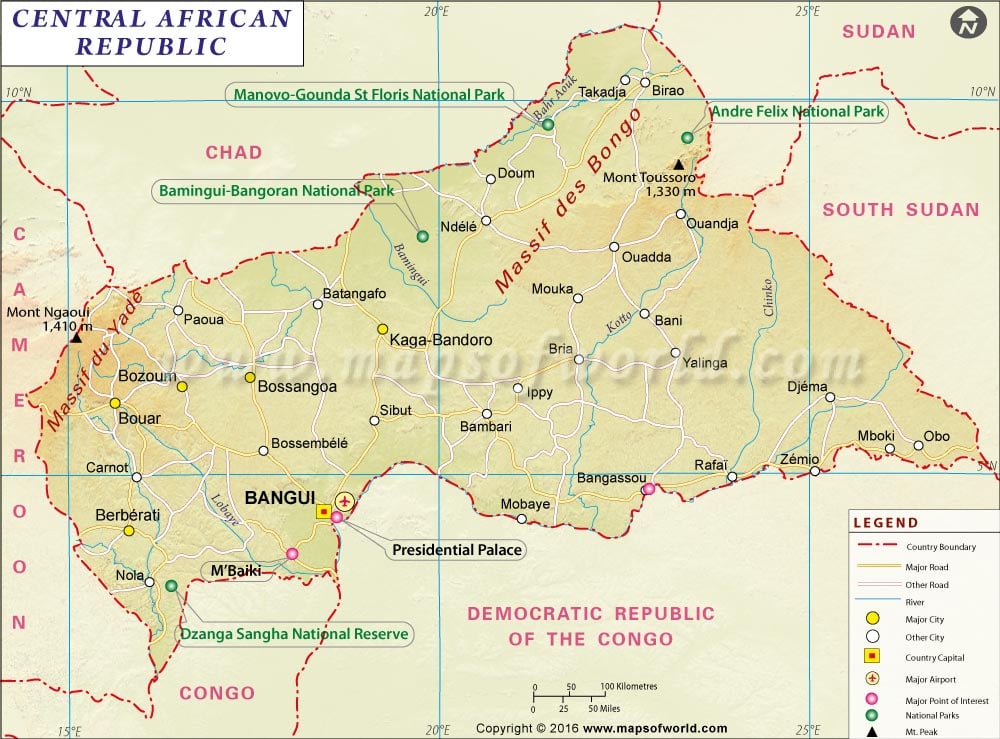
Map: Maps of the World.
The National Ballet in the Central African Republic brings to life traditional dance forms from different ethnic groups across the country. 

In parts of Africa where colonialism glommed together disparate tribes with ancestral enmities, wars have continued off and on for decades. But the Central African Republic (CAR) is setting a different example, with the help of its national ballet company. The idea is to give all the CAR groups a moment in the sun by highlighting the dance traditions of each. The effort also brings people together in new ways.

In the following article, we learn about a number of ethnic dance groups, including the National Artistic Ensemble that performed recently at the Africa Day of School Feeding (ADSF) in Bouboui. [See the African Union site for an explanation of ADSF. Interesting.]

France24 reports: “The dancers shake their hips, kicking their feet to the beat of the age-old ‘dance of the caterpillars,’ typically performed in the south where the insects are gathered for food.

“Three times a week the National Ballet rehearses traditional dances of the many ethnic groups making up the Central African Republic.

” ‘The creations they ask of us are based on the particularities of each ethnicity. I’m Banda and I have to suggest dance steps from the Banda ethnic group,’ Sidoane Kolema, 43, said.

“They aim to preserve the heritage of the CAR, a mosaic of ethnic groups that is scarred by decades of conflict and instability and is among the world’s poorest countries.

“From behind the scenes, 26-year-old Intelligentsia Oualou began singing in Gbanu, the language of her native southwestern Ombella-M’poko region.

“To the jingle of bells and rhythmic thud of the drum and xylophone-like balafon, the spinning silhouettes of the other dancers soon appeared across the dilapidated stage, set up on waste ground in the capital Bangui.

” ‘All my relatives are artists and I’ve dreamed of being an artist too,’ said Oualou. She is one of 62 dancers in the National Artistic Ensemble, created by CAR President Faustin Archange Touadera in 2021.

” ‘Promoting our cultures means going to the hinterlands to find the different dance steps of the Central African Republic in order to create a show that is diverse,’ National Ballet choreographer Ludovic Mboumolomako, 55, said. He spent three weeks living among the Pygmies in their ancestral forests in the south in order to enrich his choreography with their dances, songs and ways of living. …

“The company is often called upon to perform the ancestral dances in public at political gatherings, inaugurations and official ceremonies. In front of officials or at festivals, they dance in costumes of raffia skirts topped with pearl belts and patterned wax-print fabrics.

” ‘We need to raise awareness among young people … by dancing the different dances of our different ethnic groups in front of everyone. Tomorrow, if we are no longer here, it will be up to them to take over,’ Kolema said.

“The dancers were even recently integrated into the civil service, just like the actors and musicians who also belong to the National Artistic Ensemble.

“One of the upsides is that the dancers ‘have not a subsidy, but a salary’ [Culture Minister Ngola Ramadan] said. …

“Kevin Bemon, 44, said he had been able to put his former ‘difficult’ life dancing at neighborhood wakes behind him, thanks to the monthly salary of [$124] – just over twice the minimum wage in the CAR. …

“For a decade until 2013, the CAR was wracked by civil wars and intercommunal conflict, and although the violence has lost intensity since 2018, tensions persist.

” ‘Traditional dance has brought us together. After the recent wars, different ethnic groups were divided. Thanks to dance, we’ve become children of the same family,’ Oualou said.”

Check out the great photos at France 24, here. No paywall.

Read Full Post »

Photo: Erika Schultz / The Seattle Times.
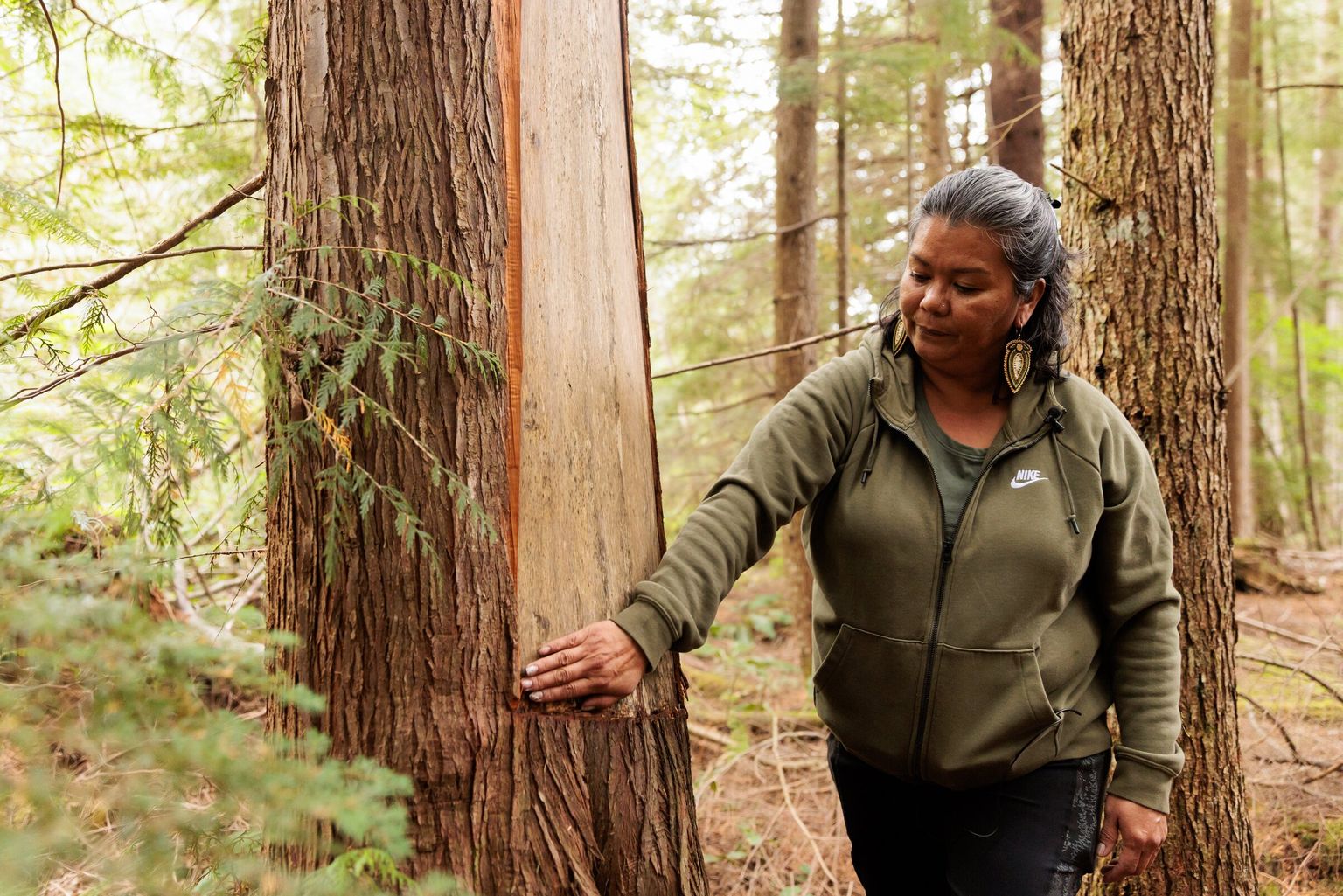
Gail White Eagle, a master cultural traditions specialist and master weaver at Muckleshoot, shows a cedar tree where she has traditionally stripped cedar bark for weaving baskets, hats, and more.

There’s always something more to learn about the generations that inhabited North America before European settlers came. Today’s article explains how indigenous people both used and managed forests, and how some continue to do so today.

Environmental reporter Lynda V. Mapes writes at the Seattle Times, “On a promontory above Puget Sound, a Douglas fir with arms bent at right angles stands above a quiet cove, where shellfish would have been gathered, long before this place was settled by newcomers. This tree was deliberately shaped by generations of hands into its current form, to mark what was here for countless years: rich clam beds, and a gathering site. … Modified trees are a connection interweaving generations of the region’s first people tightly as a cedar basket.

“ ‘It is the sacred fingerprint of the ancestors that shaped this place,’ said Sam Barr, a Samish tribal citizen and tribal historic preservation office supervisor for the Stillaguamish Tribe.

“Another tree, a cedar near the tree on the promontory over the cove, is elaborately trained to grow with branches at 90 degree angles low on its trunk that also were cut and recut so the branches would fork, and then fork again. The result is an elaborate candelabra. This is a marker tree, Barr said, that may have denoted the village that was here — today a housing development. It may also have indicated the direction toward the confluence of the deltas of the Skagit and Stillaguamish rivers that also fork and refork. …

” ‘People don’t think about it much, but we truly are living in an Indigenous garden, from which the gardeners have been forcibly removed,’ Barr said. ‘The entire landscape around the Pacific Northwest was carefully managed and stewarded by Indigenous hands. And there are traces of this everywhere.’

“Trees were stripped for bark for weaving, trees were planked for building materials, trees were made to serve as indicators of everything from trails, to a water source, a rich area for harvest, village or sacred place. …

“Trees are slow growing, and for a marker tree, it takes multiple generations of a family to curate it. … The presence of modified trees all over the landscape today, and continued traditional use of cedar in particular, binds tribes up and down the West Coast. … The Snoqualmie Tribe recently identified — and the state registered as an archaeological site — a modified tree in a lot being cleared for new homes in the Wedgwood neighborhood of Seattle. …

“Gail White Eagle, a Muckleshoot master weaver, said she always looks forward to this moment, as she paused the tribal van at a yellow gate that opens to a forest road in the foothills of Mount Rainier. She was about to enter Tomanamus Forest, 105,000 acres of forest land in King, Pierce and Lewis counties purchased by the Muckleshoot Indian Tribe in 2013. …

“The forest is in part of the territory ceded by the tribe in its treaty with the U.S. in 1855. Taking the forest back into tribal ownership was an act of healing, White Eagle said. Every tribal member can request a key to the gate, unlike at other forests that used to be theirs, now owned by other governments, corporations and individuals.

“A soft misty rain was falling as she walked into the forest, looking for trees from which she had harvested bark the previous spring. … She explained the harvesting process, which always begins with asking permission before taking anything.

She gives an explanation to the tree that its bark will be put to good use. And she often leaves a gift at the tree’s base, such as a bit of tobacco, sage or smoked fish.

“It’s a gesture of thanks and reciprocity in the relationship she holds with this tree, and this forest.

“White Eagle put her hand gently on the healing bark scar, and explained she is careful never to take a piece wider than two hands’ length. She chooses trees only big and robust enough for her to hug. And she pulls bark only in spring, when trees are full of sap, making the harvest easier on her and the tree. A tree can be harvested multiple times over many generations of users, if the harvest is done correctly.

“Tree wounds that penetrate bark damage the cambium layer, vascular tissue that is vital to movement of water and nutrients in a tree. The tree will seal and close the wound, compartmentalizing it with healing lobes to cover it and prevent rot. As long as a tree is not girdled — cut entirely around its circumference, severing all the vascular tissue — it will continue to live.

“Sometimes modified trees are recorded by tribes and government land managers as archaeological sites. But much more often, these trees are known only to the families that use them.

“Jacob Earnshaw is an independent archaeologist based in Victoria, B.C., who works to find and register modified trees as archaeological sites. His work has been entered as evidence in a right and title case in B.C. with the Nuchatlaht First Nation, who are working to prove their long presence on the northern half of Nootka Island on the northwest coast of Vancouver Island, to regain control of lands they never ceded. That case has not yet been resolved.

“Earnshaw has documented more than 1,000 years of cutting and pulling bark for harvest on Vancouver Island. The trees show management of these forests, Earnshaw said, by the island’s first people to protect what was an exhaustible resource. ‘What we are looking at is woodland management by these people who were thought of as hunter-gatherers,’ he said.

“That term is a myth, says Chelsey Geralda Armstrong, assistant professor in the Department of Indigenous Studies and School of Resource and Environmental Management Studies at Simon Fraser University in Burnaby, B.C. The first people didn’t just pick up what they needed here and there; they managed and cultivated their land and waters just as they do today — and evidence of their ancestors’ practices persists in the landscape.

“Armstrong teamed up with Earnshaw and other researchers to publish a 2022 paper that described forest gardens on Vancouver Island with still-evident remnants of cultivation, transplanting and all the other usual horticultural arts. The gardens were just part of the associated archaeological evidence of long prior use, including clam gardens, village sites, shell middens and trees in the nearby forest bearing scars of harvest for bark and other needs.

“Their work shows that far from an unpeopled wilderness, the Northwest Pacific Coast was a managed and stewarded place for thousands of years.” More at the Seattle Times, here.

Read Full Post »

Photo: The Nicholson Project.
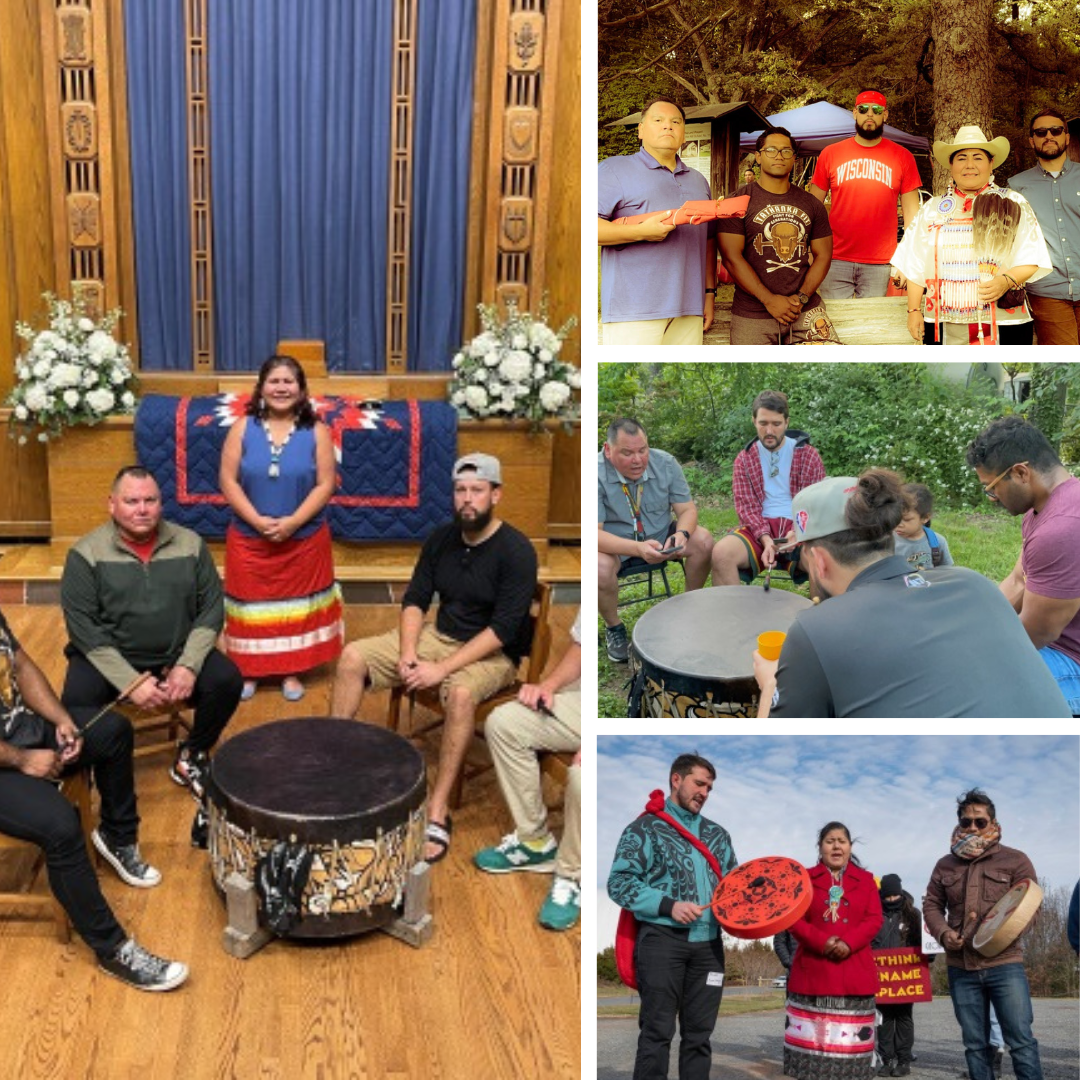
The Uptown Singerz are a DC-based intertribal Native American Northern powwow drum group that performs powwow, ceremonial, and in some cases political songs.

We are all enriched when previously below-the-radar groups begin to share their culture more widely. The featured article for today is from the Washington Post and highlights a cultural collaboration by members of several indigenous tribes.

Dana Hedgpeth writes, “When Nick Courtney came to D.C. seven years ago to work on education issues, he missed his Native American tribe in Washington state.

“Longing to connect with other Native Americans in the region, the 31-year-old member of the Makah Tribe helped form the Uptown Singerz, a Native American drum group that shares and celebrates their heritage.

“ ‘D.C. is a transient city because folks come and go, so that can be hard,’ said Courtney, who lives in Baltimore. ‘I still long for my own culture, but this fills my cup. It’s a bond, and I’m a part of something that’s allowed me to build a community here. It’s like a family for me.’

“In the United States, roughly 9.7 million people — or about 3 percent — of the overall population — identified themselves as being American Indian or Alaska Native in the 2020 Census. Fewer than 1 percent of people in the District, Maryland and Virginia said they are American Indian or Alaska Native.

“There are more than 500 federally recognized tribes in the country, and more than 70 percent of American Indians live away from their tribal reservations or communities.

“Being a part of Uptown Singerz gives members who are far from their tribes’ home ‘a renewed sense of community and family every time we sing, every time we drum,’ said Mary Phillips, the group’s lady backup singer (as the role is officially called by Native Americans), who is from the Omaha Tribe in Nebraska and the Laguna Pueblo Tribe in New Mexico. …

“The Uptown Singerz … practice several times a month and perform up to 20 events a year in theaters, rallies, community events and Native American gatherings and powwows in the D.C. region to showcase their talents and educate the public. They, along with the Zotigh Singers — who are from the Kiowa Tribe of Oklahoma and live in Waldorf, Md. — are one of the few American Indian drum groups in the D.C. region.

“ ‘Having the Uptown Singerz is so important because they help keep our culture alive here in D.C.,’ said Angela Gladue, 38, who is a powwow and hoop dancer. A Cree and a member of the Frog Lake First Nation in Alberta, Canada, Gladue moved to Northeast Washington six years ago and got to know other American Indians in the area, along with the drum groups. …

“The Uptown Singerz typically play around one large drum made from wood and dried animal hide. Sometimes they play smaller hand drums. Considered sacred and often used at events and some ceremonies, the drum for many American Indians represents the heartbeat of Mother Earth.

“They follow the Native American tradition of having only men sit around the drum. Women stand behind them and join in the singing because ‘women carry the sacred water of life,’ empowering them to ‘absorb or change the energy of the people around them or the energy of the drum,’ Phillips said. …

“For Gladue, hearing the drum and seeing American Indians from different tribes gather and dance was a special moment. … ‘People will ask, “Indians are still here?” To be around other Natives and not have to explain myself makes me feel good.’ “

More at the Post, here.

Read Full Post »

Photos: James Austin V.
Alaska is delivering vaccines by sled, boat, plane, and snowmobile. Flashback to the Iditarod origins — when diphtheria antitoxin was rushed to Nome by dog sled.

It’s so interesting to me which states are doing well with vaccine distribution and why! West Virginia was ahead of the pack because it used local pharmacies but also had a central sign-up site. Now Alaska seems to have taken the lead, and its techniques are completely different.

Cathy Free writes at the Washington Post, “Alaska, the state with the largest land mass in the nation, is leading the country in a critical coronavirus measure: per capita vaccinations.

“About 13 percent of the people who live in Alaska have already gotten a shot. … But the challenge for Alaska has been how to get vaccines to people across difficult, frigid terrain — often in remote slivers of the state.

“ ‘Boats, ferries, planes, snowmobiles — Alaskans will find a way to get it there,’ said the state’s chief medical officer, Anne Zink, 43.

“Alaskans are being vaccinated on fishing boats, inside 10-seater planes and on frozen landing strips. Doctors and nurses are taking white-knuckle trips to towns and villages across the state to ensure residents are protected from the coronavirus.

“Contributing to Alaska’s quick speed in getting the vaccine to its residents is a federal partnership that allows the state, which has more than 200 indigenous tribes, to receive additional vaccines to distribute through the Indian Health Service.

“Other reasons include the state’s small population of 732,000, as well as a high number of veterans, Zink said. The U.S. Department of Veterans Affairs is working with the Centers for Disease Control and Prevention to ensure that high-risk veterans receive priority for the vaccine.

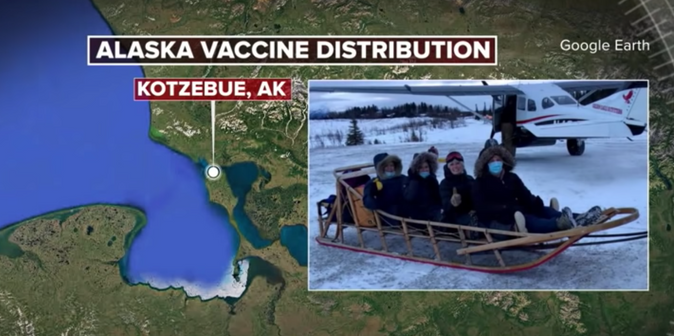
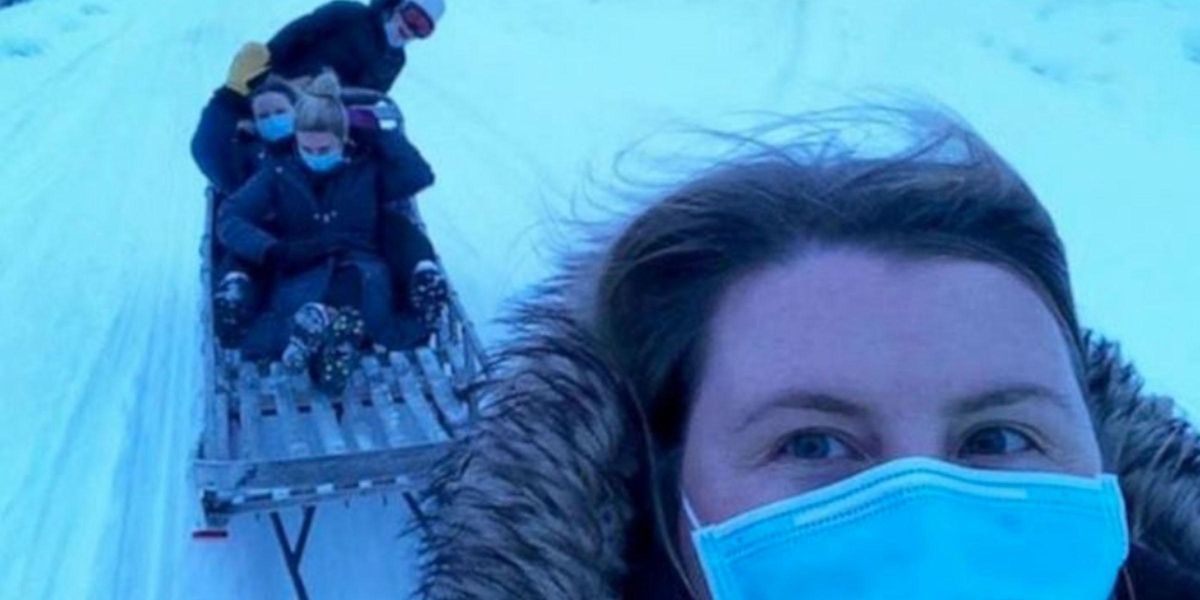
“But one big reason is the state is practiced in delivering precious cargo by transport not often used in the Lower 48. Sometimes that even means adventures by sled. One all-female medical crew of four in December used a sled pulled by a snowmobile to deliver vaccine to the village of Shungnak in the state’s remote Northwest Arctic Borough.

‘It’s just an easier way to get around when you don’t have a lot of roads,’ said Kelli Shroyer, public communications director for the Maniilaq Health Center in Kotzebue, Alaska, where the crew started their journey. …

“Zink was so impressed by the sled crew’s delivery in December that she posted about it on her Facebook page. ‘I love the pictures of vaccination distribution in Alaska,’ she wrote. ‘Recipients expressed how grateful they were that even though they are so remote, they are getting this vaccine. They are not forgotten. …

‘One chief told me how his grandmother took his mother out to the wilderness for a year so that she would be safe. When they returned, they learned that most of their village had died.’ …

“Thousands of Alaskans are playing a role in getting people vaccinated, Zink said.

“Curt Jackson used to employ his water taxi, the Orca, to shuttle tourists from the small city of Homer to villages across Kachemak Bay that aren’t accessible by roads. In late December, Jackson received a request to take three nurses across the bay to Seldovia, a town with about 450 residents, including members of the Seldovia Village Tribe. Planes couldn’t fly that morning because of weather, and the water was rough.

“When the women climbed aboard his 32-foot aluminum landing craft and took seats in the windy darkness, Jackson said, he noticed that the woman in the middle, Candace Kreger, was clutching a bright blue cooler. That was when he realized that the women were traveling with the precious doses. …

“For Ellen Hodges, a doctor from Bethel, Alaska, the coronavirus vaccination effort is the most rewarding project in which she has been involved, she said. Hodges, 46, has flown to several villages in a six-seater plane to vaccinate medical workers and elders, who meet her on the runway.

“ ‘We land in the isolated tundra, and they’ll be lined up waiting,’ she said. ‘Some places have up to 30 people, and some have only one.’ “

More at the Washington Post, here.

An all-female medical crew from Alaska’s Maniilaq Health Center took a sled to deliver vaccine to the isolated village of Shungnak in December.

Read Full Post »

tribesonthebrink

Photo: The Explorers Club

You remember the great marine explorer Jacques Cousteau? Well, his granddaughter has grown up to be an explorer of vanishing cultures, and recently she made a movie about endangered tribes in the Amazon.

The film by Céline S. Cousteau is called Tribes on the Edge, and according to its website, it’s “more than a narrative of tribal reality in the Amazon [as it] suggests the universal story of our human tribe and how our future is interwoven with each other and with nature. This is a story that invokes the critical importance of respect and care – for land, culture, and humanity. …

“[The film] explores the timely topics of land threats, health crises, and human rights issues of indigenous peoples, expanding the view to how this is relevant to our world. More than a film, it has grown into a movement driven by a passionate effort to enact tangible impact in the Javari [Valley of Brazil] through education, advocacy, and activism. …

“Spanning more than 85,000 km2 (an area the size of Portugal), the Vale do Javari is the second largest indigenous territory in Brazil and is home to 5000 indigenous peoples from 6 tribes as well as the largest population of people living without any contact with the outside world in the entire Amazon and some say the world.

“Though the Javari has been designated for the tribes living there, there is looming pressure to increase harmful resource extraction which in other parts of the Amazon has led to environmental degradation. … It is estimated that the Amazon produces 20% the world’s oxygen and releases 55 gallons of water into the Atlantic ocean every second.”

Read more at the website, here, about what the International Union for Conservation of Nature calls “one of the irreplaceable areas of our planet.” And at the website for New York’s Explorers Club, which screened the film this past April, you can also can read about speaker Beto Marubo. A Marubo Indian, he has served with the national Indian foundation of Brazil, FUNAI, an initiative threatened by the likely election of someone Wikipedia calls “a polarizing and controversial politician” to the country’s presidency.

The movie is more timely than ever.

beto_250

Read Full Post »

05lenape2-superjumbo

Photo: Dolly Faibyshev for The New York Times
In a ceremony at the Abrons Arts Center in New York, Emily Johnson acknowledges the Lenape tribe, which inhabited Manhattan before Europeans arrived. The bonfire event is part of an initiative by artists called “land acknowledgment.”

It’s interesting to me that at the same time that nationalism and harsh attitudes about migration are sweeping the Western world, some very different movements are gaining traction. One is the increased acknowledgment in some English-speaking countries that Europeans were once interlopers, too.

Siobhan Burke writes at the New York Times about arts groups starting to pay attention to first residents.

“On an evening in early June, before the sun had gone down, a bonfire blazed outside Abrons Arts Center on the Lower East Side. Handmade quilts lined the steps of the outdoor amphitheater. Anyone walking down Grand Street could come in and take a seat. As a group of singers arranged themselves around a large cylindrical drum, the choreographer Emily Johnson stood up to speak a few careful, welcoming words.

“ ‘I’d like to acknowledge and pay my deep respect to Lenape people and elders and ancestors — past, present and future,’ she said. She gestured toward the ground and in the direction of the East River. ‘I acknowledge and offer deep gratitude to this Lenape land and water that supports us, as we’re gathered here right now together, and I invite you to join me in that acknowledgment, that respect and that gratitude.’

“In recognizing Manhattan’s original inhabitants — the Lenape (pronounced len-AH-pay) — and their ancestral homeland, Lenapehoking, Ms. Johnson was taking part in a ritual that, with her guidance, has become increasingly common at New York performing arts spaces in the past year.

“Routine at public gatherings in Australia, New Zealand and Canada, the custom of Indigenous land acknowledgment, or acknowledgment of country, has only recently started to gain traction in the United States outside of tribal nations. In New York City the practice is sporadic but growing, occasionally heard at high-profile cultural and educational institutions like the Whitney Museum of American Art and New York University. …

“Ms. Johnson, 42, a Native Alaskan artist of Yupik descent, has been the catalyst for much of that progress in the city’s dance scene. … Wherever she tours, she publicly honors — and engages with — the Indigenous people of that place.

“And behind the scenes she has been working to strengthen relationships between predominantly white institutions and Indigenous communities, to ensure that more Indigenous voices are heard at all organizational levels, from the artists onstage to the board of directors. That process, she said, begins with institutions recognizing where they are: on land taken from Indigenous peoples. …

“For the inexperienced, speaking an acknowledgment can be awkward at first. Hadrien Coumans, a co-founder of the Lenape Center, said false starts were to be expected. …

“While land acknowledgment might be a mere formality in some contexts, Mr. Coumans emphasized that he sees it as something much greater, an invitation to consider and appreciate where, really, you are standing.

“ ‘We’re part of a living being,’ he said. ‘Earth is a living entity, so in acknowledging land, what we’re really doing is acknowledging life. Not nationalism, not patriotism. Life.’ ”

More at the New York Times, here.

Read Full Post »