Feeds:
Posts
Comments

Posts Tagged ‘tsunami’

Photo: Soren Ryesgaard.
A boat looks tiny cruising by the rockslide gully of a destroyed glacier in Greenland recently. Rockslide plus global warming equals a surprise.

I don’t remember reading about this mysterious rumble at the time, but I’m always interested when scientists are stumped. I like how they approach figuring out a new phenomenon. Here’s hoping that science will continue to guide us the future. For one thing, unlike business or politics, it is usually collaborative, as seen in this story.

Kasha Patel wrote at the Washington Post, “The strange rumble was detected mid-September last year. An odd seismic signal appeared at scientific stations around the globe, but it didn’t look like the busy squiggles of an earthquake. A day passed, and the slow tremor still reverberated. When it continued for a third day, scientists worldwide began assembling to discuss what was causing the grumble in the ground.

“Some initially thought the seismic instruments recording the signal were broken, but that was quickly nixed. Maybe it was a new volcano emerging before their eyes, others said. …

“ ‘No one had ever seen this. We have nothing to compare it with,’ said Kristian Svennevig, a geologist at the Geological Survey of Denmark and Greenland.

“Nine days later, the vibrations greatly dissipated. But the mystery of the USO [Unidentified Seismic Object] lasted much longer. A year later, the puzzle has been solved, according to a study published in the journal Science [in September 2024]. It took about 70 people from 15 different countries and more than 8,000 exchanged messages (long enough for a 900-page detective novel) to crack the case.

“The short answer: A mega-tsunami created waves that sloshed back and forth in a fjord in Greenland, creating vibrations that traveled around the world.

“The long answer begins in the atmosphere. As greenhouse gas concentrations increase due to climate change, those heat-trapping gases accelerate ice melt particularly around Earth’s poles. On Sept. 16 last year, that extra heat thinned a glacier in eastern Greenland over time so much that it could no longer support the mountain rock above it.

“A 500-foot-thick piece of metamorphic rock, about a third of a mile wide and long, fell and triggered a massive landslide. Rock and ice, enough to fill 10,000 Olympic-size swimming pools, let loose as fast as 47 meters per second and ran for more than a mile. The avalanche plunged into the Dickson Fjord, triggering a 650-foot-high tsunami — one of the highest seen in recent history.

“Farther away from the fjord, tsunami waves reaching 13 feet high damaged an unoccupied research station and destroyed cultural and archaeological heritage sites, including an old trapper hut that had never been affected by tsunamis during its century-old history. …

“Meanwhile, in the fjord, the mega-tsunami wave traveled back and forth in the inlet and created a standing wave called a seiche. We often see small-scale seiches — this rhythmic oscillation in water — in a swimming pool or bathtub. This tsunami source was so energetic that the seiche radiated seismic waves globally, shaking the planet for nine days before it petered out.

“Members of the Danish military sailed into the fjord only days after the event to collect drone imagery of the collapsed mountain face and glacier front and scars left by the tsunami.

“Of course, Svennevig and many of his close colleagues didn’t fully know of the connection between the tsunamigenic landslide and the seiche as the events unfolded, which is detailed in the study.

“At the time, they were scratching their heads about the data at the seismograph stations. The seiche appeared as a single slow vibration, like a monotonous-sounding hum, as opposed to the frantic lines of a typical earthquake reading. The wave peaked every 92 seconds, which is slow compared with an earthquake. …

“ ‘When we started doing this research, nobody had any ideas about what was the root cause,’ said Carl Ebeling, a co-author of the study and a seismologist at the Scripps Institution of Oceanography at the University of California at San Diego. ‘Even for a large landslide under normal circumstances, it would be hard to see that on a global scale, so something special is going on here.’

“As some scientists investigated the peculiar seismic data, another group of authorities and researchers had heard of a large tsunami in a remote fjord in eastern Greenland. The two teams, among others, joined forces, quickly growing into a 24/7 international collaboration via a messaging system. The group brought a variety of local field data and remote, global-scale observations.

“ ‘We knew there was a landslide and a tsunami. You could pull the seismic signal of those,’ Svennevig said. ‘But then there was this other seismic signal that continued for nine days, and they were taken from roughly the same area, so they must be associated somehow.’ …

“The breakthrough came when they received new bathymetry data of the fjord, similar to a topographic map, from the Danish military, which allowed them to better map the seabed in the computer models. Once incorporated, the team used an unprecedentedly high resolution model to show how the landslide direction, along with the uniquely narrow and bendy fjord channel, led to the nine-day seiche.”

More at the Post, here.
Read Full Post »

Photo: Upcycle Stitches.
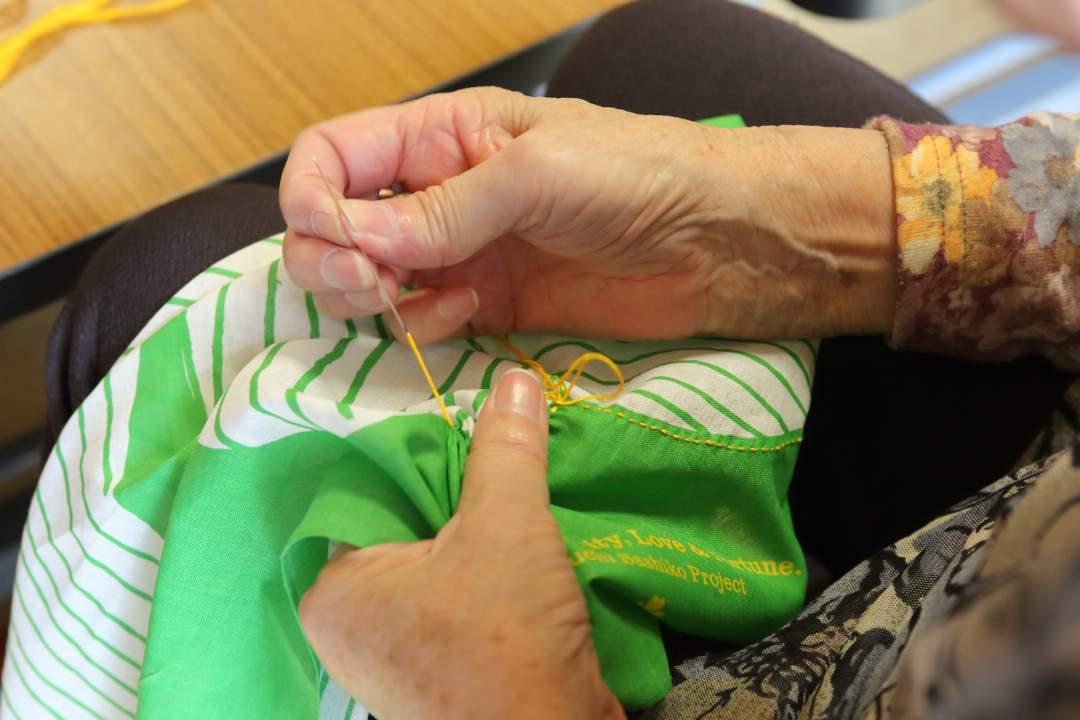
Sashiko is a needlework to reinforce, to repair, to mend, and to decorate the fabric. 

Whenever I hear something good on Public Radio International’s the World, I hope they will post a text version online so I have something to edit, but today’s story is accessible only as audio. So I am combining it with a May 2018 blog post that “atsushijp” wrote at Upcycle Stitches: “Otsuchi Recovery Sashiko Project.” (Atsushijp did us all a favor by sharing this work with a different audience, and I have not tried to tweak her English.)

“It has been almost 7 years since I had encountered this beautiful project: Otsuchi Recovery Sashiko  Project. … After the earthquake followed by Tsunami on March 11th, 2011, the five volunteers established the project to support the people in Otsuchi, especially those who had nothing to do but sitting in the evacuation shelter. The men had a lot of things to require the muscle power after the disaster. The young generation also had many tasks to revive the infrastructure such as distributing the support goods and clean. However, those who wouldn’t be able to move, mostly elderly women, did not have things to do and had to wait. …

“The project tries to create jobs for those who couldn’t do hard labor outside. They have been trying to create the community where anyone can gather for the purpose of stitching. We all then hope that the stitching can be a part of the purposes of their new life after the earthquake. I, Atsushi, first join the project in June 2011. …

“I had written many articles and reports regarding the Otsuchi Sashiko in English, but I had to give them up when my father passed away and the stakeholders decided to shut down the website. Well, even after the sad reality of me leaving Sashiko behind for while, my mother, Keiko Futatsuya, kept in touch with them. Now, she is the advisor of Sashiko technique and designing in Otsuchi Recovery Sashiko Project. …

“Otsuchi town was badly damaged by the earthquake followed by Tsunami, including the loss of town hall and the mayor and more than 1,280 of people’s life. The survivors [who] needed an evacuation shelter by losing their house were more than 9,000 people.

“In the evacuation shelter, mothers and grandmothers, who were very much hard worker in their own house as a house-maker, didn’t have anything to do. There were no kitchen to cook, no living room to clean, no dishes to wash. Men and young generation could work for the cleaning debris, but the job required a lot of muscle power. Mothers and Grandmothers couldn’t help them even if they wanted to. …

“The answers they had come up with was Sashiko, in which requires only a needle, thread, and piece of fabric. The Sashiko was doable in a limited space of the evacuation shelter. The mothers and grandmothers wanted to do ‘something’ instead of just waiting.

“An elder woman who lied down all the day in the evacuation shelter. A hard-working mother who lost her house-making job. A young woman who lost their job opportunity. Everyone in Otsuchi moved the needle with hoping the recovery of Otsuchi. Otsuchi Recovery Sashiko project is their first step to the recovery by women in Otsuchi since June 2011. The Earthquake destroyed the houses and jobs and took away our previous people. We, as Otsuchi Recovery Sashiko Project, would like to re-establish the town of Otsuchi throughout Sashiko by strengthening, mending, and making it more beautiful. …

“When a mother, who enjoy Sashiko, is happy, the household will be filled with smiles. If the household is filled with smiles, the town of Otsuchi will be energetic. When the town of Otsuchi become energetic, everyone in the town and related to the town will be happy. …

“We strongly respect the value of hand-made craft culture with spending so much time and putting the good-heart in it in the era of ‘speed’ and ‘efficiency (productivity)’ with mass-production and mass-information. ‘Hand-Made Craft’ provide us ‘Care’ and ‘Mindfulness (Mental Wellness)’ by thinking of other, and using our own hands.”

More at Upcycle Stitches, here. The audio story at the World, here, covers aspects of the initiative in which men have helped, too.

Read Full Post »

Photo: Margaret Jankowski.
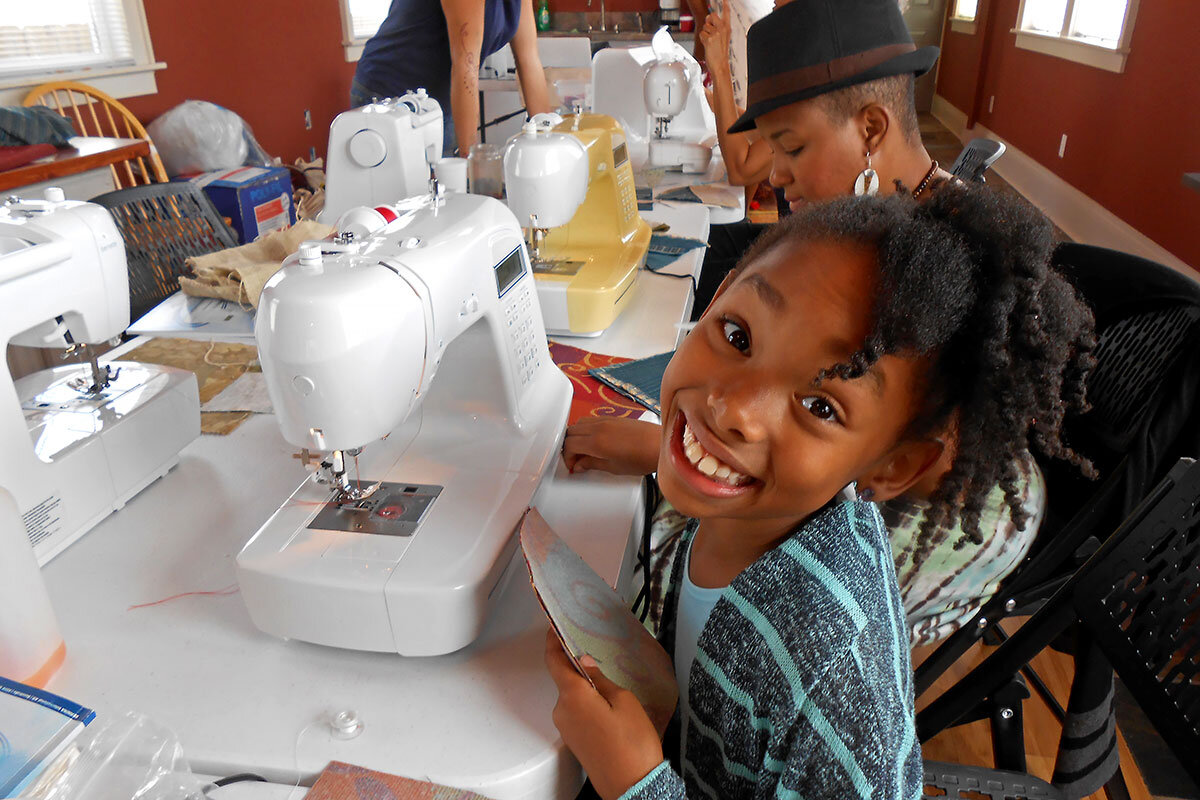
Students in a 2013 sewing class test their new skills on a suite of machines donated by the nonprofit Sewing Machine Project to a community center in New Orleans. 

There have always been a few followers of this blog who quilt, weave, knit, crochet, or sew, and I’m hoping they will like today’s focus on a nonprofit that harnesses the multifaceted power of sewing. Richard Mertens reported about it at the Christian Science Monitor.

“A tsunami helped Margaret Jankowski understand the real value of a sewing machine. Like many girls of her generation, she had learned to sew at an early age. Her mother taught her on an old Singer Featherweight, and she learned the basics by hemming her father’s handkerchiefs. As an adult, she bought her own clothes off the rack but sewed for her first child. … She taught classes at a sewing shop, ‘preaching the gospel of sewing,’ she says. …

“Then, in December 2004, a tsunami hit Sri Lanka and other coasts around the Indian Ocean, leveling communities, hurling wooden fishing boats far inland, and killing 230,000 people. … What touched Ms. Jankowski most deeply was the story of a woman returning to her ruined village. The woman had worked for years to save enough to buy a sewing machine, enabling her to work as a tailor and giving her a future. Now it was gone. …

“She resolved to send sewing machines to Sri Lanka. ‘I thought maybe I could collect a few of these machines that people are getting rid of anyway,’ she says. She explained her idea on a local news program and was inundated with machines. She raised money for voltage converters and shipping, and in 2005, with the help of the American Hindu Association, sent five boxes each to five orphanages in India and Sri Lanka, each packed with toys, medical supplies, fabric, and the most precious cargo – a sewing machine.

“ ‘They were used to sew for kids,’ she says. ‘They were also used to teach kids a trade, which I felt was really important.’

“It didn’t end there. Ms. Jankowski went on to start the Sewing Machine Project, a small organization that redistributes used machines. It’s a mission that springs from a love for an old craft and a belief in its practical and redemptive possibilities today. …

“In 16 years the project has shipped 3,350 machines around the world – and across town. It’s sent them to coffee pickers in Guatemala, women who help vulnerable girls in Guam, and war widows in Kosovo. It’s sent them to programs that help refugee women in Detroit, incarcerated women in Mississippi, and sewers of Mardi Gras outfits. … In these and other places, unwanted machines find new uses. In many places sewing can be a livelihood, whether in a factory job or at home.

For those trapped in poverty, Ms. Jankowski says, sewing ‘is a way out.’

“Sewing is also a way forward for immigrant and refugee women in Detroit, says Gigi Salka. Ms. Salka is the director of the B.O.O.S.T. training program at Zaman International, a nonprofit that serves poor and marginalized women and children, including immigrants and refugees, in the Detroit area. … Zaman began offering a two-year sewing instruction program. Graduates earn money doing alterations and creating made-to-order clothing, often from their homes. …

“The pandemic disrupted the classes but also created new opportunities for the women. ‘We gave them fabric. They took machines home. They made masks,’ Ms. Salka says. ‘In a population where five dollars makes a big difference, any supplemental income, any extra dollar is a dollar they can have. … Sewing is very empowering. You see it in a population that’s lost hope; the ability to create a product is very powerful to them. They’re so proud.’ …

“This idea is being tested in Rankin County, Mississippi, where a local woman, Renee Smith, persuaded prison officials to allow her to start a sewing program for women in the Central Mississippi Correctional Facility. Her aim was to get help producing reusable menstrual pads for girls in countries like Uganda and Haiti where girls frequently stay home from school while menstruating, or quit school altogether because they lack access to sanitary supplies. … The inmates were glad to have something to do, she says, but sewing for distant schoolgirls also gave them a sense of purpose. …

“Some of the biggest beneficiaries of the Sewing Machine Project have been the Mardi Gras Indians of New Orleans, an African American community known for the elaborate feathered and beaded suits they wear for Mardi Gras. That effort, too, started with a disaster. In 2005, Hurricane Katrina struck the city, hitting African American neighborhoods especially hard. Cherice Harrison-Nelson, also known as Queen Reesie and an early collaborator with the Sewing Machine Project, says that making Mardi Gras suits is an important cottage industry in the city, but that many people lost their machines in the hurricane.”

Read more at the Monitor, here.

Read Full Post »

At work we have partnered with an urban high school for 35 years. Tomorrow a group of 15-year-olds from the school will come into the office for Job Shadow Day.

The students fill out a form in advance to let their assigned mentor know something about them — favorite subject, least favorite, hobbies, career ambitions.

My student has an unusual ambition for a 15-year-old. She wants to be a philanthropist.

Perhaps I will tell her what I read recently about how many of today’s top philanthropists are active in their causes. They don’t just give money.

“The global face of philanthropy is changing,” writes the Christian Science Monitor. “Donors no longer just open their wallets. They’re actively involved in causes, use savvy business practices, and leverage what they give to achieve more good.”

One such philanthropist is F.K. Day. Read how his work has benefited people in Zambia and beyond.

“Life in rural Zambia has improved dramatically for dairy farmer Cecil Hankambe. He has doubled his milk sales, purchased a farm, and earned enough money to send his children to school. He still milks the same cow and travels the same rugged roads to the local dairy co-op. The only difference now: Instead of lugging a heavy jug on foot, he pedals a bicycle.

“Mr. Hankambe rides a Buffalo, a bike so sturdy and basic that its steel frame can carry up to 220 pounds and be repaired with a rock. Instead of delivering only seven to 10 liters of milk a day, Hankambe can now transport 15 to 20 liters to a chilling station before it spoils, boosting his profit.

” ‘A reliable bike can create reliability in a dairy farmer’s income,’ says F.K. Day, founder of World Bicycle Relief, a foundation based in Chicago that produces the Buffalo and provides two-wheeled aid to people in developing nations. ‘You forget how important transportation is.’ ”

Day started young, as young as the girl who will visit me at work tomorrow.

“As a teenager, he flew – on his own initiative – from Chicago to Brazil to knock on the door of Irish priests who were building schools in São Paulo‘s poorest neighborhoods. They hadn’t responded to his letters. But when he showed up on their doorstep, they had no choice but to put him to work.

“That experience laid the groundwork for what followed three decades later. On Dec. 26, 2004, horrific images of tsunami-swept Southeast Asia flickered on TV screens in the United States. Day, now a successful cofounder of SRAM, an elite bicycle-parts manufacturer, wanted to do more than just fund relief efforts. …

“So he and his wife, Leah, boarded a plane to Sri Lanka. Within weeks, Day had partnered with World Vision; he eventually oversaw the distribution of 24,000 bicycles that gave thousands of people affected by the tsunami the ability to reach their jobs, schools, and health-care centers.” His bikes are now in many countries were transportation needs are great.

” ‘If you can enter something new, open and honestly with beginner’s eyes, something good is bound to happen,’ says Day.”

How does one come by that core impulse to help? Probably it shows itself at a very young age. Even at 15.

Read about seven additional innovative philanthropists in the Monitor.

Photograph: Leah Missbach Day
F.K. Day, President of World Bicycle Relief & Executive Vice President of SRAM Corporation, pictured in downtown Chicago.

other innovative philanthropists

Read Full Post »

I went to the concert of an oboe-playing friend Sunday. The 3 p.m. event coincided with the anniversary of the earthquake and tsunami that took place a year ago in Japan. My friend, of Japanese heritage, was moved by the music he was playing, and so was I. The modern pieces really sounded like an earthquake to me. I had visions of Poseidon, the Bull from the Sea, rising up in anger against humankind, and later of hope dawning.

The Charles River Wind Ensemble, where my friend plays, has a new conductor. I liked Matthew Marsit’s energetic style and his explanations of the pieces. Marsit, a clarinetist himself, is also a conductor at Dartmouth College, where he practices his belief in music outreach to lower-income communities.

“An advocate for the use of music as a vehicle for service, Matthew has led ensembles on service missions in Costa Rica and Philadelphia, Pennsylvania, collecting instruments for donation to schools, performing charity benefit concerts and offering workshops to benefit arts programs in struggling schools.  His current work at Dartmouth allows for outreach projects in the rural schools of New Hampshire and Vermont, working to stimulate interest in school performing arts programs.” Read more.

I think musicians can be very giving people. Indian Hill Music in Littleton, Massachusetts, offers scholarships and more. Someone I know on the board tells me that Indian Hill has “a program to bring music instruction to schools in the region that have cut out music due to budgetary constraints. They also offer free concerts, a Threshold choir (music for dying patients), and a number of other outreach efforts.”

In Providence, Rhode Island, Community MusicWorks demonstrates how music builds community and teaches social responsibility. You can read about this and other innovations in Rhode Island’s creative economy here.

Read Full Post »