Feeds:
Posts
Comments

Posts Tagged ‘tutor’

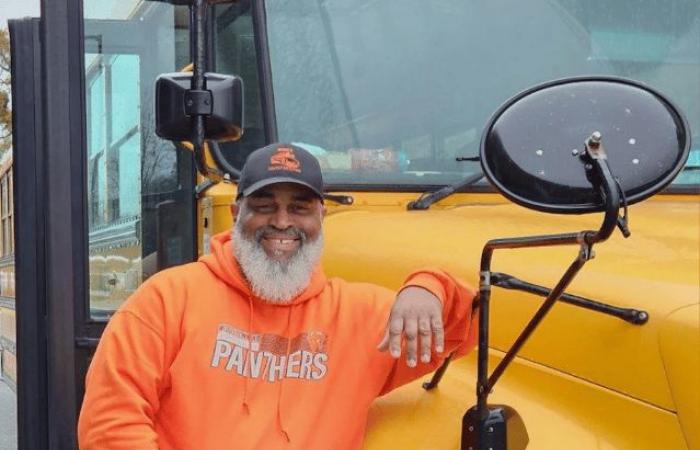
Photo: Alex Bakley via Washington Post and Italy 24.
Herman Cruse is a school bus driver who is a regular volunteer in classes at Middle Township Elementary No. 1 in Cape May Court House, N.J.

I like that every week the Washington Post sends subscribers a collection of upbeat stories it calls “The Optimist.” It’s good to be reminded that there are people doing kind and generous things every day. We just don’t hear about them often.

Today’s story, by Cathy Free. is about a school bus driver who was concerned when a child on his bus was discouraged about reading. It’s about how his decision to help out led to a whole new avocation.

“New Jersey school bus driver Herman Cruse noticed that a kindergartner seemed a little sad and out of sorts during one morning ride to Middle Township Elementary #1.

“ ‘Bus drivers are the eyes and ears of students when they’re away from home,’ said Cruse, 55, who drives students of all ages for Middle Township Public Schools in Cape May Court House, N.J.

“ ‘We have an uncanny gift to discern what kids are feeling,’ he said.

“When Cruse asked the kindergartner what was wrong, he said the boy explained that he wasn’t able to complete his reading assignment because his parents were busy with his four siblings at home. It was hard to find one-on-one time to practice reading with his mom or dad, he told Cruse.

“Cruse said an idea popped into his mind.

‘I told him, “Listen, I have some free time, and if you don’t mind, I’d like to come to the school and read with you,” ‘ he said.

“Cruse received permission from the 6-year-old’s teacher, Alex Bakley, to show up at her kindergarten classroom the following week. When he walked in, he said the boy shouted, ‘Hey, that’s my bus driver!’

“ ‘We went into a quiet corner and began reading together,’ Cruse said. … ‘So he read to me, I read to him and we read together, and from there, it took on a life of its own. … A second student wanted to read to me, then a third. All these kids were going to the teacher asking, “Can I read with Mr. Herman?” ‘

“Almost two years later, Cruse now volunteers to help Bakley’s 18 kindergarten students and another kindergarten class with reading two days a week, and on a third day, he tutors the school’s first- and second-graders. After dropping the kids off at school, of course. …

“Middle Township Elementary Principal Christian Paskalides said every child at the school looks up to Cruse, both on and off the school bus. … ‘Positive adult interactions can sometimes dictate a child’s day, and a bus driver is the first and last adult interaction for most students other than family,’ Paskalides added. ‘This is more than just a job to Herman — he’s a great role model and mentor.’

“Cruse said he’s never wanted to be anything other than a bus driver. … Because he lives in Egg Harbor City, N.J., about 40 miles away, it didn’t make sense for him to drive home after delivering students to high school, middle school and elementary school, he said. … ‘Instead, I’d hang out at the gym, go the library or sit in my car and go to sleep to fill up the time,’ Cruse said.

“It wasn’t until he offered to help the kindergartner on his bus last year that he realized there was something more rewarding he could be doing, he said. Cruse had spent a lot of time reading to his own five children when they were growing up.

“ ‘They’d say, “Dad, how come you read so much?” and I’d say, “Come on over and find out,” ‘ he said. ‘I’d tell them, “The book is always better than the movie.” There’s nothing better than time spent with a good book.’ …

“When Bakley showed him the round table where children would read to him in her classroom, he pulled up a small chair and made himself at home, he said. … He spends about 20 minutes reading books with each child on a rotating basis, and he also challenges them to word games like alphabet bingo.

“LaCotia Ruiz said her son Kingsly, 5, is more excited about books since he started reading with Cruse.

“ ‘Kingsly had a rough time with reading at the beginning of the school year, but he’s doing much better because of this fun one-on-one time,’ Ruiz said. ‘In the morning he wakes up excited and says, “I’m going to read with Mr. Herman!” ‘ she said. …

“ ‘There’s now another bus driver who wants to help me out between his routes,’ [Cruse] said. “What started out as a way to kill time has now blossomed into a way to make a difference in the heart of a child.’ ”

Props to him and props to that first kindergartner, too. I’m going out on a limb here and opine that the little boy sensed he could reveal his problem to this adult and maybe have something good happen. More at the Post, here.
Read Full Post »

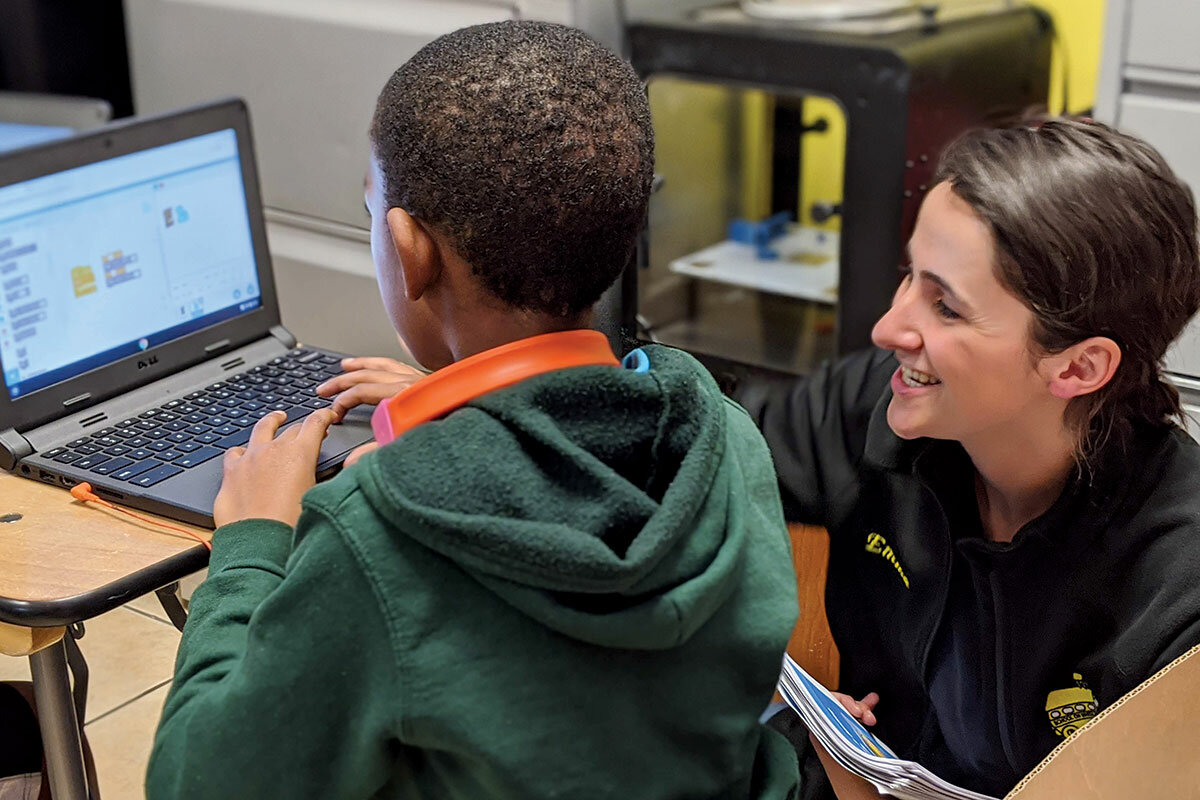
Photo: School on Wheels.
A student at School on Wheels’ Skid Row Learning Center works with staff member Emma Gersh.

All children need an education, but those experiencing homelessness get a spotty one at best. That’s a situation the nonprofit School on Wheels is aiming to rectify.

Magda Hernandez wrote about it at the Christian Science Monitor. “The little girl was 6 years old, and life hadn’t been kind to her. 

“When Catherine Meek walked into a homeless shelter for their tutoring session, she found the child hiding under a desk. 

“No questions asked, the volunteer joined her on the floor and began reading to her. For an hour a week, the session would allow the girl to be just a kid, getting the assistance she needed, and for at least a moment forgetting about the circumstances that put the girl educationally behind by about a grade. 

“The space remained their meeting spot for six sessions until, one day, Ms. Meek walked in to find the girl sitting at the desk waiting for her. 

“ ‘I had, I remember, the biggest smile on my face, and she did too,’ Ms. Meek says. ‘I think even at that young, vulnerable age she understood that something had changed, that there was a set level of trust, that she could trust me.’

“Ms. Meek lights up recalling that moment – one of her greatest success stories as a volunteer tutor for School on Wheels, a nonprofit addressing educational needs of children K-12 who are experiencing homelessness. She and the girl worked together for about two years until the child moved out of state and they lost touch. 

“Recently, Ms. Meek – now executive adviser to the organization – attended that no-longer-little-girl’s wedding after they reconnected through social media. 

“A brainchild of the late Agnes Stevens, a retired schoolteacher, School on Wheels began in 1993 when she started tutoring kids living in shelters on Skid Row, an area of Los Angeles known for its large homeless population. In the next few years, she formalized her efforts, recruited more volunteers, and grew the organization with the help of Ms. Meek, who joined in 1999. 

“ ‘She was the inspiration and teacher and had the education background, and I had the business and financial background,’ says Ms. Meek.

‘The need was there in 1993, and it’s just grown astronomically since then. One in 30 kids in California in a classroom is homeless.’

“The organization grew steadily, partnering with shelters, school districts, motels, libraries, anywhere homeless families could be – even reaching those living in cars, in foster homes, and on the streets. With year-round operations in six counties, prior to the pandemic, the organization reached more than 3,000 homeless children a year, and it recruited and trained more than 2,000 tutors annually. …

“ ‘Students experiencing homelessness move on average about three to four times a year, and with each move, it’s estimated that they fall behind four months academically,’ says Charles Evans, the organization’s executive director. …

“School on Wheels doesn’t get into the students’ backgrounds but focuses solely on assessing the kids’ educational needs – like a fourth grader who is two grades behind in reading or a 10th grader who’s struggling with pre-algebra and biology – and matching them with tutors. …

“Says Mr. Evans. ‘We don’t pry and try to figure out why a family became homeless.’

“The children are assessed every few weeks to make sure they’re improving. Ms. Meek says that in 2021, K-4 students improved their literacy skills by 21%; in the past six months, fifth through eighth grade students increased math skills by almost one grade level, and self-efficacy surveys showed a 40% increase in confidence in ninth through 12th graders. 

” ‘Before the pandemic, tutors would meet students wherever they were – motels, shelters, libraries. But tutoring sessions have been remote – via donated Chromebooks and laptops – in the past couple of years. The drastic change had benefits and drawbacks. On one hand, students could stay in touch with tutors even on the move. On the other, School on Wheels had to pivot from handing out backpacks and school supplies to figuring out how to get digital equipment into kids’ hands and making sure they had Wi-Fi access. … Now, the organization is returning to in-person sessions, particularly for younger kids. But it will keep the hybrid model. …

“Outside of tutoring, School on Wheels is out to erase the stigma of homelessness. Many of the families the organization works with found themselves homeless through no negligence of their own – victims of domestic violence or economic hardship, doing their best to get back on their feet.

“For example, one single mother in her 20s, who for security reasons asked not to be named, left an abusive relationship, and ended up in a shelter with her four young kids. When she noticed her children falling behind in school, she connected with School on Wheels.

“ ‘It’s been the best thing ever, because my kids love their tutors,’ says the young woman, who works and goes to school. She now gets reports from school that her kids are doing much better: ‘The teacher did see a lot of improvement in [my daughter’s] math and her spelling.’ That motivates her to do better herself, says the mother.”

Read at the Monitor, here, about Angela Sanchez and how she got math help from a rocket scientist. No firewall.

Read Full Post »

People where I work have been volunteering in an inner-city school for years. It started with reading picture books to first graders and expanded to second grade reading, fourth grade math, and fifth grade “Book Club,” the one I do. I once taught fifth grade, and I would still read the books written for that age even if I weren’t volunteering in the school.

This past week, the NY Times had an interesting article on using technology to enable tutors to work with elementary school kids remotely.

“Edward’s tutor was not in the classroom. His school, a 20-minute walk from the nearest subway stop in a crime-plagued neighborhood, has long had trouble finding tutors willing to visit. ‘It is hard to get anyone to volunteer,’ said the school’s principal, Luis Torres, who sometimes cancels fire drills because of the gunfire he hears outside.

“Now, newly designed software for the tutoring of beginning readers has bridged the gap, allowing volunteers to meet students online from a distance. P.S. 55 is testing the program with students in its four first-grade classes.

“Edward’s tutor, Jenny Chan, was an hour away in Midtown, on a bustling trading floor at JPMorgan Chase, where she provides technology support. She was talking to Edward by phone and seeing the story he was reading with screen-sharing software on her desktop computer.

“JPMorgan Chase is sponsoring the remote tutoring program and encouraging its employees to get involved from their desks during the school day.” Read more.

There’s nothing like face-to-face contact, but if people can’t take work time for the commute, perhaps more people will tutor.

Photo: Librado Romero, NY Times

Read Full Post »