Feeds:
Posts
Comments

Posts Tagged ‘typewriter’

Photo: Elisabeth von Boch/Stanford.
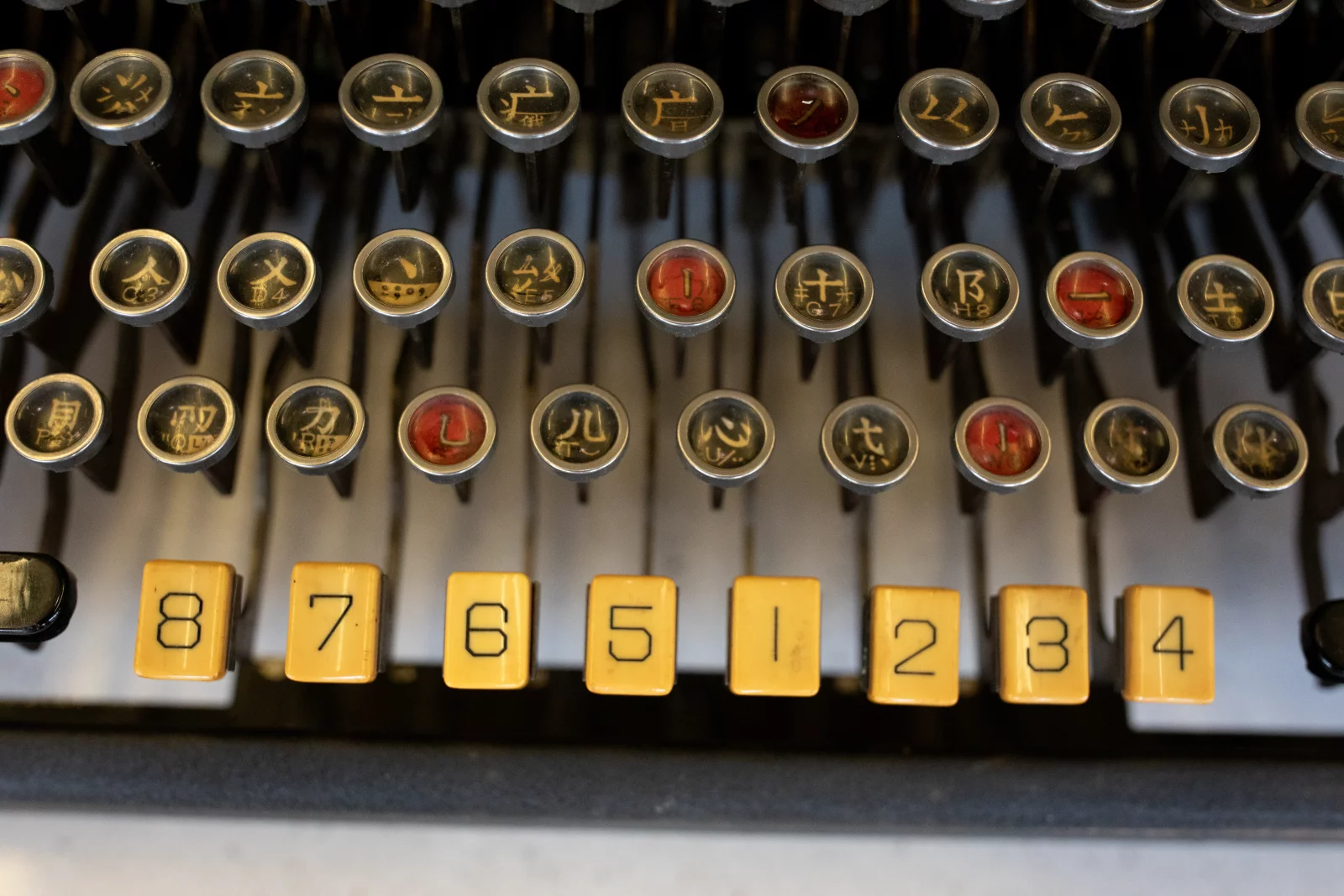
The MingKwai typewriter, crucial to the development of modern Chinese computing, has resurfaced. Its keys enable the typist to find and retrieve Chinese characters.

I love stories about finding long-lost treasures. The story of this old typewriter, the only one of its kind ever made, fits that category.

Emily Feng writes at National Public Radio (NPR), “Scholars in the U.S., Taiwan and China are buzzing about the discovery of an old typewriter, because the long-lost machine is part of the origin story of modern Chinese computing — and central to ongoing questions about the politics of language.

“China’s entry into modern computing was critical in allowing the country to become the technological powerhouse it is today. But before this, some of the brightest Chinese minds of the 20th century had to figure out a way to harness the complex pictographs that make up written Chinese into a typewriter, and later, a computer.

“One man succeeded more than any other before him. His name was Lin Yutang, a noted linguist and writer from southern China. He made just one prototype of his Chinese typewriter, which he dubbed the MingKwai. …

“Detailed U.S. patent records and diagrams of the typewriter from the 1940s are public, but the physical prototype went missing. Scholars assumed it was lost to history.

” ‘I had really, truly thought it was gone,’ says Thomas Mullaney, a history professor at Stanford University who has studied Chinese computing for two decades and is the author of The Chinese Typewriter.

Mullaney was at a conference last year when he got a message that someone in upstate New York had found a strange machine in their basement and posted a picture of it on Facebook.

” ‘It was a sleepless night.’ …

“Eventually, the owner reached out to him. They had acquired the typewriter from a relative who had worked at Mergenthaler Linotype, once of the most prominent U.S. makers of typesetting machines. The company helped craft the only known prototype of the MingKwai typewriter. …

” ‘It’s like a family member showing up at your doorstep and you had just assumed you would never see them,’ Mullaney says.

“The story of why such a typewriter even exists runs parallel to the political upheaval and conflict over Chinese identity and politics in the 20th century.

“Lin, its inventor, was born in 1895 in southern China during the tail end of a failing Qing dynasty. Student activists and radical thinkers were desperate to reform and strengthen China. Some proposed dismantling traditional Chinese culture in favor of Western science and technology, even eliminating Chinese characters altogether in favor of a Roman alphabet.

” ‘Lin Yutang charted a path right down the middle,’ says Chia-Fang Tsai, the director of the Lin Yutang House, a foundation set up in Taiwan to commemorate the linguist’s work. …

“Typing Chinese was a monumental challenge. Chinese has no alphabet. Instead, it uses tens of thousands of pictographs. When Lin started his work in the early 20th century, there was no standardized version of Mandarin Chinese. Instead, people spoke hundreds of dialects and languages, meaning there was no singular phonetic spelling of the sound of each word.

“Lin had financial backing from the American writer Pearl S. Buck to create the typewriter, but he also sunk much of his own savings into the project as costs ballooned.

” ‘He’d spent a lot of money. A lot,’ says Jill Lai Miller, Lin’s granddaughter. …

“The typewriter’s ingenuity comes from the way Lin decided to break down Chinese pictographs: by their shapes, not sounds. The typist can search for certain combinations of shapes by pressing down on the ergonomic keyboard. Then, a small screen above the keyboard (Lin called it his ‘magic eye’) offers the typist up to eight possible characters that might match. In this way, the typewriter boasts the ability to retrieve up to 90,000 characters. …

“Encoded in the machine’s engineering was an ambitious globalism. Lin’s way of breaking down languages by the shape of their words rather than their sounds or alphabets meant his machine theoretically can type English, Russian and Japanese as well, according to the typewriter’s manual.

” ‘One thing that was very interesting … in Li Yutang’s thinking about Chinese-ness and Chinese culture is that it must not be insular. It must have this porous border, it must be capacious and be able to communicate and talk with other cultures,’ says Yangyang Cheng, who first wrote about the typewriter’s discovery. …

“Mullaney is now researching the typewriter full-time, trying to understand how its mechanical innards work, with the far-off dream of one day replicating it. He recently found the typewriter’s ink spool was still fully intact inside.

” ‘You would need the sort of technology that they used on, like, discoveries of the Dead Sea Scroll and stuff like that, but you’ll notice that the ink spool is still there,’ he points out, using a dental mirror to peer inside the machine.

“The ink spool could contain traces of the last words Lin or his daughter typed on the machine — meaning perhaps the inventor’s own words are in his magical machine too.”

More at NPR, here. The New York Times also has a story on the typewriter. Read it here.
Read Full Post »

Photo: Anthony Casillo
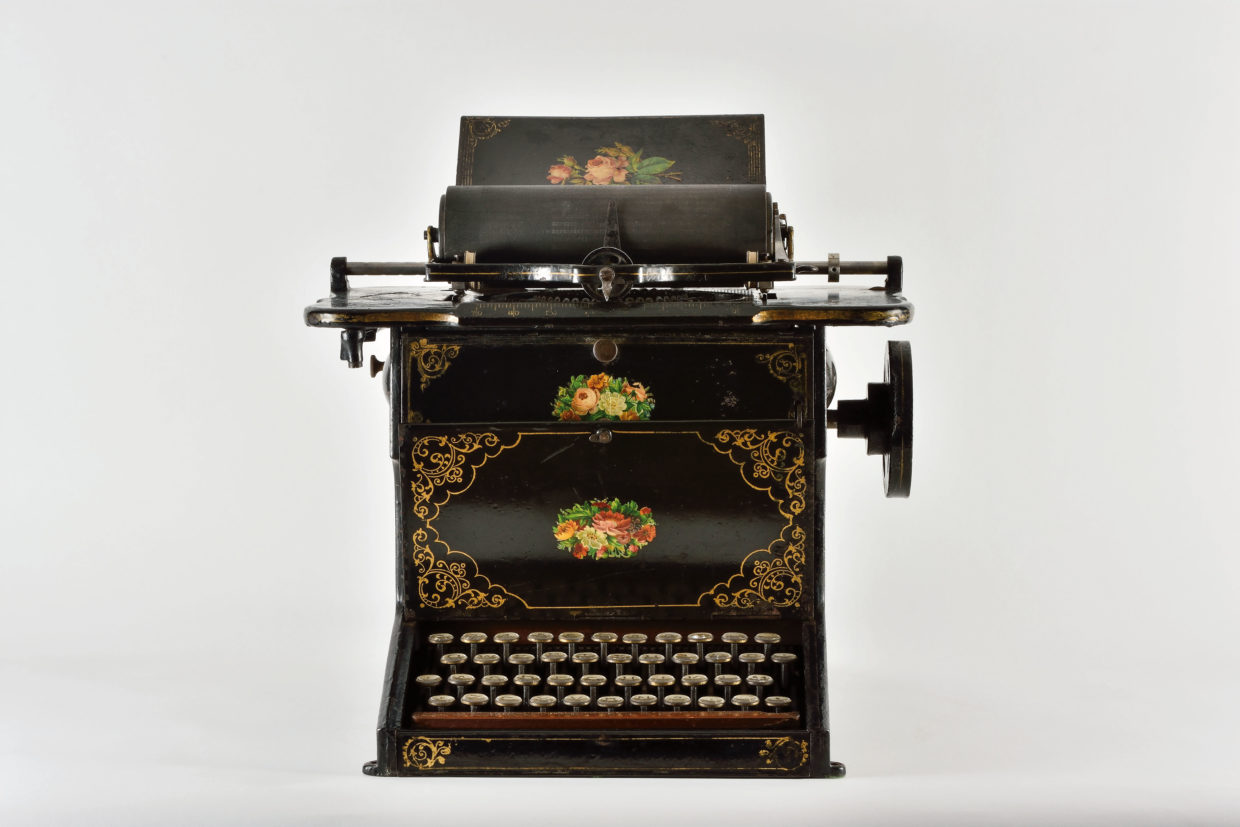
The Sholes & Glidden Type Writer, 1874.

Personally, I never liked using a typewriter. Part of the problem was I didn’t learn to touch-type until I was over 50. But I also find typewriters are too limited. Word processors let you search for a word, fix mistakes fast, cut and paste — they also let you see if you accidentally hit the space bar an extra time. (Well, some features are more important than others.) I don’t love spellcheck because it uses a different dictionary from my favorite, and I hate the distracting grammar check. I turn it off.

We all value different things. Some people, for example, still value typewriters.

Anthony Casillo writes at LitHub, “In the late 1970s, I stumbled upon an old, long abandoned, Oliver typewriter stored away in the back room of a typewriter repair shop where I worked in New York City.

“The Oliver was unlike anything I had ever seen. … It was old and deserving of greater appreciation than it was receiving there. It begged me to rescue it from that dark room — and potentially the trash heap. So, I packed up the 30-pound orphan and carried it home on the subway during my standing-room-only rush-hour commute.

“Once home, I began to explore this beauty a little further. The Oliver opened a door to a new world for me, one that ignited my curiosity about the early history of the typewriter. …

“Shortly after the Oliver discovery, I was leafing through the classified section of a monthly typewriter trade magazine when another vintage machine caught my eye: a Blickensderfer typewriter from the 1890s was being offered for sale. The Blickensderfer was a small manual typewriter that used a type element similar to the modern IBM Selectric typewriters that were popular in the 1970s. …

“I took a road trip across two states to purchase and pick up my prize. After all, I thought to myself, when would I ever see another one? On my return trip, a voice inside kept telling me that not only had I just acquired something special, but also, on that day, I had become a collector. …

“Some remained faithful to their typewriters during a period of technological change that began in the 1980s with the introduction of the personal computer. They were the holdouts who refused to part with their trusted friend as technology marched forward, always keeping a place on their desks for tasks that a typewriter could perform more efficiently than their computer. For these people, the filling in of forms, addressing of envelopes, and other small tasks always seemed to get done more quickly on a typewriter, giving the machines an extended life as a secondary writing instrument in many offices.

“And then there are the collectors who see beauty in old, twisted, and often rusted metal. It is not uncommon for a dedicated collector to travel great distances to procure an ancient typewriter for his or her collection. …

“Many of us have a typewriter story to tell — whether we used the machines for papers in high school and college, or watched our grandparents type out letters on their cherished machines — stories that evoke fond memories of a much simpler time.” Hmm. My memory is of paying Harriet to type my college papers. That’s how hopeless I was then.

Read more at LitHub, here. And at National Public Radio, here, you can read about actor Tom Hanks and how his love of typewriters led him to write a book about them.

Read Full Post »

Ian Burrell has a funny story at the Independent about the Times of London deciding to create the old-tyme newsroom ambiance by piping in the sound of typewriters clacking. Goodness knows if the young people can concentrate, but it must make the guys with the green shades feel they’re in the right place.

“Almost as if the digital revolution never happened,” writes Burrell, “the newsroom of The Times once again resounds to the clatter of the old-fashioned typewriter.

“Nearly three decades after Rupert Murdoch’s UK newspaper publisher revolutionised the industry by moving to Wapping and ending the ‘hot metal’ era, his flagship title has reintroduced the distinctive sound of old Fleet Street.

“To the surprise of Times journalists, a tall speaker on a stand has been erected in the newsroom to pump out typewriter sounds, to increase energy levels and help reporters to hit deadlines. The audio begins with the gentle patter of a single typewriter and slowly builds to a crescendo, with the keys of ranks of machines hammering down as the paper’s print edition is due to go to press.

“The development, which was described as a ‘trial’ [in August] by publisher News UK, has caused some bemusement among journalists, one of whom tried unsuccessfully to turn the sound off. …

“The Times’s initiative coincides with a revival of interest in the typewriter, a trend which the newspaper reflected on Page 3 today, with a report on how the actor Tom Hanks has developed the Hanx Writer app, which simulates the sound of an old-fashioned typewriter and has gone to the top of the iTunes app store in the US. Hanks, it noted, can tell the difference between the sounds of an Olivetti, a Remington and a Royal typewriter model. …

“Michael Williams, who began his newspaper career at The Times’s old offices in London’s Gray’s Inn Road in 1973, and is now a senior lecturer in journalism at the University of Central Lancashire, saw merit in the idea.

“ ‘People feel to some extent disengaged from the thrill of producing a newspaper, which is galvanising,’ he said, referring to the relative quiet of modern newsrooms.”

More here.

Photo found at Gizmodo 

Read Full Post »