Feeds:
Posts
Comments

Posts Tagged ‘uzbek’

Photo: Michael Frachetti.
Using a drone equipped with LiDAR (light detection and ranging equipment), archaeologists have mapped two abandoned cities in the mountains of Uzbekistan. The location of the larger city, known as Tugunbulak, is pictured above

Over the years, I’ve read quite a few novels from other lands and cultures, including one unsettling story about nomads in Africa and another called The Railway, by Uzbek writer Hamid Ismailov. Possibly something died in translation, because I remember little of either book. Wikipedia reminds me that The Railway is about a small town on the Silk Road as seen through the eyes of its inhabitants.

Although the books did not come across as great literature, the cultures continue to draw one who hears so little about them from the American media unless it’s radio show The World. The Monitor and Reuters also seek out such stories.

Will Dunham of Reuters reports, “In the mountains of Uzbekistan, archaeologists aided by laser-based remote-sensing technology have identified two lost cities that thrived along the fabled Silk Road trade route from the 6th to 11th centuries AD — the bigger one a center for the metal industry and the other reflecting early Islamic influence.

“The fortified highland cities, located three miles apart at around 6,560-7,220 feet above sea level, are among the largest known from the mountainous sections of the Silk Road, the sprawling web of overland trade routes linking Europe and the Middle East to East Asia.

” ‘These cities were completely unknown. We are now working through historical sources to find possible undiscovered places that match our findings,’ said archaeologist Michael Frachetti of Washington University in Saint Louis, lead author of the study published in the journal Nature.

“The bigger of the two, called Tugunbulak, covered about 300 acres, with a population perhaps in the tens of thousands, the researchers said. It was one of the largest cities of its time in its region of Central Asia, rivaling even the famed trade hub Samarkand situated about 70 miles away. It existed from around 550 to 1000 AD. …

“The other city, Tashbulak, was only a tenth the size of its neighbor, with a population perhaps in the thousands, the researchers said, lasting from around 730-750 to 1030-1050 AD.

“Founded in early medieval times in what is now southeastern Uzbekistan, the cities were eventually abandoned and forgotten until archaeologists came across the first evidence of them while scouring a rugged mountain area, with deep ravines, steep ridge lines and forests. They deployed drone-based lidar remote scanning to map the scale and layout of the sites. …

“It revealed evidence of numerous structures, plazas, fortifications, roads, habitations and other urban features.

“Preliminary excavation at one of Tugunbulak’s fortified buildings — girded by thick earthen walls — yielded the remains of kilns and furnaces, indicating it was a factory where metalsmiths may have turned rich local deposits of iron ore into steel.

“The researchers are working to confirm steel was made there by chemically analyzing slag — a byproduct of iron and steel production — found at the site. The region in the 9th and 10th centuries was known for steel production. …

” ‘Tugunbulak in particular complicates much of the historical understanding of the early medieval political economy of the Silk Routes, placing both political power and industrial production far outside the regional “breadbaskets” such as Samarkand,’ Frachetti said.

“Tashbulak lacked the industrial scale of Tugunbulak but boasted an interesting cultural feature — a large cemetery that reflects the early spread of Islam in the region. Its 400 graves — for men, women and children — include some of the oldest Muslim burials documented in the region.

” ‘The cemetery is mismatched to the small size of the town. There’s definitely something ideologically oriented around Tashbulak that has people being buried there,’ Frachetti said.

“Islam arose on the Arabian Peninsula in the 7th century and rapidly spread in the successive centuries. The Silk Road enabled economic, cultural, religious and political exchanges between East and West, as the caravans that traversed its pathways toted not only a panoply of products but also people and ideas. It linked cosmopolitan Chinese cities such as Xi’an to destinations including the Byzantine capital Constantinople and the sophisticated Islamic metropolis Baghdad. More at Reuters, here.

I must say, this research sounds like fun to me. You discover a city no one knows anything about except its location on the Silk Road, and then you go back and read all the ancient documents you can on the Silk Road — the history, the legends — and look for a likely match.
Read Full Post »

img_4528-800x600-1

Photo: Filip Noubel
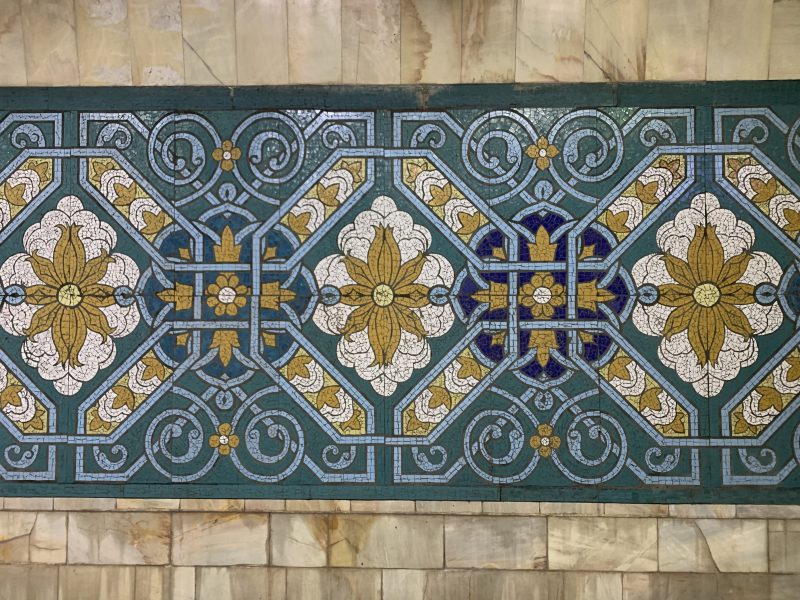
Tiles representing Uzbekistan’s huge cotton industry at the Paxtakor metro station. The  ornamentation of various subway stops portrays the accepted history of the moment.

As we struggle today with our nation’s history and painful, long-suppressed facts come to the fore, let’s turn off the television and think about Uzbekistan.

Back in the day, the Uzbeks thought it would be a beautiful thing to build something Stalin really wanted. They eventually completed a mighty subway system full of the kind of history their now discredited leader would have liked.

Filip Noubel reports at Global Voices, “For many years, it was strictly prohibited to photograph the ornate stations of the Tashkent metro in the Uzbek capital. The Soviet-era system had also been constructed with nuclear attack in mind, and could serve as a fallout shelter in wartime. But ever since that ban was lifted in early 2018, visitors from abroad have started to show heightened interest in Central Asia’s oldest subway system. And with good reason.

“Tashkent’s metro system is so much more than just a means of transportation. Over the decades of its existence, the design and names of the metro’s 29 ornate stations have changed to reflect the turbulent trends of Uzbekistan’s history. …

“Back in November 1920, electricity was a taste of the bold promises of progress to come; it embodied the new innovations now made accessible to the masses. Just 12 years later, the Soviet leadership pronounced yet another strategic and futuristic priority: the construction of the metropolitan, as Europe’s subway systems had come to be known in the second half of the 19th century. On May 25, 1932, the Sovnarkom, the then executive body of the Soviet government issued a decree …

‘The construction of the metropolitan must be considered a project of the utmost importance to the state, with its provision of timber, metal, cement, transportation, etc, and as a key priority in matters of superproductivity at the national level.’ …

“The development of the metro also marked a key turning point in the development of the Soviet economy: while the first five-year plan (1928–1932) emphasised heavy industrialisation, the second five-year plan focused on urbanisation. As a result, the metro became a major cultural symbol, present in films, children’s books, poetry and songs. It was hailed as testament to the success of Stalinism in official songs, such as this one from 1936:

” ‘We believed, we knew, That by digging a pit,
” ‘We would, Comrade Stalin, Make your plan come true.

” ‘They will describe it for centuries on, And not with just one pen
” ‘And they will tell the children, How they fought for the metro!’ …

“The people of Tashkent had to wait several decades for their metro, which was the first in remote and comparatively underdeveloped Soviet Central Asia. Planners faced several challenges: the Uzbek capital had experienced a crushing earthquake in 1966, which destroyed half the city. The city lacked trained engineers and metro workers. Uzbekistan’s long and scorching summers posed problems for ventilation. Which was precisely why the Soviet authorities had to demonstrate that they were up to the task.

“Mobilising human resources and special construction material from all across the Soviet Union, the first metro pits in Tashkent were dug in 1973. Just four years later, in a Stakhanovite spirit which set a record, the metro’s first line was opened in November 1977. The date was chosen to coincide with the 60th anniversary of the Russian revolution. Accordingly, as news footage from that day shows, all local politicians were present at the opening, where a message of congratulations from Soviet leader Leonid Brezhnev was read out before the crowd. …

“As in other Soviet metro systems, each station of the Tashkent metro was assigned a particular political and cultural message to illustrate key messages of Soviet ideology.  …

“Of the 29 stations operating today (a third line was opened in 2001), five metro stations are particularly revealing in what they tell us about Uzbekistan’s changing narratives around national identity.

“[One] station is an emblematic example. Known as Friendship of the Peoples during the Soviet period, its previous name reflected Soviet ideology’s extensive attempts to emphasise its supposedly peaceful international role during the Cold War, in opposition to western imperialism. …

“[The Cotton Grower] station’s name symbolises the Uzbek economy’s everlasting dependency on cotton production. During the Soviet period, Moscow assigned each of the 15 Soviet republics a particular crop to produce en masse. This focus on cotton monoculture has been continued by all subsequent Uzbek governments at a high price for the country’s population. The cotton sector has used forced labor, including that of children.”

Forced child labor, huh? Bet they’re not proud of that now. Read more about the stations and (how the accepted history keeps changing) here.

Hat tip: Arts Journal.

Read Full Post »

Have you read any of the articles in the NY Times about the Russian art collector who saved Uzbek folk art and modern Russian art from destruction by collecting thousands of pieces for his museum? The museum was long unknown to most of the world, located as it was in a remote desert area of Uzbekistan (near the dried up Aral Sea), a region called the Republic of Karakalpakstan.

The first Times story, published in January 1998, is posted here. It stunned the art world. Igor Savitsky, who died in 1984, had seen the beauty of the modern art that was considered “degenerate” by Stalin and the post-Stalin Soviet Union. He tracked down artists and artists’ relatives and squirreled the works away in the desert museum.

Savitsky was sly and often got government functionaries to pay for an acquisition without their realizing what it was exactly. Many thought his museum housed only the ancient artifacts uncovered in state-sponsored Central Asia archeological digs. The collector even got government money for devastating works by a woman who had been sent to the Gulag. He didn’t tell the authorities that the pictures detailed the horrors of the Gulag but said they were of Nazi concentration camps.

We watched “Desert of Forbidden Art” Saturday and highly recommend it. Read about the documentary in the NY Times.

Read Full Post »